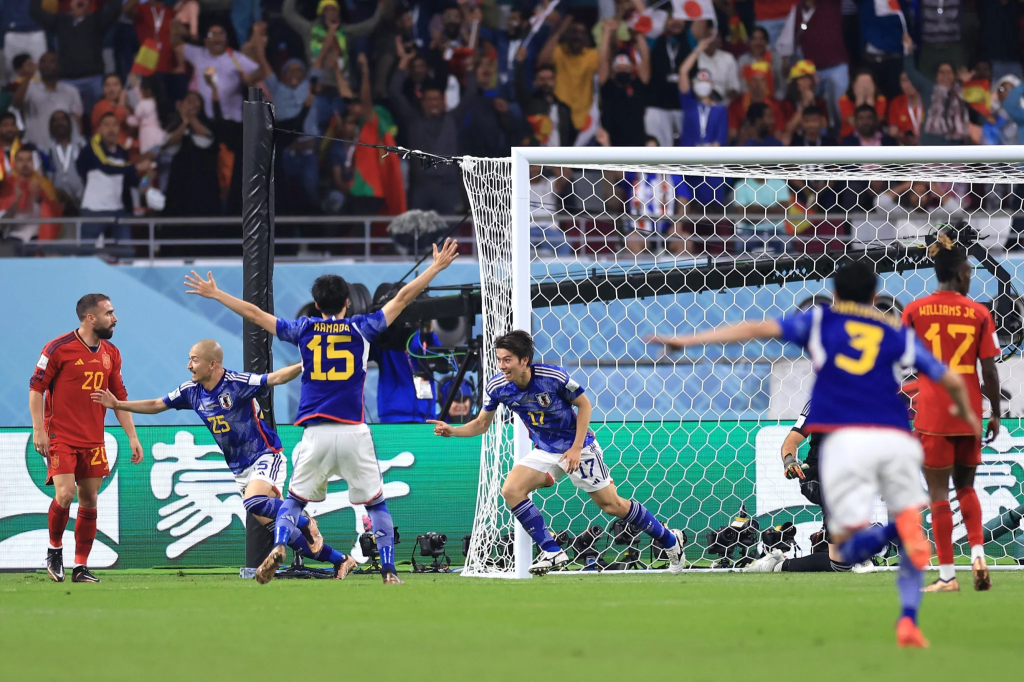
It was a game that had everything: beautiful Spanish passing, super-subs off the bench, VAR reviews, and a resilient Japanese side with a well-executed game plan who showed their might against Europe’s elite.
How They Lined Up:
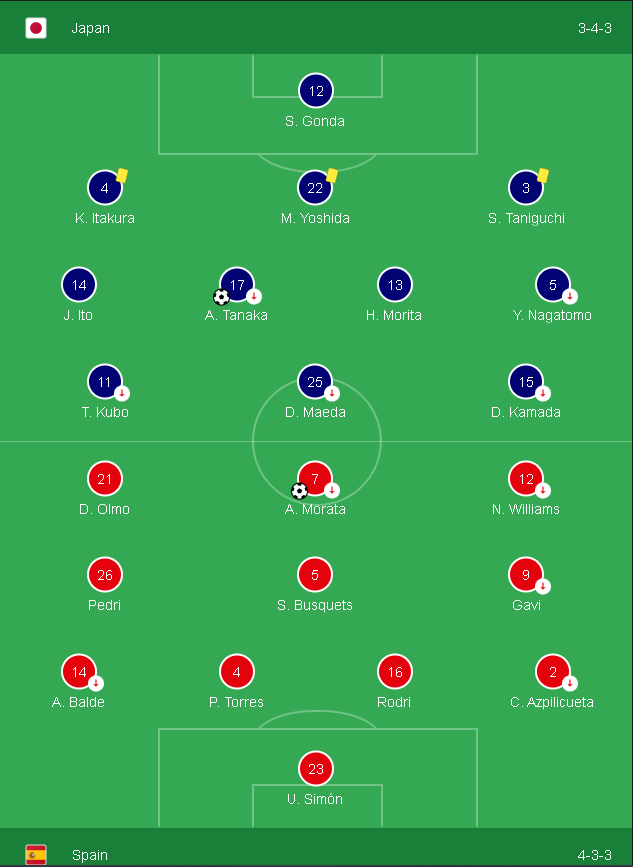
Luis Enrique went back to the classic Spanish 4-3-3, with a few changes to the starting lineup that took on Germany in their previous game. Alex Baldé and Cesar Azpilicueta started in place of Jordi Alba and Dani Carvajal at fullback, Alvaro Morata made his first start of the world cup in place of Marco Asensio, while Nico Williams started on the right wing in place of Ferran Torres. Clearly, Spain was looking past the group stages with this lineup, with Enrique wanting to give some young players experience in case they are called on in the knockouts.
On the other side of the pitch, Japan manager Hajime Moriyasu had a game plan coming into this must win game for Japan. In their first two games of this World Cup, Japan lined up in a 4-2-3-1, but against Spain and their love of possession, Moriyasu switched to a 3-4-3, with CB Shogo Taniguchi getting the start instead of RB Hiroki Sakai. Hidemasa Morita also started in the midfield alongside Ao Tanaka, who’s offensive/defensive tendencies balance each other out well. This formation was likely chosen with an assumption that Spain would hold most of the possession (not a big surprise, it is Spain we’re talking about).
In defense, the 3-4-3 of Japan played like a 5-4-1, with both wide midfielders acting more like wingbacks, and the wingers coming back to defend in the midfield. This turned out to be a good choice against Spain, who looked to use wing play constantly in the first half. Although dominating possession and spending a fair amount of time around Japan’s box, Japan did not look under pressure. This was their plan, to defend with heart in the first half and let Spain pass the ball around the outside, perhaps tricking the Spaniards into thinking Japan was planning on playing the entire game on the back foot.
Spain set up to attack Japan’s defense through getting their fullbacks and midfielders forward, to create a 2-3-5 shape, with Busquets anchoring the midfield (He did this, noticeably. Busquets spent most of the first half closer to the midfield line than Japan’s box, which actually left Japan with a man advantage defending, as Daizen Maeda could often cover him from the striker position). Depending on the side of attack, either Pedri (left-side) or Gavi (right-side) would look to move up into the half space between Morata and the winger, creating an overload and providing Spain with plenty of lovely triangles to pass the ball around. The opposite side CM acted as the 5th man forward, staying in the midfield near Busquets in case of a turnover, then moving centrally to the edge of the box. Spain’s wingers generally stayed by the touchlines, unless a fullback made an overlapping run, in which case they would drift into that half-space to support. Below is an example from a 23′ Spain attack down the right side, with Azpilicueta driving forward with the ball.

In this sense, Spain’s attacking play was solid. The four runners of Spain are forcing the Japanese defenders to make difficult decisions on marking. Dani Olmo slipping by Ito on the left makes it a 4 on 4, with Azpilicueta able to choose his pass. However, Japan did not give them much time, even when caught upfield. Azpilicueta only had moments to make this pass before the Japanese midfielders will be in range to cover Morata/Gavi. This setup was what got Spain their first goal. A Nico Williams cross was blocked, with the ball eventually coming back to Azpilicueta on the outside corner of the 18-yard box. He swings in a lovely cross, and on what seemed like the only clear error by the Japanese defense, an unmarked Alvaro Morata heads home the finish to put Spain up 1-0. This goal would mark the only blemish on Japan’s first half gameplan, they went into the halftime break only down a goal, while conceding 83% possession to Spain. After scoring, Spain seemed content to sit deep in Japan’s half and pass the ball around, retaining possession, leading to the halftime possession stats being so skewed.
Halftime: I only wish I could have been a fly on the wall of Hajime Moriyasu’s dressing room as he gave his halftime talk. For lack of more eloquent words, I imagine it went something along the lines of “They will regret not scoring more in the first half.” Two substitutions were made, and they had quite the impact. Ritsu Doan, who scored Japan’s first goal against Germany, came on for Takefusa Kubo on the right wing, who did not have much opportunity to show his skills while defending for the first half. Additionally, young Brighton standout Kaoru Mitoma came on for Yuto Nagatomo at LWB. For Spain, only one change occurred, Dani Carvajal coming on for Azpilicueta, who leaves the field with his assist standing as the game winner. What a ride he, and all of us watching, would be in for.
Second Half: it cannot be understated how infrequently Japan pressed the Spanish defenders in the first half. At first, it seemed like it was a tactical choice, as the Japanese frontline was on average, 13kg lighter than the Spanish centre-backs Rodri and Pau Torres who also held a considerable height advantage. As the second half started it became apparent that Japan was simply waiting for their moment to attack. This moment came as soon as the second half started, with Japan coming out looking like they had endless energy compared to the Spaniards. Daichi Kamada, Daizen Maeda, and the new substitute Ritsu Doan pressed the Spanish backline all the way into their own 6-yard box. Unai Simon was under heavy pressure from Maeda, and was forced to clear the ball to his left. The ball was won by Japan and fell to Ritsu Doan at the edge of the box, who cuts inside with his first touch and sends a determined drive to the right side of the goal, which Simon is able to get a touch on but cannot prevent from finding the net. Three minutes into the second half, and we have a tie game! Japan are not satisfied, and continue their endless pressing, winning the ball back shortly after Spain kicks off following the first Japanese goal. Ritsu Doan, full of confidence, beats Baldé in a 1-on-1 down the right wing, and squares a cross through the 6-yard box that goes through everyone, and looks to be going out for a Spain goal kick. The halftime substitute Kaoru Mitoma was unwilling to accept that, and burst to the goal-line, getting a touch on the ball and knocking it back towards the face of goal, where Ao Tanaka beat Rodri to the loose ball and knocked it home for Japan.
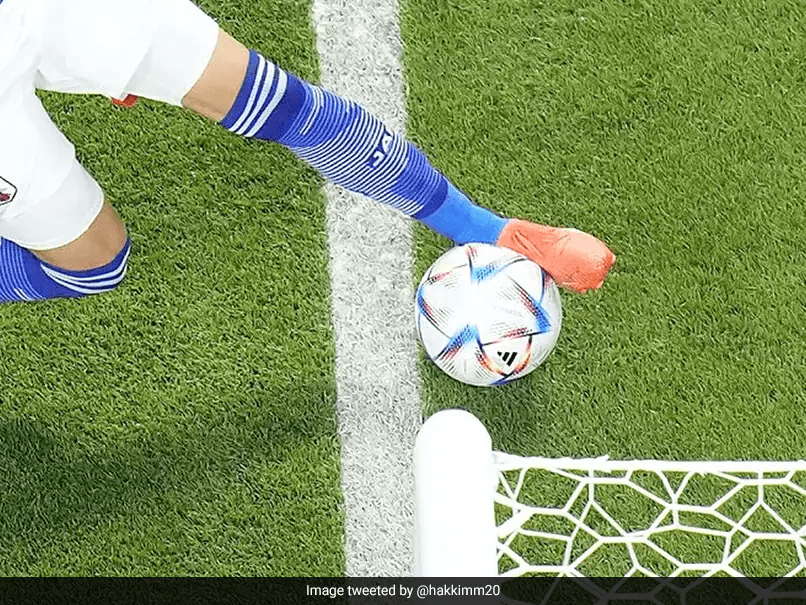
If any picture can tell the story of this game, it is the above. Taken just before Japan’s winning goal, it perfectly shows the fine margins between pure elation and crushing defeat in football. After a VAR review, and plenty of protests from the Spanish side, it was confirmed that Mitoma had kept the ball in by a matter of millimetres. For the ball to be considered out of play, the entire ball must be across the goal-line. Through sheer will and determination, Mitoma produced one of the most memorable moments of this World Cup, and potentially Japanese football history. After just 6 minutes of the second half, Japan lead Spain 2-1.
At this point, the Japanese stopped the high press, and fell back into their 5-4-1 defensive shape for the rest of the game. In my opinion, it is important to mention that Japan did not “park the bus” here, which could have allowed Spain to produce more pressure and scoring chances. Instead, they sat back waiting for a Spanish pass, and then closing down on the receiving player as they received the ball, looking to block the path to goal. It worked wonders, as Spain seemed to be uncertain of how to break through the defense. For every ball played forward, another was played back to reset the Spanish attack, and this sequence played out for the majority of the rest of the half. Ferran Torres and Marco Asensio came on in the 57′, and provided a much needed spark to the Spanish attack, generating the best chances Spain had in the second half. Spain could not break through the inspired Japanese defense, led by captain Maya Yoshida who was instrumental in picking out pass after pass played into the Japanese box. Japan held on for the win, which sent Germany home on a heartbreaker.
Final Stats:
| Statistic | Japan | Spain |
| Possession | 18% | 82% |
| Expected Goals | 1.45 | 1.04 |
| Total Shots | 6 | 12 |
| Shots on Target | 3 | 5 |
| Interceptions | 17 | 3 |
| Blocked Shots | 5 | 1 |
The selected stats show Japan’s deserving win, from both sides of the ball. For those unfamiliar with Expected Goals (xG), it is a statistic that shows the overall quality of the attacks generated by each team. The xG value assigned to a shot is mostly based on the location of the shot, but is also affected by in-game factors such as location of defenders, if the pass was controlled or shot first-time, the foot the player shoots with (dominant/non-dominant), and others. The xG value ranges from 0-1, representing the expected likelihood of that shot going in. Ao Tanaka’s game winner had an xG value of 0.96, which makes sense when you consider the fact that it was taken from the goal-line, with an empty net ahead of him. It would be very difficult to miss such a chance! However, Ritsu Doan’s goal that got Japan started only carried an xG value of 0.05, indicating this was a much more “unlikely” shot to go in. Some might argue that Unai Simon should have saved it.
On the defensive side, it is the Interceptions stat that catches my eye as most representative of the game I watched. The aforementioned Maya Yoshida led the backline phenomenally, communicating positioning and keeping his teammates ready for the next Spanish attempt to break through. Japan’s 5 blocked shots are from their positioning and recovery when Spain had an opportunity to shoot. Aside from Morata’s unmarked header, which carried an xG value of 0.53, Spain hardly produced quality scoring chances. The best opportunity for Spain in the second half will only show up on the stats sheet as a 0.02xG long shot from Marco Asensio, which was saved and cleared before Ferran Torres could get his foot on the ball to tap it in the net.
Conclusion: This was a well-deserved hard fought win from the Japanese. In my pre-tournament predictions, I backed Japan to take points off of either Spain or Germany, but could not have predicted the Samurai Blue beating both European powerhouses (and then losing to Costa Rica of all teams in this group). Hajime Moriyasu did his homework, set up a game plan to neutralize Spain early, absorb their pressure, and look to strike in the second half. Moriyasu’s two substitutions at halftime contributed a goal and an assist on the two Japanese tallies, and his defensive structure looked rock-solid. Japan will be feeling confident going into the knockouts against Croatia, with their only goal conceded to Spain coming off an addressable error. Croatia has shown a lack of final touch around the box in recent form (aside from their dominant victory over Canada fueled by John Herdman’s choice of words in his motivational speech to his team). Croatia failed to score against Morocco and Belgium, producing a total of 1.22xG over those two games. With a midfield-dominant Croatia ahead, the 4-2-3-1 may make a return to outnumber the midfield trio of Kovacic, Modric, and Brozovic. Brozovic plays a similar position to Busquets on Spain, but will absolutely look to get up around the box and shoot if he has an opportunity, providing a different challenge for Japan in defense. This is absolutely a winnable match for Japan, and I look forward to seeing what strategy Hajime Moriyasu comes up with for the knockout stage. Keep an eye on him, he is showing us all what he can do on the biggest stage.
 futbird