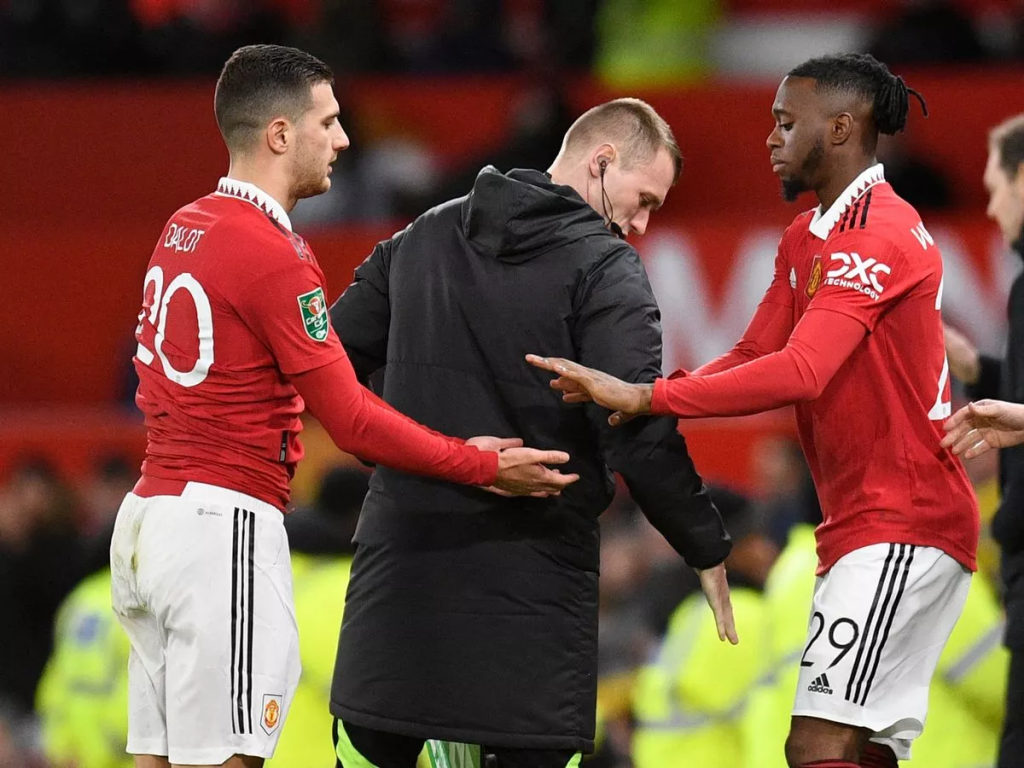
I’m sure I was not the only one shocked when watching Monday’s game when Manchester United hosted Wolves at Old Trafford, and then proceeded to get completely outplayed but somehow came away with 3 points. Now some might say, “who cares, they got the win”, but ignoring the result there are some concerning takeaways from this game. Here’s how the two teams lined up:
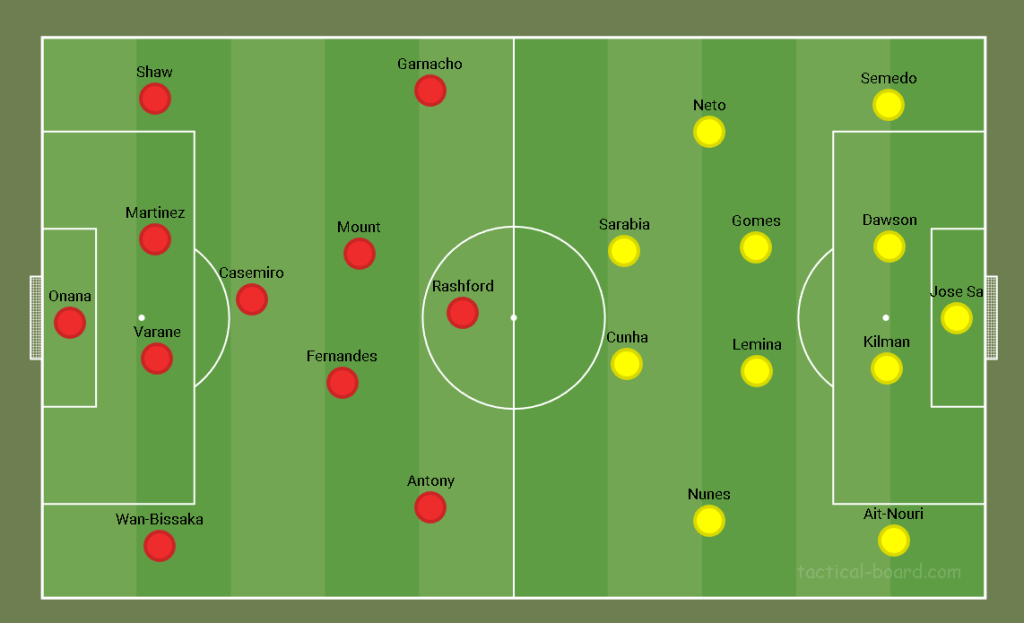
Straight away, this is a squad worth nearly 900 million euros at home against a team worth a shade over 350 million euros who many (myself included) picked as potential relegation candidates this season. This should not have been a close game, never-mind a domination by Wolves in every area except the final score. However, Wolves seemed to have United figured out from minute one, and their pressing tactics proved to be extremely effective in preventing Manchester United from building out from the back.
The first thing to note is that Manchester United had a very small starting lineup, especially in midfield and up front. Marcus Rashford is the tallest of the bunch, at just over 6′ tall. This presents an issue in that Manchester United will have to be predictably one-sided in possession. The biggest risk to pressing high is that the space left behind the defence can be exploited by a long ball to a forward. However, none of Manchester United’s front 5 could reliably be expected to win headers over Wolves’ defenders. This meant that United had to play out from the back, on the ground. With this in mind, Gary O’Neill instructed his side to force United into playing the ball to Wan-Bissaka, identifying him as the weakest on-the-ball player in the United backline. Here is how the Wolves press looked on the pitch:
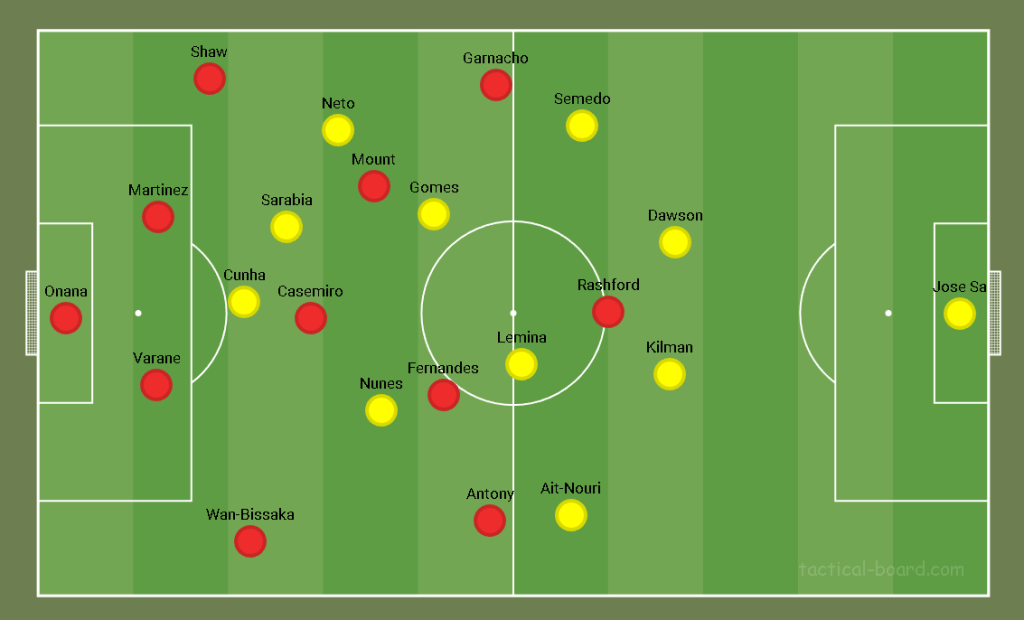
Note the clear shift of the team over to United’s left side of the pitch. Wolves know that United want to try and get the ball to Bruno Fernandes or Mason Mount, through the triangles formed by Casemiro and the defense which are supposed to help break through the initial line of press. On the left flank, Matheus Nunes pulled inside to block the passing lane to Bruno when United had the ball at the back. Pedro Neto positioned himself in a place to block the passing lane to Mason Mount, while being close enough to Luke Shaw to prevent him from becoming a viable passing option. The striker duo of Cunha and Sarabia aimed to further block off Mount and Casemiro, while forcing United to play the ball to the right. When this happened, the Wolves press shifted like so:
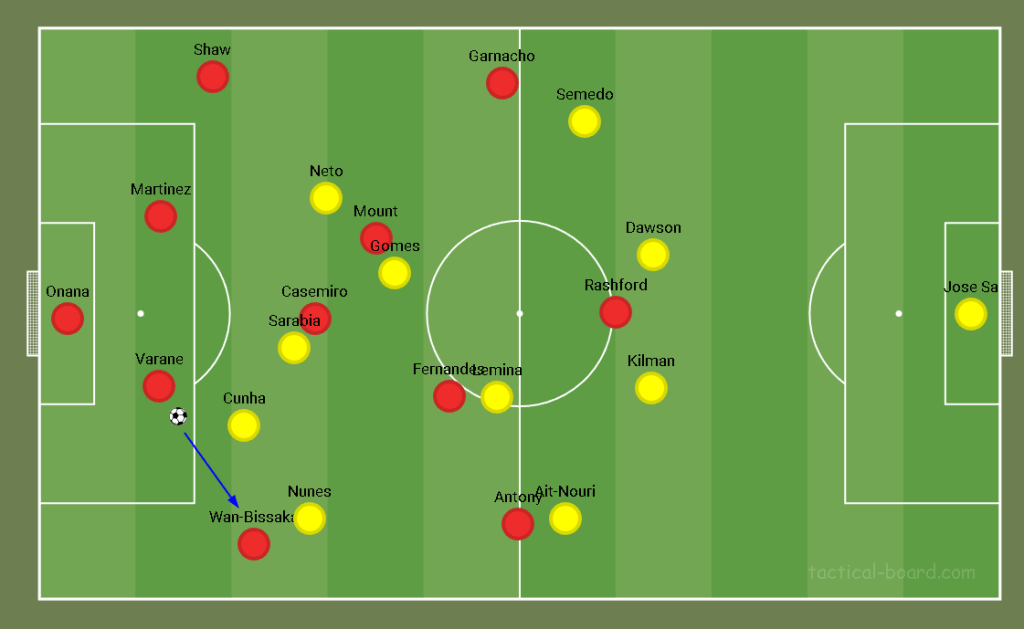
Matheus Nunes instantly charged out to meet Wan-Bissaka as he received the ball, while the strikers moved over to effectively remove the passing lanes to Casemiro and Fernandes. This meant Wan-Bissaka could play a rushed pass to Antony, where Ait-Nouri was waiting to instantly close him down to win the ball back alongside Mario Lemina, or he could pass back to Varane or Onana. Wan-Bissaka generally chose to pass back, and when the ball came back to Onana, the Wolves press had reset to its original position. Essentially, Onana’s only real option to try and progress the ball was to make a quick long-ball pass to Garnacho on the left flank. Garnacho did not have enough support from Mount and Shaw if the ball came to him in this position, as they were pinned back by the Wolves press and forced to stay closer to goal. The header would be won by Semedo or Dawson, and Wolves could generate a scoring opportunity. Just as Wolves exposed the weaker on-the-ball right side of United’s build-up play, most of the attack was targeted down United’s left flank. Luke Shaw and Lisandro Martinez struggled to make an impact in this game, as they were marked out of play in possession, and struggled to contain Pedro Neto out of it.
Now you might be thinking, “Ok, Wolves were better than United when United had the ball, and were better creating chances on the counter, but surely Wolves wouldn’t be able to build out from the back better than United?” Unfortunately, you would be wrong.

Manchester United attempted a similar pressing trap as Wolves, seeming to want the ball to go to the LB, Rayan Ait-Nouri. Wolves would have a numerical advantage playing out from the back, and with a few different passing patterns would be able to work the ball out to the free man, Ait-Nouri. At this point however, neither Bruno or Antony moved to press Ait-Nouri as Matheus Nunes did to Wan-Bissaka. United looked like they wanted to engage around the halfway point of the pitch, in an effort to have more space behind the defence when the ball was won back. Unfortunately for United, they did not win the ball back on that flank very often. Ait-Nouri had space to run, and by the time Wan-Bissaka met him at the halfway line, there was already a triangle with Nunes and Cunha that Wolves used to play around the United defence far too easily. Once the ball came to Cunha specifically, the striker was able to run through the midfield of United with ease, and bring Wolves into the final third by himself very often, setting up Sarabia and Neto for a few good chances. Neto had the best chance of the game and will be regretting not converting it.
So how can Manchester United adapt to avoid being so one-dimensional and predictable? Bring back Wout Weghorst, of course! I joke, but the hole that Ten Hag brought Weghorst in to fill last year still remains void. If United aren’t going to bring in any more signings up front, we can assume that the long-ball won’t be a great option to get away from a high-press. If Ten Hag chooses to start Diogo Dalot at right-back instead of Wan-Bissaka, he would force opposition teams to be wary of the ball playing ability of either full-back and make them unable to force his team to one side before squeezing any space out. The downside to this, is that United would be dropping their best 1v1 defender in the team. Considering next week’s game is against Spurs, who could have any of Son Heung-Min, Ivan Perisic, or Manor Solomon starting on the left-wing, keeping Wan-Bissaka on the bench could make United extremely vulnerable in defense, as Dalot will have a hard time keeping any of those options in check for a full 90 minutes. It is possible that without any new signings, the best way to get rid of United’s biggest weakness in build-up may actually be the most unlikely change to happen. I say this because that change is the abandonment of positional play theory in build-up. Ten Hag is a coach of the Guardiola school, meaning he prefers to instruct his teams in positional play, which in essence is positioning your players to cover as much of the pitch as possible in possession. What I think Ten Hag might benefit from is studying the tactics of the Fluminense manager, Fernando Diniz. Diniz has revolutionized possession football, entirely abandoning positional play structures for something known as “relationism” instead. Diniz does not care about covering as much of the pitch as possible with his players’ positioning, as traditional positional play managers from the Guardiola school prioritize. However, his relationism tactics revolve around player’s positioning in relation to one another, instead of in relation to the space on the pitch. In build-up, you can often see almost the entirety of the Fluminense team shifted to one side of the pitch, to create numerical advantages that would not be possible in positional play. Instead of the set passing patterns of a Guardiola side, Diniz leaves the passing patterns up to his players’ creativity, instructing them to position themselves so that whoever gets the ball has a multitude of passing triangles available to them, so the specific pass is up to the player on the ball. Fluminense orchestrate very fast, intricate build-up moves, with no player holding the ball for longer than 2 seconds, and constant movement and interchanging between players to confuse defenses. With what United lack in size, they can make up for in the natural flair of their attacking players. While perhaps Antony likes to hold on to the ball a bit too long for this style of play and would require coaching into it, players like Garnacho, Sancho, Fernandes, Mount, and Rashford could suit this style perfectly. If United were to try overloading one side of the pitch in build-up, it could look more like this:
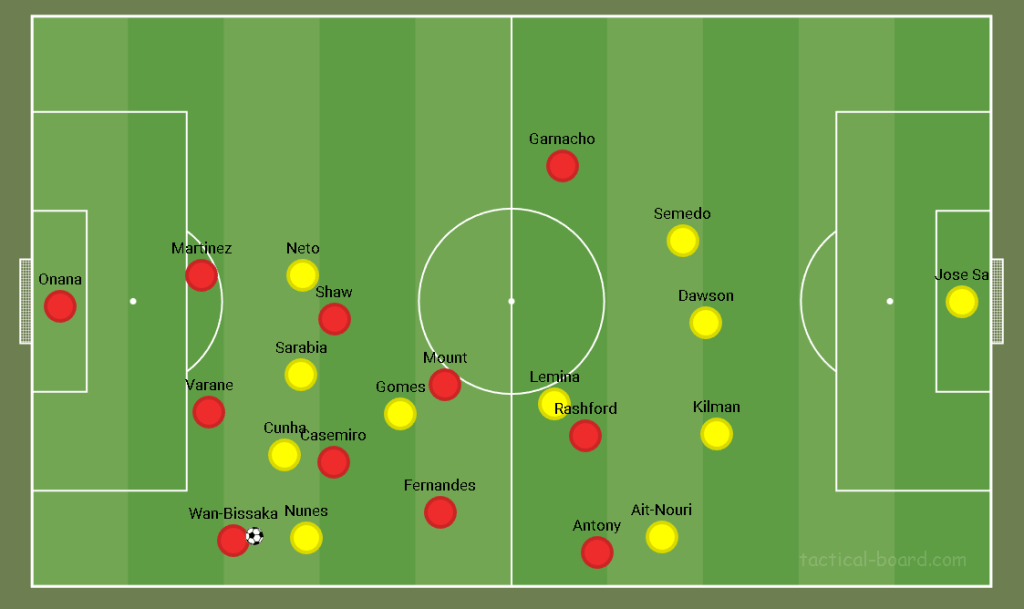
Now in the same situation as earlier, if the ball is played to Wan-Bissaka, his options are no longer only a pressured-pass to Antony, or a back-pass. Once the first open man is found, the players would quickly move to provide say, Casemiro, with a similar variety of passing options. This approach could help get the most out of a smaller team, and force defenders into some difficult decisions that they may not be used to. If the Wolves backline gets caught-up in the action on the right side, then Garnacho may be left open in much more space than he had in this match, and room to receive the ball and run. If you want to see more examples of this “relationism” I’m referring to, search up some Fluminense highlights from within the past year, and notice where the players position themselves in possession.
While admittedly this would be a huge change from the system Ten Hag is used to, I believe positional play is not suiting the current Manchester United squad, and a more relational approach could surprise the Premier League, which has become accustomed to Guardiola’s positional play and similar systems. As it stands, I think United need a tactical change, or need to bring in yet another new signing to make Ten Hag’s preferred system work best. I hope you found this insightful as the kind of article mainstream football media would not cover. Feel free to leave a comment, and check back soon for more football content!
 futbird