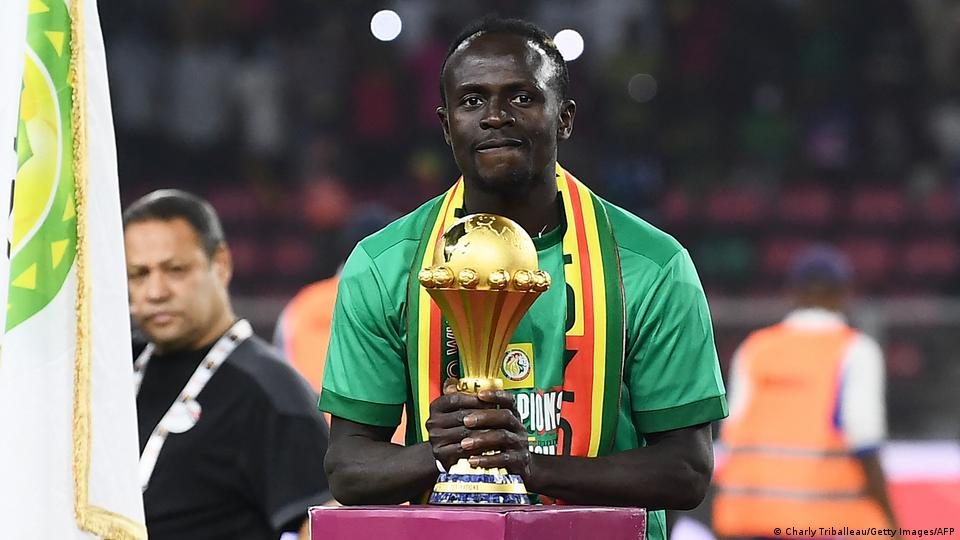
The 2023 African Cup of Nations tournament began just over three weeks ago on the 13th of January, 2024. The tournament was initially scheduled to be played in the summer of 2023 (why it’s not called the 2024 AFCON), but was rescheduled due to concerns about the hot summer weather in the Ivory Coast, the host nation. To me, AFCON represents everything football stands for. In the modern era of football, clubs are owned by venture capitalists, oligarchs, and even entire countries (looking at you, Man City, PSG, and Newcastle). Football is seen more and more as a business, and players seen as assets of those businesses. For those in charge, the profits are never enough, culminating in ideas like the Super League, which goes against pretty much everything football stands for. In this climate the African Cup of Nations is a breath of fresh air, and I have enjoyed every minute of it so far. Here you see international football in its purest form, with all the passion, creativity, and unpredictable moments you could hope for as a fan of the game. The many different cultures and fans of Africa all coming together for a truly one of a kind tournament had made for an unforgettable experience. Today I’ll give a review of how each of our four semi-finalists made it here, and what the final matches might look like.
Semifinal 1: Nigeria (Group A) vs South Africa (Group E)
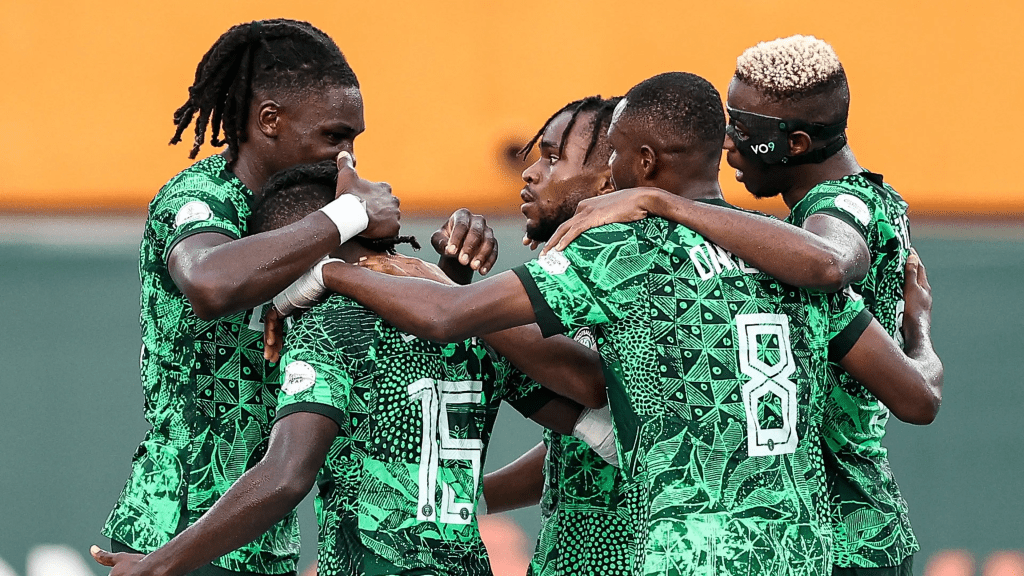
In the first semi-final, we have representatives from Group A and Group E. Starting with Nigeria, the Super Eagles did not perform as well as they might have expected in the group stage, but still did more than enough to qualify for the knockouts in 2nd place behind Equatorial Guinea, who shocked Group A coming out on top led by their defender-turned-striker Emilio Nsue, who was AFCON’s top scorer in the group stages. Nigeria started their tournament with a 1-1 draw against Equatorial Guinea thanks to a Victor Osimhen equaliser. In their next match, they played tournament hosts Ivory Coast in what was a very fast and direct game from the Nigeria side. Despite Ivory Coast holding 64% possession, Nigeria produced almost 3 times the amount of expected goals as the hosts and deserved their 1-0 win from a William Troost-Ekong penalty. In their final group stage match, Nigeria needed a point to secure qualification, and got all three, scraping a 1-0 win over Guinea-Bissau thanks to an own-goal, in a game that could’ve gone either way. Although it wasn’t a dominant group stage performance, the Super Eagles certainly deserved a place in the knockout stages. In the Round of 16, Nigeria were drawn against their neighbors Cameroon, in what looked to be a potentially close match following Cameroon’s momentous final matchday to qualify for the knockouts. In reality, Nigeria dominated this game, preventing Cameroon from registering a single shot on target, and comfortably winning 2-0 to advance. Onto the quarterfinals, where Group D winners Angola awaited. Angola looked to be Nigeria’s toughest opponent yet, and this proved to be the case. Almost exactly even on expected goals and shots on target, the Angolans held a 55% possession advantage in the game, but could not convert any of their chances. A lone Ademola Lookman strike just before halftime would be the only goal of the match, as Nigeria advanced to the semi-finals!
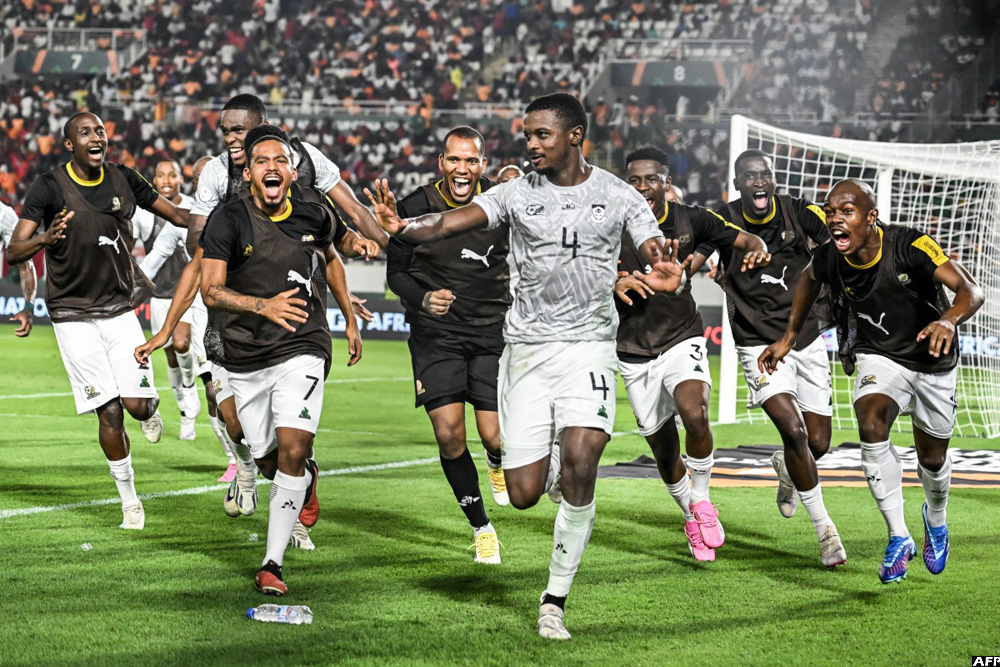
The Super Eagles would have to wait to see who their opponent would be, as Cape Verde and South Africa played out the other quarterfinal after the Nigera-Angola match. Cape Verde, winners of Group B over Egypt and Ghana, had made an impressive run to the quarterfinals this tournament, and knocked out Mauritania to face South Africa. South Africa were not considered the favorites in this match based off performances at this AFCON so far, having finished 2nd in their group behind Mali to qualify for the knockout stages. This was due to an opening day 2-0 loss to Mali in which the South Africans were not without chances. Bafana Bafana responded well with a 2nd matchday 4-0 win over Namibia, before closing out their group stage in a 0-0 draw against Tunisia. This final point would be just enough to qualify in 2nd place over Namibia on goal difference, setting up a Round of 16 match against tournament favorites Morocco. What a game this was. Morocco only have themselves to blame in a match where they showed uncharacteristically poor finishing, generating 0.33 xGoT from 1.94 xG (for context, “average” finishing should’ve seen Morocco score 2 goals from these chances). On the other side, South Africa only generated 0.32xG, but took those chances extremely well, producing 1.16xGoT from that 0.32xG. 11 of Morocco’s 13 shot attempts were either off target, or blocked. A 57′ strike from Evidence Makgopa from the left side of the box into the bottom right corner gave South Africa a shock lead, where they dug in to try and defend the Moroccan response. In the 85′, Morocco finally broke through, winning a penalty that could tie the match. Achraf Hakimi stepped up to take, and rattled his shot off the crossbar and over the net! This miss looked to crush the Moroccan side, who looked visibly defeated afterwards. Then, in the 95′, South Africa won a free kick just outside of the box when Sofyan Amrabat was sent off with a red card. Mamelodi Sundowns man Teboho Mokoena stepped up to take, and caressed the ball into the top left corner, sending the South African fans into absolute pandemonium! Morocco was sent home, and Bafana Bafana advanced to face Cape Verde. Against the Blue Sharks, South Africa were very much on the defensive for much of the game. After a back and forth first half without too many dangerous chances created, Cape Verde put on the pressure in the second half, throwing everything they had on net. 13 shot attempts in the second half, with 11/13 shots off target or blocked by the South African defense. Into stoppage time, it looked like Cape Verde might win it late on a fast break. Gilson Tavares collected a pass just inside the box, and fired his shot to the top right corner. The quality of this shot meant it had an xGoT value of 0.91 (this quality of shot placed where it was would be expected to go in 91% of the time). However, South African keeper Ronwen Williams refused to go home yet, and stretched his fingertips to the ball to make the most crucial save of the match. Cape Verde gave their all in the 2nd half to try and win the match, and that showed once Extra Time started. Having already used 5 substitutions by the 86′, Cape Verde only had one remaining for extra time, while South Africa had 4 substitutions saved for extra time, and used them. South Africa controlled the first half of extra time, with two excellent chances in the 92′ saved and 63% possession. The second half of extra time looked like both teams had gotten tired, understandably, and without any major chances in the final 15′, this quarterfinal went to penalties. In the penalty shootout, it was a match to remember for Ronwen Williams. After keeping his side in the match with his crucial 92′ save, Williams went on to SAVE FOUR OUT OF FIVE PENALTIES. I can’t remember the last time I’ve seen such a dominant performance in a penalty shootout from a keeper, and South Africa only needed to convert 2 of their 4 penalties before clinching their trip to the semi-finals. This South Africa team is on an unlikely run, and we cannot count out another surprising match in their semi-final vs Nigeria. Expect the South Africans to allow Nigeria possession, defend strong, and try to expose the Super Eagles on the counter.
Semifinal 2: Ivory Coast (Group A) vs DR Congo (Group F)
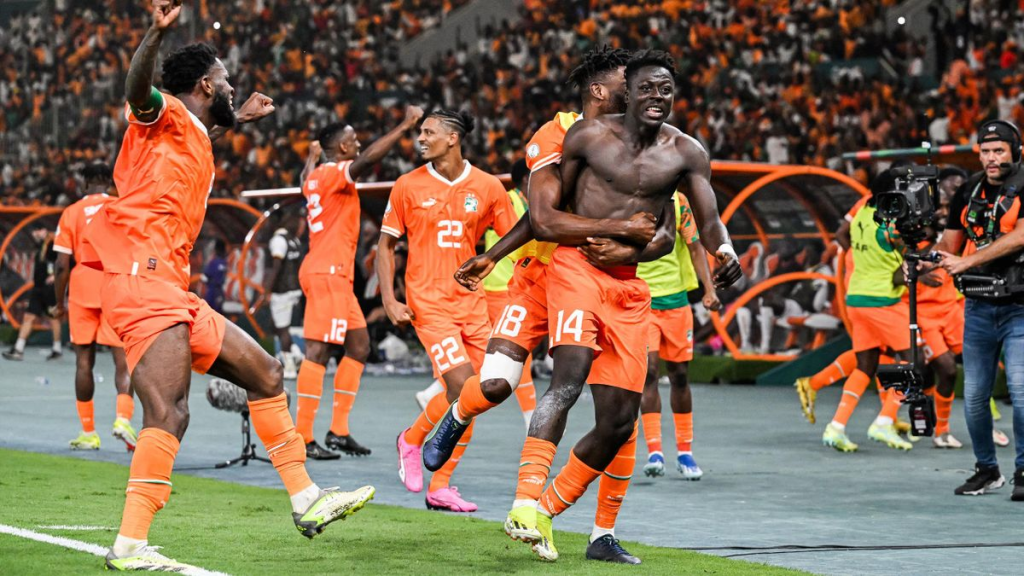
In the other semifinal, we have two very interesting stories. We will start with the hosts, Ivory Coast, who are our second semifinal representative from Group A. I watched every match Ivory Coast played in the group stage, and was thoroughly underwhelmed. With the squad available to the Ivorians, the performances on the pitch were very sub-standard. Their tournament started with a win, albeit over the lowest ranked team in their group, Guinea-Bissau. As previously mentioned, in their second match, Ivory Coast would lose 1-0 to Nigeria, conceding the Super Eagles’ only shot on target from the penalty spot. Going into the final matchday, the Ivorians were on 3 points and a win would guarantee them a qualification spot. However, they went out in front of their home fans and were shocked 4-0 by Equatorial Guinea. In a match where Ivory Coast produced 2.06xG to their opponent’s 1.39xG, they could only manage 0.67xGoT to Equatorial Guinea’s 3.17xGoT. Ivory Coast was not clinical with their chances and cannot say they deserved anything from the match. This result meant that Ivory Coast had to wait out the rest of the group stage results to see if they would qualify for the knockouts as one of the four best 3rd place teams in the group stage. The Equatorial Guinea result was also the final straw for their manager, who was sacked immediately after Ivory Coast’s final group stage match. In the end, it would be Morocco who would help the hosts qualify as the final team in the knockouts with their final matchday win over Zambia. Going into the Round of 16 with a new manager, Ivory Coast were drawn against another tournament favorite in Senegal, the defending champions. After going down 4 minutes into the first half, the Ivorians showed their resilience by coming back to dominate the rest of the game and earning a deserved 86′ penalty converted by Franck Kessié to equalise the match and force extra time. In the first half of extra time, Senegal had the better chances, with Sadio Mané seeing his 105+2′ shot from 5 feet saved. The second half of extra time saw no big chances, and this match went on to penalty kicks. This would not be a penalty shootout for a keeper to be the hero in, as 9 of 10 penalties taken were converted. After Moussa Niakhaté hit the post with Senegal’s 3rd penalty, Sebastian Haller, Serge Aurier, and Franck Kessié stayed cool to convert their attempts and send the host nation into the quarterfinal! Against Mali in the next round, Ivory Coast had to yet again come from behind, this time late. The first half was all Mali, but thanks to a saved penatly from Yahia Fofana, the Ivory Coast was able to get to halftime all square, despite being down a man after Odilon Kossounou’s second yellow card in the 43′. In the 71′, Mali struck with a beautiful strike from distance thanks to Nene Dorgeles and took the lead. This turned out to be Mali’s last good chance of the game and after extended pressure, Ivory Coast managed to force the equaliser through Simon Adingra in the 90′ even though they were down a player, forcing extra time yet again in these AFCON knockouts. In extra time, Mali dominated the ball, averaging 78% possession, but could not generate any attacking threat aside from a missed chance from a corner. In the 120+2′, Ivory Coast won an indirect free kick from outside of the box. The ball was delivered in and cleared to Seko Fofana at the edge of the box, who took the volley on first time. Fofana’s shot cannons into the box, and takes a deflection off Oumar Diakité right in front of the Mali keeper, rolling in at the death to steal the win for Ivory Coast! Against all odds, the Ivorians went from nearly missing out on the knockouts altogether to playing in their home tournament’s semifinal.
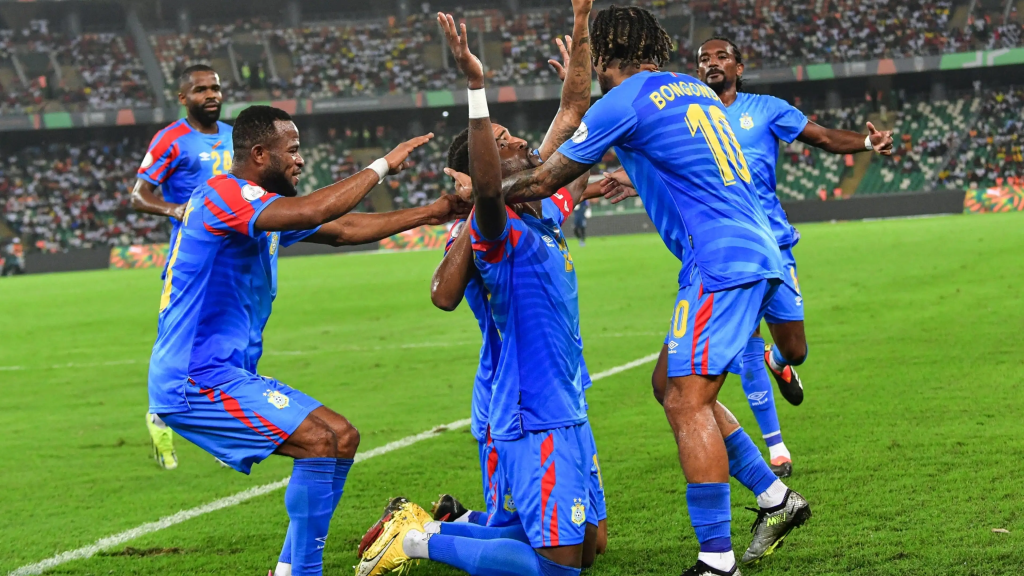
Our final semifinalist balances out the North/South African representatives, as the Democratic Republic of Congo joins Bafana Bafana as southern Africa’s second semifinalist in this year’s AFCON. Coming into this tournament as FIFA’s #67 ranked national side, not much was expected from DR Congo in terms of a knockout stage run. In fact, the group stages did not seem to change expectations much, as DR Congo did not win a single match. However, they did not lose a single match either, and after equalising in both of their first two matches to claim 1-1 draws against Zambia and Morocco, Congo would play a 0-0 draw on the final matchday against Tanzania to secure themselves 2nd place in Group F behind Morocco. Their Round of 16 matchup was drawn to be Egypt, pre-tournament favorites who had lost their talisman Mohamed Salah in the group stages to injury but had fought their way into the knockout stage regardless. DR Congo would strike first thanks to Meschack Elia in the 37′, but their lead would not last until halftime as Mostafa Mohamed converted an Egyptian penalty in the 45+1′ to draw level. Congo did not have a shot on target in the second half, but held strong to take the game to extra time. In the 97′ Egypt picked up a second yellow card on Mohamed Hamdi, who was sent off. Despite having a man advantage, DR Congo could not manage to convert a chance in extra time, leading to a penalty shootout that would require 9 shooters to decide the match. Both sides converted their first penalty, missed their second penalty, and scored the next 3. Tied at 4-4, the shootout would have to move on into sudden death. Egypt and DR Congo both converted their next 3 penalties as well, sending us to the 9th round, where the keepers would shoot on one another. The Egyptian keeper Mohamed Abou Gabal rang his shot off the crossbar, giving Lionel Mpasi-Nzau, the Congolese keeper, a chance to win the match for his side. He would convert his penalty, sending Gabal the wrong way and sparking electric celebrations amongst the DR Congo team and supporters. In their quarterfinal match, DR Congo faced Naby Keita’s Guinea and made no mistake, scoring each of their 3 shots on target including an Arthur Masuaku free kick from distance en route to a 3-1 win. This gave DR Congo their chance at a semifinal matchup against the host nation Ivory Coast.
This semifinal could truly go either way as both sides have shown remarkable resilience and self-belief to make it this far. DR Congo are making only their third AFCON semi-final appearance since 1974, when they won their 2nd and most recent AFCON. Ivory Coast are making their first semi-final appearance in four tournaments, last reaching this stage in the 2015 AFCON, which they would go on to win. Will the West African powerhouses book their places in the final, or will the Southern African teams continue to shock us at this AFCON and make history? The last southern African nation to make the final of AFCON was Zambia in 2012, with South Africa being the next most recent, making the final in 1998. Every team left in these semifinals has won an AFCON before. Nigeria hold the most out of any remaining team with 3 wins (most recently in 2013), Ivory Coast(1992, 2015) and DR Congo (1968, 1974) each have 2 AFCON wins to their name, and South Africa can also call themselves AFCON champions, having won the 1996 edition of the tournament. Take your pick, it will be a great finish to what has been a wonderful tournament so far!
Thanks for reading and I hope you enjoy the rest of this year’s AFCON!
-LM
 futbird