Hello again football fans,
This past season I noticed the further emergence, or re-emergence, of a tactical trend, and thought it would be worth a discussion. Across Europe, it seems as if the days of the False 9 are over for now, as many sides have reverted to using a more traditional out and out #9. Why is this the case? Have managers just gotten nostalgic for the “good old days” where a striker’s job was simply to put the ball in the back of the net and win aerial duels? Was Sean Dyche right all along? Why are playmaking #9’s less effective at Europe’s top level now? I believe there are several reasons for this.
Reason 1: Pressing
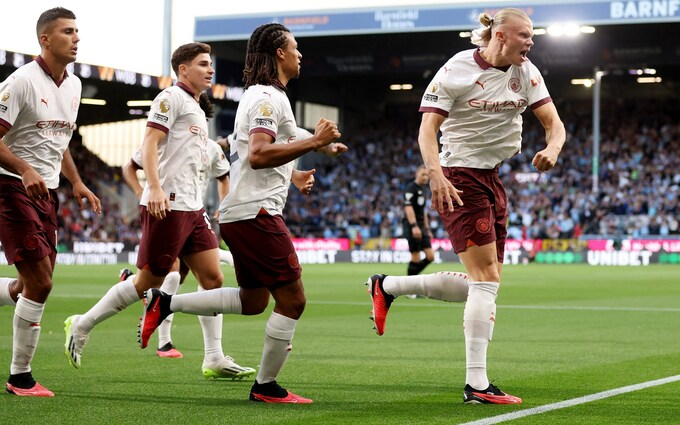
High-intensity pressing is the norm more than the exception now, especially in the Premier League. When Jurgen Klopp joined Liverpool nearly 10 years ago now in October 2015, he brought his “gegenpress” style to England, and at the time this was a unique approach. Many teams preferred to sit deeper in a mid or low block, and look to build counter attacking moves from their own half. Now, the value of winning the ball high up the pitch has become apparent: the closer to the opposition goal you win the ball, the less distance there is to cover to get to goal, and generally less offensive actions are required before a scoring chance is created. More and more modern managers are selecting this approach, whether they are a title challenger or a relegation-battling club. When teams press you high up the pitch, there are generally two options: try to play through the press, which risks turning the ball over close to your goal with more of your players committed up the pitch, or attempt a long ball to bypass the press entirely. While most teams prefer to play from the back (thanks Pep), having the outlet long ball pass be available is a handy “get out of jail free card” when under pressure. This is one reason why the traditional #9 is being used more. Erling Haaland at Manchester City is a prime example. Now this past season, Mikel Arteta adjusted his pressing approach vs City to not commit as many players forward to the press. He learned this lesson in Arsenal’s 4-1 defeat to City on April 26, 2023. Look how the first City goal was created:
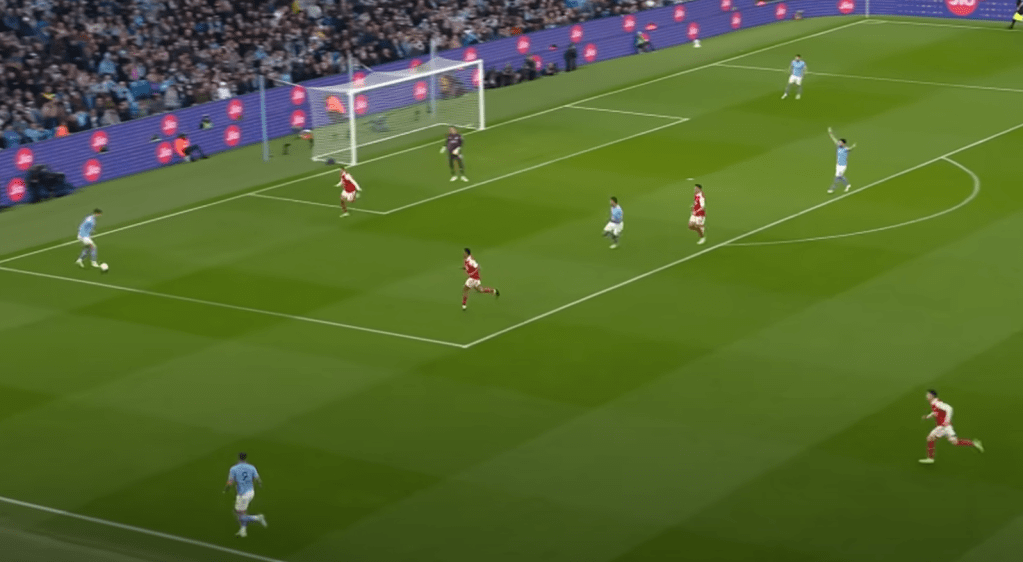
Ederson plays the ball out wide to John Stones, who is immediately under pressure from Martinelli and Jesus. He opts not to pass short to Walker, but waits until the Arsenal players close him down more, before opting for a long ball.
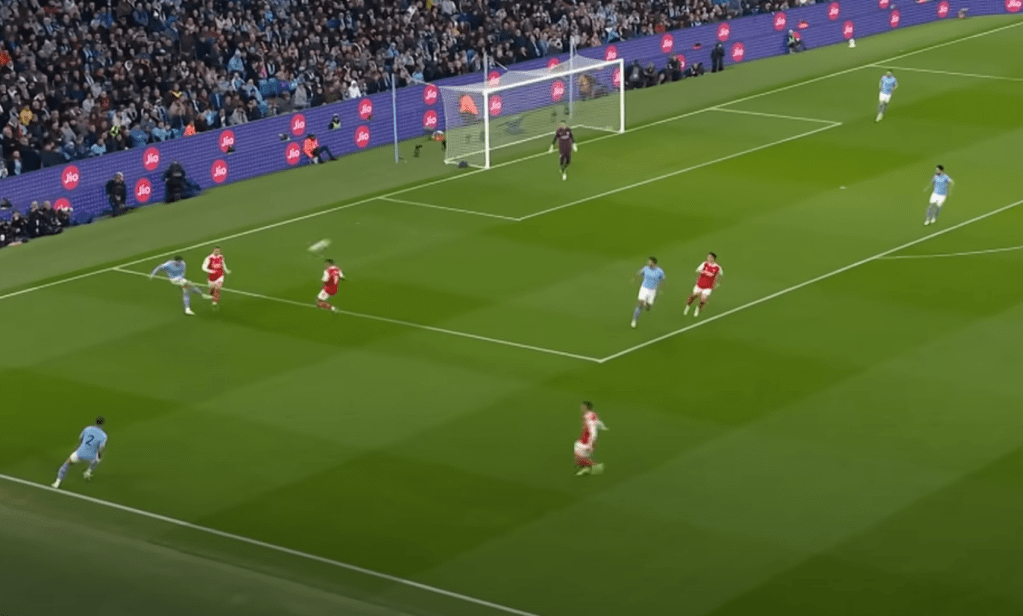
The target of this long ball? Erling Haaland of course. You can see how as the ball comes in to Haaland, he has gotten body positioning on Rob Holding and is able to control the ball down and make a pass to Kevin de Bruyne, who has slipped past Thomas Partey with his run through midfield:
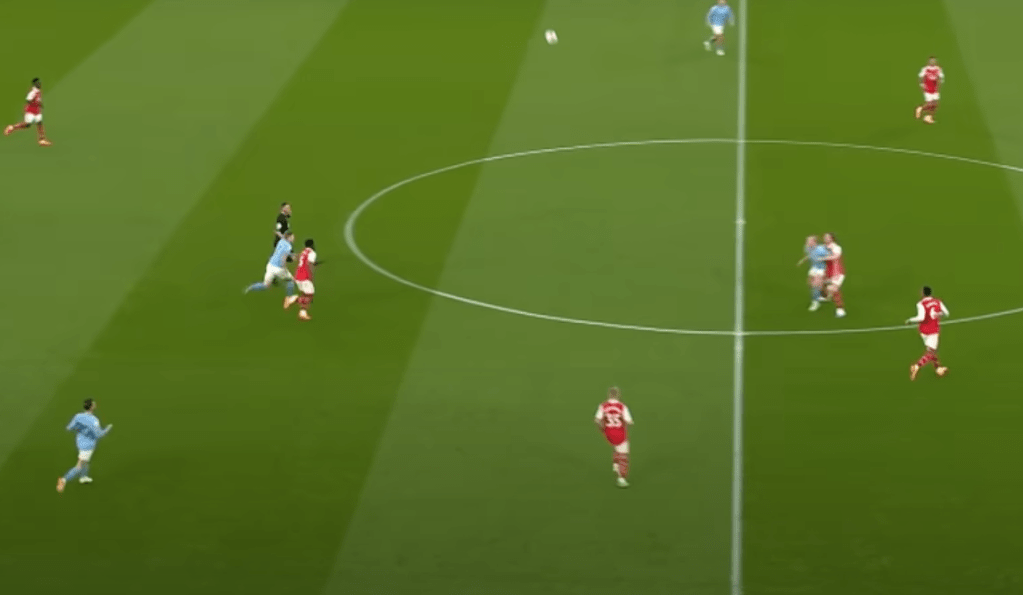
Seconds later, de Bruyne runs towards the edge of the box and unleashes a low strike into the bottom corner. 1-0 City.
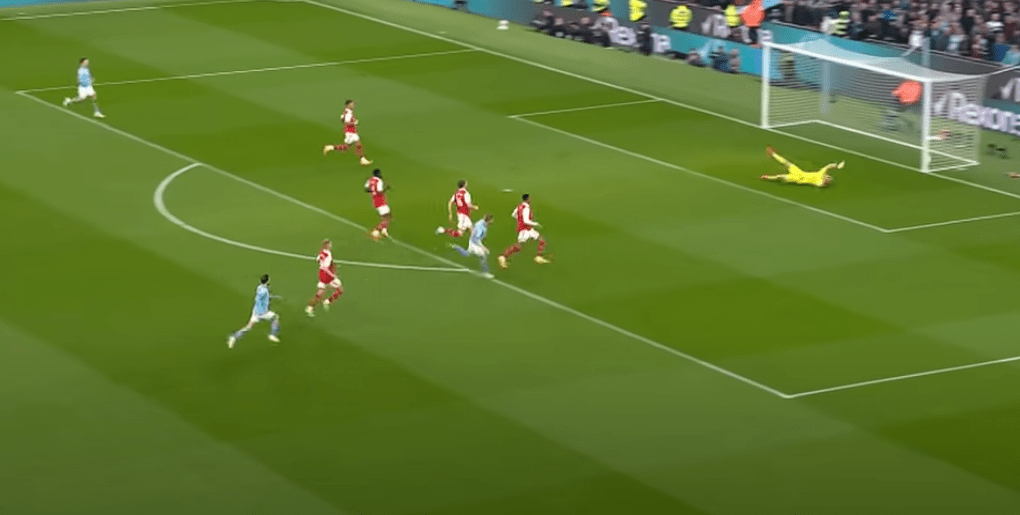
If Manchester City still had Gabriel Jesus, or even Sergio Aguero as the lone striker, they would be much less likely to win the aerial duel vs Arsenal’s CB and retain possession. Having the option to both play short through a press or send a long ball to the ST to hold possession, allowing midfielders to make supporting runs for a pass forward gives teams more unpredictability in their buildup, and forces the opposition to think twice about committing so many players forward to the press. This past season, Postecoglu’s Spurs encountered this difficulty, with Richarlison being their best forward equipped to perform this role. When he was not fit and Son Heung-Min played in the #9 role, there was a noticeable difference in Spurs’ ability to retain the ball when under high pressure in their own end of the pitch: teams could cover the short passing options, with some degree of confidence that a long ball towards their CB’s would be dealt with and the ball would be won back. Now I used this as an example because Son is clearly a world class player, but holding up the ball under physical challenges is not his biggest strength, one of the reasons he is more effective off the left wing. Having a physical striker able to win duels vs opposing CB’s offers a lifeline when the opposition is committing a lot of players up the pitch to press and at the same time, will offer more space to play out from the back, as the risk of the long ball needs to be considered by the defence before pressing.
Reason 2: Structured Defences
In current-day football, teams are more structured than ever and are well drilled defensively to protect their box when under attacking threat. Arsenal, one of the best teams in world football at the moment, have encountered the issue of not being able to convert extreme amounts of attacking threat to shots on goal and goals scored. They would frequently make several passes in the box before a shot attempt was taken, which allowed defenders to close them down, and any backtracking players to arrive in the box to help. With defences being as well organized as they are now, it is more imperative than ever to generate chances quickly, and take the opportunities when they present themselves instead of overpassing or trying to be too fancy dribbling around the box. This is the same reason why high-pressing has become so popular, it allows your team to get the ball in a good offensive position, with the least amount of opposition players in position to defend. So for this reason, having a physical striker who can operate at times like a pure poacher is more valuable than it has been in past years. Not to overuse Haaland as an example, but just think, how many times have you seen Haaland receive the ball in the box and try to make an extra pass, or dribble a defender before shooting? His job in the final third is to put the ball in the net, so when he is in a position to shoot, he does so immediately, while also offering an aerial threat of any subsequent set pieces that might arise from a blocked shot or defensive clearance.
This is more than a trend in the Premier League however. La Liga’s top two scorers this year? Girona’s Artem Dovbyk, and Villareal’s Alexander Sorloth, two imposing strikers who are aerial presences and not so much known for their dribbling or playmaking ability. In Serie A? 6 of the top 8 goalscorers fit this player profile, all being physically strong and primarily looking to score when in the box (Lautaro, Vlahovic, Osimhen, Giroud, Zapata and Lukaku). The leading goalscorers of the Liga Portugal and the Eredivisie? Viktor Gyokeres and Luuk de Jong. It seems that now more than ever, the most efficient way to play against modern defences is to bring back the traditional #9. Small, agile, skillful players are showing to be much more effective on the wings or through midfield, while leaving the physicality to be brought by the striker in attack.
Now like always, I don’t want you to take my word for it but rather consider my ideas with what you yourself have seen in European football this year compared to previous years. In addition, keep an eye on the ST transfers this summer to see what teams are prioritizing for their #9. Do you agree that there has been a larger shift back to the traditional #9, and how long do you think this may continue before there is a defensive change to the game that continues the constant tactical evolution in football?
Thanks for reading, I hope you found some insight in this article. I’ll be looking to publish a preview of the summer’s Euros and Copa America tournaments in the coming days, so stay tuned!
-LM
 futbird