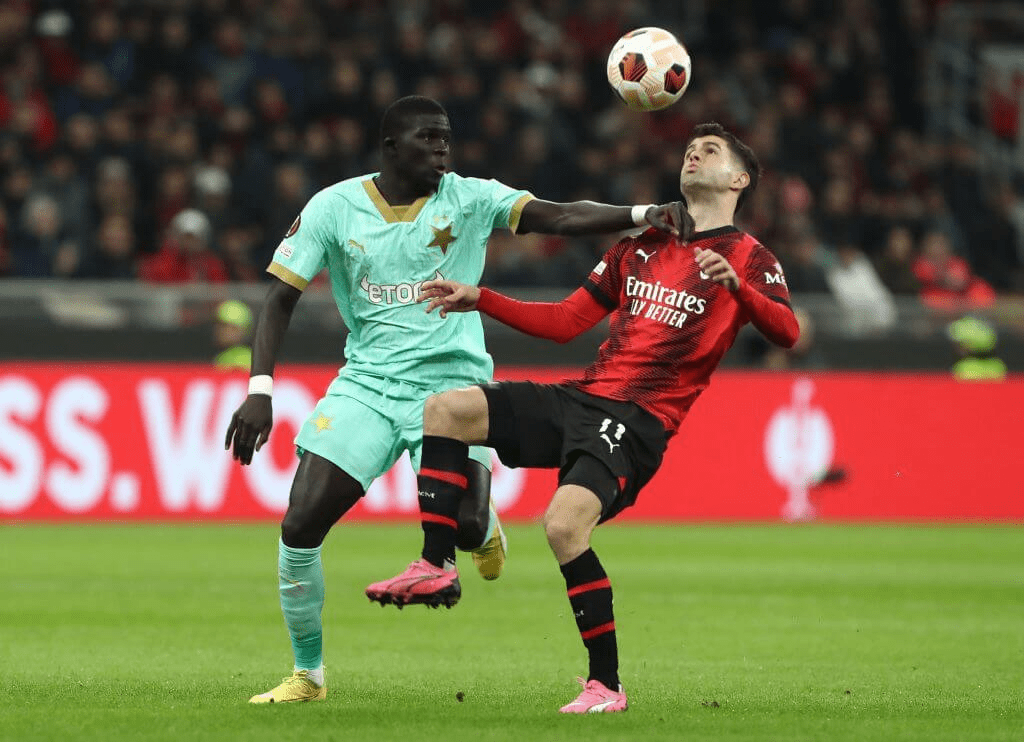
As you may have seen, West Ham have completed the signing of El Hadji Malick Diouf from Slavia Prague for a fee of £19m. However, you may be asking “Who?” – which is why I’m here today. I’ve been watching this player develop ever since I first spotted him playing for Tromsø in Norway’s Eliteserien, and always felt like he had the potential to make a transfer like this. Time to learn some more about West Ham’s new signing.
Diouf is a native of Dakar, Senegal, where he first played at the Galaxy Football Academy, followed by the Académie Mawade Wade (both Senegalese academies). After impressing scouts enough to earn a trial, Diouf performed so well at his trial that he was signed to Eliteserien club Tromsø in February of 2023, shortly after turning 18 years old. He took some time to acclimate, (understandable given that Tromsø is the northernmost top-flight football club in the world), but finished the season with 21 appearances for the club, and became an important player at Left Wing-Back.
Photo: Marco Luzzani/Getty Images
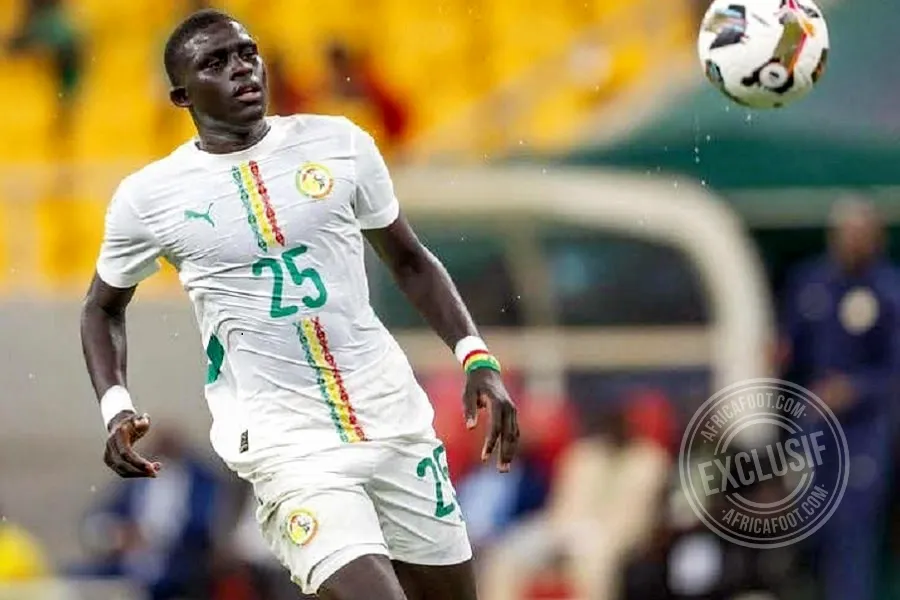
This was enough for Slavia Prague to take a chance on Malick Diouf, who moved to the Czech capital in January of 2024. With limited game time in the league for the remainder of the 23/24 season, he performed well for Slavia, after spending some time playing for their reserve team. This season also gave him his first experience in European play, in the Europa League. 2024 also saw Diouf receive his first caps for the Senegalese senior team.
He would take a big step forward in the 24/25 season with Slavia, contributing 7 goals and 3 assists while playing an overall strong game. His performances in the Europa League also improved, with Diouf being one of Slavia’s best players in the competition. His season would result in the reward of starting at LB in Senegal’s 3-1 win over England at Wembley in June. This match might have been what put him on West Ham’s radar, although the Hammers do have somewhat of a history of scouting the Czech league – you might remember longtime players Tomáš Souček and Vladimír Coufal. A month after his strong performance at Wembley, El Hadji Malick Diouf is a West Ham player.
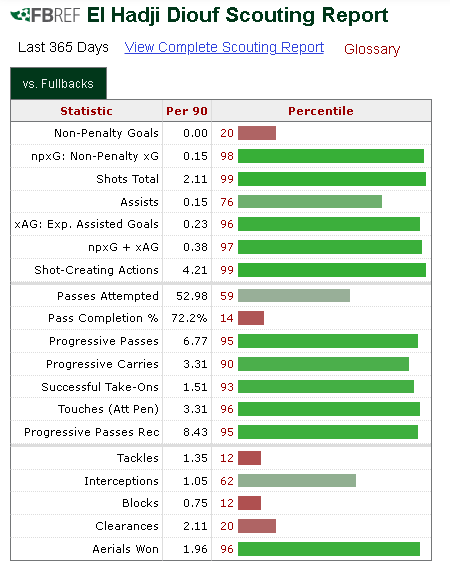
In terms of the type of player he is, Diouf profiles as an attacking fullback, and can play as a winger in midfield as well. Since he is coming from the Czech league, which is a top 15 league in Europe but of a significantly lower standard than the Premier League, his stats from the Czech league will likely not translate directly to the Premier League. However, using his Europa League stats (the highest level competition he has played in) from the past season, Diouf is one of the best attacking fullbacks in the competition. He ranked in the 95th percentile or higher in non-penalty xG, shots, xA, shot creating actions, progressive passes, and progressive passes received. See FBRef’s player profile below:
Now, Diouf only played 600 minutes in the Europa League this season, which is just over 6.5 full 90’s. I believe this is enough of a sample size at a high level of competition to show that his performance was not a fluke. A very physically gifted, attacking-minded full-back, Diouf is already playing at a high level and at only 20 years old, has plenty of time to improve even further.
I believe this will turn out to be a great signing for West Ham, and they could well be selling Diouf to another Premier League team for significant profit in a few years. I am very excited to see how Diouf’s game translates to the Premier League, especially as another player to come through the Eliteserien on their way to Europe’s top leagues. Yet another reason to keep an eye on Scandinavian football, plenty of future stars are making a name for themselves.
I’ll leave you with the words of his now former manager, Jindrich Trpisovsky, in regards to Malick Diouf moving to London: “I had it in my head that he wouldn’t be here. I was already resigned to it. It was a matter of days. The club’s management did a great job. Slavia got what they wanted.” His manager at Slavia clearly saw the same things I did in Diouf as a player, continuing on to say: “No one knows exactly what Malick is still capable of achieving … I’ll miss him as a football player, but above all as a person. The boy is extraordinary and will be even better. His potential is brutal.”
I have a new name to add to your watchlist: 16 year old Danish striker Mikkel Bro Hansen. A product of the Aarhus GF academy (the same club that former Glimt star Albert Grønbaek came from), and Danish youth international, Bro Hansen recently signed with Bodø/Glimt in February and has been immediately integrated into the first team. Moving from youth teams, to training with the Glimt first team every day will be very beneficial to Hansen’s development, and Glimt is a club that he can start to reach his full potential at.
The Bodø/Glimt manager, Kjetil Knutsen, takes a general philosophical approach of “marginal improvements, every day.” This means he does not set specific targets or goals for his players to try (or possibly fail) to reach. Instead he wants his players to simply focus on making improvements every day, focusing on the process instead of the end goal. This type of environment will be key to help Bro Hansen develop while also growing in confidence, without an unrealistic progression goal to try and reach.
So far, the young striker has featured for the Glimt senior team in two cup matches so far this season. While both were against lower tier sides in Norway, these were still fully grown men, and the 16 year old striker was given the start in both matches. He delivered, scoring a hat trick + assist in each match. While not the most physically imposing centre-forward (this is to be expected, as he is still just a child), Mikkel Bro Hansen has already shown a high level of competence in many of the mental areas that are necessary to be an elite striker, things many strikers often do not develop until later in their careers. His sense of when to make a run and WHERE to make that run is excellent, some of the best I’ve seen for a player this age. This allowed him to totally dominate opponents who were held significant physical advantages over him. Bro Hansen is a very fluid type of centre-forward, who does like to drop deeper and link up with his teammates. This suits Glimt’s style of football, another reason this transfer is likely to be beneficial to him. He is a smart player who knows how to play to his strengths, and with where he’s at now at 16, I believe he has all the potential to become a elite centre-forward at a top European club. Bro Hansen has the talent, and seems to have the ambition required to reach his full potential. Leaving home and joining the Glimt first team at 16 is no simple task for a very young player, but the plan Glimt have presented to him for his development made it worthwhile. If Bro Hansen reaches his full potential, it isn’t a question of if Bodø/Glimt can keep hold of him, but rather when a club with more than 10x the budget of Bodø come knocking.
In the end this move will only be a win-win for Bodø. Top European clubs likely will not try to make a move for Bro Hansen until he turns 18 (which will happen near the end of the January 2027 transfer window). If his development skyrockets at Glimt, we could see him making a move this early. However, as many other players have shown at Glimt, it would not hurt his career to stay in northern Norway for another year or two, playing regular European football with Bodø. It is impossible to know with certainty how good a player this young could become. There are so many factors affecting a player’s development, on and off the pitch, that all we can really do is track their progress year by year and re-evaluate regularly. Given what we’ve seen so far, Mikkel Bro Hansen has everything he needs to become one of Denmark’s finest centre-forwards in their nation’s proud history, and even if he doesn’t reach his full potential, will almost certainly carve out a very respectable career in Europe at the top level.
In the Europa League semi-final against Tottenham (the first leg starts today), Bro Hansen is coming into the match as Glimt’s only legitimate backup striker, as Andreas Helmersen, the usual sub for Kasper Høgh, is suspended for the first leg. Obviously Knutsen will not want to harm his development by throwing him into a game-state that isn’t set up for him to succeed. However, this is the most likely chance we will have to see Bro Hansen make his top-level debut for Glimt, and that is exciting.
Mikkel Bro Hansen. Remember the name, he is One to Watch.
Time to go through the rest of the UEFA nations who have not had any club capture a major continental trophy.
Kosovo:
While Kosovo, the Balkan nation of ~1.9M people, has not been competing in UEFA competitions for as long as many of the other countries here, they are still without a major trophy. Their best European finishes have been recorded by FC Ballkani, who have qualified into the group stage of the 2023-24 UEFA Conference League, and even recorded a 2-0 win over Dinamo Zagreb.
Latvia:
Next up is Latvia, who have about the same population as Kosovo (1.9M). No Latvian team has ever made the group stage of the Champions League, but Skonto FC made it to the third qualifying round in the 1999-2000 season, before being drawn against and losing to Chelsea. More recently, FK Ventspils have qualified to the group stage of the Europa League in 2009-10.
Lithuania:
Lithuania has almost 3 million people in population, but has come no closer to a continental trophy than most of the other countries here. Their most successful team is FK Zalgiris, who hail from the city of Vilnius. Zalgiris qualified to the group stage of the Conference League in 2022-23, which represented the nation’s best European result to-date.
Luxembourg:
Luxembourgish clubs face a long road to qualify for a UEFA competition. The winner of the league enters the Champions League first Qualifying Round, leaving them with 4 ties to win in order to qualify to the Champions League group stage. Due to this, no Luxembourg club has ever made the group stage of the Champions League. The best result so far is F91 Dudelange qualifying for the group stage of the Europa League in back to back seasons, 2018-19 and 2019-20.
Malta:
The tiny island nation of ~535k people does not boast a high-ranking domestic league, or a history of success, understandably. As of 2024-25, no Maltese club has made it to the group stage of a UEFA competition, with the closest one reached being the Third Qualifying Round of the Europa League. This was achieved by Birkirkara FC.
Moldova:
Moldova is a bit of an interesting case. The most powerful corporation in the country, Sheriff, owns the most successful team in the league, Sheriff Tiraspol. Since the year 2000, Sheriff has won the Moldovan league every year except for 3 (with the most recent surprisingly being last year, when Petrocub Hincesti won their first ever league title). With that level of consistent domestic dominance, Sheriff could turn their attention towards qualifying for the Champions League, which they did in 2021-22, including a famous 2-1 victory over Real Madrid. Technically the closest they have come to a trophy is reaching the Round of 16 in the Conference League in 2022-23, losing out to Nice.
Montenegro:
Another relatively small Balkan nation, Montenegro (population ~620k) does not have a large history in European club football. FK Zeta is their most successful club in this regard. Zeta reached the final playoff qualifying round for the Europa League in 2012-13 before losing, and the 2nd qualifying round of the Champions League in 2007-2008. Never has a Montenegrin club reached the group stage of a UEFA competition.
North Macedonia:
North Macedonia have been best represented in European competition by FK Vardar, who have qualified for the group stage of the Europa League in 2017-18, but were drawn into a group with Real Sociedad, Rosenborg, and Zenit St. Petersburg, finishing 4th. The lower level of the domestic league, and easy departures of domestic players for the Serbian/Croatian/Bulgarian leagues could all be reasons why Macedonian clubs have historically struggled to qualify for UEFA competitions.
Northern Ireland:
Northern Ireland (considered a separate nation from the UK by UEFA) are another country without a group stage appearance in a UEFA competition by one of their clubs. The club that has gone the furthest is Linfield FC, who have reached the final playoff qualifying round of the Europa League, coming within a match of the main competition. Perhaps we see a Northern Irish club break into one of the UEFA competitions proper in the coming years!
Norway:
Norway is one of the larger footballing nations on this list. The domestic league experienced their first great wave of European competition when Rosenborg dominated the domestic league for most of the 1990’s and 2000’s. In the 1996-1997 season, Rosenborg reached the Champions League quarterfinals, before narrowly losing out to Juventus. One of the members of this Rosenborg team was Runar Berg, a member of the well-known Berg footballing family from Bodo, Norway. Runar’s nephew, Patrick, would go on to reach UEFA competitions several times with Bodo/Glimt, the furthest Glimt reached being the quarterfinals of the Conference League. This year, Bodo/Glimt were one half of football from qualifying to the Champions League proper, before Crvena Zvezda mounted a comeback at home and ended the Norwegian’s hopes of being the next club from their country to reach the UCL.
Poland:
Poland, the largest nation by population without a major UEFA continental club trophy. With 41 million people calling Poland home, it is a surprise that there has not been a crowning moment for Polish club football yet. Multiple clubs have come very close, however. Legia Warsaw were semi-finalist of the 1969-70 UEFA Cup (Champions League), as Widzew Lodz were in 1982-83. Gornik Zabrze has come the closest, reaching the final of the 1969-70 UEFA Cup Winners’ Cup (Europa League), before ultimately losing. The spring of 1970 must have been a rough time for Polish football fans, seeing two of their clubs come so close but ultimately fail to win a UEFA competition in the same season.
Ireland:
Unfortunately for the Irish, they do not have a similar story to Sir Alex Ferguson at Aberdeen to be proud of in their footballing history. No Irish club has made it to the semi-final of a UEFA competition, with the furthest one has reached being Dundalk in the Round of 16 of the 1979-80 UEFA Cup. There’s a nation waiting to celebrate success here, the only question is when it could happen.
San Marino:
San Marino is the smallest nation on this list, and as such should not be judged too harshly on failure to win a UEFA trophy. Just making it through the qualifying rounds is a gauntlet in itself, which no San Marinese club has succeeded in doing yet. Tre Penne is in rare air, having actually won a qualification round, in the Europa League. They would go out in the Second Qualifying Round, but still made memories for a lifetime, I’m sure. (Side Note: This is half of the most difficult challenge in Football Manager: Winning the Champions League with a club from San Marino, and win the World Cup with the San Marino national team. Nobody has ever officially done it).
Slovenia:
Slovenia, while still having a modest population of 2.1 million, have an advantage over many of their neighbors in the sense of sporting infrastructure. This has resulted in a regular pipeline of Slovenian players into the European leagues, but has not yet resulted in a crowning moment for a Slovenian club. NK Maribor technically have a trophy, being joint-winners of the smaller Intertoto Cup, a former international football tournament. This does not count, as the Intertoto Cup was an apply-to-enter tournament mostly intended to allow Football “Pools” (the predecessor to the sports gambling we know today) to continue throughout the summer, when there would otherwise be no matches. Olimpia Ljubljana has gone the furthest in a legitimate competition, making the group stage of the 2023-24 Conference League.
Switzerland:
Time for another Intertoto cup claim! Swiss side Grasshopper Club Zurich were joint winners of the very same Intertoto Cup mentioned that NK Maribor shared. In relevance though, Grasshopper Club have made the Champions League quarterfinal in 1978-79 (as the UEFA Cup), and the semi-final of the 1977-78 Cup Winners’ Cup (Europa League). They are without a doubt the most successful club in Europe for Switzerland.
Wales:
Wales is another interesting example, where there is a Welsh domestic league, but that isn’t the only way for a Welsh club to reach a UEFA competition. This is due to several Welsh clubs competing in the English football pyramid, most notably Cardiff City and Swansea City. Both clubs have qualified to UEFA competitions, with Cardiff City making it all the way to the semifinal of the 1967-68 Cup Winners’ Cup (Europa League)
That wraps it up! Every UEFA nation without a major continental club trophy, and the closest they’ve come to-date. Hopefully this was an interesting look at the other end of the football spectrum that gets covered much less. Perhaps this will inspire your next FM save 🙂
Extended weekend article time! Today, I thought it would be interesting to look at which European countries had won a major European trophy (including now abolished competitions). In doing so, I also found it more interesting looking into the countries that have never won a major European trophy, and how close they came!
First, let’s establish what I’m considering a major European Trophy:
UEFA Champions League
European Cup (Predecessor to the UEFA Champions League)
UEFA Europa League
UEFA Conference League
UEFA Cup Winners’ Cup (Predecessor to the UEFA Europa League)
UEFA Cup (Predecessor to the UEFA Europa League)
Inter Cities Fairs Cup (Predecessor to the UEFA Cup)
Mitropa Cup (active from 1927 to 1992)
The history of European Cups can be a little complicated with all the renaming and merging of competitions, so to simplify, the importance of these trophies is as follows:
UEFA Champions League/European Cup
UEFA Europa League/ Cup Winners’ Cup/ UEFA Cup/ Inter Cities Fairs Cup
UEFA Conference League
Mitropa Cup (only former Austro-Hungarian states were eligible, but was one of the first major European tournaments)
With that in mind, I’d like to give an honorable mention to three countries you might have thought would be included on this list but have won one of these competitions in their past.
Serbia/Romania:
Starting off with more well known knowledge, but still not common knowledge, Serbia and Romania each have a club that has managed to win the European Cup, before it was known as the Champions’ League. For Serbia, this was Red Star Belgrade, who triumphed in the 1990-1991 season and beat Marseille in the final on penalties. To qualify for the final, the Serbian side had to surpass Bayern Munich in the semifinals and Dynamo Dresden in the quarterfinals.
In Romania, it was FCSB who are their country’s European Cup winners. In the 1984-95 European Cup season, FC Steaua Bucuresti faced FC Barcelona in the final at the Ramon Sanchez Pizjuan Stadium in Sevilla. The Spanish champions were the clear favorites, but after a goalless draw ended, the game proceeded to a penalty shootout. Legendary Romanian keeper Helmuth Duckadam saved all 4 Barcelona penalties, securing his side, and his country, their first and only European Cup triumph.
Sweden:
Many football fans may not know that Sweden’s IFK Göteborg were actually 2-time UEFA Cup (Europa League) winners in the 1980’s. For the first time in the 1981-82 season, the club endured a turbulent start which saw many of the upper management replaced, manager Sven-Göran Eriksson lead the team to a quadruple for the season (take that Pep), including all 3 domestic trophies and the UEFA Cup, beating Hamburger SV in the final. 5 years later, with the team rebuilding following Eriksson’s departure, they would claim yet another UEFA Cup, triumphing over Dundee United in the final. These remain Sweden’s only ever european competition wins.
The next countries in this article cannot claim the unlikely successes of the aforementioned winners. In many cases, it can be hard to blame countries with populations in the mere tens of thousands, or those that only entered UEFA more recently, for failing to win one of these competitions. This is why instead, I’m going to be looking at this through the lens of each country’s best performing team, and with 31 UEFA Countries on this list there just might be your next Football Manager save waiting for you!
Albania:
The Balkan nation of 2.8M inhabitants has not had an illustrious history in European competitions. KF Tirana have the best record of any club, having reached the Round of 16 in the European Cup on several occasions, but being unable to progress further.
Andorra:
One of the smallest countries on this list with only 80,000 citizens, the small mountain-locked nation of Andorra sits between Spain and France. Their top level club team, FC Andorra, does not even play in the Andorran top division, instead opting to play in Spain, currently in the 2nd division. As a result, the most successful Andorran club is FC Santa Coloma, who impressively reached the 3rd qualifying round of the 2023-2024 UEFA Europa Conference League, before a tough matchup that they lost vs. Dutch side AZ Alkmaar. Yet to have a club qualify for the group stage of a European competition, will Santa Coloma be able to improve upon this finish and become the first for Andorra?
Armenia:
One of the countries near the Black Sea that participate in UEFA, Armenian clubs have not seen much success in international competitions, although they have been improving. FC Pyunik have reached the group stage of the UEFA Conference League in 2022-23, and nearly qualified again in 2023-24, reaching the 3rd qualifying round. Now with 3 clubs seeded into UEFA competition qualifiers, we may not have to wait long to see another Armenian participant in Europe.
Azerbaijan:
Neighboring Armenia is Azerbaijan, a relatively larger country on this list with over 10 million inhabitants. Their most successful club in European competition is FK Qarabag, who have succeeded in qualifying for the Europa League group stage on several occasions, but have never progressed further.
Belarus:
The Baltic country in Europe’s northeast, Belarus is home to just under 10 million inhabitants, and have a respectable history in Europe’s top competition, the Champions’ League. BATE Borisov are Belarus’s most successful club, having reached the Round of 32 in the Champions’ League twice, bowing out to Paris Saint Germain in 2010-11 and Arsenal in 2018-19. It is unclear whether the war in Ukraine and related consequences for Belarus will affect the ability of club teams to participate in upcoming UEFA competitions, but the clubs have shown the ability to play with Europe’s best.
Bulgaria:
From Bulgaria, CSKA Sofia is the most successful European team, experiencing their most successful period from the late 1960’s to early 1980’s, reaching two European Cup (UCL) semifinals in this period. In 1966-67, CSKA Sofia lost to Inter Milan in the semifinal, and had their dreams of a final in 1981-82 crushed by Bayern Munich. Neither of those teams are ones to be ashamed of losing to, although Bulgaria with their almost 7 million inhabitants are one of the largest countries on this list. More recently CSKA Sofia have made the group stage of the Europa Conference League, in which they may have a good chance at achieving a result in future years!
Cyprus:
The island nation of 1.2 million inhabitants located in the Mediterranean Sea, between Turkiye and Greece. It is generally difficult for the Cypriot champions to do well in the Champions League given their small league stature, however we have not been entirely devoid of success stories! The most successful clubs from Cyprus hail from the city of Nicosia. APOEL Nicosia and Omonia Nicosia claim 49 Cypriot First Division titles between them, while all other clubs have managed 34 titles between them. APOEL Nicosia have had the better runs in european play, qualifying for the Champions’ League group stage 4 times between the 2009-10 and 2017-18 seasons, and participating in the group stage of the Europa League in 3 of those years as well. Their best finish was a surprise run to the 2011-12 Champions’ League quarterfinals, where they topped a group with Zenit St. Petersburg, FC Porto, and Shahktar Donetsk, before knocking out Lyon on penalties in the Round of 16. Their quarterfinal matchup was not favorable, being drawn against Real Madrid, where an 8-2 aggregate loss ended this Cinderella story. These island teams should not be underestimated!
Denmark:
Along with Switzerland, Denmark is one of the two countries who’s domestic league is ranked the highest among all countries without a major European trophy. We have regularly seen Danish clubs competing in the various European competitions recently, but yet the ultimate prize has escaped the Danes. The best finish by a Danish club in the Champions’ League belongs to Brondby IF, who achieved a semifinal finish in the 1990-1991 UEFA Cup (Europa League). F.C. Copenhagen have been stronger in recent years, reaching the Round of 16 of the Europa League on several occasions, and competing in the Champions’ League group stage, but not progressing further.
Estonia:
Estonia, who’s national team is currently ranked 123rd in the world by FIFA, has little success to speak of. FC Flora, who play in Talinn, can boast that they are the only Estonian club to ever have qualified for a European competition’s main stage. They did so in the 2021-22 season by qualifying for the Europa Conference League, albeit not coming very close to winning the competition.
Faroe Islands:
While not technically a country, the Faroe Islands are considered a separate nation by FIFA, and have their own domestic league system. Quite recently history was made from the Faroes, when KI Klaksvik qualified for the group stage of the 2023-24 Conference League! If you’ve heard the term “village club” used as an insult to a smaller club, KI Klaksvik has surely heard it all as a club hailing from a town of only 5,000 people. Hopefully they can use their prize money to build a solid foundation on which to continue competing in Europe.
Finland:
While Swedish clubs have captured major European trophies, their next door neighbors have not had the same success. Finland has been represented in the 1998-99 Champions League Group Stage, and more recently in the Europa League, all by HJK Helsinki. There are no deep runs in the knockouts to really speak of here though unfortunately.
Gibraltar
Now nobody really expected Gibraltar, the small rock with ~33k inhabitants, to have claimed a major European trophy right? Regardless, they’ve made for some fun representatives in the qualifying rounds of the European competitions at least. The most successful club from Gibraltar is Lincoln Red Imps, who have made the 2nd Qualifying Round of the Champions League. Recently, a relatively new club, Bruno’s Magpies, made a surprise trip to that same 2nd Qualifying Round that the Red Imps managed to. For any who don’t know, Bruno’s Magpies is the true definition of a “pub team”. Founded in a pub, they have enjoyed a surprising rise to the top of Gibraltar football last year! This season, the Magpies managed a 3-2 win over Derry City from Ireland to set up a trip to play FK Kobenhavn in Denmark. They didn’t beat the Danes, but certainly made Gibraltar proud.
Greece
Greece is one country that has been incredibly close to not being on this list. It is also has the largest population of any country on this list, at 10.3 million. So how did it never happen for a Greek club? In the 1970-71 European Cup, Panathinaikos made it all the way to the final, only to fall to Ajax. Panathinaikos would again make the semi-finals of the European Cup in 1984-85 and 1995-96, but not reach the final again. In more modern years, Greek clubs have regularly competed in the several European competitions, but could not achieve a result greater than being European Cup Finalists in 1971. This is until last season, where Olimpiakos captured the UEFA Conference League to bring a European trophy home to Greece! I’ve left them on this list because I think their history in the 70’s and 80’s is interesting, but Greece has very recently added themselves to the list of countries with a major European club trophy.
Iceland
Iceland, with their population of only 375k, has the odds stacked against them in UEFA competitions. However they have competed in UEFA competitions before! Breidablik, which has been the best club in Iceland for a while now, qualified for the 2023-24 Conference League Group Stage. It is not a long history, but similar to their neighbors in the Faroe Islands, Iceland will also be looking to build upon this qualification moving forward, and use it as a foundation for future success.
Kazakhstan
So most of Kazakhstan isn’t in Europe, sure. Point taken. Counterpoint, they’re a UEFA member and not a Asian Football Confederation (AFC) member, so for our purposes here they are de facto “European”. This was not always the case though, before the 2001-02 season, Kazakh clubs did compete in the AFC instead of UEFA. Another note, Kazakh clubs have major AFC competition trophies in their history, but not any UEFA trophies. In the 24 seasons that Kazakh clubs have competed in Europe, FC Astana has qualified to the Champion’s League Group Stage in 2015, and made it to the Round of 32 in the Europa League in 2017-18. They are the powerhouse of Kazakh football, and are without a doubt the most successful team from Kazakhstan. Now that Greece has a champion, Kazakhstan holds the title for largest population without a major UEFA trophy, at 19 million people.
So this wraps up the first half of the countries without a major UEFA competition trophy. In Part 2, I’ll be going from Kosovo to Wales and detailing each country’s best result. There’s one massive nation (40+ million in population) that’s still on this list! Try to guess which country it is, before Part 2 comes out.
Hello again! First of all I want to thank all the various readers from all around the world who have taken the time to read my work. If there are any specific stories or topics that you would be interested in, feel free to leave a comment! There is no area of football too isolated or niche for me to be interested in. Now, let’s get into today’s article on the final weeks of the English Premier League.
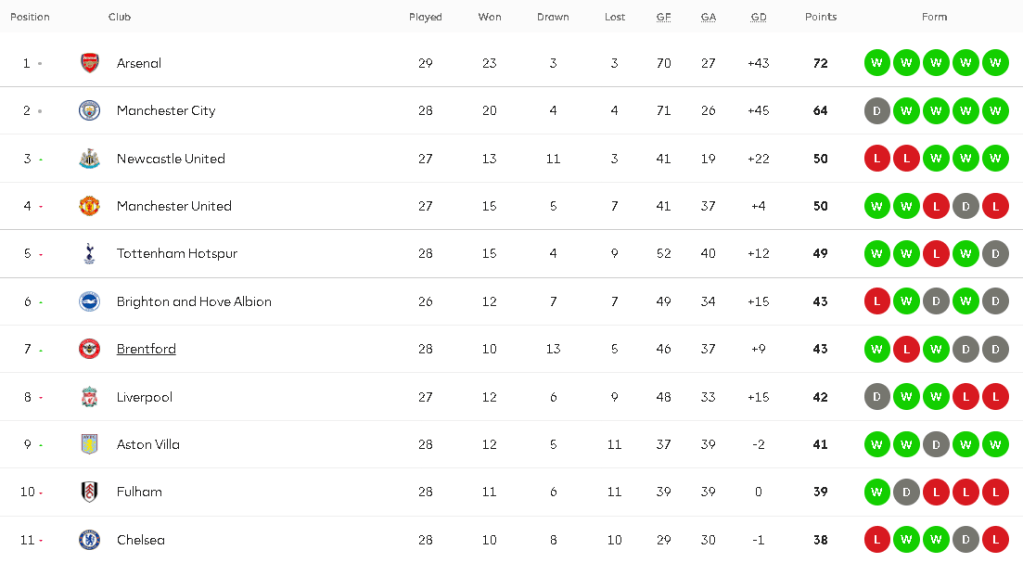
Matchweek 29Table:
To start, I’ve split up the table into two parts, to discuss clubs with similar aspirations and worries together. First up, our clubs who still have a shot at the European qualification spots.
League Table Part 1: We’re Going to Europe?
Before looking at any of these clubs, I thought it might be useful to remind ourselves of the UEFA qualification places in the EPL. The top 4 teams qualify for the UEFA Champions League. The 5th place team, as well as the winner of the FA Cup, qualify for the UEFA Europa League. If the FA cup winner finishes in the top 5, then their UEL qualification place goes to the highest finishing club without European qualification. The final spot, in the UEFA Conference League, is awarded to the team that wins the League Cup. Similarly to the UEL, if the League Cup winners finish in the top 5, the UECL qualification spot is awarded to the next highest finishing team without European qualification. So that being said, let’s look at the teams still with a chance to win the FA and League Cups in the top positions.
TheFA Cup:
The Semi-finals of the FA cup are set, with Manchester City facing off against Sheffield United of the Championship, while upstart Brighton and Hove Albion play Manchester United for the other spot at Wembley. Unless Sheffield United pull off a miraculous victory, I believe the winner of the FA cup is very likely to finish in a Top 6 place in the Premier League, with Brighton looking more and more deserving of that place every week. This being considered, we should reasonably expect the teams that finish 5th and 6th this season to gain Europa League Qualification.
The EFL League Cup:
The League Cup winners have already been confirmed as Manchester United! Assuming they will finish in a Top 6 place, this will mean that the UEFA Conference League qualification spot will go to the team finishing 7th in the Premier League this season. With all this in mind, let’s discuss the possible candidates.
The UEFA Champions League:
There is still a lot of change that can happen in the Top 4 places throughout the rest of the season. The two likely locks are Arsenal and Manchester City, who hold 22 and 14 point leads over 4th place. Only a colossal collapse would see either of these squads fail to qualify for the Champions League, and in terms of the title-race, Arsenal have shown that it is their trophy to bottle. Look forward to the match at the Etihad vs. City that might decide this season’s winner for good. The real intrigue is in the final two UCL spots. After their victory over Ten Hag’s Red Devils, Newcastle have tied United on points, and are ahead on goal differential in 3rd place. After seeing off Antonio Conte, Spurs are 1 point behind Newcastle and Manchester United, provided having played one more game. The remainder of the season will show if Conte was the problem at Tottenham, if Spurs can finish strong to claim a Top 4 place. However, they are likely the greatest uncertainty in the UCL race, with both teams on their heels, Brighton and Brentford, showing much more consistent form over the season. Brighton has 2 games in hand, and can pass Spurs on goal differential for 5th place by winning both games. An extremely strong finish to the season for either Brentford or Liverpool could see them snag the 4th spot, but their future is more in the hands of the teams above them than in their own control. I do not think there is a significant enough chance of any teams below Liverpool to challenge for the UCL places this season to discuss.
The UEFA Europa League:
As we noticed earlier, the UEL qualification spots will likely go to the 5th and 6th place teams. At this stage of the season, the teams most likely to finish in these places are: Manchester United, Spurs, Brighton, or Liverpool. If you’ve noticed I haven’t included Newcastle here, this is because I believe their remaining schedule for the season is the least congested, with only Premier League games to play. Spurs are also out of all cup competitions, but have not looked as functional as Eddie Howe’s men this year. Manchester United are still in the Europa League and the FA Cup, have struggled in the Premier League recently, and I could see them dropping points in the league around the European fixtures vs. Sevilla. One of the four teams I’ve mentioned will finish in the Top 4, so you could say these are my choices to finish in places 4th through 7th.
The UEFA Conference League:
The Premier League representative in the Europa Conference League will be the 7th placed team in the Premier League, provided Manchester United finish no lower than 7th (as League Cup winners). I do not think United will fall to 7th, so I believe we should be looking at Brentford and Liverpool for this spot. Liverpool’s recent resurgence give reason for optimism, but the work done by Thomas Frank at Brentford cannot be ignored, and there is every chance Brentford could be in Europe next season. If Aston Villa, Fulham, or Chelsea are to qualify to Europe after the way their seasons have gone, that will be quite the achievement. Chelsea have not named their (possibly interim) replacement for the recently-sacked Graham Potter, but who knows, maybe they can work some magic?
The League Table Part 2: Let’s Not Get Relegated Lads
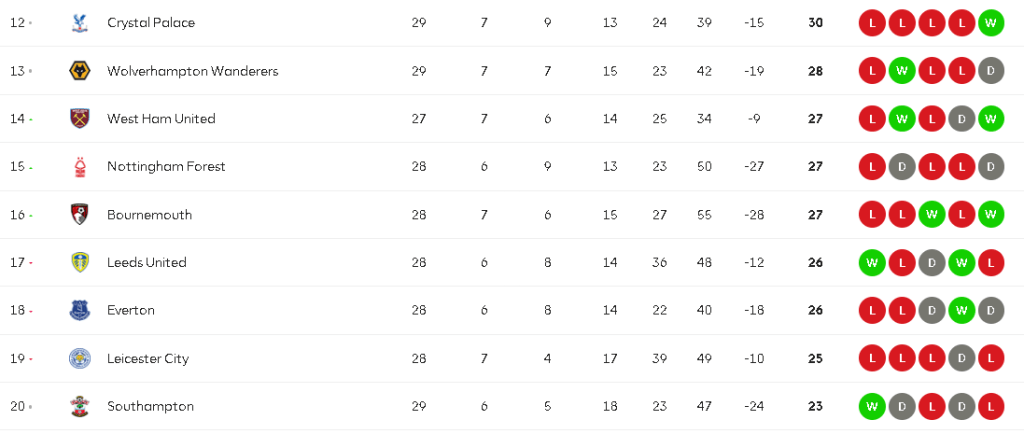
I’ve separated the table here, as Chelsea on 38 points, with the squad they have, SHOULD have no chance at relegation. Crystal Palace on the other hand, are sitting just 4 points clear of the relegation zone, with an extra game played over the teams on the verge. Add in yet another sacked manager in Patrick Viera, and Crystal Palace are a large unknown. We could see a resurgence into the top half of the table, or a further collapse into a true relegation battle. Unsurprisingly, Palace are not the only team in this part of the table who have sacked their manager this season. In fact, only West Ham and Nottingham Forest of the remaining teams have not sacked a manager this season. I think both of these squads have shown enough to make me relatively confident (as confident as can be this season) that they will not be relegated. Gary O’Neil has done enough at Bournemouth following Scott Parker’s dismissal to earn a full-time contract, and with a 2-1 win over Fulham on the weekend, the Cherries should be looking away from the relegation zone come the end of the season. The teams I am most worried for are the ones who haven’t shown much promise, or ability to pick up points, against their fellow bottom-table teams. Sean Dyche should be the stabilizing presence Everton need to stay up this year, his debut win over Arsenal inspiring some belief in a club much in need of it this season.
Top 5 Picks for Relegation:
Southampton: this is no hot take, the Saints have caused their fans to lose faith this year, with multiple managers being sacked, and utterly uninspiring displays every week. (Only a depressed Spurs team could give them a point)
Leicester City: This makes me sad to write, as I’ve always been a fan of Leicester constantly pushing the “Big 6” year after year, and giving us possibly the best underdog story in sports history. This season, the Foxes have lost their bite, and have recently dismissed long-standing manager Brendan Rogers. The story is set for the new manager to save Leicester from relegation and start a new legend at the club, but only time will tell. Optimism is great, but points on the table are better.
Leeds United: Firing Jesse Marsch immediately after backing him in the transfer market and bringing in US international Weston McKinnie seemed… impulsive. Especially when Leeds were clearly underperforming their expected attacking output most games, and Patrick Bamford having been sidelined for large portions of the season. The appointment of Javi Gracia was slightly unexpected, and the Spaniard will have his work cut out for him to keep Leeds in the Premier League this season.
Wolverhampton Wanderers: Wait, buying as many Portuguese players as possible doesn’t automatically win titles? Someone tell Wolves please. Jokes aside, bringing in Julen Lopetegui was a rational decision, and I believe he’s shown enough promise to keep the Molineux side up, but a run of bad results could prove fatal to Wolverhampton’s aspirations of remaining a top-flight club.
Crystal Palace: Like with Leicester, it would be hard to imagine the Premier League without Crystal Palace, who have been a mainstay since the 2013/14 season. Viera’s high intensity pressing style got decent results early on in the season, but following the world cup break, the intensity out of possession never returned to the early-season levels. Following Viera’s departure, Palace are a team lacking an identity, which can be a disastrous flaw to have when fighting for survival in the Premier League. I believe the top 3 teams on this list are much more likely to be relegated than the final 2 options, but as this season has shown us, the Premier League is as unpredictable as ever (and no manager’s job is safe).
That’ll be all for today, if you’ve made it this far, thanks for reading! I hope you found something interesting here, and be sure to check back in for more articles coming soon!













 futbird