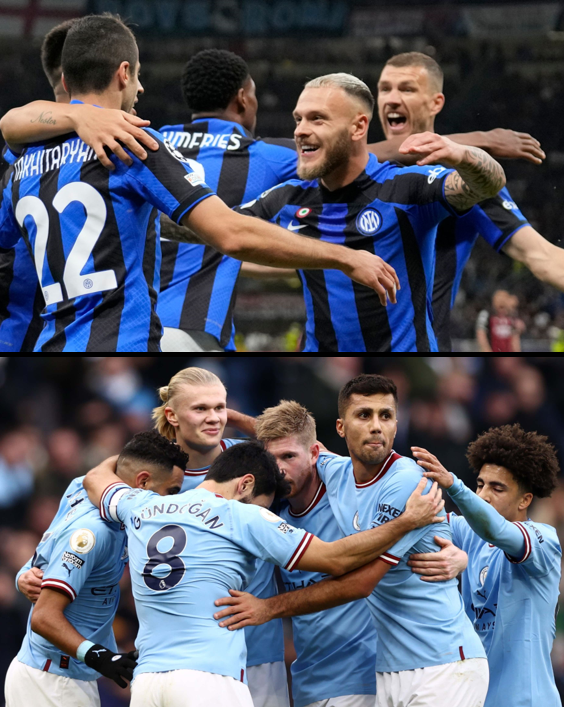
The Final of this years Champions League is set: the seemingly inevitable Manchester City led by Pep Guardiola will take on Simone Inzaghi’s Inter Milan, who are not only fighting for the trophy now, but also fighting for their competitive future in the coming seasons. In this article, I will discuss the tactics employed by both managers, the storylines of the final, and predict how we are likely to see the game play out.
Manchester City: Striving for Immortality
Pep Guardiola’s Manchester City side could be as little as 3 wins away from becoming the second ever English team to win the treble of the Premier League, FA Cup, and Champions League. They would also be the 8th club to have accomplished the treble in Europe.
Celtic (1967), Ajax (1971), PSV Eindhoven (1988), Manchester United (1999), Barcelona (2009 and 2015), Inter (2010), and Bayern Munich (2013 and 2020) are the previous clubs to have completed the feat. Guardiola already features on the list with his 2009 Barcelona side – his very first full year in charge of the team. The greatest motivation on this list for City’s fans is to join their rivals, Manchester United, as the only English clubs to have won the treble. As it stands, that 1999 treble is something United fans have held over their heads for close to a quarter of a century now. A victory at the Atatürk Stadium in Istanbul would make the treble a very likely occurrence, as City are set to clinch the Premier League title with a single win from their last 3 games, and will then have to dispatch the aforementioned Red Devils in the FA Cup final at Wembley.
So how have the Cityzens arrived at this final? By bringing back one of the oldest tactics in football, of course. When the offsides rule was changed such that only two defenders (including the keeper) were required to play an attacker onside, many English teams starting sending more players forward, and would often line up in a 2-3-5 shape (yes, 5 forwards). To counteract this, a shift that at the time was considered very defensive was made: the W-M formation. The name comes from the shape that the players form, which is a 3-2-2-3 (the front 5 make a W, while the back 5 form a M-shape). If you take the 4 midfield players and rotate them to form a diamond, or a flat line, then this looks like a version of the 3-4-3 that we still see today. However, this is NOT a 3-4-3. Here is how Guardiola’s side lines up:
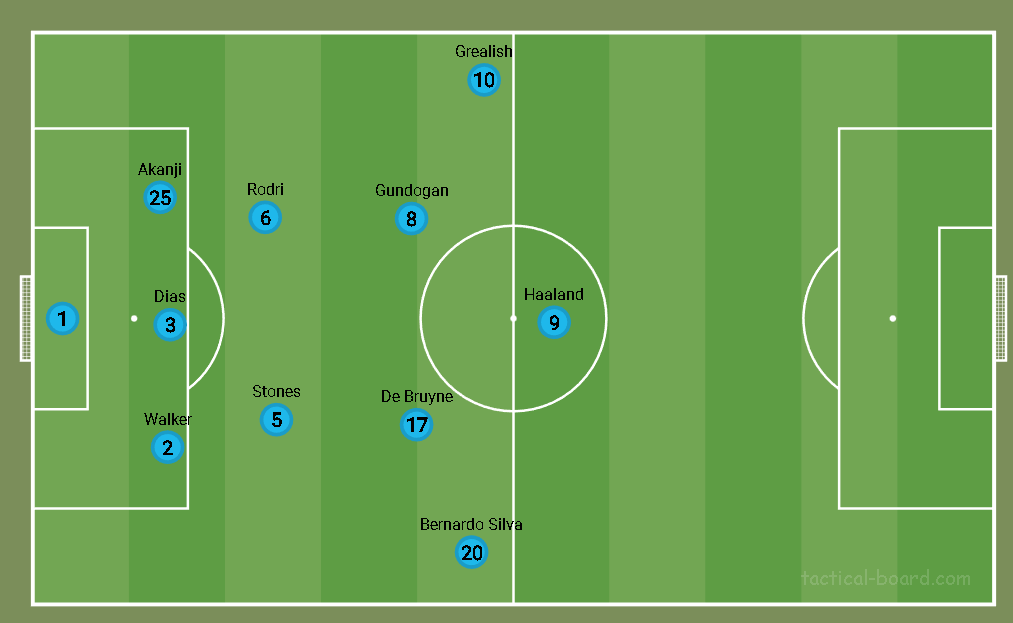
The first point I want to mention is the box in midfield formed by Rodri, John Stones, Gundogan, and Kevin De Bruyne. This midfield box is a shape commonly used in buildup in modern football, but is usually formed by a player moving infield. At Barcelona, Gavi is often played as a left winger, but drifts infield to form a box with the 3 midfielders in their 4-3-3. This box shape is so popular in midfield, as it provides the 4 players with a variety of passing options. Against most opposition, the midfield box is working around at most 3 midfielders in the centre of the pitch. If the defending team brings a 4th player in to press, then this opens up space elsewhere on the pitch. This is why many teams that use this box midfield shape are high-quantity passing, possession-based sides. I’ll take another look at how this could open up space against Inter’s side later in the article.
The second main point I want to add is that this formation is not static in buildup. As many of you already know, Pep Guardiola teams play the positional-play style of football. A short explanation of positional play:
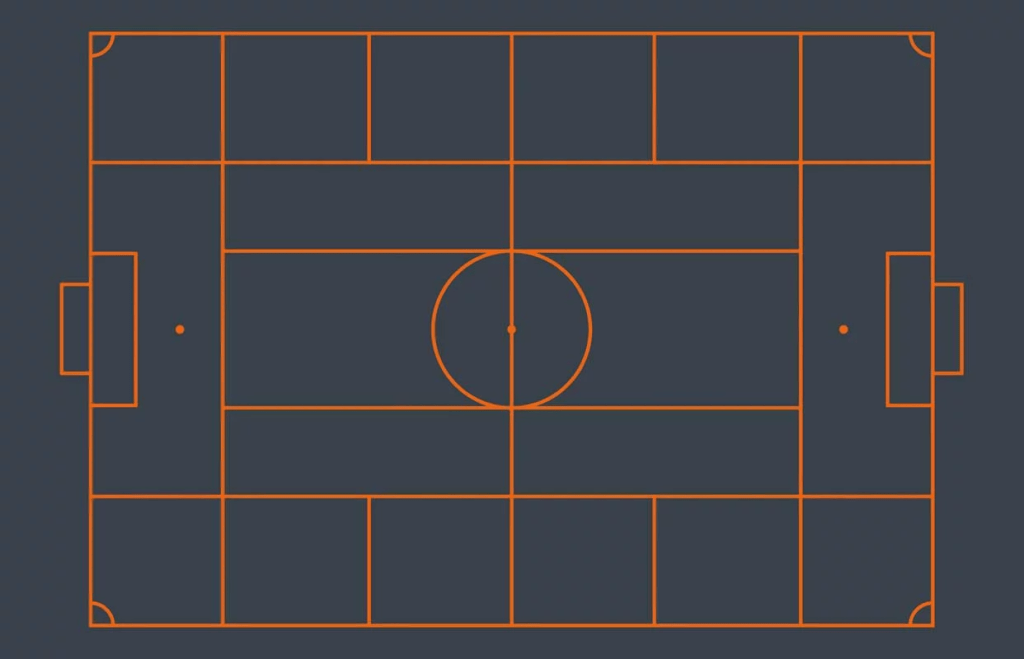
In positional play theory, the pitch is divided into spaces as shown in the image above. Simply put, no more than 2 players should be in the same vertical channel, and no more than 3 players should be in the same horizontal line to cover the full pitch as efficiently as possible and provide adequate passing options. You’d have difficulty finding a game where City showed how well drilled they are in these principles more than the second leg of their semi-final against Real Madrid. No player was stuck to a position on the field, and when one moved, the others adjusted accordingly to maintain positional-play on the field. The versatility of the City squad was also on full display, with each player showing their proficiency in different roles as the situation required. In buildup, City would often overload one side of the pitch. To me, it almost appeared as if Bernardo Silva and Ilkay Gundogan were positioning themselves in relation to Kevin De Bruyne, who is often given a free-roaming role in this system. When De Bruyne moved, with or without the ball, Gundogan and Bernardo reacted as if on cue.
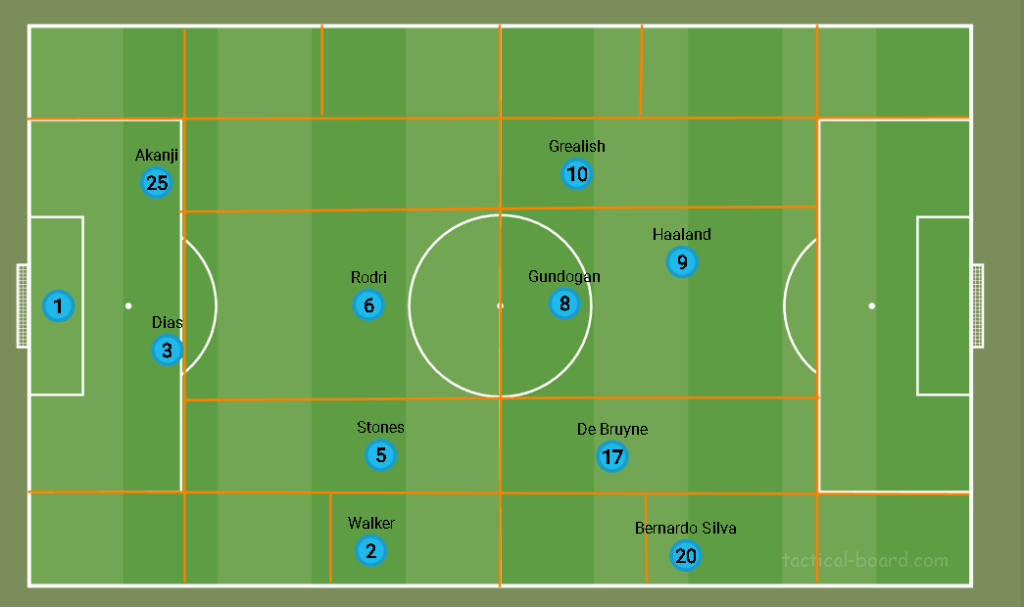
When De Bruyne ran towards the right flank, an overload was created by Bernardo staying wide and moving forward, Kyle Walker moving up from his RCB position into a RWB space, and the rest of the midfield box moving over to match De Bruyne. Alternatively, De Bruyne would move all the way into the wide space, and Bernardo drifted inside to take his place in the midfield box. No matter the side of the field or the rotation of players, City’s midfield box was the only constant in a sea of movement, formed by committee with whoever was in the right position to take the spot. The fluidity was at a level higher than I’ve seen in recent memory, reminiscent of the glory days of Barcelona.
Path to the Final:
- Group G: City topped their group with Dortmund, Sevilla, and Kobenhavn unsurprisingly, with little drama.
- Round of 16 vs. RB Leipzig: 8-1 on aggregate, after a first leg 1-1 draw. Home field advantage seems real.
- Quarterfinal vs. Bayern Munich: 4-1 on aggregate. Bayern is in a period of uncharacteristic chaos, and it’s translating to the pitch. Thomas Tuchel was given a warm welcome to his new job.
- Semifinal vs. Real Madrid: 5-1 on aggregate. The score was 3-1 on aggregate going into halftime of the second leg, and after City withstood Madrid’s efforts early in the second half, Los Blancos looked resigned to their defeat
Inter: Restoring Past Success for The Future
Inter Milan had not made the Champions League semi-final stage since they won the competition in 2010 under Mourinho. Only 6 clubs have won more than Inter’s 3 UCL titles in history however, and winning this final would put them level with Ajax on 4 titles. Bringing the biggest trophy in Europe home to the San Siro would mean so much more than just the history being made, it could give Inter a much needed boost in finance and spirit to stay competitive and continue qualifying for the Champions League, which they have not failed to do since the 2016-17 season. This season, Inter’s financial position has been well known to fans and Directors of Football around Europe. To compete with billionaire-owned clubs in Europe, Inter Milan’s spending in recent years has not been sustainable. As a result of this, the club was forced to take out an emergency loan from American asset management firm Oaktree Capital totaling 275 million euros. This debt is due to be repaid in the summer of 2024, and if it cannot be repaid, Oaktree Capital could take control of the club. While the Champions League cannot provide all the revenue to make up that debt, it can certainly be said that missing out on the additional revenue that comes with playing in the Champions League would be a de-facto nail in the coffin for Inter. Below, I’ve attached the prize money breakdown for this season’s Champions League.

This season, Inter won 3 group stage games and drew 1, totalling 9.33 million euros. Reaching the final has since added another 48.2 million euros to their total, and winning the competition could take this years prize money up to over 75 million euros. This is not including broadcast revenue and match-day revenue (Inter raked in over 10 million euros of match-day revenue in their semi-final tie against AC Milan). If it couldn’t be any clearer by now, Inter need the Champions League to survive. At one point in the season, it looked in doubt whether Inter would qualify for next season’s Champions League by finishing Top 4 in Serie A. With 3 games to play, Inter now holds a 5 point lead over AC Milan in 5th place, putting them in a good position to qualify. If they fall out of the top 4 places in Serie A however, Inter will need to win this year’s Champions League final to qualify for next season’s competition. Talk about pressure. With the stakes known, let’s look at how Inter will likely line up.

Since Milan Skriniar went down with a spinal injury in the first leg vs. Porto, the only change to Inter’s main 5-3-2 formation arrived. Darmian was dropped back to RCB to take Skriniar’s place, and Denzel Dumfries came in at RWB. While Inter would love to have Skriniar in this final for his defensive capabilities, Dumfries and Darmian make for a much more offensive right side than Darmian and Skriniar. Accordingly, this formation will play more like a 3-5-2 than a 5-3-2.
Look for Federico Dimarco to keep a more reserved role on the left-hand side to allow him to mark Bernardo or De Bruyne when they run into the space. This will mean Mkhitaryan will be the more offensive midfielder behind Calhanoglu, while Barella, an excellent ball-winner, will play more of a box-to-box role. I can also see Barella dropping back centrally to allow Calhanoglu and Mikhitaryan to rotate into a box shape with the two strikers.
On Inter’s right flank, much will depend on how well Grealish and Gundogan can balance their offensive contributions with the marking of Denzel Dumfries, who Inter will look to find in space with switches of play. When City press, they often look to split the field in half down the centre line and overload the flank. If City can prevent the switch of play from left to right over to Dumfries, then Inter will find it much more difficult to break through.
The biggest unknown for City’s defense will be how they will approach the 2-striker front of Inter. City have yet to play a team that utilizes two strikers in the Champions League this season. It will be interesting to see if Rodri and John Stones opt to cover the strikers more often, or move upfield to press Inter’s midfielders. If Inter are able to counter with numbers into space behind City’s line of Grealish-Gundogan-De Bruyne-Bernardo, I can see several dangerous chances being created.

If City’s shape in defense is the 3-2-4-1 shown above, then I believe Inter will have plenty of opportunities to create chances. If Barella and Mkhitaryan can get behind Gundogan and De Bruyne, Inter will have an overload in the centre of the pitch, leaving City’s CB’s with constant decisions to make on whether to move wide and cover the wingbacks, or stay centrally to cover the strikers and runs from the midfield. The same goes for City’s wide players covering Dumfries and Dimarco. If the advanced midfield line of Manchester City neglects their defensive responsibilities, Inter will look far more dangerous. However, out of possession Manchester City often move into a 4-4-2 or a 4-1-4-1 shape. Personally, I think a 4-1-4-1 out of possession would provide cover in defense across the field and prevent Inter from finding man advantages, as shown below.
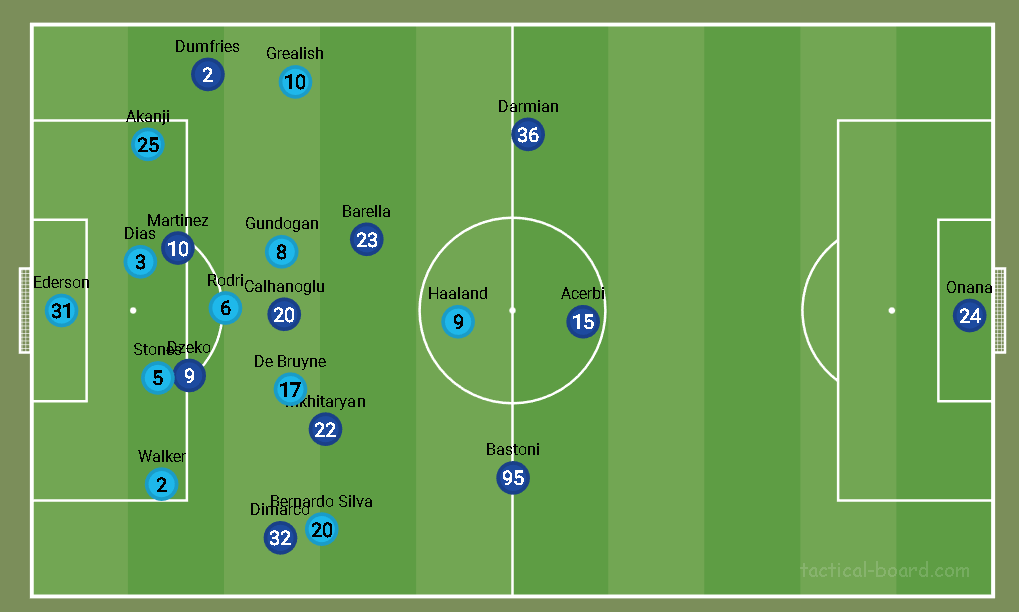
In this shape, City are not left with any free attackers in the centre of the pitch, as Rodri can move centrally to cover Inter’s front 3, freeing up Akanji and Walker to close down wide areas when needed. When defending in the second half vs. Real Madrid, City opted for this 4-1-4-1 shape, and I would not be surprised to see it in the final.
Path to the Final:
- Group C: Inter finished 2nd behind Bayern Munich in a group that saw Barcelona sent to the Europa League.
- Round of 16 vs. Porto: 1-0 on aggregate, Inter went to Porto and held a clean sheet to move on.
- Quarterfinal vs. Benfica: A 5-3 tie on aggregate that looks closer than it was. Inter won a strong away game 2-0, and then were up 5-1 on aggregate in the 78′ of the second leg before two late Benfica goals gave the Portuguese side something to keep their heads high about.
- Semifinal vs. AC Milan: 3-0 on aggregate. What could be the final Milan derby at the historical San Siro was more impressive in the record books than on the pitch, where AC Milan failed to show up.
June 10th, 2023
This is the date that the Champions League Final will be played, in Istanbul, Turkiye. We’ve laid out the tactics, the stories to watch, and what this win would mean to each club. All that’s left is to wait for the big match! If you’re still reading by now, thank you for your time and I hope you found something to enjoy in this preview.
Until next time!
-Lukas
 futbird