Crystal Palace have won the FA Cup. The team who have become known for always finishing between 10th and 15th in the Premier League (always good enough to not be staring relegation in the eye, but never able to crack into the European qualification places), have won their first major trophy in club history. Next season, they will play in the UEFA Europa League as their reward. Seemingly out of nowhere, how did this happen?

I think I should start with Oliver Glasner. When Palace announced the signing of Glasner as their new manager in February of last season, my first thought was that it was a coup. While not having the Premier League already on his CV, Oliver Glasner had an impressive coaching history to speak of. As a player, he accumulated 516 appearances for SV Ried in Austria, and also spent a season on loan at LASK, one of the country’s biggest clubs. After retiring, Glasner was the assistant manager to Roger Schmidt with RB Salzburg for two years, before starting his head coaching journey the same way his player career went. Glasner was appointed manager of SV Ried for one season, just 3 years after retiring from his playing career, before moving to LASK as a manager and director of football. Keep the latter in mind when we get to Palace. Glasner gave LASK a clear identity and style of play, which earned them promotion to the Austrian first tier in Glasner’s 2nd season with the club. In his first year in the Austrian Bundesliga, Glasner finished in 4th place with LASK, earning them a place in the Europa League qualifying rounds (you might notice the UEL becoming a theme here). The following year, Glasner further improved LASK and finished 2nd, just behind RB Salzburg who win the Austrian Bundesliga most seasons.
The success with LASK led to Glasner being appointed manager of VfL Wolfsburg in the (German) Bundesliga, where he finished 7th, earning a Europa League qualification place that was converted into a Round of 16 appearance for Wolfsburg. The following season Glasner (yet again) offered further improvement, guiding Wolfsburg to a 4th place finish and Champions League football. A poor relationship with the sporting director at Wolfsburg and some key players led to Glasner departing Wolfsburg after two seasons. A short sabbatical would then find him taking on the job at Eintracht Frankfurt.

It is important to mention that Glasner did not inherit a Frankfurt team built for success, instead joining during a period of significant change both on and off the pitch. Frankfurt had a new Chairman, Sporting Director, and had just lost André Silva (the team’s top scorer) to RB Leipzig when Glasner arrived in May of 2021. Frankfurt would lose to third tier side Waldhof Mannheim in the first round of the DFB-Pokal, and only manage one league win by November (against Bayern Munich, funnily enough), putting them very close to the relegation zone. After the rocky start, Glasner guided Frankfurt to winning six of seven matches before the halfway point of the season, bringing them back up to 6th place. The second half of the season was inconsistent, possibly in part due to the Europa League knockout rounds over this period. Frankfurt would finish 11th in the league, but Glasner would make the most of the Europa League, advancing to the final for just the 2nd time in club history, before winning the final on penalties against Rangers. This earned them a Champions League place and more than made up for the league finish in the eyes of the Frankfurt faithful. In the following season, Frankfurt would finish 2nd in a UCL group of Tottenham, Sporting CP, and Marseille, before eventually losing in the Round of 16 to Luciano Spaletti’s Napoli, who you might recall winning the Scudetto that year in dominant fashion.
Glasner would depart Frankfurt at the end of the 2022-23 season, before arriving at Crystal Palace in February 2024, with the club in 15th place in the Premier League. Glasner immediately made an impact where it was sorely needed. While Palace would not be where they are today without the services of Roy Hodgson, in the final months before Hodgson eventually was replaced by Glasner, there was a growing lack of hope around Crystal Palace. Their tactics seemed tired, and would have to just rely on moments of brilliance from Eze or Olise to get a result. Glasner changed all of this, and added a new lethal attacking threat to the Palace attack. However this wasn’t a new signing, but rather Glasner being able to get the absolute most out of Jean-Philippe Mateta like no previous manager ever had before. In the run-in to the 23-24 season, Glasner led Palace to 7 wins and 3 draws in 13 matches (that pro-rates to 70 points over 38 matches), and Mateta to 13 goals in 13 matches. Previously, Mateta’s career high in a PL season was 5 goals. This run also included a 1-0 win over Liverpool at Anfield, marking the end of Liverpool’s 29 match home unbeaten streak. Crystal Palace would finish the season having equalled their highest ever points tally of 49 and finishing in the top 10 for just the 2nd time in the Premier League era.
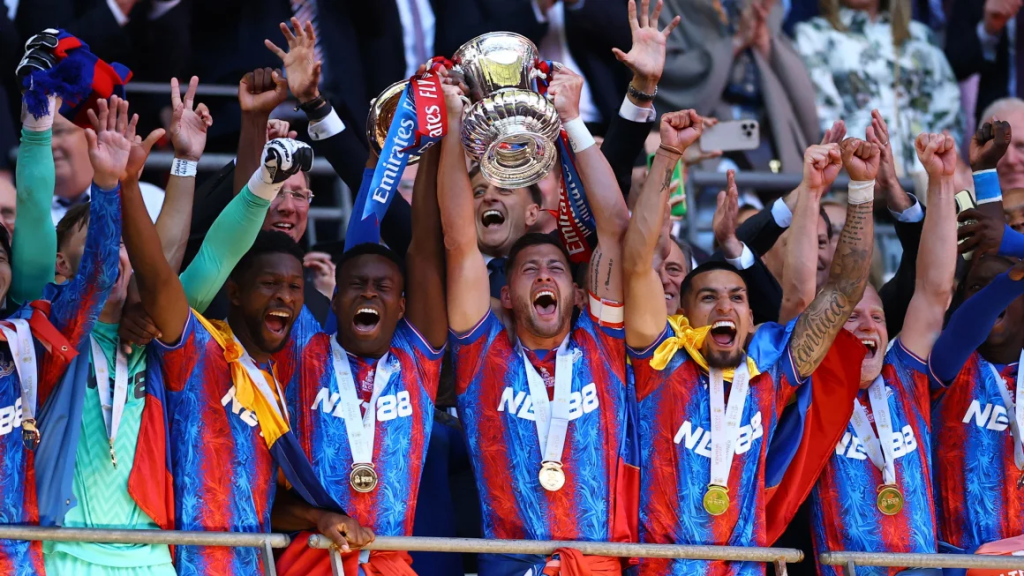
Then, we arrive at this season, where Crystal Palace did the unthinkable and won the FA Cup. A major reason this happened was a key adjustment that Glasner made in his team selection. For most of Daichi Kamada’s time at Palace, he had been deployed as a #10 in the 3-4-2-1 system. This year, Kamada was moved into the double pivot, allowing Ismaila Sarr to play as the #10 at the same time. This changed two important things: first, it took advantage of Kamada’s incredible work rate and off the ball pressing by putting him in a deeper area of the pitch. This meant that Kamada wasn’t so restricted to pressing the opposition pivot, where a pass out wide effectively removes Kamada’s pressing from the equation, and forces him into more challenges from recovery runs. With the ball in front of him more often, Kamada has been a welcomed complement to Jefferson Lerma or Will Hughes in the double pivot. You can think of it as Kamada is the screen in front of Lerma/Hughes, while Lerma/Hughes is more of the classic #6 who’s job is to be the screen in front of the defense. It allows much more freedom for the attacking players, and has allowed Palace to take advantage of Ismaila Sarr’s devastating counter-attack ability. Long passes up to the striker, or over the defence are now much more effective with Sarr running down the right flank, and have allowed Palace to choose the way they want to build up in each match.
After progressing through the early rounds with a 1-0 win over Stockport, a 2-0 win over Doncaster Rovers, and a 3-1 win over Milwall, Palace were drawn against Fulham in the Quarterfinals. Here is where Glasner is starting to be forced into playing his strongest side, and where we can see his tactics at work best. With the match away at Craven Cottage, I think most people expected a close game. Here is where we start to see the real strength of Crystal Palace against strong opposition (a potential preview of how they might play in Europe next year). The back three of Chris Richards, Maxence Lacroix, and Marc Guehi, with Tyrick Mitchell and Daniel Munoz on the flanks, can defend their box with the best of them. Jefferson Lerma can effectively drop into the line as a 4th CB, while the aforementioned Kamada and Adam Wharton play in reserved roles that protect the defence.
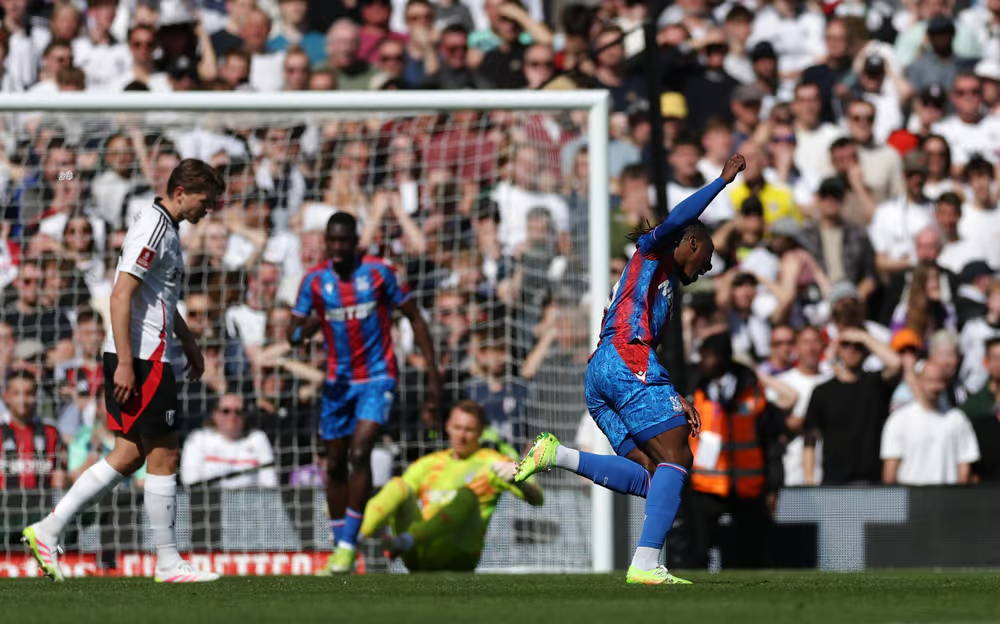
In this match, Fulham had 16 shot attempts, but only 3 actually found their way to Dean Henderson. If this doesn’t tell you what it can be like to try and attack Crystal Palace, I’m not sure what else could. Fulham had 71% possession, 12 corners to Palace’s 2, and double Palace’s shot attempts. That’s exactly the kind of apparent domination that Oliver Glasner wants his opposition to feel they have, because when his team strikes, they strike hard. Eze, Mateta and Sarr are direct on the counter attack, with Mitchell and Munoz quickly getting forward to support out wide. This generally leaves Palace attacking on the counter with a considerable man advantage, at worst with just one extra attacker. Palace produced 6 shots on target from their 8 attempts, and won 3-0 with goals from Eze, Sarr, and Nketiah.
In the semi-finals, Palace drew Aston Villa, which made them clear underdogs in the minds of pundits, fans, and bookies. This wasn’t entirely disrespectful to Palace, given the significant investment and success Villa have had over the past few seasons, but Glasner doesn’t care if you consider his team the favorite. This match ended up going just like the Fulham match: Villa with 71% possession, almost double Palace’s shot attempts, but being unable to convert the majority of attempts into shots on target. Villa managed to produce some good chances, and ended up with 5 shots on target in the match, forcing Dean Henderson into some important stops. However, Palace on the counter were too much for Villa, converting 3 of their 4 shots on target into goals, and stunning Villa with a 3-0 victory.

It’s Manchester City in the Final. Surely the dream ends here, and we’re all reminded that modern football is more and more a closed club, with only the richest clubs having a chance at silverware. Well Oliver Glasner wasn’t about to give up now, and knew the system he needed to play to win the match. In fact, after Palace’s last match against City (a City win), Oliver Glasner said that he told Pep: “If we meet again, you cannot play the same system because we will solve it.” Well, he talked the talk, and then walked the walk. The Palace defensive organization was yet again at a very high level, and this time were under even more of a barrage. City held a whopping 79% possession (helped in part due to Eze putting Palace up 1-0 in the 16th minute), and produced 23 shot attempts. All but 6 were no threat to Henderson, as the Palace defense closed off shooting angles, blocking shots or forcing a miss. The goal by Eze was a wonderful example of Glasner’s evolved tactics at work: Mateta holds up a long ball perfectly, finds Daniel Munoz sprinting down the flank, who whips a cross into the box that Eze calmly slides past Ortega and in. From defending their box, to scoring in 3 passes. You can see the effects his time working with Red Bull Salzburg had on Glasner: one of the principles of “RB football” is to try and produce a scoring chance with the least amount of passes possible. However, Glasner is not just copying generic RB football, as that usually involves a gegenpressing 4-2-3-1. Glasner’s taken the aspects that suit his team from the Red Bull system, and applied it to a squad that generally will be having to defend and break on the counter more often than not.
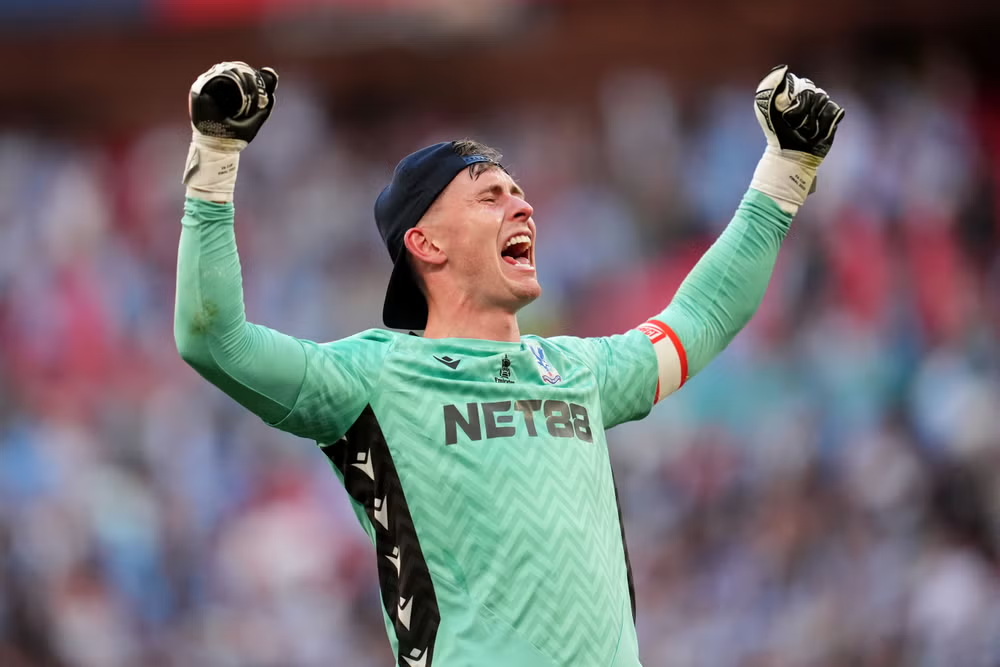
A special shoutout does need to go to Dean Henderson, who played possibly the best match of his career. After a (non) penalty was awarded to Man City, Henderson guessed correctly and saved from Marmoush, before stopping Haaland on the rebound. City had another golden chance to tie the game later on, with young Claudio Echeverri finding himself about 10 feet from Henderson with space in the box. Henderson produced an incredible point blank reaction save to deny the young Argentine, and was flawless until full-time, securing his club their first ever major trophy.
I know it’s been a longer article, so I’ll summarize concisely. This was no fluke. Oliver Glasner has transformed Crystal Palace into a group of believers, and given them a tactical system that maximizes the individual strengths of the squad. If he is matched with some investment this summer ahead of the UEL campaign, I would not be surprised to see Palace go far in the competition. Balancing the Premier League with European competition will be a first for Palace, so it will be interesting to see where their priorities lie. Glasner has laid the foundations for success at Crystal Palace, and if the club can match his ambition, I would not be surprised to see Palace break out of the purgatory of 10-15th place finishes and start challenging for European places more regularly.
Thanks for reading.
-LM
 futbird