Hello football fans from wherever in the world you are reading this! Since my Eliteserien season preview seemed to provide some unique content that was not covered elsewhere, I’ve decided to carry on with providing regular updates throughout the Eliteserien season, giving all readers the in-depth coverage in English that you would miss out on if you do not speak Norwegian. With that said, let’s take a look at how the matches played out in week 1!
The four teams I labelled as title contenders pre-season: Bodo/Glimt, Rosenborg, Molde, and Vålerenga, had few surprises. In the first game of the season, Rosenborg hosted Viking FK, and were lucky to escape with 3 points off a 1-0 victory, who’s scoreline did not reflect the pattern of play. Viking produced almost 3 times the amount of xG as Rosenborg, but were unable to convert any of their 4 shots on target, while Rosenborg scored their only shot on target. These are the kinds of wins you need to secure to fight for the title. Elsewhere, Vålerenga and Bodo/Glimt picked up away wins, 1-0 at Aalesund, and 2-0 at Sarpsborg, respectively. Molde was our only title contender to not win their first match, losing 0-1 away to Tromso. It looks more like an anomaly result than a cause for concern, with Molde amassing an impressive 3.48xG on 24 shots (6 on target) to Tromso’s 0.98xG. What makes this more impressive, is that Tromso missed a penalty, which accounted for 0.79/0.98xG. Somehow, through Vegard Ostraat Erlien, Tromso got their goal from 0.19 open play xG, and defended well enough to get the 3 points. Molde should rebound well in their next match.
A projected mid-table match between Brann and FK Haugesund at the Brann Stadion ended in a dominant 3-0 victory for the home side Bard Finne bagged a brace, and the match never looked in question.
In a battle of two teams I projected to be fighting their way out of the relegation places this year, HamKam won a dominant 2-0 victory over Sandefjord at home, producing significanly more chances and deserving their win. As the Lillestrom/Stromsgodset game was postponed, the final game of the week was a 0-0 draw between Stabaek and Odd. Odd have their keeper, Leopold Wahlstedt (a player I bought on my FM save), to thank for the point, as he made 8 saves in the match.
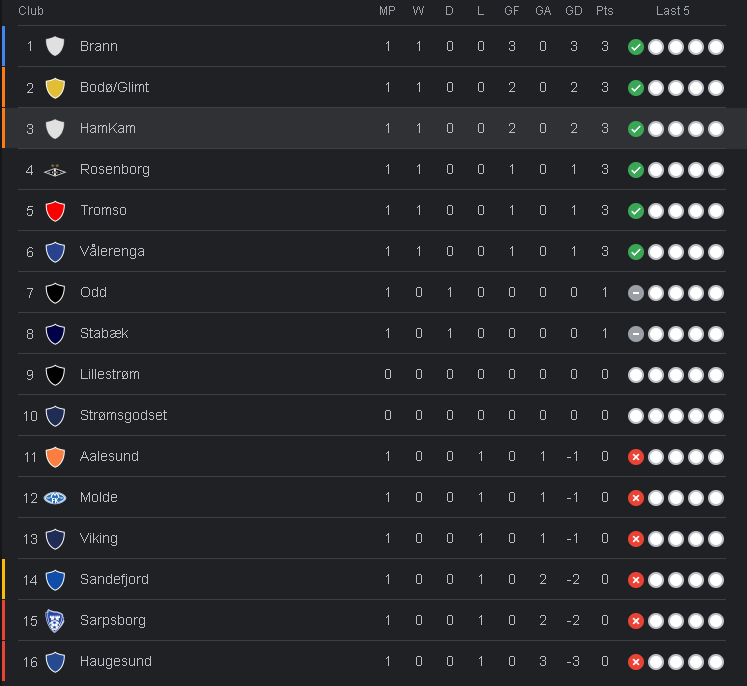
Here’s a look at the league table after the first week.
A great first week for our northernmost clubs, seeing Tromso, Bodo/Glimt, and Rosenborg all picking up wins, while Molde failing to make their many chances count was the biggest surprise of the week. The Eliteserien will start Matchweek 2 on Saturday, April 15 with Viking FK hosting Lillestrøm. Molde will have a tough test to try and avoid starting their season with back-to-back losses as they host Rosenborg.
Check in again soon for more updates from Norway, and other places around the footballing world!
One of my favorite competitions in football begins in less than two weeks, Norway’s top flight, the Eliteserien. This is where one of my favorite teams, Bodø/Glimt, call home; which is why I have had the pleasure of watching this league for several seasons now. As many football fans do not know much about the Eliteserien, allow me to give you an introduction.
Eliteserien: The Beginning
Norway founded the “Norgesserien” (The League of Norway) in 1937, with the 1937-1938 season being its first, and Frederikstad winning the inaugural season. The format of the league was very different from the standard we see today, with clubs divided into eleven groups. The league would be decided through a knockout tournament or a final between the winners of the groups. The choice to separate teams into groups based on their regional district makes sense, and can be seen in early origins of many other national leagues. By the time of World War II, it had become a general consensus to merge the league into a single national competition, removing the regional group format. In 1948, the “Hovedserien” (The Main League), was created, formed by the 16 top clubs from the district leagues, who were split into two groups of 8, with group winners contesting a two-legged final for the league title. This formation remained until 1961, when the transition was made to a single group of 16 teams: the format we see today. The name of the league changed several times over the years before settling on “Eliteserien” in 2017.
For the 2023 Season, these are the teams competing in the Eliteserien, sorted by their finishing position in 2022. Note that Brann and Stabaek were promoted from the Norweigan First Division (the 2nd tier of Norweigan football):
Club
Position in 2022
Points in 2022
Molde FK
1st
78
FK Bodø/Glimt
2nd
60
Rosenborg BK
3rd
56
Lillestrøm SK
4th
53
Odd BK
5th
45
Vålerenga
6th
44
Tromsø IL
7th
43
Sarpsborg 08
8th
41
Aalesund FK
9th
39
FK Haugesund
10th
38
Viking FK
11th
35
Strømsgodset IF
12th
33
Hamerkameratene (HamKam)
13th
31
Sandefjord
14th
24
Brann
1st (First Div.)
81 (First Div.)
Stabaek
2nd (First Div.)
58 (First Div.)
Tiers of Teams:
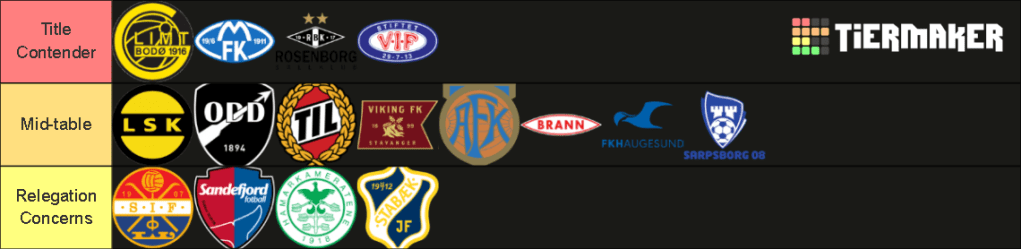
To use the English Premier League as an example, there are your top 6-type of clubs, your challengers for continental competition places, mid-table teams, and those that could be battling relegation. Since most of the readers will not have watched much Norwegian football, it is my hope that separating the teams into three tiers can help explain the power balances within Norwegian football.
Tier 1: Title Contenders
I have four clubs on my list with the potential to win the Eliteserien title this year if things go their way: Molde, Bodø/Glimt, Rosenborg, and Vålerenga.
While Vålerenga may seem like underdogs, I’ve really liked their transfer window and see them poised to improve a few places from their 6th place finish in 2022. Henrik Heggheim, an U21-capped Norwegian international centre-back was brought back from Sweden, as well as managing to sign a young Palmeiras U20 winger in Vitinha. This will be a energetic, exciting team that will be able to give any other title contenders here a fantastic match.
Molde and Bodø/Glimt have been the dominant force in Norwegian football for the past 4 years. Since 2019, Bodø/Glimt and Molde have each won the league with the other in 2nd, two times. Molde are coming into the season having sold their best striker, David Datro Fofana, to Chelsea for 12M euros. They’ve replaced Datro Fofana with Veton Berisha, a veteran Norwegian centre-forward with 10 caps for his country coming back to the Eliteserien after a year in Sweden. Berisha has most recently scored 38 goals in 56 appearances over his last two seasons in Norway, and shouldn’t need long to adapt back to the league. Aside from Berisha, Molde haven’t used the money Chelsea paid them to improve their squad, leaving me thinking that it will be unlikely that they repeat their 78 point total from 2022.
Bodø were more active in the transfer market, although it was due to necessity. Several starters the last time Bodø won the Eliteserien in 2021 moved on free transfers. Faris Pemi, the Cameroonian centre-forward, was purchased from relegated Kristiansund after managing 7 goal contributions in 14 games on a struggling side. The defensive line and midfield were also bolstered with several signings. The biggest question mark for Bodø will be at striker, regarding who will take the majority of minutes. The performance of the Bodø/Glimt centre-forward will directly decide the team’s title chances.
Last but not least, Rosenborg rounds out the title contenders. The most historically successful team in Norway football history, Rosenborg have won a record 26 Norwegian League titles with heavy dominance from the 1980’s to the early 2000’s. Most recently, they have been crowned champions 4 consecutive times between 2014 and 2018. Their squad changes include the sale of top goalscorer Casper Tengstedt to Benfica, who had 15 goals and 9 assists in 14 games last season. Rosenborg did not spend much of the 7M fee from Benfica, signing Canadian national team left winger Jayden Nelson from Toronto FC for 1M, and Norweigan Oscar Aga from the Allsvenskan for 500k. The lack of spending to replace such an integral part of the offence could be concerning, but Rosenborg has the quality in their squad to challenge for the top this season.
Tier 2: Mid-Table
In a 16-team league with 4 European spots up for grabs, if you aren’t a title contender or in a relegation battle, you’ll be mid-table. These are the teams that should not be worried about relegation, nor will they have dreams of the title. For me these teams are Lillestrøm, Odd, Tromsø, Viking, Aalesunds, Brann, Haugesund, and Sarpsborg. Of these teams Lillestrøm has the squad worth the most according to Transfermarkt.com, yet this is still less than half of the estimated value of the Bodø/Glimt and Molde squads. This is an example of a dropoff in power as we go down the league table. (Note: Vålerenga’s squad is estimated to be worth similar to Lillestrøm, even though I have them in Tier 1.) Teams like Tromsø and Aalesunds are working with much smaller budgets than most of the league, as regularly qualifying for UEFA competitions is the main reason Bodø/Glimt, Molde, and Rosenborg have higher financial power than the rest of the league. The highest points total from one of these mid-table teams should be around 50 points from 30 league games, while the mid-table teams closer to relegation will likely return 25-35 points over the season.
Tier 3: Relegation Concerns
In the Eliteserien, the bottom 2 teams are automatically relegated, and the team in 14th place (3rd last), plays against the team who finished 3rd in the second-tier for the final spot. Last season, Kristiansund and Jerv were automatically relegated with 23 and 20 points, respectively. Jerv lost 20 of their 30 matches. This season, I predict Strømsgodset, HamKam, Sandefjord, and newly promoted Stabaek to be fighting for 13th place and safety.
Stabaek has sold their top striker, Gift Orban, to Gent in Belgium, and have not replaced him with anyone nearly as inspiring. The signing of Danish CB Andreas Skovgaard from Brann is a pragmatic one which should help their cause. I don’t think the transfer activity has improved the team enough to survive in the Eliteserien, and I believe Stabaek are likely to go down again. This team finished 31 points behind Brann in the First Division last season and look to be fielding a similar roster to 2022.
HamKam and Sandefjord barely avoided relegation last season, with Sandefjord winning the relegation playoff, and HamKam finishing in 13th, 7 points clear of the relegation zone. HamKam’s transfer activity is not inspiring, adding 3 players from relegation-zone teams, with 2 signings from Vålerenga providing the most incoming quality. I have HamKam finishing 14th in the Relegation Playoff place, ahead of Sandefjord.
Sandefjord had a tough time last season, but managed to end it on a high(er) note, winning the relegation playoff and remaining in the Eliteserien. However, their challenge has not gotten any easier. Having the least valuable squad (according to Transfermarkt.com) in the league is not a competition one wants to win, and Sandefjord may well be looking for Brad Pitt to star in a “Moneyball” sequel in a few years’ time if they can stay in the top-flight with their limited budget. One team had to have the dishonor of being predicted to finish last, and for me, it is Sandefjord. I’m sorry :(.
Conclusion:
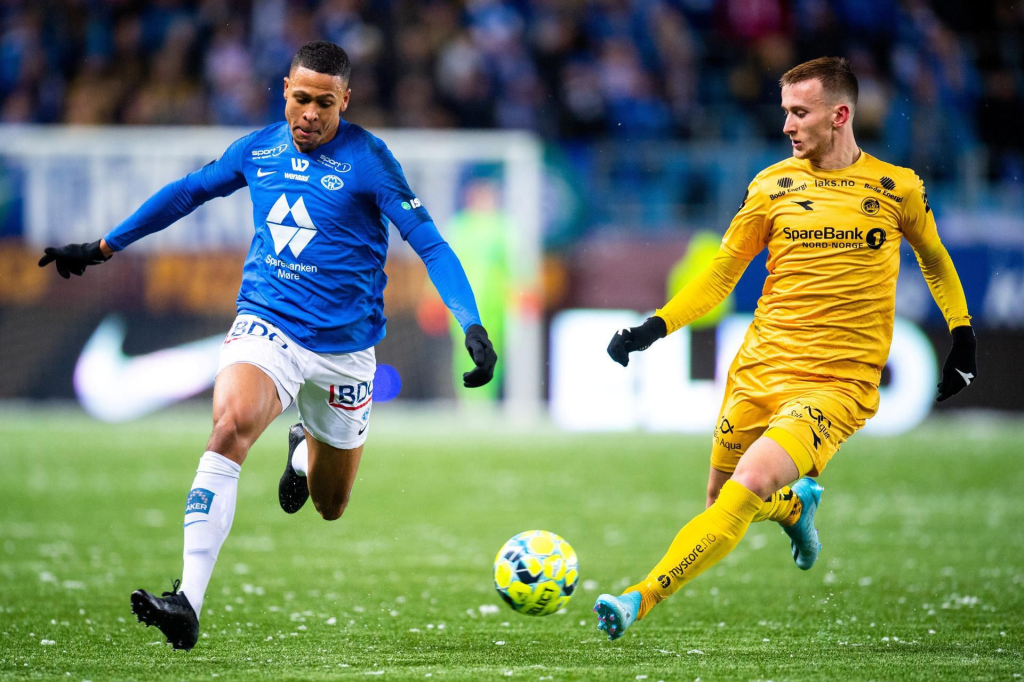
Photo Credit: BILDBYRÅN NORWAY
After one of their most successful seasons winning the domestic double, can Molde repeat as Norwegian champions? Or will the yellow shirts from the North put together a season truly worth remembering to win their 3rd title in 4 years? Perhaps Rosenborg find inspiration from their incredible historical success, or Vålerenga show the league that money isn’t everything. Regardless of the outcome, it will be a wonderful season full of excitement and suspense.
For anyone that’s made it this far, I truly appreciate you taking the time to read this story. If I can help just one person become more interested in Norwegian football, then it’s all worth it. This league will continue to produce prospects that flood Europe’s top clubs and warrants keeping an eye on it.