It is obviously important to have a good goalkeeper if you wish to win football matches. But should you have two? This is the question I wanted to take a look at today. It’s something that has caught my eye before which got spurred on (pun intended) by transfer news today.
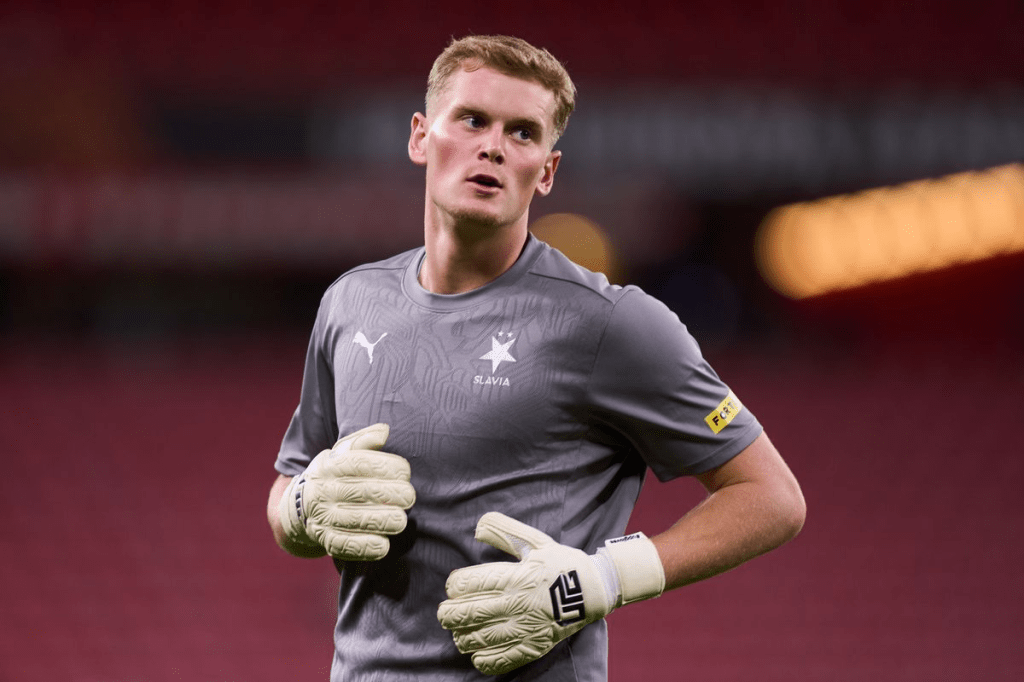
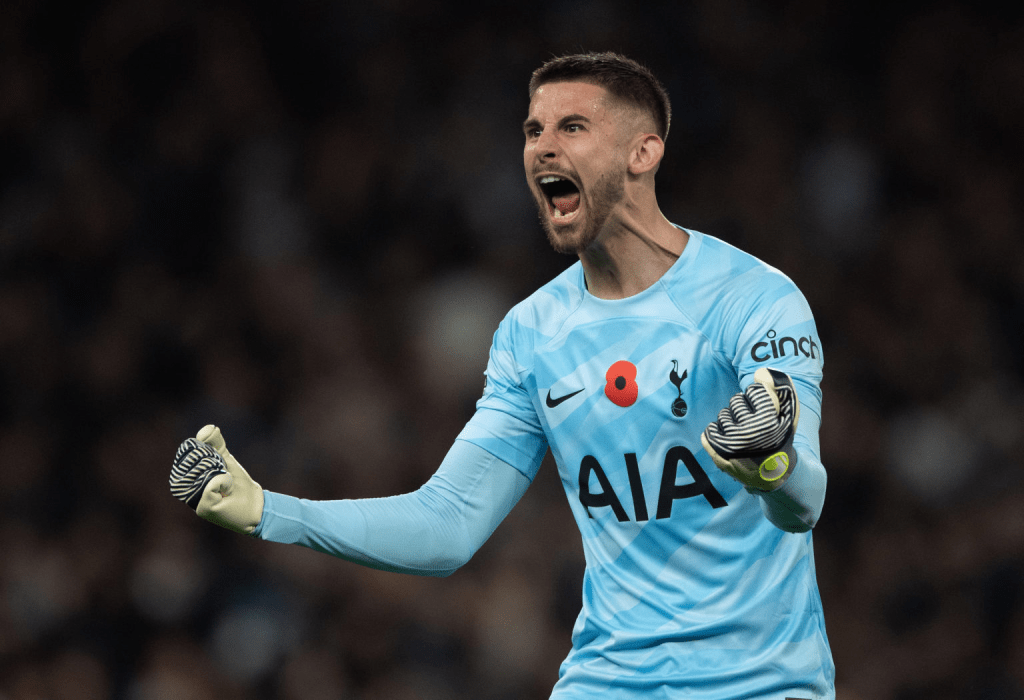
Spurs have signed 21-year old Czech youth international Antonín Kinský from Slavia Prague today. If you looked him up and are now wondering why Wikipedia says he’s 49, that’s due to his father sharing the same name and profession. In the Czech league this year, the younger Kinský was covering himself in glory, holding the highest save percentage across Europe’s Top 10 leagues, as well as looking mighty confident in build-up with the ball at his feet. The intent of the club with this signing is for Kinský to compete with Guglielmo Vicario for the club’s #1 keeper role, rather than be a set backup right from the start. This is what made me think of similar instances, most notably coming to mind the Alisson/Kelleher duo at Liverpool, or Arsenals’ Raya/Ramsdale duo last season. So lets take a look at what the pros and cons seem to be of having pair of “starting” keepers.
In the case of Liverpool, it seems to have been almost entirely beneficial keeping two quality keepers at the club. However, I’m not sure how much of Liverpool’s ability to do this was due to Kelleher not demanding a move. That’s the thing with this situation, you have to get a bit lucky with both keepers wanting to stay and compete with each other. They’re professional athletes who want to play football, it makes sense that a move to become a first-choice keeper again would appeal to whichever of the two ends up getting less playing time. In Liverpool’s case, the age gap between Alisson and Kelleher has helped, as with 6 years’ less experience than his Brazilian counterpart, it is perhaps easier for Kelleher to accept being the “backup” unless Alisson gets injured.
Now in Arsenal’s case, it seemed to not work as well long term. When David Raya was brought in from Brentford, Mikel Arteta said that he had two #1 keepers now, and that they would be competing for the starting spot. How much truth there was in this statement, I’m not sure, because very quickly into the season David Raya was starting near every game, and Ramsdale was already looking at summer transfers. Arteta couldn’t satisfy both keepers with enough playing time but he also might have personally considered Ramsdale the backup to Raya, and just said otherwise to the press. Raya is three years older than Ramsdale, who is 26, so I can see why Ramsdale might not have wanted to stick around to be Raya’s backup.
So it seems obvious that having two starting keepers is better than one, but the downside to this is how difficult it is to KEEP two starting-quality keepers for more than one or two seasons. That’s not to mention keeping both keepers happy. The arrival of a new keeper to compete for the starting role could damage the original starting keeper’s confidence. What happens with Vicario and Kinsky at Spurs will have to be seen. My guess is that for the next season or two they will compete for the #1 role, and then if Vicario wins the starting role, Kinsky is more likely to accept less play-time without requesting a transfer due to his age. Vicario is 7 years older than Kinsky, which is similar to the Alisson/Kelleher age gap. If all goes ideally, the competition will make both Kinsky and Vicario play better, then when the older of the two keepers moves on from Spurs, Kinsky will be very much in his prime to take over.
Think about what you’d prefer at your team! A clear #1 and #2 keeper tandem, or this #1a and #1b duo that we are starting to see more teams target in recruitment. There’s no one correct answer.
Hey Everyone, quick post here. It’s pretty clear to anyone who’s been paying attention to the Premier League that the past few weeks haven’t exactly been incredible for Tottenham Hotspur. Two wins from their last eleven games in all competitions, four draws, five losses. Perhaps it was a really tough schedule? I’ll let you decide, here are the opponents from the past twelve matches, and whether Spurs were home (H) or away (A):
Wins: Southampton (A), Manchester United (H)
Draws: Roma (H), Fulham (H), Rangers (A), Wolves(H)
Losses: Bournemouth (A), Chelsea (H), Liverpool (H), Nottingham Forest (A), Newcastle (H)
When you look at the opposition, its clear that the only wins have been against teams who would self-identify as “struggling” this season, and even against Man United, Spurs nearly threw the win away (albeit from two shocking errors by Fraser Forster). Several of the draws involved late goals as well! Mats Hummels scored a 91′ equalizer for Roma, Kulusevski was needed with a 75′ contribution to rescue a point against Rangers, Jorgen Strand Larsen executed a brilliant finish in the 87′ to tie the game for Wolves most recently. With a few chances going a different way, we might not even be having this conversation now.
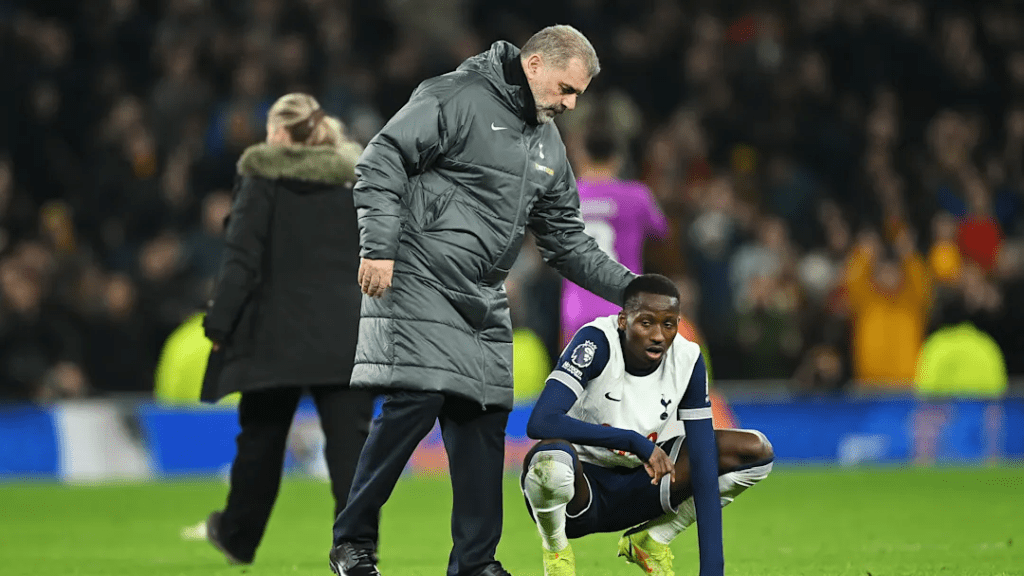
Injuries have also been somewhat of a crisis. An overall lack of proper squad depth (players who are ready to compete in the Premier League right now) has forced several first-choice players to play far too many minutes, leading to a pileup of injuries. As it stands, Spurs are without Destiny Udogie, Cristian Romero, Micky van de Ven, and Guglielmo Vicario for most if not all of the month of January before the first of them could return. Spurs might as well be without their captain Son Heung-Min, as he is showing signs of having played too much this season, and could do with a rest. However, the top 3 candidates to step into his position on the pitch and contribute, being Richarlison, Wilson Odobert, and Mikey Moore, are actually all currently injured. It’s a huge mess, and Ange Postecoglou has his work cut out for him to try and navigate this stretch, as it is going to be crucial for him to keep his job.
Most people can agree that Ange has so far done a pretty good job at Spurs. Sure you can criticize some things, like perhaps the high intensity training and tactics are causing some of this injury crisis, but overall he has moved Spurs in the right direction. However, the modern football world is not very patient with managers. The average manager at Spurs over the last few years has gotten about 18 months on the job before results hit a poor stretch, Daniel Levy feels the heat on his neck, and then makes a rash change. Reminder: he sacked Jose Mourinho the week of the League Cup final, which would’ve been Spurs first trophy since 2008.
It is due to this history in the league, and at Spurs specifically, that I worry for Ange’s position. December and January are probably the worst two months to have players injured in, due to the intense fixture congestion. Spurs need more players in January – I’m talking the busiest January window the club has ever had. The foundations for a bright future with Ange are there, but Spurs need to bring in reinforcements in January so that results don’t drop so far that Levy makes yet another managerial change.
As I’m writing this, it has been confirmed by Fabrizio Romano that Spurs are closing up a deal to sign a young Czech keeper from Slavia Prague, Antonin Kinsky, to challenge Vicario for the future #1 keeper role. This is already a step in the right direction, but more is needed, and specifically an established player or two to help all the youth on this team.
I’ll keep you updated on what goes on this January, hope you all have a great day!
Hello again, football fans! I hope everyone’s had an enjoyable holidays, and are ready for the second half of the season in Europe! As we are pretty much at the halfway point for Europe’s top 5 leagues, I thought I’d start a series looking at the top players from each position based on performance this season alone! Today’s article will be the keepers, and there are certainly some standouts to discuss, none more so than this articles headliner: Alvaro Valles.
Álvaro Valles (La Liga/ Las Palmas,/26 years old)
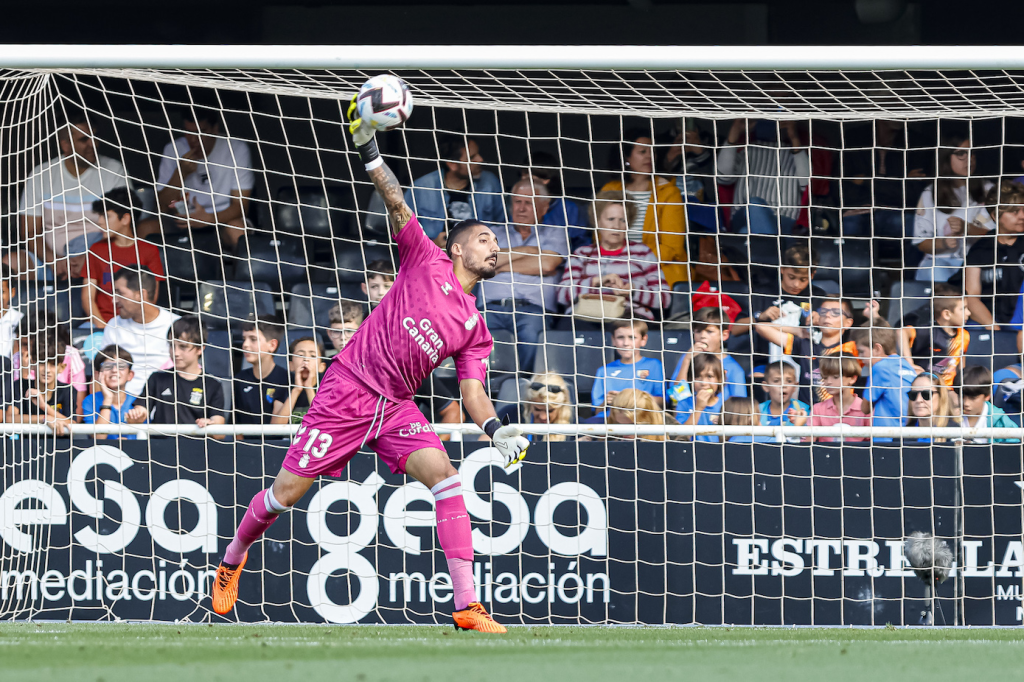
For me, the award of “Most Valuable Keeper” so far this season can only go to one man. Álvaro Valles is performing so much better than any other keeper could be expected to in his place, it is almost unbelievable. Playing for a newly promoted Las Palmas side in La Liga, Valles has accumulated a mind-blowing 10.3 Goals Prevented so far this season across 18 matches.
Goals Prevented and xG on Target (xGoT):
Goals Prevented is an advanced statistic that compares the total xGoT (xG on Target) a keeper has faced to the number of goals conceded. Most of you have probably heard of xG by now, but perhaps not xGoT. While xG is a measure of the quality of shot selection (location of shot, # of nearby defenders, type of shot), xGoT is a measure of the quality of the actual shot taken. The most obvious example to use is someone like Roberto Carlos, known for his powerful and accurate free kicks. The xG given to a Roberto Carlos free kick would be very low, because it is based on an average of all shots taken by all footballers in that league over time (let’s say the xG = 0.05). Now let’s say Roberto Carlos takes the free kick, and it is perfectly struck right into the top corner, off the post and in. The xGoT attributed to this shot would be very high, much higher than the initial xG, due to the quality of Carlos’s shot. This is why we use xGoT when analysing keepers, not xG. To summarize, “Goals Prevented” is the difference between all of the xGoT accumulated on a keeper, and that keeper’s goals conceded.
Now, back to Valles. Valles has a Goals Prevented total this year of 10.3 so far, meaning based on the quality of shots he has faced, we would expect at least 10 more goals to have been conceded by Valles. To put this stat into context, the next best in La Liga is Unai Simon, with 4 Goals Prevented, while the Premier League’s leader, Thomas Kaminski, has 5.0 Goals Prevented, less than half that of Valles! Las Palmas, as a newly promoted side, have the 2nd fewest goals conceded in La Liga after only Real Madrid, and Alvaro Valles is the biggest reason why. Las Palmas currently sit 9th in La Liga at the time of writing, and one has to expect them to stay mid-table if they can hold on to Valles, which may not be a sure thing. Barcelona are reportedly already looking at buying Valles from Las Palmas, which would make sense from their perspective.
Thomas Kaminski (Premier League/Luton Town/ 31 years old)
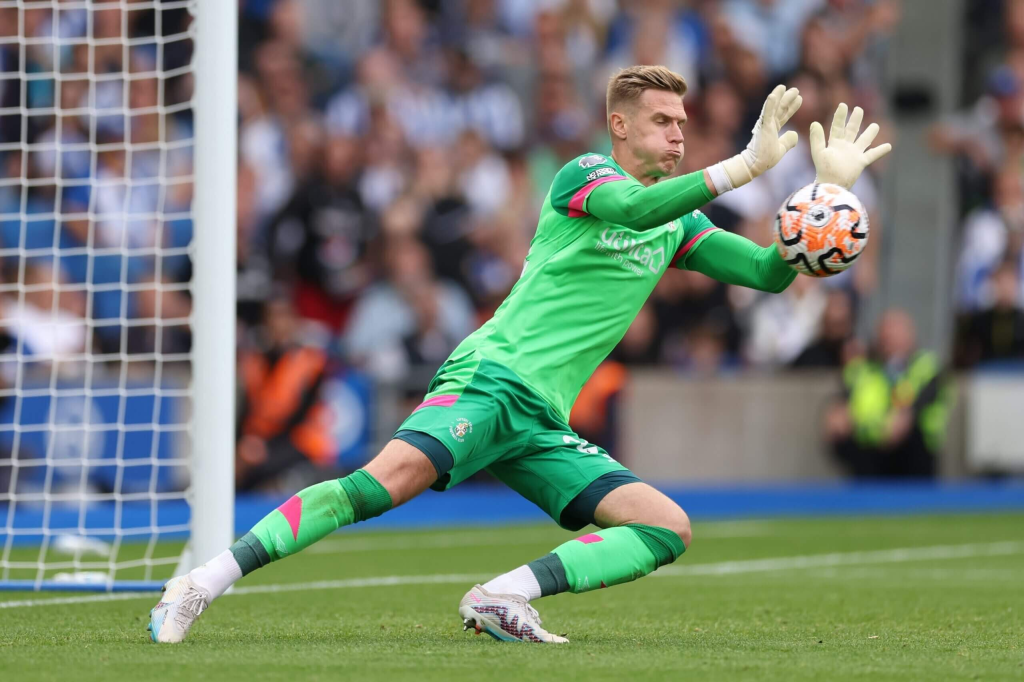
After making 118 appearances for Blackburn from 2020-2023, Thomas Kaminski signed with Luton Town ahead of their inaugural Premier League season. Since joining, he has been outstanding for the Hatters, seemingly giving them a chance in every game despite not having nearly as much talent in the squad as the rest of the league. This is reflected in the fact that Luton are 3rd worst in the Premier League in goals conceded this year, and yet Kaminski is still outperforming expectations, with 5.0 Goals Prevented this season. With Luton currently sitting one win from pulling themselves out of the relegation zone, there will be one main person to thank if they stay up this year, Thomas Kaminski. His performances against the best clubs in the league have been quite admirable , making 5 stops to earn a draw vs Liverpool, while outperforming his expected goals conceded in near every match Luton play.
Marcin Bulka (Ligue 1/OGC Nice/24 years old)
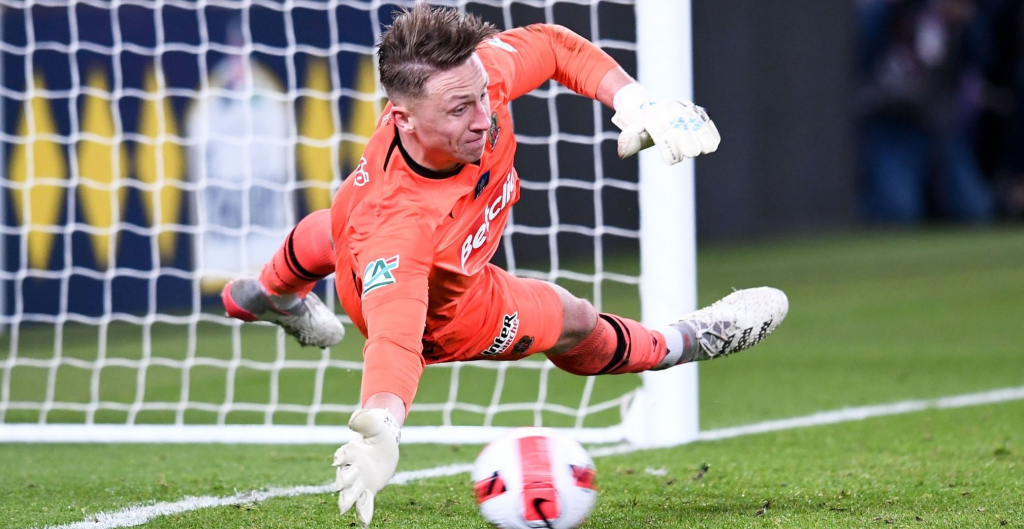
Undoubtedly the top keeper in Ligue 1 this season, and a major part in Nice sitting just 5 points off league leaders PSG by New Year’s, the Polish former Chelsea academy keeper is truly making a name for himself this season. 17 matches played, 11 clean sheets. Yes, you read that correctly. Bulka has recorded a clean sheet in 65% of Nice’s Ligue 1 matches this season, and Nice’s 9 goals conceded so far is the lowest in Ligue 1, 5 less than next best PSG and Lille. Bulka boasts the highest save percentage in Ligue 1, as well as a very respectable 4.0 Goals Prevented. Bulka has saved 2/3 of the penalties he’s faced this year, and looks to become one of the transfer market’s most wanted keepers if he can continue this form. At only 24 years old, the sky is very much still the limit for Bulka and I wouldn’t be surprised if he’s moved on from Nice in a year’s time.
Guglielmo Vicario (Premier League/Spurs/27 years old)
Throughout last season, it became a sad truth to Spurs that their longtime leader in net, Hugo Lloris, was clearly past his prime and could no longer offer what is needed from a modern goalkeeper, especially with the ball at his feet and acting as a sweeper. Enter Guglielmo Vicario, fresh off a career season at Empoli where he was the main reason that Empoli did not get relegated (see: this year’s Serie A table), arriving at Spurs for a 18.5 million euro fee. Vicario wasted no time upon arriving, establishing himself as the clear #1 keeper of the future and showing how perfectly suited he was to play under Ange Postecoglu’s new system at Spurs. If there were any doubts about Vicario’s sweeping ability before this year, I’d like to turn your attention to the Chelsea 4-1 Spurs result from this year. In this match, Spurs went down to 9 men and played an extremely high line despite the disadvantage, often at the midfield line. Countless times Vicario sprung out of his box to clear a through ball sent in behind the Spurs’ backline, and he alone prevented the scoreline from being something closer to 8-1. Having watched every Spurs game so far this year, I have yet to see a bad performance from Vicario, he has been without a doubt Tottenham’s most consistent player this season, offering so much calmness and composure at the back. Even when his teammate makes a mistake, Vicario is quick to tell them to shake it off and move on, unlike many keepers we see who seem to love any opportunity to scream at their defence whenever they make a save. From his ball playing ability, to his shot stopping, to his mentality and leadership, Guglielmo Vicario has been a perfect signing for Spurs, and will be one of the Premier League’s top keepers for years to come.
Honorable Mentions: Lukas Hradecky (Leverkusen), Marvin Schwabe (Koln), Michele Di Gregorio (Monza), Yann Sommer (Inter), Brice Samba (Lens)
Conclusion:
So that wraps up my top performers in goal so far this season! How many of these keepers will remain on their team in a year’s time, and how many will be picked up by bigger clubs? By just how much will Alvaro Valles finish the season as the best keeper in La Liga? Will Thomas Kaminski or Guglielmo Vicario finish the year with the most Goals Prevented in the Premier League? We’ll have to wait and see to find out the answers to these questions, but that’s the fun of football isn’t it? Thanks to everyone for reading, and as always feel free to leave any comments or suggestions!
Hello again, and welcome back for a very exciting day for Spurs fans, possibly the only exciting day they’ve had this season apart from the day Manchester City ensured their North London rivals would not win the title. It has been a rough few seasons in the white half of North London: the big-name manager appointments of Jose Mourinho and Antonio Conte have failed with fireworks. Each manager grew increasingly frustrated with the club failing to meet their demands in terms of player recruitment, and both were sacked in dramatic fashion – Mourinho days before what could have been Tottenham’s first trophy since 2008 in the League Cup final, and Conte hours after delivering a a press conference filled with criticisms and frustrations of managing Spurs, effectively forcing his own departure.
It makes complete sense though.
To not be mistaken by the reader, both Mourinho and Conte are two of the game’s best ever managers, and their history of accomplishments cannot be denied. However, they were never the right fit for Tottenham, and the signs of discontent were evident long before each manager’s eventual departure. Daniel Levy has been the chairman of the club for almost the entire Premier League era, taking the role in 2001 when ENIC purchased Tottenham. Since his arrival, Spurs have created a club identity around attacking, entertaining football. The transfer profile of the club has been to purchase younger players with potential to develop and then be sold on at a healthy profit to sustain the club’s operations. This has been effective for Spurs, albeit obviously not in the trophies department (Let’s get all the trophy jokes out now so we can discuss the less amusing but more relevant details). Despite never winning the Premier League, or other major silverware recently, this approach by Tottenham has led to increased fan support and financial stability.
In an era where it no longer feels uncommon to hear about some of the biggest clubs in world football having severe financial issues, Spurs have stayed clear of any danger without the unlimited budget that comes with a club owned by an entire country with massive oil reserves. Did Spurs become the first team in history to have a self-imposed transfer ban for 2 consecutive transfer windows? Yes they did, and I shared the frustration of all the fans during that time period. The lack of spending helped Spurs complete the construction of their new stadium, which provides a massive boost to revenue compared to the old White Hart Lane. Once the stadium was completed, the plan was to start spending with more ambition. This was the right idea, but as we have seen through the Mourinho and Conte eras, the right manager for the project was not chosen.
Both managers prefer older, more established players, and play a strict defense-first style. These two preferences directly contrasted with the club identity and culture that Spurs had worked to build over the past 15+ years. High potential young players were not trusted enough to be given game time, and the overall age of the squad increased. Under Pochettino, Spurs regularly lined up with a starting XI who were on average, younger than 25 years old. Meanwhile, Antonio Conte’s most recent edition of Tottenham had the oldest average age of starting XI players (29.6 years) since Glenn Hoddle managed the team in the early 2000’s. The abandonment of “The Tottenham Method”, if you will, resulted in a significant portion of the fanbase losing all trust with upper management, and calling for Daniel Levy’s exit. Gone was the exciting, free-flowing attacking football that entertained fans, win, lose, or draw. Instead, Spurs fans sat through 3 years of boring, pragmatic, defensive football.
“When you’re winning, nobody cares how you play” – A smart man, probably
That’s the thing about defensive football, it’s only tolerable to the fans for so long after the results stop coming. Now, that’s enough about how we’ve gotten to this point, time to talk about the main point of the article: Ange Postecoglu is taking over as the next Spurs manager. This is exactly what Spurs need. Here’s why:
Postecoglu has made his career playing attacking, high-pressing football. An early mentor in his career was his coach in Australia, Ferenc Puskas, who imparted his philosophy of playing a beautiful attacking game over a more pragmatic one to Postecoglu, who acted as a translator for Puskas upon his arrival in Australia (Puskas spoke little English but was fluent in Greek, which Postecoglu also spoke). He believes in this philosophy, and will not abandon his approach due to a bad run of results. A favorite quote of mine from Ange sums it up perfectly: “The way I see it is this: if you are a vegetarian, you’re not just going to pop into a Macca’s (McDonald’s) because you’re hungry!”
Naturally suiting his brand of football, Postecoglu has no qualms about playing young players, seeing the energy and potential they bring to the game rather than their lack of experience.
His teams are families. Any interview of one of Ange’s former players shows nothing but good signs. He knows when to be a disciplinarian and knows when to be a father figure. A change in mentality around the locker room is exactly what Spurs need after 3 years of failure.
He has never managed a top club at the level of the Premier League. Confused as to why this is a positive? Postecoglu will have a level of motivation that is hard to match once you’ve won everything there is to win in club football. Additionally, he comes across as a very selfless individual. In his interview following Celtic’s completion of their treble, Postecoglu was filled with nothing but praise for his team, accrediting all their success to his players, seemingly uninterested in discussing his own personal contributions. This lack of reputation and ego will likely result in much less frustration and clashes with the management of Spurs. The club will feel less of a need to change their entire identity, and rather have Postecoglu integrated into the Spurs Process.
Before arriving in North London, Ange Postecoglu has managed, and won titles, with the Brisbane Roar of the A-League, the Australian national team, the Yokohama Marinos in the J-League, and finally with Celtic in Scotland. These teams have received some high praise: his Brisbane side are often affectionately referred to as Roarcelona (a compliment to the Catalonians), and the former coach of the alluded-to Barcelona side, Pep Guardiola, heaped praise on Postecoglu’s Yokohama Marinos side (who are interestingly enough also owned by the City Football Group). Most recently, he became one of just a handful of managers to have won the treble with Celtic. The man wins wherever he goes.
How might Spurs line up under Postecoglu?
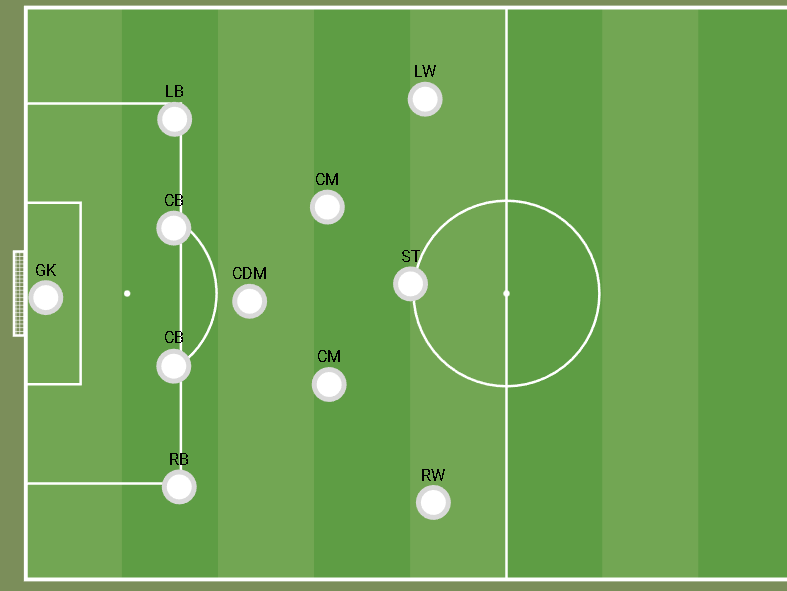
Ange Postecoglu likes to use a 4-3-3 shape in his teams.
Out of possession, the wingers often stay high up on the pitch, and do much less tracking back than in other systems. They will often stay in line with the striker, acting as an outlet for a quick counter if the ball is won back. Their role is very much single-minded, focused on creating offensive chances. In possession, Postecoglu instructs his wingers to stretch the pitch wide and stay near the touchline, operating in more space with which to beat a defender and get the ball into more central areas. The fullbacks generally tuck into the midfield in buildup, with one playing as a more traditional inverted fullback, and the other operating more in the wide areas of the pitch, but not making many overlapping runs. This forms the 2-3-5 buildup shape that we see many possession-based, high-pressing sides use. With the fullbacks more inverted, this opens up space for the two CM’s to make forward runs into the half-spaces, which is where Postecoglu wants the ball to end up in the final third. Now here is where Ange might need to tweak his approach to fit the current Spurs squad. Assuming there isn’t an entire overhaul of the midfield and fullback positions, the players in the Tottenham squad at CM and FB do not often play the roles they would under Postecoglu. Players like Pedro Porro and Destiny Udogie prefer to be influencing the final third more often, using the width of the pitch. To make matters more complicated, Tottenham’s midfielders all fall more into the holding midfield or box-to-box role than a playmaker. So the question I will attempt to answer is: How can Ange Postecoglu best recreate his offensive build-up shape with the current Spurs team?
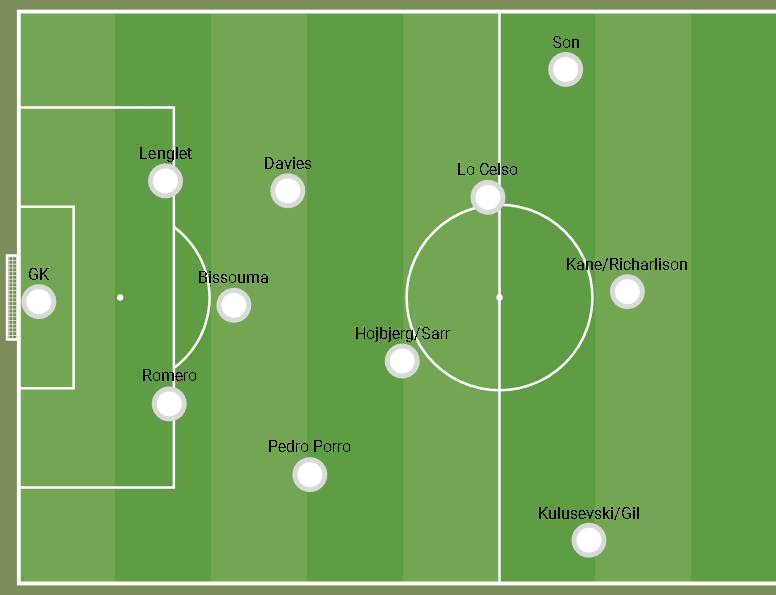
In this lineup, I attempted to emulate Postecoglu’s Celtic lineup. Here, Ben Davies is playing as the inverted LB, and Pedro Porro is operating as the wider, inverted RB. Naturally, the CM on the right side will be dropping slightly deeper in buildup to account for Porro’s offensive contribution, and the RW Kulusevski can move inside to the half-spaces, allowing Porro to overlap down the flank. Runs behind the defense from Porro will certainly be a target for switches from the left flank. Alternatively, the fullback combination of Destiny Udogie and Emerson Royal could be used, with Emerson filling the more inverted fullback role, and Udogie given more freedom to make forward runs. This would flip the formation I’ve lined up, and result in the more attacking CM moving over to the right side of the pitch.
Generally, the striker in a Postecoglu team plays right on the last line of defense, moving into the channels to find space and support build-up, while looking for his opportunity to make a run behind the defense. This is different from the role Harry Kane usually occupies, as he likes to drop deeper to create from midfield, often finding a winger making an inverted run. If Kane stays at Spurs next season, Postecoglu will have to make a decision on whether he asks Kane to play a different role than he is used to, or whether he will change his system to adapt to Kane. If Kane leaves North London, Richarlison fits the mold of a Postecoglu #9 much better.
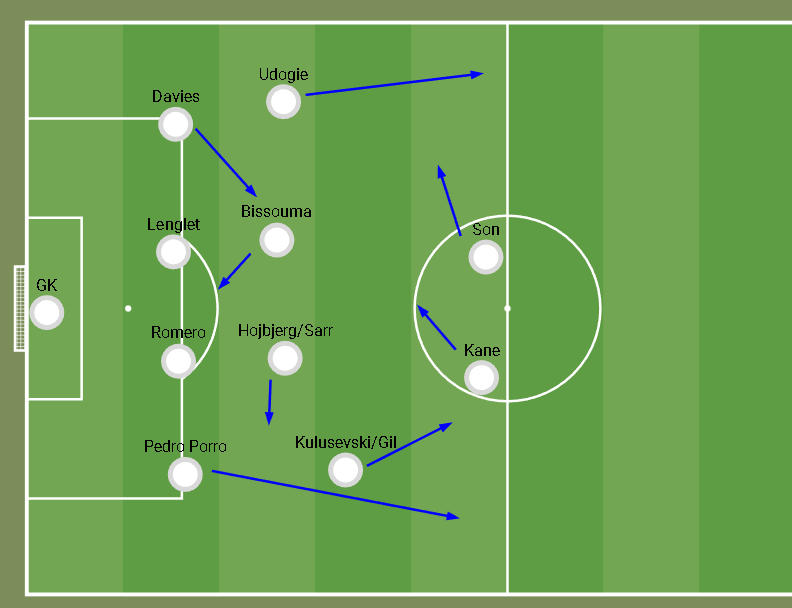
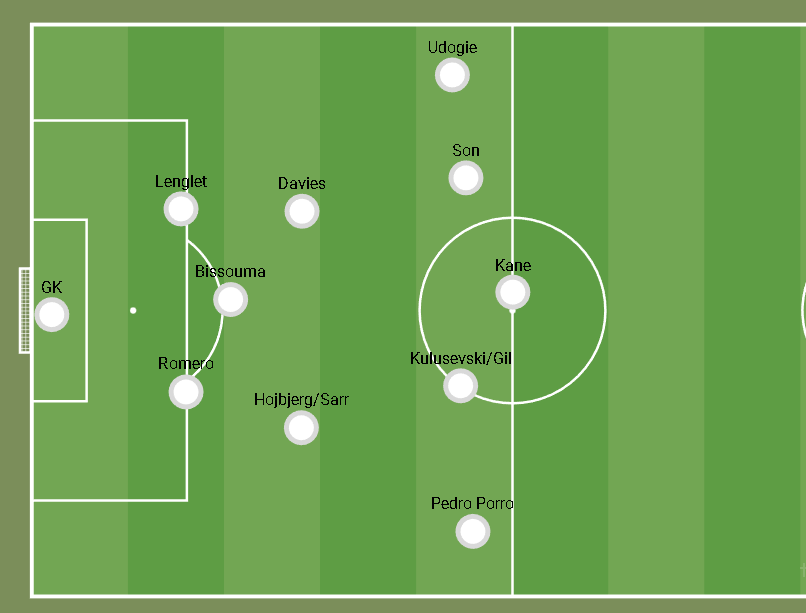
I’ve mentioned that Tottenham’s central midfielders are hard-working solid players, but they lack creativity. Giovani Lo Celso, who I think is the most needed in the team from the players out on loan, fits the #10 role the best, but I would expect Postecoglu to address that deficiency in the transfer market if he wants to play his style without making any changes. Another way that Spurs could form the 2-3-5 buildup shape in a slightly different manner is from a 4-4-2 defensive shape. We saw Ryan Mason use a 4-4-2 out of possession shape in his time managing the club this season to good effect. The benefits of this are that the 4-4-2 takes advantage of Tottenham’s squad strength, allowing an extra wide player on the pitch instead of a third midfielder. Porro can play RM with Emerson at RB, or Udogie can play LM with Davies at LB. Son and Richarlison can be played both in the wide roles or as a striker. My favorite part about this shape for Spurs is that it allows Kane to effectively function as the team’s creative midfielder in build-up, something he is so good at doing. As Davies inverts, the midfield duo of Bissouma and Hojbjerg/Sarr will slide over, creating the 2-3 base of the buildup shape. This lets both Porro and Udogie drive forward into wide areas, Kulusevski and Son occupy the half-spaces, and Kane can play centrally, dropping deep if he wants to with plenty of passing options. I’ve shown the shift from the 4-4-2 starting shape into the 2-3-5 buildup shape below.
I believe that if Postecoglu wants to play his style of attacking football, he could achieve that without any transfers by lining the team up in such a fashion. To truly make Ange-ball successful, Spurs should look to bring in a left-sided CB, an inverted fullback, and a creative attacking midfielder, along with a new keeper capable of playing the modern sweeper role effectively.
In conclusion, Ange Postecoglu brings a strong mindset, an unyielding self-belief, an electric brand of attacking football, and reason for Spurs fans to be optimistic once again. He has turned every team he has managed into a family of winners, and now he takes on his toughest test yet: bringing silverware to Tottenham. If he is given patience and time (looking at you Mr. Levy), Spurs will soon find themselves back up fighting for Champions League qualification and entertaining their fans with beautiful football.
Keep an eye on the summer transfers and the start of next season! Spurs will bring a much different look than in recent history, and look to be on the right course. Thanks for reading!
 futbird