Hello football fans, wherever you might come from! I’m excited to introduce the latest project that I am working on. As someone who loves maps and geography (as well as football, obviously), I’ve always wanted something specific that wasn’t out there: a map showing the locations of football clubs in every country, in every league. Why, you ask?
Seeing the geographical distributions of football clubs in a country can often explain a lot about the power balance in the league. You might wonder why a certain team has won a league year after year, only to find they call the country’s largest economy hub and population center home. An interesting example is Germany, where every Bundesliga winner comes from western Germany, or more specifically, from what was formerly West Germany. Two separate countries existed simultaneously before the fall of the Berlin Wall, with two independent economies and governments. The impacts of that period are still evident in modern German football: a team from the former East Germany has never won the Bundesliga. This is no curse, but rather simple finances and population differences. The top 5 German states by Gross Regional Product, to represent the size of economy, all hail from former Western Germany and together made up 71% of the total GRP of Germany in 2022.
In terms of population, the six largest regions are all from western Germany, with over 60 million inhabitants. Comparatively, the six regions that make up eastern Germany have just over 16 million inhabitants. This imbalance has translated through to football for as long as the Bundesliga has existed, and is just one example of the interesting connections you could make by looking at the game of football from a map. I encourage you to go down a rabbit-hole and see what you might find!
Eventually, my goal is to create one map for the entire world. Due to current software limitations, I am restricted to only putting a certain amount of layers on per map, so I’m separating the map into continents. Finally, I’ve finished all UEFA member nations and their domestic leagues, even San Marino and Gibraltar! This means I can happily share my map with you for the first time, embedded below.
The Football Map of Europe:
To read this map properly, there are a few things to know:
The different icons used represent the level of league within that particular country. Using Denmark as an example, the green icon of the football player represents top-division clubs. The football player icon will represent top division clubs in every country, with the color changing to provide better contrast between neighboring countries. In Denmark, the 2nd division clubs are marked with the yellow football icon. This ball icon will represent 2nd division clubs in every country. Third division clubs are represented by the “stadium” icon, shown in Denmark in navy blue.
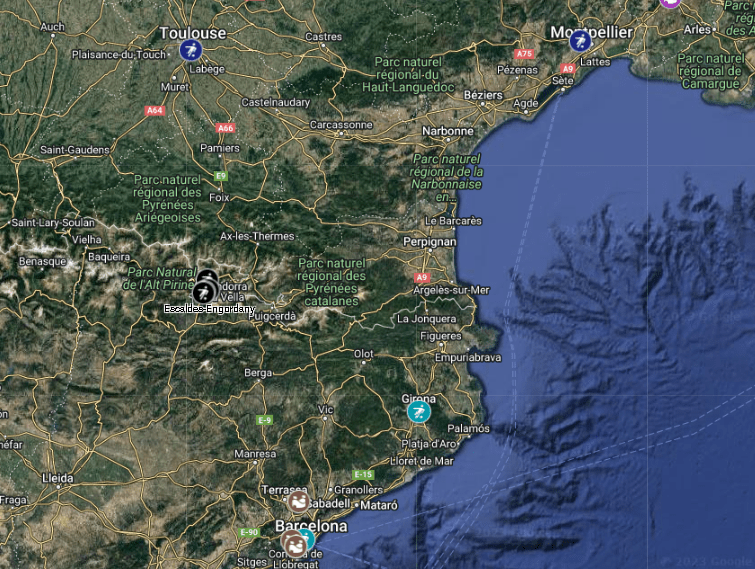
Most countries will not have more than the top 3 divisions on the map, with England being one exception, having the 4th and 5th divisions on the map. Just remember, two of the same icon with different colors near one another means the two clubs are in different countries. For example, I’ll show you the border between France, Spain, and Andorra.
Notice the identical icon for 1st division clubs, the footballer. In France, this icon is a navy blue. In Andorra, this icon is black, and in Spain, the icon is a teal/turquoise color.
Clicking on any icon on the map will bring up the description, which includes the full club name, the league they compete in currently, and a link to their Wikipedia page if it was available. Below, I’ve listed all countries and domestic leagues included on this map. I hope you enjoy this resource, and please feel free to leave any comments on corrections if I’ve made any errors! Feel free to bookmark the map link for future reference and share with any friends who might appreciate it!
Contents of Map:
Country:
Leagues Included on Map:
Albania
(1): Kategoria Superiore
Andorra
(1): Primera Divisió
Armenia
(1): Premier League
Azerbaijan
(1): Premier League
Belarus
(2): Premier League, First League
Belgium
(2): Jupiler Pro League, Challenger Pro League
Bosnia and Herzegovina
(1): Premier League
Bulgaria
(2): First Professional League, Second League
Croatia
(2): First League, Second League
Cyprus
(1): First Division
Czechia
(2): Fortuna Liga, National League
Denmark
(3): Superliga, 1st Division, 2nd Division
England
(5): Premier League, Championship, League One, League Two, National League
Estonia
(2): Meistriliiga, Esiliiga
Faroe Islands
(2): Premier League, 1.deild
Finland
(2): Veikkausliiga, Ykkonen
France
(3): Ligue 1, Ligue 2, Championnat National
Georgia
(1): Erovnuli Liga
Germany
(3): Bundesliga, 2.Bundesliga, III.Liga
Gibraltar
(1): Premier League
Greece
(2): Super League, Super League 2
Hungary
(2): NB1, NB2
Iceland
(2): Besta Deild Karla, Lenjudeildin
Israel
(1): Premier League
Italy
(3): Serie A, Serie B, Serie C
Kazakhstan
(1): Premier League
Kosovo
(1): Superleague
Latvia
(2): Higher League, First League
Lithuania
(2): A Lyga, I Lyga
Luxembourg
(1): National Division
Malta
(1): Premier League
Moldova
(1): Super League
Montenegro
(1): First League
Netherlands
(2): Eredivisie, Eerste Divisie
North Macedonia
(1): First League
Northern Ireland
(1): Premiership
Norway
(2): Eliteserien, First Division
Poland
(2): Ekstralasa, 1.Liga
Portugal
(2): Liga Portugal, Liga Portugal 2
Ireland
(2): Premier Division, First Division
Romania
(2): Liga I, Liga II
San Marino
(1): Campionato Sammarinese di Calcio
Scotland
(2): Premiership, Championship
Serbia
(1): Superliga
Slovakia
(2): First Division, 2.Liga
Slovenia
(1): Prva Liga
Spain
(3): La Liga, La Liga 2, Primera Federacion
Sweden
(2): Allsvenskan, Superettan
Switzerland
(2): Super League, Challenge League
Turkey
(2): Super Lig, First League
Ukraine
(2): Premier League, First League
Thanks for checking out the map! If you find any interesting observations through your time exploring the map, please let me know!
Hello all, and welcome back for a big one! Today I’ve had the idea to try and predict the full standings of each group in this year’s Champions League. There are some newcomers to the competition in first time participants Royal Antwerp and Union Berlin, as well as some returning clubs who have taken a bit of a hiatus from UEFA’s premier competition in recent years like Arsenal! Will Manchester City repeat as champions of Europe, or will we see a new team take the glory? Below are the results of this year’s Champion’s League draw.
The clear “Group of Death” here is Group F, containing Paris Saint-Germain, Borussia Dortmund, AC Milan and Newcastle United. Manchester City got a typically Manchester City-like draw, with their strongest opponents being RB Leipzig, a team which they smashed 8-1 on aggregate in last season’s Round of 16. Barcelona finally avoided Bayern Munich in the group stage, much to the delight of the culers. Their eternal rivals, and record winners of this competition, Real Madrid, were drawn into an interesting group with post-Spaletti Napoli, Braga, and Union Berlin. Now how will these groups look after the group stage (according to me)?
Group A
Bayern Munich. Ok, we can move on now. This group should be interesting to see if Galatasaray can manage to beat Manchester United to the 2nd qualification spot in this group. I think it’s almost a foregone conclusion that Bayern will top this group, especially with Harry Kane filling the squad’s greatest hole from last season. Early on in England, Manchester United have looked predictable and uninspiring. If Wolves were able to figure out United within the opening 15 minutes of their match, I have little doubt that the likes of Bayern and Galatasaray will be able to do the same. I’m sorry to Copenhagen, as I’d love to see them do well, but I do not see them having a great chance at qualifying to the next round or the Europa League. The matches between Galatasaray and United will likely determine who moves on from this group, so keep your eye on those fixtures.
Group B
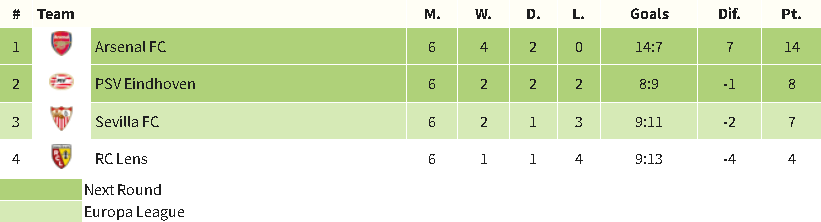
In Arsenal’s return to the Champions League, they have been given a fairly reasonable group with PSV Eindhoven, Sevilla, and RC Lens. PSV Eindhoven have gotten worse since last season, losing several key players including Xavi Simons. Sevilla are the resident Europa League owners, and seem destined to continue the cycle of: Win Europa League, qualify for Champion’s League, finish 3rd in your UCL group and get sent to Europa League, Win Europa League… you get the idea. RC Lens are a very exciting young team that are certainly one to watch, but their task to qualify out of this group is a difficult one. Arsenal should be considered favorites to top this group, with PSV and Lens competing for the 2nd spot. No matter who gets that 2nd spot, Sevilla will finish 3rd and go win the Europa League. It’s just football heritage.
Group C
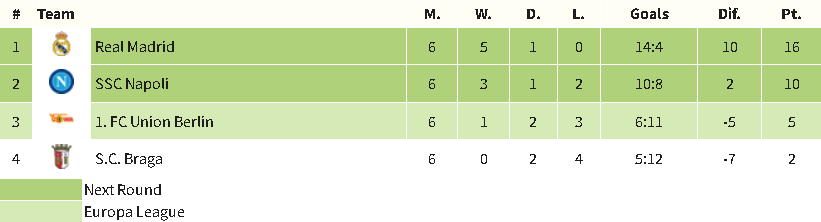
Group C looks to bring exciting football in all of its fixtures. UCL-debutants Union Berlin bring a high-energy style of play, and will look to disrupt the favorites to advance alongside SC Braga and their flair-filled Portuguese squad. The favorites, Real Madrid and Napoli, will both be looking to improve upon last season’s performances: Madrid looking towards the final in Carlo Ancelotti’s last season as manager, and Napoli looking to do themselves more justice than their R16 exit last year. Expect Victor Osimhen to bag the most goals in this group, but for Real Madrid to finish 1st.
Group D
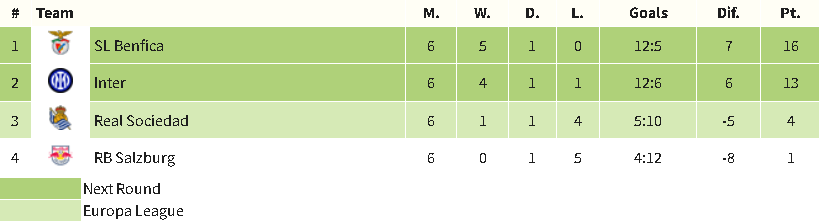
Last season’s finalists, Inter Milan, return to the Champion’s League in a group with Benfica, Real Sociedad, and RB Salzburg. Inter are not the same team they were last year, but look to be a strong team still. Benjamin Pavard, Yann Sommer, Marcus Thuram, Juan Cuadrado, Kristjan Asllani, and Yann Bisseck have all come in to help balance out the losses of Andre Onana, Marcelo Brozovic, Gozens, Dzeko, and Milan Skriniar. Their competition to top Group D are a familiar foe, Benfica, who Inter Milan faced in the quarterfinals of last year’s competition. Benfica have also added some talent to their roster, acquiring Orkun Kokcu from Feyenoord, Arthur Cabral from Fiorentina, as well as David Jurasek, Anatoliy Trubin, Angel Di Maria, and Juan Bernat. Roger Schmidt’s side will be looking to get revenge on Inter, and finish first in this group. I don’t believe Real Sociedad or RB Salzburg should pose much of a threat to the top 2 of Group D.
Group E
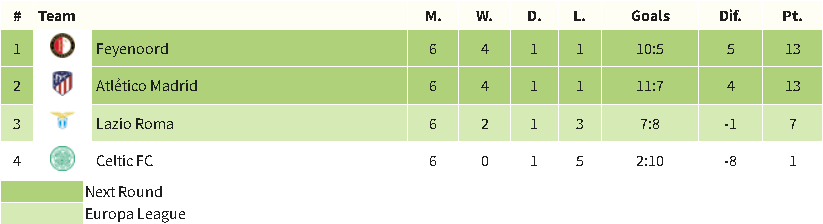
Group E isn’t the most exciting one on paper. Feyenoord is the most appealing side to a neutral fan to watch, with Arne Slot’s side enjoying some attacking football. Atletico Madrid however, are not known for that. Diego Simeone’s squad play to win their battles and get results, not to entertain the fans. I believe they will do just that, and get the results needed to advance over Lazio and Celtic. Celtic look much worse than the side that qualified for this competition, with Brendan Rogers replacing Ange Postecoglu as manager and results falling off as a result. I predict Feyenoord and Atletico to finish tied on points at the top of the group, with just goal differential putting Feyenoord on top.
Group F
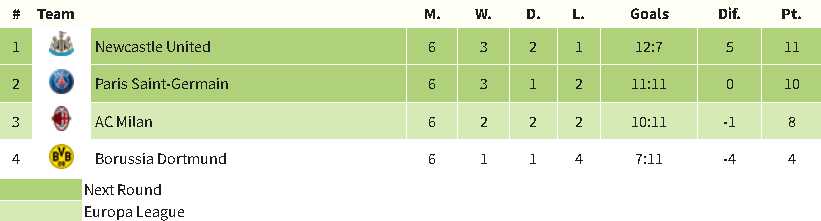
Sandro Tonali’s return to the San Siro, Ousmane Dembele, Alexander Isak, and Christian Pulisic’s returns to Signal-Iduna Park, and two of football’s modern day oil tycoons, Group F has it all. Newcastle United return to the Champion’s League and are immediately given a warm welcome with this draw. It is extremely difficult to predict how this group will turn out, with the only thing I’m sure of being that PSG will not win the Champion’s League. As much as I’m reluctant to praise a team that has a budget higher than many countries GDP, the transfers completed by PSG this summer have been solid business and in my opinion, enough to get them out of this tough group. AC Milan are not the most inspiring side here, still not as strong as their rivals Inter, and unlikely to qualify out of this group after selling their best player (Sandro Tonali) to another team in their UCL group. While it is nothing against Dortmund, they are in a group with 2 clubs owned by an entire country’s government and all the wealth that comes with it, and last seasons semi-finalists. I find it hard to see a future where Dortmund is able to finish in the top 2 here, but they could certainly sneak into the Europa League place in 3rd.
Group G
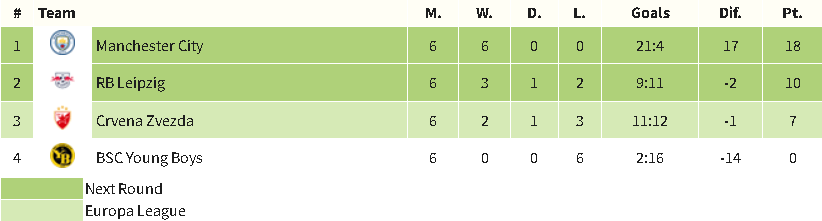
Manchester City were given a gift again by UEFA, and have little to no excuse for not winning 6 of 6 games in this group. Reigning treble-winners and holders of arguably the best squad in the world, RB Leipzig, Crvena Zvezda and Young Boys are going to be up against it. One of these teams will get the 2nd qualification spot, and for me it is between Leipzig and Crvena Zvezda. The away trip to Serbia is difficult for anyone, and Leipzig could struggle, leaving a window for the Serbs to qualify out of this group. Young Boys, representing Switzerland, have a promising team with some exciting young players to watch, but will not be expecting much in this group draw. Here’s hoping Manchester City’s draws for the knockouts won’t be as easy.
Group H
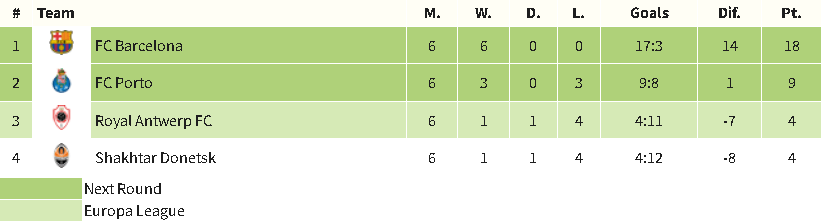
It only seems right that after finally avoiding Bayern in their UCL group, Barcelona will go on to top the group. Porto have a strong team, but have also lost their best player Otavio to the Saudi League, and do not have José Mourinho as manager. It’s not 2004, unfortunately for Porto. I think they will still be strong enough to make it out of the group, although a stumble against Royal Antwerp could give the debuting club a route to the knockouts. Shakhtar Donetsk will simply be happy to be here and taking a trip to the Camp Nou and Estadio de Dragao.
So, there’s my predictions for the group stages. To summarize, here are the teams I think will move on to the knockout stages of the 2023/2024 UEFA Champions League. Since the knockout stages will be drawn following the conclusion of the group stage, I cannot predict what the matchups will be at this point.
Final 16 – UCL
Group A: Bayern Munich, Galatasaray
Group B: Arsenal, PSV Eindhoven
Group C: Real Madrid, SSC Napoli
Group D: SL Benfica, Inter Milan
Group E: Feyenoord, Atletico Madrid
Group F: Newcastle United, PSG
Group G: Manchester City, RB Leipzig
Group H: FC Barcelona, FC Porto
When the knockout stages are drawn, I’ll be writing another prediction article for the rest of the competition! If you had any comments or disagreements, feel free to leave a comment. I hope you’ve enjoyed today’s article, and I’ll see you back soon!
Hello football fans, and I hope you sung that previous line just like I did! The UEFA Champions League qualifying rounds are nearly finished, with only the final legs of the last round to play next week. With that said, let’s take a look at some of the storylines that came from this year’s qualifying rounds, and which teams are starting to dream of making history in the main competition. I wanted to shine a light on the qualifiers specifically, to give some recognition to some of the best teams from the leagues that many likely don’t follow very closely.
History for Faroe Islands!
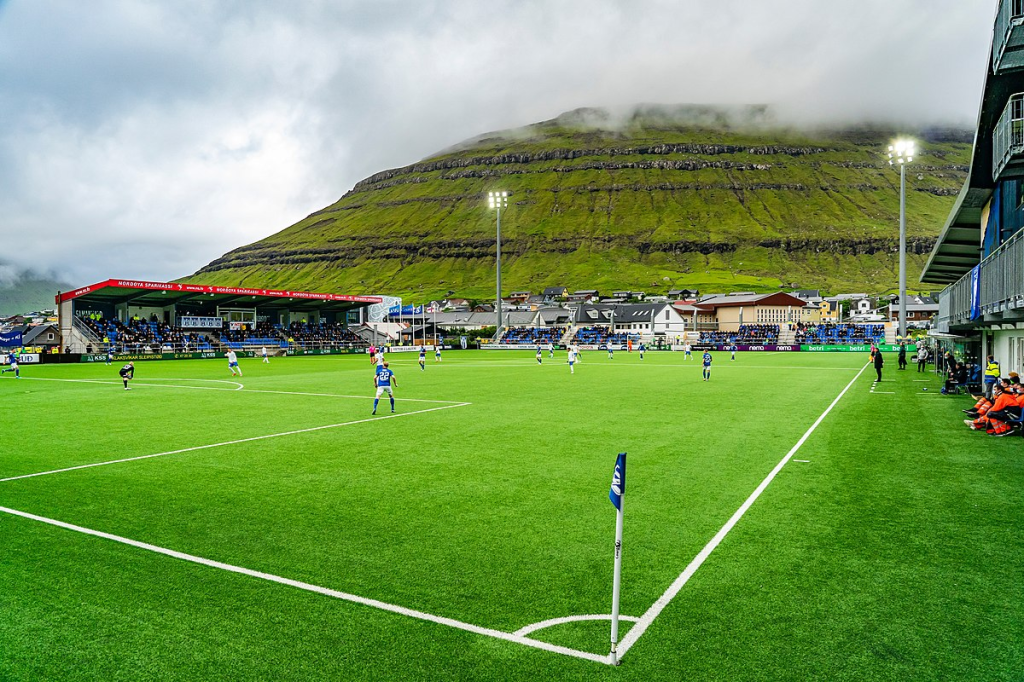
The first qualifying round of this year’s Champions League was composed of teams from countries all over Europe, with the smallest country represented being the Faroe Islands. While technically part of Denmark, the Faroe Islands compete separately in international and club play, with their own league. The Faroe Islands are home to just over 54,000 people, which leaves a large gap between their population and that of just the individual cities that call the other UCL clubs home. (Their only opponent from a city with a lower population than the Faroe Islands was Molde, a small town in Norway with 30,000 inhabitants). The winners of the Faroese league last year, earning them a spot in the first qualifying round, are Klaksvíkar Ítróttarfelag. Did you catch that the first time? If you also fear the thought of properly pronouncing their name correctly, they are commonly referred to simply as “KI” or “KI Klaksvik”. This is what their home pitch looks like:
It might be a far cry from the Santiago Bernabeu, but to me it’s just as beautiful. In the first qualifying round, Klaksvik were drawn against Hungarian champions, Ferencvaros. After holding the Hungarians scoreless at home on the islands, KI went on to Budapest for the return leg, and shocked the home crowd with a 3-0 win to move on to the next round! Swedish Allsvenskan winners BK Hacken were next up for the Faroese club, and after back to back draws with an aggregate score of 3-3, KI triumphed on penalties to make it 2 steps from the Champions League, something never achieved by a Faroese club before. In the third qualifying round, Klaksvik came up against Norwegian champions Molde, where 4,584 proud fans watched Klaksvik take a 2-1 win off an 86′ winner from Arni Frederiksburg. Unfortunately, the fairytale run would end in the second leg in Norway, where Molde would win 2-0 to advance. Still, this performance by KI Klaksvik has secured them the Europa Conference League group stage, with a chance still to qualify for the Europa League group stage with a win in the final qualifying round. A wonderful, historical achievement for the small club from the Faroe Islands, where the prize money from their performance in European competitions will surely give them the platform to aim even higher in future years.
An Atypical Family Reunion
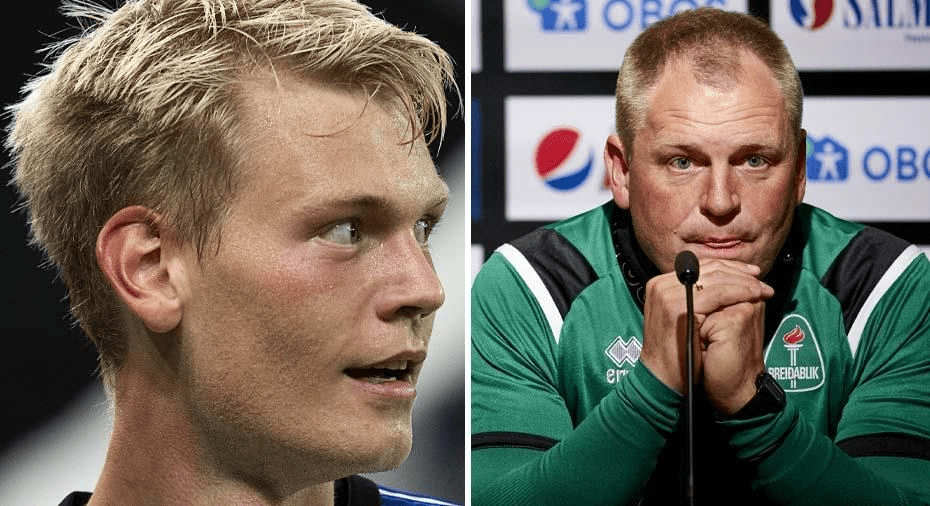
Alright, so imagine you’re Óskar Hrafn Þorvaldsson, a former Icelandic professional footballer who after your playing career ended, decided to settle down and start a family. Your son, Orri Óskarsson, grows up wanting to play football as well, and when you decide to try your hand at management in the Icelandic third tier, give him his senior debut before his 14th birthday. You go on to win back to back promotions, earning you the managerial position at Breiðablik in 2020, one of Icelands top clubs. Your son Orri becomes a highly rated prospect after making his senior debut at age 13, and gets a move to FC Kobenhavn at the same time, joining their youth academy. Fast-forward 3 years, and you’ve won the Icelandic league with Breiðablik, and after beating Shamrock Rovers in the first qualifying round, are drawn against… FC Kobenhavn. Kobenhavn won the first leg away 2-0, and in the second leg are up 5-1 on aggregate. On comes your son Orri, who proceeds to score a second-half hat trick, sealing the victory for the Danish club and knocking you out of Champions League qualifiers. Talk about an awkward dinner the next time Orri comes home for a break. Currently, Breiðablik are still in contention to qualify for the Europa Conference League if they can manage to beat North Macedonian side FK Struga, while FC Kobenhaven are up 1-0 on Polish side Rakow Czestochowa going into the second leg of the final UCL qualifying round. I’m sure Óskar is rooting for Orri to make it into the Champions League group stage now!
New Arrivals to The Champions League?
In the final round of qualifying, 4 teams remain that have never made it into the Champions League group stage: Royal Antwerp, Rakow Czestochowa, Panathanaikos, and Molde. Another Greek club, AEK Athens, is looking to return for the first time since 1994-1995. Currently, Antwerp are up 1-0 on AEK Athens after the first leg in Belgium and Rakow Czestochowa are down 1-0 to FC Kobenhavn after their home leg. Molde have shown a “never say die” attitude, coming back from a first leg deficit in each of their 2 qualifying round wins over Finnish side HJK and the aforementioned KI Klaksvik. In the first leg of their final qualifying round against Galatasaray, Molde fought back from a 2-1 deficit to tie the game in the second half, before Norwegian substitute Frederik Midtsjo scored a 94′ winner for Galatasaray. This will have been especially delighting for Midtsjo, who was a former Rosenborg player and rival of Molde during his time in Norway. In other ties, Panathinaikos go home down 1-2 on aggregate to Portuguese side Braga, Maccabi Haifa and Young Boys produced a scoreless draw, and Scottish runners up Rangers drew 2-2 with PSV Eindhoven in Scotland. The next leg of fixtures will finish next week, wrapping up the qualification campaign for this year.
By the end of August, the teams competing in the 2023-2024 edition of the UEFA Champions League will be set, with the group draw taking place shortly after. I’ll be releasing a full group-by-group prediction once the draw takes place. I hope you enjoyed this article, and will enjoy watching the Champions League this year!
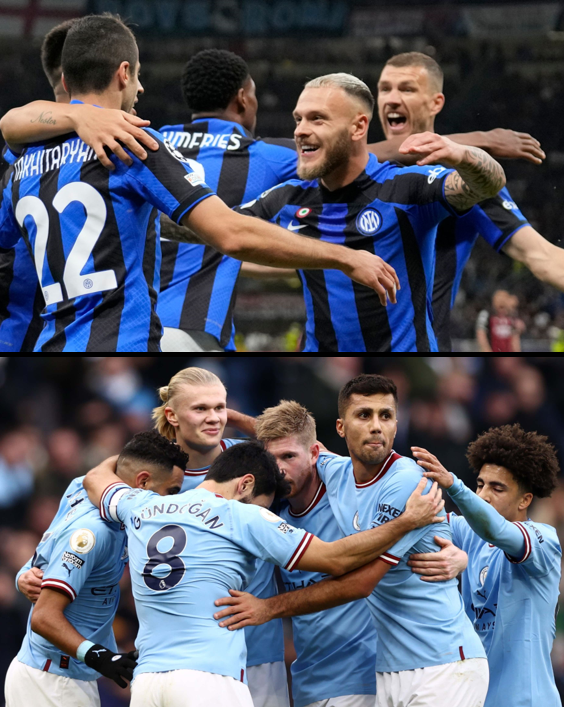
The Final of this years Champions League is set: the seemingly inevitable Manchester City led by Pep Guardiola will take on Simone Inzaghi’s Inter Milan, who are not only fighting for the trophy now, but also fighting for their competitive future in the coming seasons. In this article, I will discuss the tactics employed by both managers, the storylines of the final, and predict how we are likely to see the game play out.
Manchester City: Striving for Immortality
Pep Guardiola’s Manchester City side could be as little as 3 wins away from becoming the second ever English team to win the treble of the Premier League, FA Cup, and Champions League. They would also be the 8th club to have accomplished the treble in Europe.
Celtic (1967), Ajax (1971), PSV Eindhoven (1988), Manchester United (1999), Barcelona (2009 and 2015), Inter (2010), and Bayern Munich (2013 and 2020) are the previous clubs to have completed the feat. Guardiola already features on the list with his 2009 Barcelona side – his very first full year in charge of the team. The greatest motivation on this list for City’s fans is to join their rivals, Manchester United, as the only English clubs to have won the treble. As it stands, that 1999 treble is something United fans have held over their heads for close to a quarter of a century now. A victory at the Atatürk Stadium in Istanbul would make the treble a very likely occurrence, as City are set to clinch the Premier League title with a single win from their last 3 games, and will then have to dispatch the aforementioned Red Devils in the FA Cup final at Wembley.
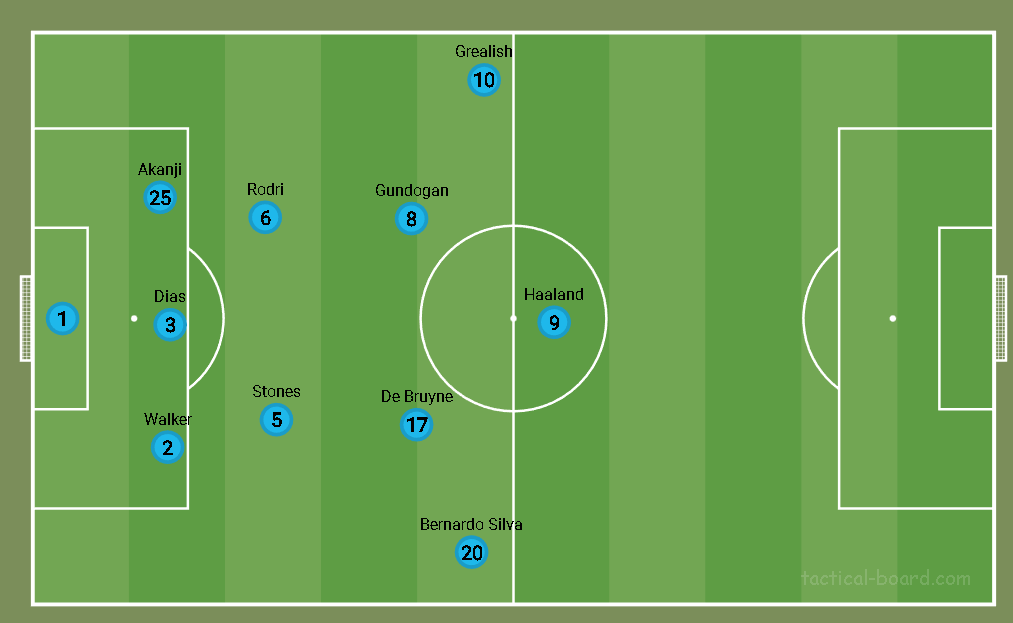
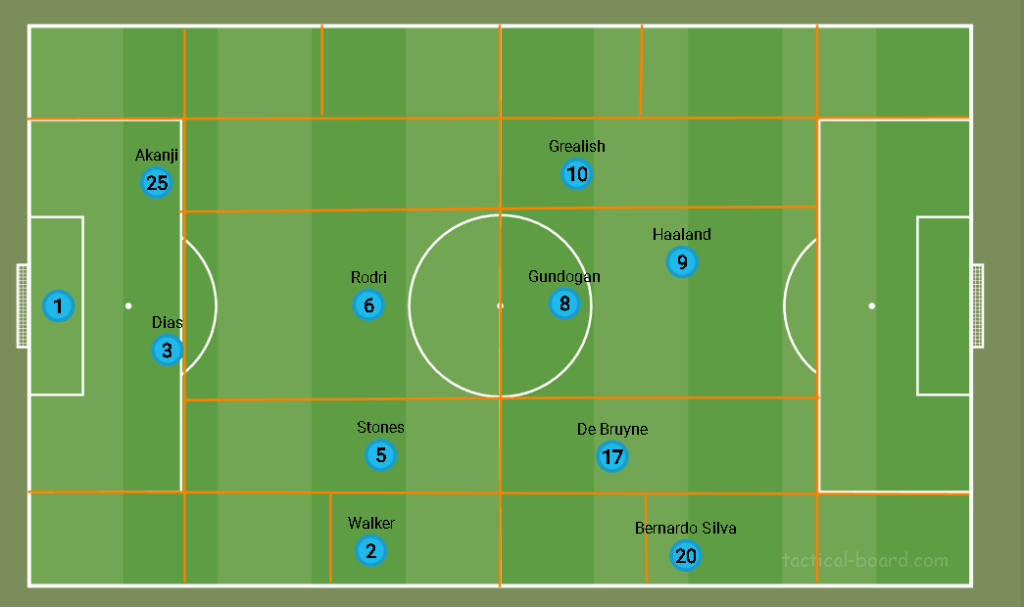
So how have the Cityzens arrived at this final? By bringing back one of the oldest tactics in football, of course. When the offsides rule was changed such that only two defenders (including the keeper) were required to play an attacker onside, many English teams starting sending more players forward, and would often line up in a 2-3-5 shape (yes, 5 forwards). To counteract this, a shift that at the time was considered very defensive was made: the W-M formation. The name comes from the shape that the players form, which is a 3-2-2-3 (the front 5 make a W, while the back 5 form a M-shape). If you take the 4 midfield players and rotate them to form a diamond, or a flat line, then this looks like a version of the 3-4-3 that we still see today. However, this is NOT a 3-4-3. Here is how Guardiola’s side lines up:
The first point I want to mention is the box in midfield formed by Rodri, John Stones, Gundogan, and Kevin De Bruyne. This midfield box is a shape commonly used in buildup in modern football, but is usually formed by a player moving infield. At Barcelona, Gavi is often played as a left winger, but drifts infield to form a box with the 3 midfielders in their 4-3-3. This box shape is so popular in midfield, as it provides the 4 players with a variety of passing options. Against most opposition, the midfield box is working around at most 3 midfielders in the centre of the pitch. If the defending team brings a 4th player in to press, then this opens up space elsewhere on the pitch. This is why many teams that use this box midfield shape are high-quantity passing, possession-based sides. I’ll take another look at how this could open up space against Inter’s side later in the article.
The second main point I want to add is that this formation is not static in buildup. As many of you already know, Pep Guardiola teams play the positional-play style of football. A short explanation of positional play:
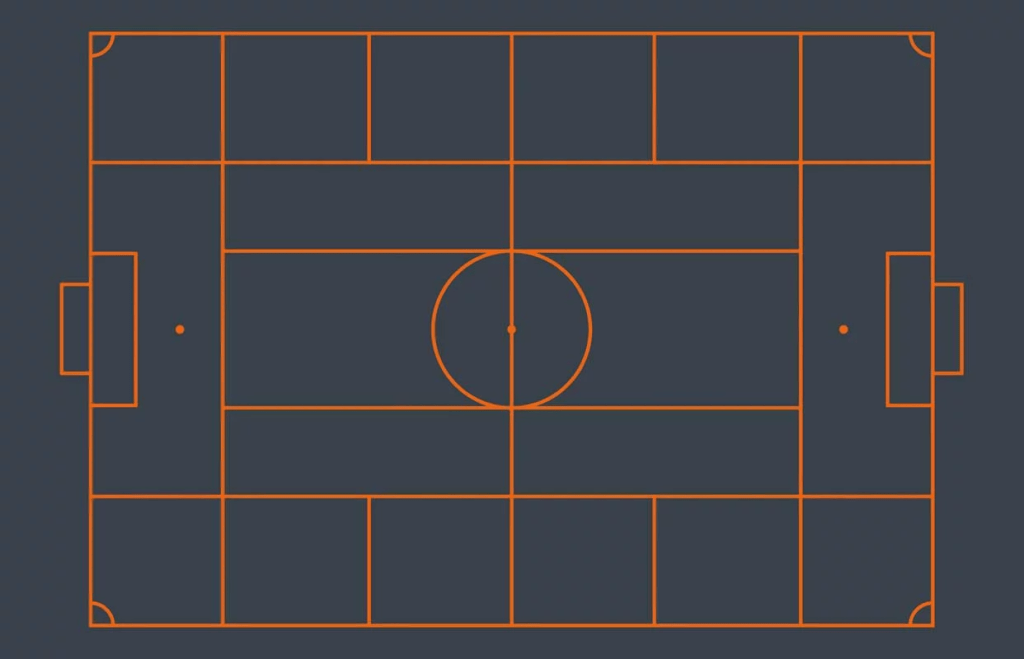
In positional play theory, the pitch is divided into spaces as shown in the image above. Simply put, no more than 2 players should be in the same vertical channel, and no more than 3 players should be in the same horizontal line to cover the full pitch as efficiently as possible and provide adequate passing options. You’d have difficulty finding a game where City showed how well drilled they are in these principles more than the second leg of their semi-final against Real Madrid. No player was stuck to a position on the field, and when one moved, the others adjusted accordingly to maintain positional-play on the field. The versatility of the City squad was also on full display, with each player showing their proficiency in different roles as the situation required. In buildup, City would often overload one side of the pitch. To me, it almost appeared as if Bernardo Silva and Ilkay Gundogan were positioning themselves in relation to Kevin De Bruyne, who is often given a free-roaming role in this system. When De Bruyne moved, with or without the ball, Gundogan and Bernardo reacted as if on cue.
When De Bruyne ran towards the right flank, an overload was created by Bernardo staying wide and moving forward, Kyle Walker moving up from his RCB position into a RWB space, and the rest of the midfield box moving over to match De Bruyne. Alternatively, De Bruyne would move all the way into the wide space, and Bernardo drifted inside to take his place in the midfield box. No matter the side of the field or the rotation of players, City’s midfield box was the only constant in a sea of movement, formed by committee with whoever was in the right position to take the spot. The fluidity was at a level higher than I’ve seen in recent memory, reminiscent of the glory days of Barcelona.
Path to the Final:
Group G: City topped their group with Dortmund, Sevilla, and Kobenhavn unsurprisingly, with little drama.
Round of 16 vs. RB Leipzig: 8-1 on aggregate, after a first leg 1-1 draw. Home field advantage seems real.
Quarterfinal vs. Bayern Munich: 4-1 on aggregate. Bayern is in a period of uncharacteristic chaos, and it’s translating to the pitch. Thomas Tuchel was given a warm welcome to his new job.
Semifinal vs. Real Madrid: 5-1 on aggregate. The score was 3-1 on aggregate going into halftime of the second leg, and after City withstood Madrid’s efforts early in the second half, Los Blancos looked resigned to their defeat
Inter: Restoring Past Success for The Future
Inter Milan had not made the Champions League semi-final stage since they won the competition in 2010 under Mourinho. Only 6 clubs have won more than Inter’s 3 UCL titles in history however, and winning this final would put them level with Ajax on 4 titles. Bringing the biggest trophy in Europe home to the San Siro would mean so much more than just the history being made, it could give Inter a much needed boost in finance and spirit to stay competitive and continue qualifying for the Champions League, which they have not failed to do since the 2016-17 season. This season, Inter’s financial position has been well known to fans and Directors of Football around Europe. To compete with billionaire-owned clubs in Europe, Inter Milan’s spending in recent years has not been sustainable. As a result of this, the club was forced to take out an emergency loan from American asset management firm Oaktree Capital totaling 275 million euros. This debt is due to be repaid in the summer of 2024, and if it cannot be repaid, Oaktree Capital could take control of the club. While the Champions League cannot provide all the revenue to make up that debt, it can certainly be said that missing out on the additional revenue that comes with playing in the Champions League would be a de-facto nail in the coffin for Inter. Below, I’ve attached the prize money breakdown for this season’s Champions League.
This season, Inter won 3 group stage games and drew 1, totalling 9.33 million euros. Reaching the final has since added another 48.2 million euros to their total, and winning the competition could take this years prize money up to over 75 million euros. This is not including broadcast revenue and match-day revenue (Inter raked in over 10 million euros of match-day revenue in their semi-final tie against AC Milan). If it couldn’t be any clearer by now, Inter need the Champions League to survive. At one point in the season, it looked in doubt whether Inter would qualify for next season’s Champions League by finishing Top 4 in Serie A. With 3 games to play, Inter now holds a 5 point lead over AC Milan in 5th place, putting them in a good position to qualify. If they fall out of the top 4 places in Serie A however, Inter will need to win this year’s Champions League final to qualify for next season’s competition. Talk about pressure. With the stakes known, let’s look at how Inter will likely line up.
Since Milan Skriniar went down with a spinal injury in the first leg vs. Porto, the only change to Inter’s main 5-3-2 formation arrived. Darmian was dropped back to RCB to take Skriniar’s place, and Denzel Dumfries came in at RWB. While Inter would love to have Skriniar in this final for his defensive capabilities, Dumfries and Darmian make for a much more offensive right side than Darmian and Skriniar. Accordingly, this formation will play more like a 3-5-2 than a 5-3-2.
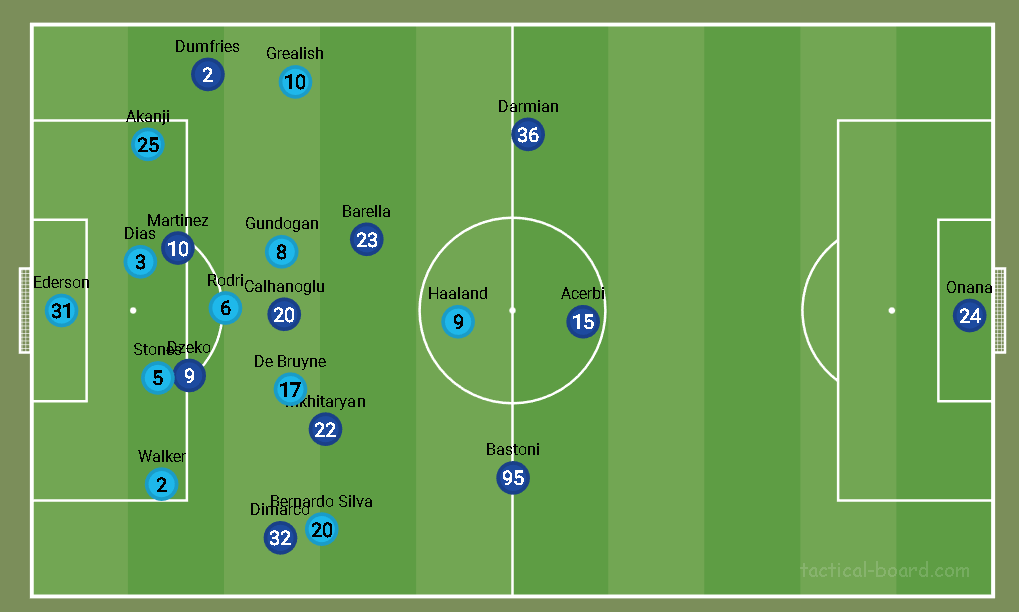
Look for Federico Dimarco to keep a more reserved role on the left-hand side to allow him to mark Bernardo or De Bruyne when they run into the space. This will mean Mkhitaryan will be the more offensive midfielder behind Calhanoglu, while Barella, an excellent ball-winner, will play more of a box-to-box role. I can also see Barella dropping back centrally to allow Calhanoglu and Mikhitaryan to rotate into a box shape with the two strikers.
On Inter’s right flank, much will depend on how well Grealish and Gundogan can balance their offensive contributions with the marking of Denzel Dumfries, who Inter will look to find in space with switches of play. When City press, they often look to split the field in half down the centre line and overload the flank. If City can prevent the switch of play from left to right over to Dumfries, then Inter will find it much more difficult to break through.
The biggest unknown for City’s defense will be how they will approach the 2-striker front of Inter. City have yet to play a team that utilizes two strikers in the Champions League this season. It will be interesting to see if Rodri and John Stones opt to cover the strikers more often, or move upfield to press Inter’s midfielders. If Inter are able to counter with numbers into space behind City’s line of Grealish-Gundogan-De Bruyne-Bernardo, I can see several dangerous chances being created.
If City’s shape in defense is the 3-2-4-1 shown above, then I believe Inter will have plenty of opportunities to create chances. If Barella and Mkhitaryan can get behind Gundogan and De Bruyne, Inter will have an overload in the centre of the pitch, leaving City’s CB’s with constant decisions to make on whether to move wide and cover the wingbacks, or stay centrally to cover the strikers and runs from the midfield. The same goes for City’s wide players covering Dumfries and Dimarco. If the advanced midfield line of Manchester City neglects their defensive responsibilities, Inter will look far more dangerous. However, out of possession Manchester City often move into a 4-4-2 or a 4-1-4-1 shape. Personally, I think a 4-1-4-1 out of possession would provide cover in defense across the field and prevent Inter from finding man advantages, as shown below.
In this shape, City are not left with any free attackers in the centre of the pitch, as Rodri can move centrally to cover Inter’s front 3, freeing up Akanji and Walker to close down wide areas when needed. When defending in the second half vs. Real Madrid, City opted for this 4-1-4-1 shape, and I would not be surprised to see it in the final.
Path to the Final:
Group C: Inter finished 2nd behind Bayern Munich in a group that saw Barcelona sent to the Europa League.
Round of 16 vs. Porto: 1-0 on aggregate, Inter went to Porto and held a clean sheet to move on.
Quarterfinal vs. Benfica: A 5-3 tie on aggregate that looks closer than it was. Inter won a strong away game 2-0, and then were up 5-1 on aggregate in the 78′ of the second leg before two late Benfica goals gave the Portuguese side something to keep their heads high about.
Semifinal vs. AC Milan: 3-0 on aggregate. What could be the final Milan derby at the historical San Siro was more impressive in the record books than on the pitch, where AC Milan failed to show up.
June 10th, 2023
This is the date that the Champions League Final will be played, in Istanbul, Turkiye. We’ve laid out the tactics, the stories to watch, and what this win would mean to each club. All that’s left is to wait for the big match! If you’re still reading by now, thank you for your time and I hope you found something to enjoy in this preview.
Hello again! First of all I want to thank all the various readers from all around the world who have taken the time to read my work. If there are any specific stories or topics that you would be interested in, feel free to leave a comment! There is no area of football too isolated or niche for me to be interested in. Now, let’s get into today’s article on the final weeks of the English Premier League.
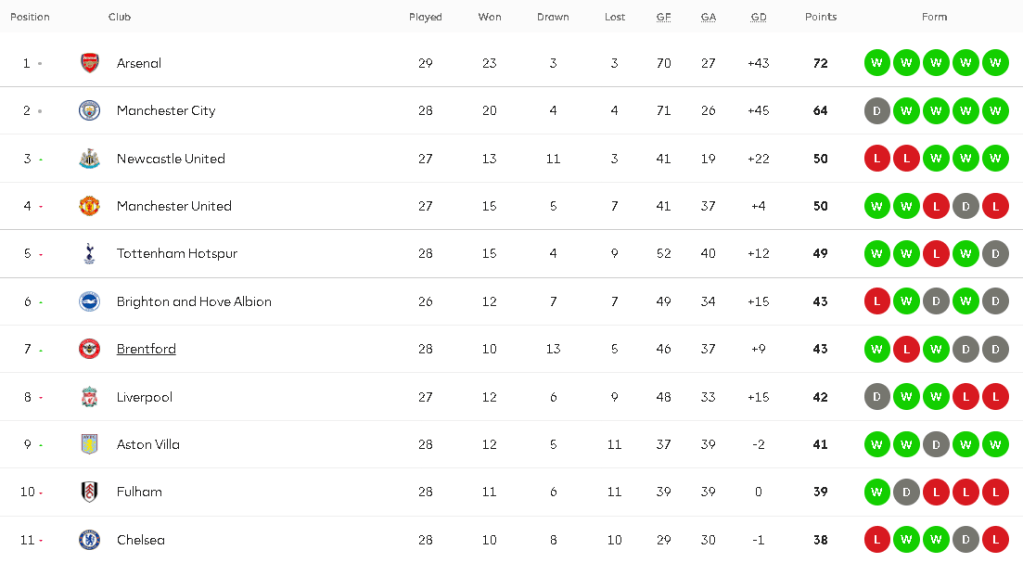
Matchweek 29Table:
To start, I’ve split up the table into two parts, to discuss clubs with similar aspirations and worries together. First up, our clubs who still have a shot at the European qualification spots.
League Table Part 1: We’re Going to Europe?
Before looking at any of these clubs, I thought it might be useful to remind ourselves of the UEFA qualification places in the EPL. The top 4 teams qualify for the UEFA Champions League. The 5th place team, as well as the winner of the FA Cup, qualify for the UEFA Europa League. If the FA cup winner finishes in the top 5, then their UEL qualification place goes to the highest finishing club without European qualification. The final spot, in the UEFA Conference League, is awarded to the team that wins the League Cup. Similarly to the UEL, if the League Cup winners finish in the top 5, the UECL qualification spot is awarded to the next highest finishing team without European qualification. So that being said, let’s look at the teams still with a chance to win the FA and League Cups in the top positions.
TheFA Cup:
The Semi-finals of the FA cup are set, with Manchester City facing off against Sheffield United of the Championship, while upstart Brighton and Hove Albion play Manchester United for the other spot at Wembley. Unless Sheffield United pull off a miraculous victory, I believe the winner of the FA cup is very likely to finish in a Top 6 place in the Premier League, with Brighton looking more and more deserving of that place every week. This being considered, we should reasonably expect the teams that finish 5th and 6th this season to gain Europa League Qualification.
The EFL League Cup:
The League Cup winners have already been confirmed as Manchester United! Assuming they will finish in a Top 6 place, this will mean that the UEFA Conference League qualification spot will go to the team finishing 7th in the Premier League this season. With all this in mind, let’s discuss the possible candidates.
The UEFA Champions League:
There is still a lot of change that can happen in the Top 4 places throughout the rest of the season. The two likely locks are Arsenal and Manchester City, who hold 22 and 14 point leads over 4th place. Only a colossal collapse would see either of these squads fail to qualify for the Champions League, and in terms of the title-race, Arsenal have shown that it is their trophy to bottle. Look forward to the match at the Etihad vs. City that might decide this season’s winner for good. The real intrigue is in the final two UCL spots. After their victory over Ten Hag’s Red Devils, Newcastle have tied United on points, and are ahead on goal differential in 3rd place. After seeing off Antonio Conte, Spurs are 1 point behind Newcastle and Manchester United, provided having played one more game. The remainder of the season will show if Conte was the problem at Tottenham, if Spurs can finish strong to claim a Top 4 place. However, they are likely the greatest uncertainty in the UCL race, with both teams on their heels, Brighton and Brentford, showing much more consistent form over the season. Brighton has 2 games in hand, and can pass Spurs on goal differential for 5th place by winning both games. An extremely strong finish to the season for either Brentford or Liverpool could see them snag the 4th spot, but their future is more in the hands of the teams above them than in their own control. I do not think there is a significant enough chance of any teams below Liverpool to challenge for the UCL places this season to discuss.
The UEFA Europa League:
As we noticed earlier, the UEL qualification spots will likely go to the 5th and 6th place teams. At this stage of the season, the teams most likely to finish in these places are: Manchester United, Spurs, Brighton, or Liverpool. If you’ve noticed I haven’t included Newcastle here, this is because I believe their remaining schedule for the season is the least congested, with only Premier League games to play. Spurs are also out of all cup competitions, but have not looked as functional as Eddie Howe’s men this year. Manchester United are still in the Europa League and the FA Cup, have struggled in the Premier League recently, and I could see them dropping points in the league around the European fixtures vs. Sevilla. One of the four teams I’ve mentioned will finish in the Top 4, so you could say these are my choices to finish in places 4th through 7th.
The UEFA Conference League:
The Premier League representative in the Europa Conference League will be the 7th placed team in the Premier League, provided Manchester United finish no lower than 7th (as League Cup winners). I do not think United will fall to 7th, so I believe we should be looking at Brentford and Liverpool for this spot. Liverpool’s recent resurgence give reason for optimism, but the work done by Thomas Frank at Brentford cannot be ignored, and there is every chance Brentford could be in Europe next season. If Aston Villa, Fulham, or Chelsea are to qualify to Europe after the way their seasons have gone, that will be quite the achievement. Chelsea have not named their (possibly interim) replacement for the recently-sacked Graham Potter, but who knows, maybe they can work some magic?
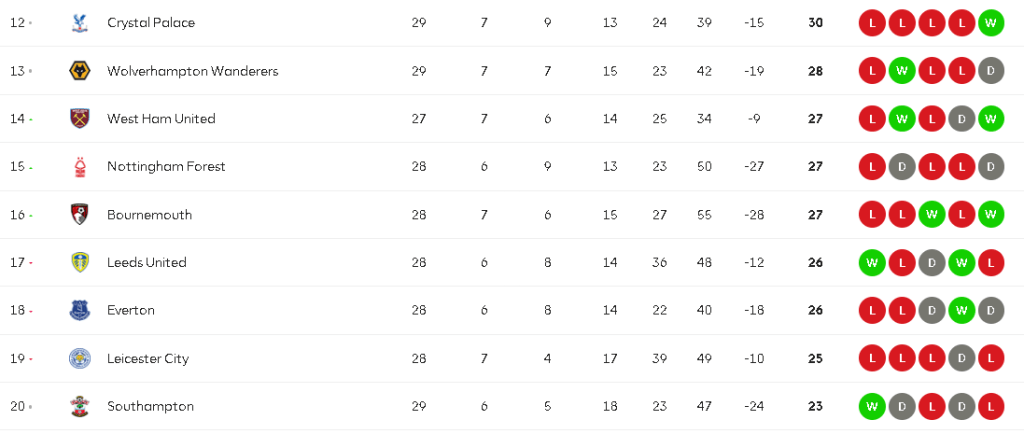
The League Table Part 2: Let’s Not Get Relegated Lads
I’ve separated the table here, as Chelsea on 38 points, with the squad they have, SHOULD have no chance at relegation. Crystal Palace on the other hand, are sitting just 4 points clear of the relegation zone, with an extra game played over the teams on the verge. Add in yet another sacked manager in Patrick Viera, and Crystal Palace are a large unknown. We could see a resurgence into the top half of the table, or a further collapse into a true relegation battle. Unsurprisingly, Palace are not the only team in this part of the table who have sacked their manager this season. In fact, only West Ham and Nottingham Forest of the remaining teams have not sacked a manager this season. I think both of these squads have shown enough to make me relatively confident (as confident as can be this season) that they will not be relegated. Gary O’Neil has done enough at Bournemouth following Scott Parker’s dismissal to earn a full-time contract, and with a 2-1 win over Fulham on the weekend, the Cherries should be looking away from the relegation zone come the end of the season. The teams I am most worried for are the ones who haven’t shown much promise, or ability to pick up points, against their fellow bottom-table teams. Sean Dyche should be the stabilizing presence Everton need to stay up this year, his debut win over Arsenal inspiring some belief in a club much in need of it this season.
Top 5 Picks for Relegation:
Southampton: this is no hot take, the Saints have caused their fans to lose faith this year, with multiple managers being sacked, and utterly uninspiring displays every week. (Only a depressed Spurs team could give them a point)
Leicester City: This makes me sad to write, as I’ve always been a fan of Leicester constantly pushing the “Big 6” year after year, and giving us possibly the best underdog story in sports history. This season, the Foxes have lost their bite, and have recently dismissed long-standing manager Brendan Rogers. The story is set for the new manager to save Leicester from relegation and start a new legend at the club, but only time will tell. Optimism is great, but points on the table are better.
Leeds United: Firing Jesse Marsch immediately after backing him in the transfer market and bringing in US international Weston McKinnie seemed… impulsive. Especially when Leeds were clearly underperforming their expected attacking output most games, and Patrick Bamford having been sidelined for large portions of the season. The appointment of Javi Gracia was slightly unexpected, and the Spaniard will have his work cut out for him to keep Leeds in the Premier League this season.
Wolverhampton Wanderers: Wait, buying as many Portuguese players as possible doesn’t automatically win titles? Someone tell Wolves please. Jokes aside, bringing in Julen Lopetegui was a rational decision, and I believe he’s shown enough promise to keep the Molineux side up, but a run of bad results could prove fatal to Wolverhampton’s aspirations of remaining a top-flight club.
Crystal Palace: Like with Leicester, it would be hard to imagine the Premier League without Crystal Palace, who have been a mainstay since the 2013/14 season. Viera’s high intensity pressing style got decent results early on in the season, but following the world cup break, the intensity out of possession never returned to the early-season levels. Following Viera’s departure, Palace are a team lacking an identity, which can be a disastrous flaw to have when fighting for survival in the Premier League. I believe the top 3 teams on this list are much more likely to be relegated than the final 2 options, but as this season has shown us, the Premier League is as unpredictable as ever (and no manager’s job is safe).
That’ll be all for today, if you’ve made it this far, thanks for reading! I hope you found something interesting here, and be sure to check back in for more articles coming soon!







 futbird