-
Euro 2024 Preview

Auf Wiedersehen, football fans! It is the eve of the summer tournament hosted by Germany, the 2024 Euros. Now I’m sure everyone reading this knows at least a little bit about the England, France, Germany, and Portugal squads that I would consider favorites to win this tournament. What about the other 20 squads competing for Europe’s greatest international prize, and does anyone else have a good chance to win the whole thing? I wanted to take a brief look at each squad today and give my prediction on how far they could “realistically” go. Realistically is in quotation marks because as we all know, this is football and anything can happen! So for example, if I say a country’s realistic best finish would be a Round of 16 exit, that does not mean I do not think they have any chance to win the tournament but rather that I think it would be a surprise if they were to advance further. With that said, let’s get right into it.
Group A: Germany, Scotland, Hungary, Switzerland
We start with the host nation Germany and Group A. Under Julian Nagelsmann, I expect to see Germany use a 4-2-3-1 formation. Ever-present German international Joshua Kimmich will likely start at RB, with a CB pairing of Antonio Rudiger and Jonathan Tah alongside Stuttgart LB Maximilian Mittelstaedt, who is coming off a very strong Bundesliga season. A double pivot in midfield of Robert Andrich and Toni Kroos seems to be Nagelsmann’s preferred duo to start, with Jamal Musiala, Ilkay Gundogan, and Florian Wirtz set up behind striker Kai Havertz. Florian Wirtz is likely to play as a left winger on the team sheet, which is a departure from his usual #10 role at Leverkusen, however the fluidity of this front 4 means that Wirtz will be able to drift inside of the pitch to form a 4 man midfield alongside Gundogan, allowing for overlapping runs from Mittelstaedt and for Jamal Musiala to drive forward from the right wing more. Germany should top this group unless a shock result happens, and I believe they have the talent to go all the way. The home crowd behind them will surely be a massive boost to the players who will be very motivated to bring home their first Euro championship since 1996.
Realistic Best Possible Finish: Winners
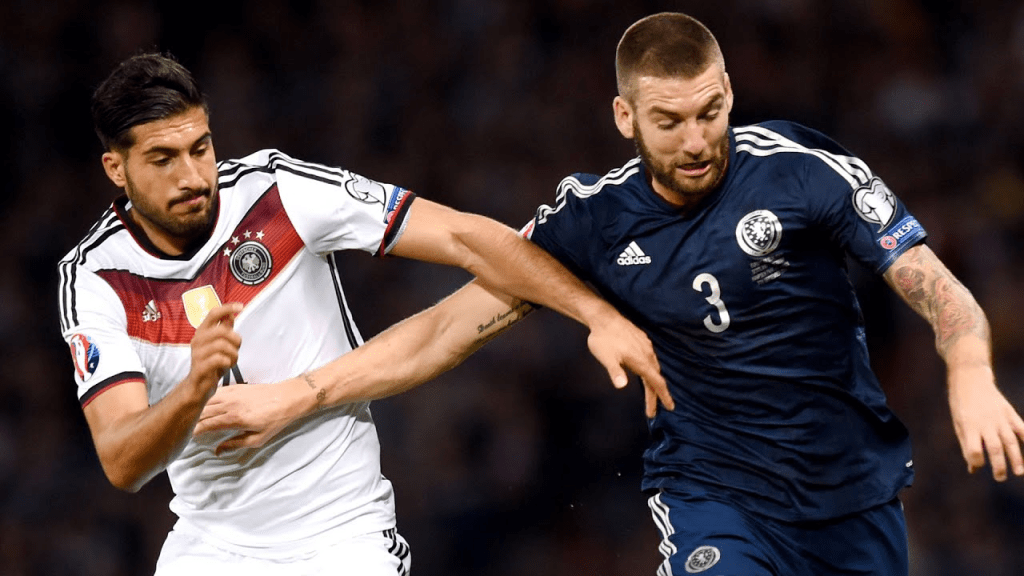
Scotland and their Tartan Army will be bringing all of the good vibes to Germany this summer, with the travelling fanbase being one of the most welcomed at international tournaments due to their passion. Scotland manager Steve Clarke may well have a few tricks up his sleeve, and he will need to in order to get the best out of his star players. Scotland have two standout left-backs in Andrew Robertson (who will be captaining the side) and Kieran Tierney. John McGinn will be asked to play a big role all over the pitch, while we may see Scott McTominay deployed in the most Libero of Libero roles. Clarke has experimented with McTominay playing as a right sided CB in a back 3, with full license to roam upfield and crash the box in attack. We are likely looking at a 5-4-1 formation, with Billy Gilmour and Celtic’s Callum McGregor as a midfield pair to provide stability while McGinn and McTominay roam around the pitch. While not guarantees to make it out of this group, I do believe Scotland can qualify for the Round of 16 if they bring their best football, but find it difficult to see them making it too much further into the knockouts
Realistic Best Possible Finish: Round of 16
The Hungarian side is also a bit of a tough prediction. On one hand, they have an aging defence, anchored by Leipzig man Willi Orban, and Omonia Nicosia defender Adam Lang, both 31 years of age. On the other hand, they have a very competent attacking trio who will set up narrowly in this 3-4-2-1 formation, with Liverpool star man Dominik Szoboszlai and Freiburg’s Rolland Sallai in the 10 positions behind Ferencvaros striker Barnabas Varga. Young Milos Kerkez, playing at AFC Bournemouth, will play an important role for this Hungarian squad out wide, being asked to contribute on both ends of the pitch. This Hungary side also have a good amount of young talent coming off the bench, with the chance to change the game with their energy and make their mark on the international stage. I believe Hungary should be favorites to finish 2nd behind Germany in this group, but if not will likely advance as one of the top 4 third place teams. If they advance and get a favorable matchup in the Round of 16, there is every chance they can win a knockout match.
Realistic Best Possible Finish: Quarter-finals
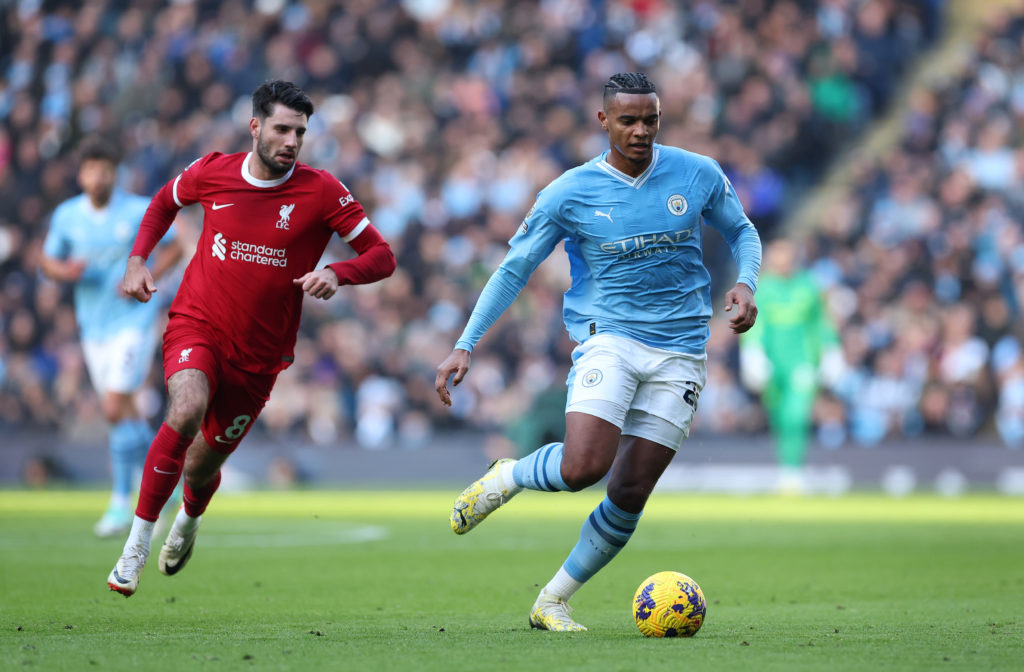
Finally we come to Switzerland. Just like Mexico keeper Memo Ochoa, who seems to come out from hiding every time the World Cup rolls around, Xherdan Shaqiri always seems to bring his absolute best form to the Swiss national team at the Euros. Expect the Swiss to also line up in a 3-4-2-1 formation. Granit Xhaka, fresh off a Bundesliga title-winning season at Leverkusen, will anchor the Swiss midfield alongside Bologna’s Remo Freuler. Manuel Akanji and Ricardo Rodriguez with his 115 caps will be at the centre of the backline providing a strong defensive base. Young Burnley striker Zeki Amdouni is prepared to make his arrival on Europe’s biggest stage and will be hoping to provide the attacking punch his team needs, although he will be competing with Noah Okafor and Kwadwo Duah for this position. Young, highly rated defender Leonidas Stergiou is also primed to make his appearance partnering Akanji and Rodriguez in defence. I believe this Swiss team has a relatively low floor (could very well not progress from the group stage), but if they do progress to the knockouts they should not be taken lightly. Peril has come to those who have made that mistake in the past.
Realistic Best Possible Finish: Quarter-Finals
Group B: Spain, Croatia, Italy, Albania
We begin the chosen “Group of Death” with the Spanish. While the Spanish are again a bit of an unknown in terms of how they will deal with the best teams at this tournament having only played Andorra and Northern Ireland in the final 2 friendlies before the Euros begin, they certainly have the talent to go far. Alvaro Morata will captain the side and start up front, most likely alongside Lamine Yamal and Nico Williams. Lamine and Nico are one of the most exciting winger duos to watch at this tournament, having both had standout seasons at Barcelona and Athletic Club Bilbao respectively. They will play in front of what is a very strong midfield with Pedri and Fabian Ruiz playing in front of Rodri, the best defensive midfielder in the world right now (and I don’t think there is much debate about that). Defence is where Spain’s weakness might lie. The experience of UCL winners Dani Carvajal and Nacho Fernandez will certainly be a big boost, the latter likely to start at CB alongside Ben Le Normand. Alejandro Grimaldo, who might just have been the best performing LB in Europe this season at Leverkusen (10 goals and 13 assists in the Bundesliga for the champions), should start at LB with Marc Cucurella as his backup. Surprisingly, Pedro Porro did not make Luis de la Fuente’s final Euro squad after a stellar season for Spurs, leaving the aging Carvajal and the already aged Jesus Navas as RB options. However, de la Fuente has experimented with Atletico’s Marcos Llorente at RB, who is naturally a midfielder but is extremely versatile in all parts of the game. Through midfield and attack, Spain have very solid depth which may help them gain an edge late in close matches. The likes of Dani Olmo, Alex Baena, Mikel Merino, Martin Zubimendi, Ferran Torres and Fermin Lopez are all available for de la Fuente to call upon. Overall the weakness of this Spain team may be as it has been in past years, a true goal threat at striker. Alvaro Morata is no bad player just to be clear, but we have often seen Spanish sides dominate possession in the opposition’s final third without being able to convert that dominance into goals. If Spain can produce balanced scoring from midfield and wing, they could go all the way.
Realistic Best Possible Finish: Winners
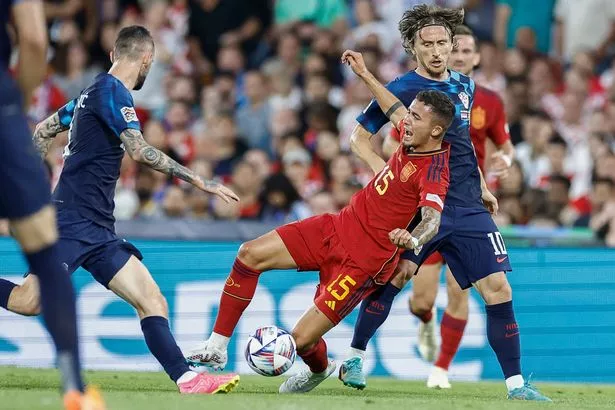
Forgive me if I sound emotional when talking about Croatia, as this is almost certainly the last international tournament for Croatian legend Luka Modric. The motivation to make the most of this tournament will be strong amongst the Croatian side, with a very strong team throughout ready to punch above their weight yet again. While I am unsure what Zlatko Dalic’s exact starting lineup will be for their first game of the Euros, there are some positions I can expect to know the starters ahead of time. The midfield will most likely be Modric and Kovacic on either side of Marcelo Brozovic, with the next generation of Croatian midfielders ready to be called upon in needed. Luka Sucic and Martin Baturina will make their first major tournament appearances, with Sucic having been touted as Modric’s successor in the national team for a few years now. Josip Stanisic and Josko Gvardiol will most likely start at either full-back position having both enjoyed very strong seasons at club level this year. There is a strong veteran cast to select from at forward, with the likes of Andre Kramaric, Ante Budimir, Lovro Majer, and Ivan Perisic available. Having made it to the finals of the UEFA Nations League last summer, only losing out to Spain on penalty kicks, there is every reason to believe that this Croatia team is still built for knockout games in international tournaments. I would not be surprised to see them knock out a tournament favorite in the quarterfinals, although I would be surprised to see them win the entire tournament (but not disappointed).
Realistic Best Possible Finish: Finalists
Then on to the Azzurri, who are not widely considered favorites to win this Euros, but have often performed at their best in such circumstances. An injury issue has come up late for Luciano Spalletti, with Giorgio Scalvini, Francesco Acerbi and Nicolo Fagioli all picking up injuries in the leadup to the tournament. Scalvini and Acerbi will miss the entire tournament, while Fagioli is confirmed to be out for the first match against Albania. That being said, Italy still have a strong squad and should be considered one of the best-of-the-rest, in the sense that they are not a tournament favorite. Expect to see a starting lineup of Donnarumma in net, a back 3 of Darmian, Buongiorno and Bastoni, di Lorenzo and diMarco at wingbacks on either side of Jorghino and Barella, with Federico Chiesa and Pellegrini/Frattesi behind Scamacca up top. Spalletti looks to be choosing a 3-4-2-1 formation that most of his players will be comfortable in rather than using his 4-3-3 tactics that worked so well for him at Napoli. I believe that the Azzurri will only have a better chance at surprising everyone by taking home the trophy because they do not have the pressure of being a tournament favorite on them. I expect them to qualify from this group without much worry, and have the potential to make a deep knockout run. We should not be utterly shocked if Italy do go on to win this years tournament, although I am not saying that is the most likely outcome.
Realistic Best Possible Finish: Winners
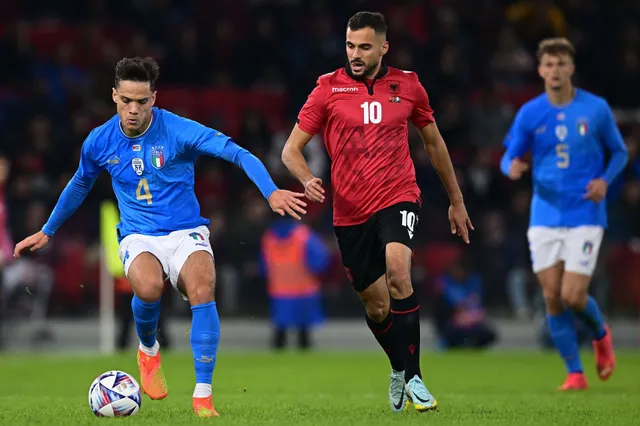
Finally we come to Albania. This is truly a case of poor luck, as they have been drawn into the toughest group they could have imagined. Albania was in great form in Euro qualifiers, topping their qualification group over the lies of Czechia and Poland. They have not had their chance to test themselves vs one of Europe’s best teams yet though, with pre-euro friendlies against Liechtenstein and Azerbaijan to prepare them for the tournament. It is no disrespect to the Albanian side to say that they are almost certainly going to finish last in this group, despite having some decent talent with the likes of Armando Broja, Kristjan Asllani, and Berat Djimsiti in the squad. I only hope to see Albania score some goals in this group (hopefully the first goal of the game to put some nerves onto their opposition) and give their travelling fans something to celebrate.
Realistic Best Possible Finish: Out in Group Stage
Group C: Denmark, England, Serbia, Slovenia
Let’s start Group C by taking a look at the Denmark squad, who are returning several players from their Euro 2020 semi-final appearance. Kasper Schmeichel is still going strong at age 37 and will be backstopping this Danish team yet again. Bright fullback talents Alexander Bah (Benfica) and Victor Kristiansen (Bologna) will play alongside Joachim Andersen and Jannik Vestergaard/Simon Kjaer in defence. Captain Pierre-Emile Hojbjerg has a very active role in this Danish team, especially in attack where he moves up the pitch much more often than he does at club level for Spurs. Alongside Hojbjerg in midfield will be Sporting CP standout Morten Hjulmand, who offers great defensive workrate alongside progressive passing. The third member of this midfield is most likely to either be Andreas Christensen in a holding role, allowing Hojbjerg and Hjulmand to move further up the pitch, or Christian Eriksen in a 10 role, with the double pivot covering more defensive ground. Young Manchester United striker Rasmus Hojlund will lead the line, accompanied by Andreas Skov-Olsen and Mikkel Damsgaard. Expect to see the likes of Jonas Wind, Thomas Delaney, Joachim Maehle, Kasper Dolberg, and Yussuf Poulsen feature prominently as well for Kasper Hjulmand’s squad. I believe the Danes should be favorites for a top 2 spot in this group securing them automatic qualification for the Round of 16, but from there it all depends on the draw. An unfavourable draw could see them up against it to qualify for the Quarter-Finals, but avoiding one of the giants in the first knockout round could see this team have another shot at making it as far as a semi-final.
Realistic Best Possible Finish: Quarter-Finals
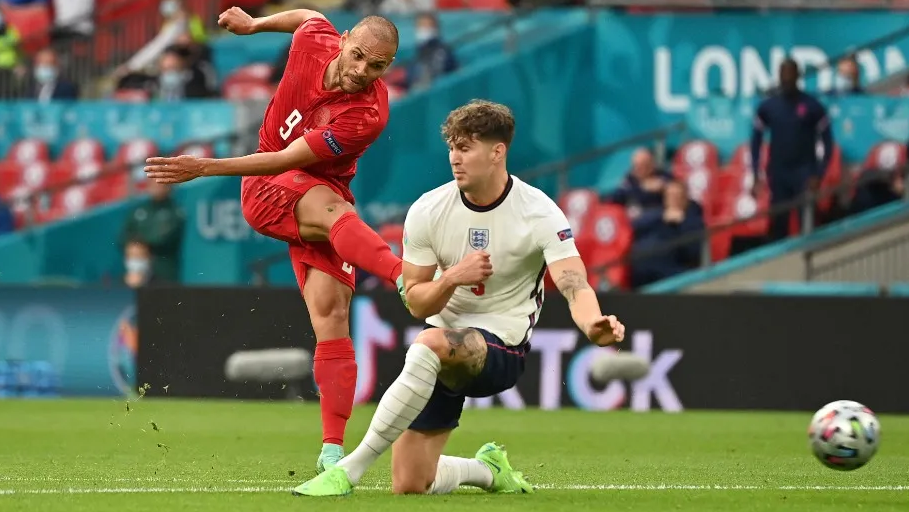
England. Oh England, what to expect from you? With arguably the most talented player pool to pick from this year, England are considered strong favorites to win this year’s Euros. That being said, Gareth Southgate is still Gareth Southgate, who has struggled to make the most of this “golden generation” of England players, with his best result being the Euro 2020 final where they memorably lost to Italy at Wembley, on penalties. Criticism can be made of Southgates squad selection and tactics, especially in the biggest matches where he often opts to play very defensive. The notable absences of Jarrad Branthwaite, Jack Grealish and James Maddison could prove to be hurtful to England’s chances in international play, where they are much more likely to come across a strong defensive side than one that is willing to press them high up the pitch (which would benefit England). Several young faces are making their first appearance at a major tournament for England including Adam Wharton, Kobbie Mainoo, and Eberechi Eze. I think England is most set up to struggle against Serbia due to the way the Serbians will set up. Expect to see a 4-2-3-1, with Pickford starting in net, Walker, Stones, Guehi, and Trippier across the defensive line, Trent Alexander-Arnold partnering Declan Rice in midfield, with Jude Bellingham being the offensive focal point as the 10. Harry Kane is obviously going to be the starting striker, leaving the most uncertainty around the wing positions. When playing with 2 wingers who like to cut inside and drop deep to receive the ball, this can play into the hands of a team setup to defend their box with numbers and crowd the middle of the pitch (like Serbia). Will we see Phil Foden on the left and Bukayo Saka on the right, or will Eze, Gordon, or Cole Palmer get a start? This I cannot answer, but England should be favorites to top this group. How far they can go? Well that’s up to Southgate.
Realistic Best Possible Finish: Winners
Now for Serbia, who I definitely think can progress from this group, either in 2nd place over the Danes or as one of the best 4 third placed teams. Specifically, I believe their match against England will be a very tactically interesting match. Serbia are likely to set up in a 5-3-2, with a very strong strike duo of Dusan Vlahovic and Aleksandr Mitrovic. For games against teams that are considered favorites, this will mean 8 players defending around the edge of their box, stacking the middle of the pitch and making it extremely difficult to play through Serbia with some quick one touch passing. When they win the ball back, Serbia will rely on support in attack from their wingbacks. On the left side this will be one of two Filip’s, either Kostic (Juventus) or Mladenovic (Panathanaikos). On the right this should be Dusan Tadic or or PAOK’s Andrija Zivkovic. The midfield 3 shouldn’t see more than 2 players join in attack, as they have a lot of defensive tendencies. There is enough talent in midfield to have solid depth options, and expect the Serbian team to defend as a unit in numbers. I think if the Serbs advance from this group (which I expect them to) they will provide a very difficult challenge for any team to face them in the Round of 16. It was not so long ago that we saw Neymar completely taken out of the game by this Serbian defence in the last World Cup. If there is one thing you can expect from this Serbian team, it is effort. They will leave everything on the pitch and should make this group’s qualification race quite interesting. I expect England to struggle the most against this side, and the game with Denmark should also be a tight contest.
Realistic Best Possible Finish: Quarter-Finals
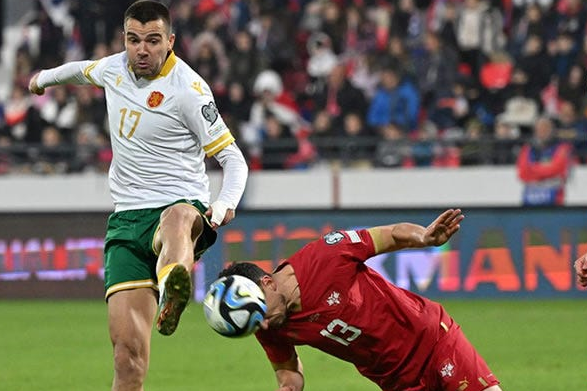
Finally to Slovenia, the last team in this group. They are also, barring any shock results or truly all-time performances from Benjamin Sesko, likely to finish last in the group table. It is no disrespect to the Slovenes, who have done brilliantly to qualify for this tournament. They have alternated between using a 4-4-2 during the Euro qualifiers, to a 4-3-3 formation in the most recent friendlies. A useful data point for the predictions were Slovenia’s matches in qualifying vs Denmark, their group-mates here. Those ties ended 1-1 in Slovenia, and 2-1 to Denmark in Copenhagen, showing that this (potentially unknown to many) Slovenia side is no pushover. This is in great part due to the their keeper, Jan Oblak. Oblak is approaching his 10th season at Atletico Madrid, and has accumulated 333 appearances for Diego Simeone’s men in his career at the highest level, as well as 65 caps for his national team. Slovenia’s lack of appearances at major international tournaments is the only reason Oblak does not have more caps, as he has been a nailed on starter in net for over 10 years now. A strong goalkeeper can win you games, or at the very least prevent you from losing them. Oblak will be protected by standout defender Jaka Bijol, who at age 25 has already earned 49 caps for Slovenia, and currently plies his trade at Udinese in Serie A. The rest of the defence is well experienced for the national team but perhaps lacks that bit of quality that comes from not playing at the top level of European football. Erik Janza at LB currently plays for Polish side Gornik Zabrze, Bijol will be partnered at CB with likely either Vanja Drkusic or David Brekalo, who play in Russia and the MLS, respectively. Right-back Zan Karnicik has spent most of his career playing domestically in Slovenia. In the 4-3-3, the midfield will be comprised of Jasmin Kurtic, Tomi Horvat, and Adam Gnezda Cerin to start matches, which follows the trend of lesser known names but a strong blend of experience and youth, with 129 NT caps between these three. Kurtic is the veteran presence in midfield, having earned 91 of those caps himself. On the wings, Andraz Sporar and Jan Mlakar will likely line up on either side of Slovenia’s starboy, Benjamin Sesko. The RB Leipzig striker has scored 14 goals in his first season in the German Bundesliga after playing for Austrian Red Bull side Salzburg beforehand, and was wanted by many of europe’s biggest clubs (with the most interest from Arsenal) before he re-signed at Leipzig, committing to at least one more year in Germany. He is a strong all-around striker, equally adept at finishing in the air or on the ground. Slovenia will heavily rely on Sesko to be clinical if they are to realize their dreams of making it out of this group. I must give a shoutout to my favorite club, Bodo/Glimt’s only representative at this tournament (thanks to Norway not qualifying), Nino Zugelj! After significantly upping his game this season for the Norwegian champs, Zugelj received his first national team cap in the leadup to this tournament, and has been selected in the final squad. He will be looking to change the game off the bench at the RW position if called upon. In short, this team is Jan Oblak, Benjamin Sesko, and several industrious players to play between them. Slovenia will not be an easy game for any team in this group, but chances are they could fail to win a match in this group stage and see an early exit. However, I won’t count them out right away, as in a 3 match group stage, 1 win could mean everything to qualification.
Realistic Best Possible Finish: Round of 16
Group D: Poland, Netherlands, Austria, France
To start off with Group D, I will be looking at the team that likely has the worst chances of qualifying from the group: Poland. After having been touted as a tournament dark horse for much of the past decade and failing to deliver on that promise, Poland’s key players are approaching the ends of their career, and with a late injury picked up by Robert Lewandowski, they will have a mountain of a challenge to qualify from the group. Wojciech Szczesny, now age 34, is still between the sticks for Poland, and he will likely have either a 5-2-3 or 5-3-2 in front of him for this tournament. There is not an absence of young talent in this squad however, with the next generation of Polish players having made their way into the senior team. The standout player of this generation of players has to be Roma’s Nicola Zalewski, who will play as a LWB in this setup, but also can play up front as a LW. Brighton’s Jakub Moder will be looking to be called upon in midfield, and Arsenal’s Jakub Kiwior is already a nailed on starter at the LCB position. Poland should be difficult to break down in defense, but the real question lies in where their goals will come from, especially if they are without record goalscorer Robert Lewandowski for the entire group stage. Being in the same group as France and the Netherlands, alongside a very underrated Austria side will make the Polish task difficult. They have the talent to take a result against any team, but likely can not be relied upon to do so. While it is not impossible for Poland to qualify from the group, it is also not impossible that they finish with 0 points from this group stage. I find it hard to see Poland qualifying from the group, and if they do harder to see them winning a knockout stage game. The Polish faithful will be praying for Lewandowski’s return as early as possible.
Realistic Best Possible Finish: Out in Group Stage
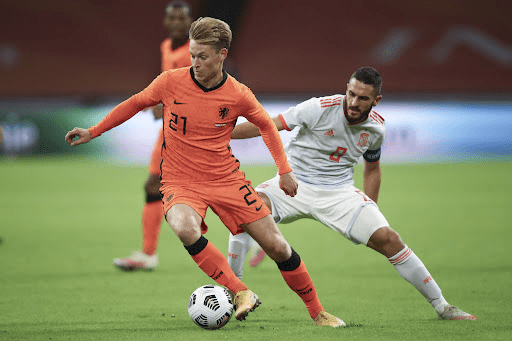
Onto the “Oranje”, Ronald Koeman’s contingent from the Netherlands. They suffered two major injuries in the lead up to the Euro’s opening matches in their midfield, with standout performers Frenkie de Jong and Teun Koopmeiners both out for the tournament. The Dutch have a vast player pool to select from, and both Ian Maatsen and Joshua Zirkzee have been called up to fill the vacant spaces in the team. Given the midfield injuries, I would expect to see the Dutch play a 4-2-3-1 formation, allowing their attacking talent to fill the space left by the midfield losses. Alternatively, Koeman may use a 3-4-2-1 formation. In classic Netherlands fashion, there is a wealth of CB talent available, and we will likely see a CB playing at LB in this team. Nathan Ake would be the first choice here, with young Spurs star Micky van de Ven ready to offer his blistering pace when Ake begins to tire in a match. Denzel Dumfries offers impressive output at both ends of the pitch at RB, and will likely be backed up by versatile Feyenoord defender Lutsharel Geertruida. Virgil van Dijk and Stefan de Vrij will likely start at CB, with Matthijs de Light and Daley Blind offering cover. In midfield, Ryan Gravenberch will be asked to carry a lot of the load now, and will likely be partnered by one of the PSV duo of Schouten or Veerman. In attack, the Dutch have strong depth, and we are likely to see Leipzig star Xavi Simons at the heart of it as the 10. Leverkusen RWB Jeremie Frimpong will play up front as a RW, with Cody Gakpo taking a left inside forward role behind Memphis Depay. If no further injuries occur, this Dutch team definitely has the talent to go all the way, but like always it depends on the knockout round draw. Expect the match between France and the Netherlands to be the highlight of this group featuring a plethora of very good footballers.
Realistic Best Possible Finish: Winners
Ralf Ragnick has transformed this Austria team into what can only be described as a team greater than the sum of its parts. His high pressing philosophy is well suited to this Austria side, and even without star defender David Alaba, will present an unwelcome challenge to any opponents. Experienced striker Marko Arnautovic leads the line, supported by a wealth of young talent in attacking midfield behind him: Patrick Wimmer, Christoph Baumgartner, and Roman Schmid were all selected for Austria’s pre-tournament friendly win over Serbia, with all 3 being 24 years of age or younger. Nicolas Seiwald adds to this trend from midfield, providing a creative spark. Seiwald should be partnered by veteran Konrad Laimer to provide a good balance for their double pivot. In defence, Ragnick has not given much away in terms of his selection, using two entirely different back 4 combinations in the two pre-tournament friendlies. The goalkeeper selection is also uncertain, with Heinz Lindner and Patrick Pentz are the more established keepers, while young Niklas Hedl (Football Manager addicts like myself will recognize that name), is the future of the Austrian national team in net and might just make an appearance at this tournament. If everything clicks, this Austrian team will at worst be a team no favourite will want to be drawn against in the knockoutst, and at best could make a strong run at this summer’s Euros.
Realistic Best Possible Finish: Semi-Finals
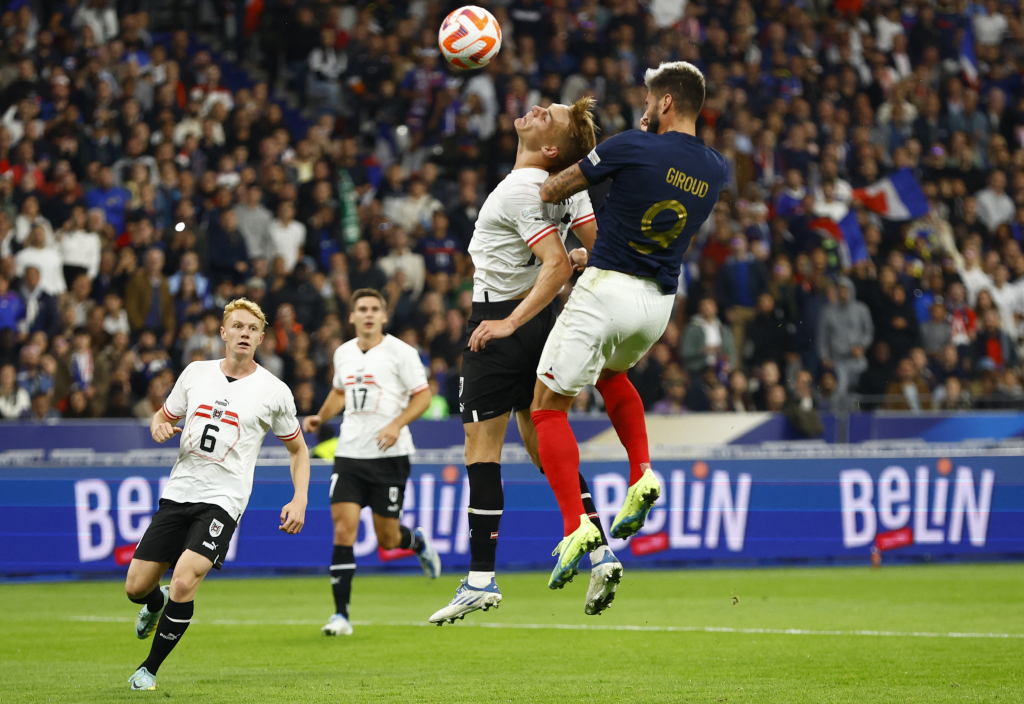
Finally, France. I probably have the least insight to offer here, as this French team is very well known, having won the 2018 World Cup and reached the finals of the 2022 World Cup. Didier Deschamps’s managerial credentials cannot be doubted, although perhaps his loyalty to his top performers of past tournaments may start to affect the peak this France team can achieve in the coming years. Ibrahima Konate will likely partner Dayot Upamecano at CB, despite William Saliba having become one of the best CB’s in the Premier League. Jules Kounde and Theo Hernandez are pretty nailed-on as starters at the fullback positions, but now for my favorite part of France’s team this year: N’GOLO N’GOLO, KANTE! The constantly smiling French midfielder makes his return to the national team for this year’s Euros as perhaps the biggest surprise of Deschamps team selection. France and neutral fans alike had no complaints, as we all love seeing Kante on the pitch. Kante, Camavinga, Youssouf Fofana, and young PSG star Warren Zaire-Emery are the players competing for the two midfield places in this team, and I would expect Deschamps to default to experience, starting Kante and Camavinga until shown a reason not to. Ousmane Dembele, Antoine Griezmann, Kylian Mbappe and Olivier Giroud will make up the attacking quartet, with a wealth of talent off the bench. Bradley Barcola, Randal Kolo-Muani, Kingsley Coman and Marcus Thuram are all available for Deschamps to call upon if needed. There’s no mincing words on this squad, they are arguably the strongest in the tournament, and if you include the manager in your assessment, they are very likely the strongest squad at this summer’s tournament. Nobody would be surprised if Mbappe and Co. take home the big prize.
Realistic Best Potential Finish: Winners
Group E: Belgium, Slovakia, Ukraine, Romania
This group offers a lot of unpredictability, which is my way of saying the favourites on paper (Belgium) have noticeable weaknesses. They’ve played 3 different formations in their most recent 3 matches, so it is hard to predict what will be used for their opening match vs Slovakia. Instead, lets look at the talent they have at their disposal. In attack, Romelu Lukaku or Lois Openda are the main two striker options, with Charles de Ketelaere as another choice. Jeremy Doku, Leandro Trossard, Johan Bakayoko and Yannick Carrasco offer support from the wings. Group E fullbacks will have their work cut out for them dealing with this group. Andre Onana and Kevin de Bruyne should both play prominent roles in midfield, with up and comers such as Arthur Vermeeren and Aster Vranckx joining the national team for this tournament. The weakness of the Belgium team is in defence: no Thibaut Courtois available due to injury, so Koen Casteels will start in net. Zeno Debast, the young Anderlecht defender with 8 caps by age 20, and Arthur Theate are the only defenders with reasonable pace in this side which is full of veterans in defence (while only 26, Wout Faes can hardly be described as pacey and has the pace of 37 year old Jan Vertonghen). Axel Witsel is still in the squad, while Thomas Meunier and Timothy Castagne make up the rest of the defensive options. Belgium will rely on a potent attack to outscore opponents, and will not pick up many clean sheets in this tournament I believe. However their attack is so good it should still give them the edge to finish first in this group, though I think any of three teams could top this group depending on how the group stage plays out.
Realistic Best Possible Finish: Semi-Finals
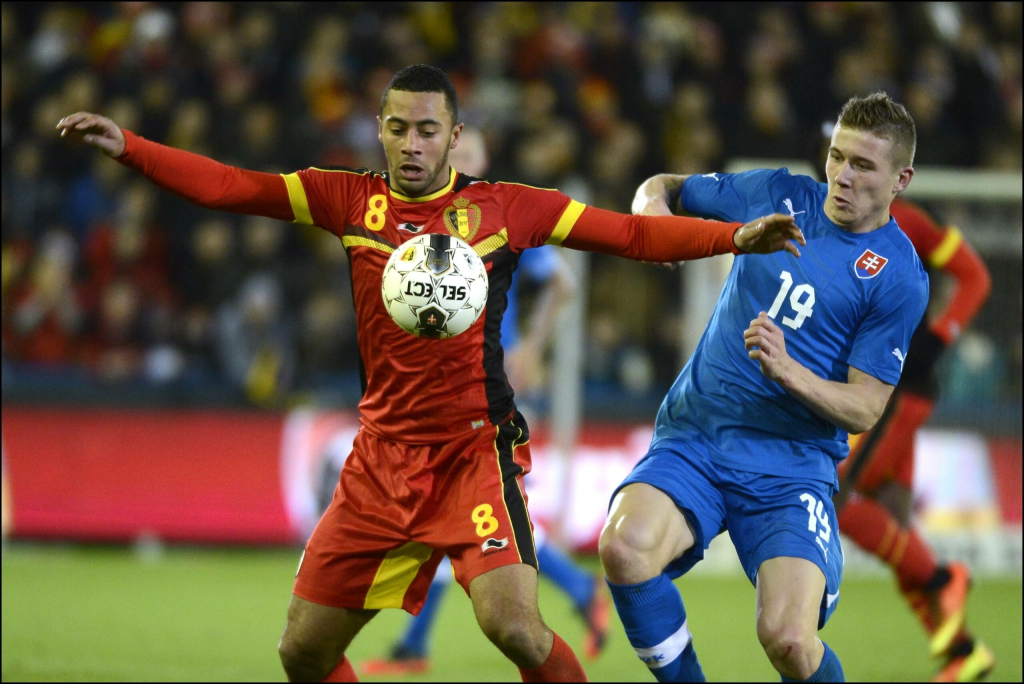
Before I begin discussing Slovakia, I should offer a disclaimer so you can decide whether what I say is in any way biased: I am Slovak-Canadian and am indescribably excited for Slovakia to begin their third ever Euro tournament with great optimism. HOWEVER, I’ll start off with the weaknesses of this slovak side to try to be unbiased. Aside from the retirement of possibly Slovakia’s greatest ever player Marek Hamsik (who joins this squad as the assistant coach), that weakness is scoring goals. In the lead-up to the Euro’s starting, Slovakia recorded back to back 4-0 wins over San Marino and Wales though. Given that those two teams are not the toughest competition in Europe, we should not overreact to the scoring, but Slovakia scored 17 goals and conceded 8 across the Euro qualifiers under Francesco Calzona, with half of the goals conceded coming to tournament favorites Portugal. In those two matches, only a goal separated Slovakia from Portugal, with a 1-0 loss in Bratislava followed by a thrilling 3-2 loss in Portugal. This bodes well for Slovakia’s ability to play against the best teams, as if it was their day both of those matches could’ve gone the other way. Slovakia likely have the best defence in this group, with Martin Dubravka in goal, and Milan Skriniar anchoring a defensive unit that should include Copenhagen CB Dennis Vavro, who has shown great ability on the ball in the lead-up to this tournament, and current active highest cap-holder Peter Pekarik at RB. Pekarik, 37 years old now, has amassed 127 caps for the Slovak national team and joins a defence full of experience. At LB, and for me the player who could potentially be Slovakia’s player of the tournament, is David Hancko. Hancko is a bit of a unicorn. Tall, physically strong, good pace and with great ability on the ball, Hancko is comfortable playing CB as well as LB, so he will offer defensive coverage as well as some beautifully whipped crosses into the box. The Slovak midfield 3 of Calzona’s 4-3-3 formation will be comprised of 234 national team caps between holding midfielder and Napoli man, Stanislav Lobotka, with Juraj Kucka and Ondrej Duda on either side of him. Keep an eye out for Slovakia on set-pieces, especially Duda’s deliveries. This is not bias but deserved praise when I say Duda’s corner delivery is better than many Premier League level players, able to put the ball in with pace and height to get past the first defender, before showing the ability to drop the ball right on the head of the first Slovak player at the near post. Excellent set piece delivery and having 3 CB-sized players in the backline makes for a dangerous recipe for defenders. Genk’s Patrik Hrosovsky and Hamburg’s Lazslo Benes will be the first options of the bench in midfield, with 21 year old Tomas Rigo potentially getting his first taste of major action. Up front young Boavista striker Robert Bozenik will start as the main man up front, with Sparta Prague’s Lukas Haraslin being a sure starter on the left wing. At right wing, Ivan Schranz is likely to start matches, where he often contributes just as much in tracking back and winning the ball as he does in attack which could be invaluable to a Slovak side that will not be able to be a possession dominant team in this tournament. 22 year old Tomas Suslov (Duda’s teammate at Hellas Verona in Italy) and David Duris are both solid options to be subbed on for Schranz. The one player in attack that I hope you all get the chance to see play is 18 year old Feyenoord winger Leo Sauer, who is without a doubt the best attacking prospect Slovakia has produced in my lifetime. Sauer moved to Feyenoord at 16 and became a regular squad player under (now Liverpool boss) Arne Slot this past season. In March, Sauer became the youngest ever player to play for the Slovak senior national team, and has his second cap from the recent pre-tournament friendlies. I believe the top 3 teams in this group will all have a chance to win the group and all 3 will advance to the knockouts, meaning a favourable knockout draw could see Slovakia surprise many. Realistically from what I’ve seen of the possible knockout matches, Slovakia will face a tournament favorite in the quarter-finals should they make it there, which I believe they absolutely have a solid chance to do.
Realistic Best Possible Finish: Quarter-Finals
Onto another potential surprise at this summer’s tournament: Ukraine. This is a very strong Ukraine squad and could be one of the 3 teams that I believe have a chance to come 1st in this group. Led by La Liga top scorer Artem Dovbyk up front, with his Girona teammate Viktor Tsygankov and Chelsea speedster Mykhailo Mudryk on the wings, the Ukraine attack is about as good as it has been in recent memory. Shakhtar Donetsk star midfielder Heorhiy Sudakov provides the vision and passing from the centre of the pitch. Several Premier League players populate the Ukrainian defence, with Vitaliy Mykolenko and Ilya Zabarnya sure to play prominent roles, while Arsenal’s Oleksandr Zinchenko is more likely to play as a holding midfielder. Real Madrid’s Andriy Lunin, fresh off backstopping Madrid to the Champions League final and La Liga title, will take the start between the sticks. Like the other top contenders from this group, there is a lot of unknowns. Whichever team of Belgium, Slovakia, or Ukraine brings their best form will likely finish 1st, while I believe all 3 will advance. Depending on the draw in the knockouts, I think it not impossible that Ukraine could win a knockout match as well, though I see it difficult for them to reach the semi-finals.
Realistic Best Possible Finish: Quarter-Finals
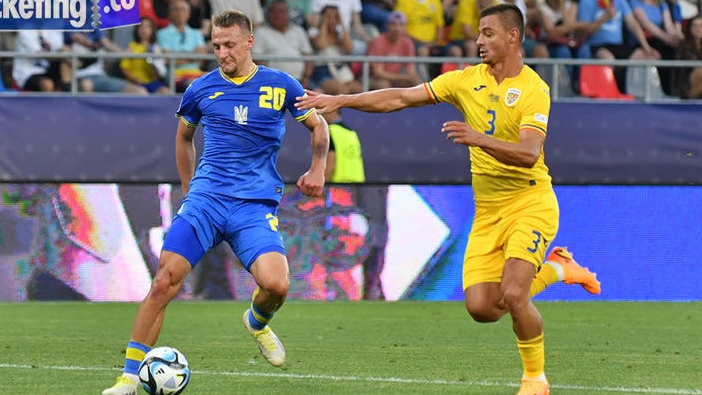
Finally, Romania, who seem the weakest team in this group by a fair margin, especially considering form coming into the tournament. The Romanians achieved a 1-0 victory over Switzerland in the final match of Euro qualifying, but since then in their friendlies before the tournament have drawn Northern Ireland, lost to Colombia, and had back to back 0-0 draws against Bulgaria and Liechtenstein. None of the European teams they drew against have qualified for this Euros, with Liechtenstein being the smallest European country outside of San Marino. It does not bode well for Romania’s chances to advance from this group. The star of this team is the 22 year old Spurs CB, Radu Dragusin. Captain Nicolae Stanciu and his 70 caps (active leader for Romania), will lead this side from an attacking midfield role, alongside Alaves midfielder Ianis Hagi, (yes, that’s Gheorghe Hagi’s son). The majority of this Romania squad plays their club football in Romania, Turkey, or the Italian Serie B. Lacking the same top-level talent as the other teams in this group, Romania could unfortunately end up without a point, while a draw is likely their best outcome from any of these matches. Dragusin is also the youngest player in this team and the only player younger than 24, so the experience of playing at this Euro’s will not benefit most of the younger generation of Romanian players who will be called upon in future years. Let’s hope they can give their passionate fans something to cheer for.
Realistic Best Possible Finish: Out in Group Stage
Group F: Turkey, Georgia, Portugal, Czechia
Time for the last group, Group F. This group should be relatively easy for a strong Portugal side to finish 1st in, while the 2nd place qualification spot is up for grabs.
Starting with Turkey, who have some talent on this team but do not look to be in the best form coming into the tournament, having not won a match since November 2023. A draw to Wales, losses to Hungary and Austria (the latter by a 6-1 scoreline), a draw to Italy and a loss to Poland in their last 5 matches do not give too much room for optimism, but this group still offers a decent chance to qualify if the Turks can turn it around. Led by youth at the front, either 18 year old Besiktas striker Semih Kilcsoy or 19 year old Juventus up-and-comer Kenan Yildiz will be called upon to bring the goals. I expect Kerem Akturkoglu, Orkun Kokcu, and Arda Guler to start behind the strikers in a 4-2-3-1 formation, which offers a good attacking punch. Turkey legend and captain Hakan Calhanoglu, who is still performing for Inter Milan at age 30, will offer the playmaking from the midfield while paired with Dortmund defensive midfielder Salih Ozcan. Recently in defence, the back 4 has been chosen with a defensive mindset, with Roma’s Zeki Celik (a CB/RB hybrid player) and Mert Muldur (also a CB), are playing at the fullback positions. Abdulkerim Bardakci is likely to start at CB, with his partner not seemingly set yet, but I think Samet Akaydin from Panathinaikos is likely to start. New Manchester United #2 keeper Altay Bayindir is likely to get the start, although Besiktas Mert Gunok could start if Vincenzo Montella prefers the veteran presence in net. If Turkey can perform against Czechia and Georgia, they are in with a solid chance of qualifying, though I doubt their credentials to go deep in this tournament.
Realistic Best Possible Finish: Round of 16
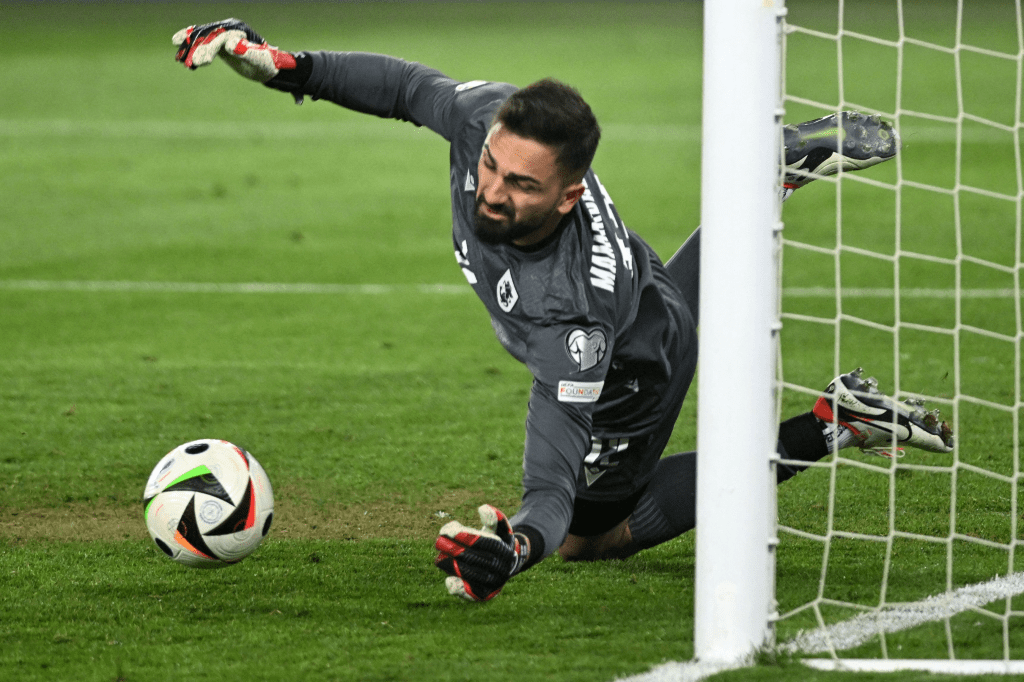
Next, to Georgia, who had to run the gauntlet to qualify for this year’s tournament after not securing automatic qualification from their group. A 2-0 win over Luxembourg and a dramatic penalty shootout win over Greece booked their tickets to Germany, with keeper Giorgi Mamardashvili becoming a national hero for his saves in that shootout. Mamardashvil is a top keeper in my opinion, and has had another solid season in La Liga with Valencia. Georgia is in ways similar to Slovenia: one of their best players is their keeper, and the other is a forward. That forward being Kvicha Kvaratskhelia, who has an impressive 15 goals in 30 caps while playing as a winger for the national team. If “Kvaradona”, as he is affectionately nicknamed by the Napoli faithful, can produce some magic in this group stage, there is no reason to believe Georgia cannot continue this dream run just one step further. Winning a knockout game will prove to be a very tough task if they do qualify.
Realistic Best Possible Finish: Round of 16
Onto a tournament favorite, Portugal. The greatest weakness of this Portugal team is honestly their manager. Roberto Martinez is one of the most successful managers in the world at failing upwards – after underperforming with Belgium’s “golden generation”, culminating in a massive fallout within the squad at the last World Cup, he has somehow landed the Portugal job. This is a case where the players may need to just ignore the manager and do what they know is best in games, as there is the talent to go all the way. Porto’s Diogo Costa, who is seen as the next big thing for European keepers, will start in net, finally getting the #1 spot over aging Rui Patricio. Portugal have switched between a 4 and 5 back formation in their 2 pre-tournament friendlies, with the back 5 being used to allow talented young defenders Antonio Silva and Goncalo Inacio to play alongside veteran Pepe, who looks an ageless wonder still able to perform at top level while 41 years old. Diogo Dalot, Joao Cancelo, and Nuno Mendes are all very strong wingback options. In midfield, there are several options to use, with Bruno Fernandes, Joao Neves, Joao Palhinha, and Vitinha being the major candidates to start (depending on formation). Bernardo Silva, Rafael Leao, Joao Felix and Goncalo Ramos are all candidates to start up front, with Cristiano Ronaldo likely to play a super-sub role in his final Euro tournament. This team has so much talent available to them, we should not be surprised if they do go all the way.
Realistic Best Possible Finish: Winners
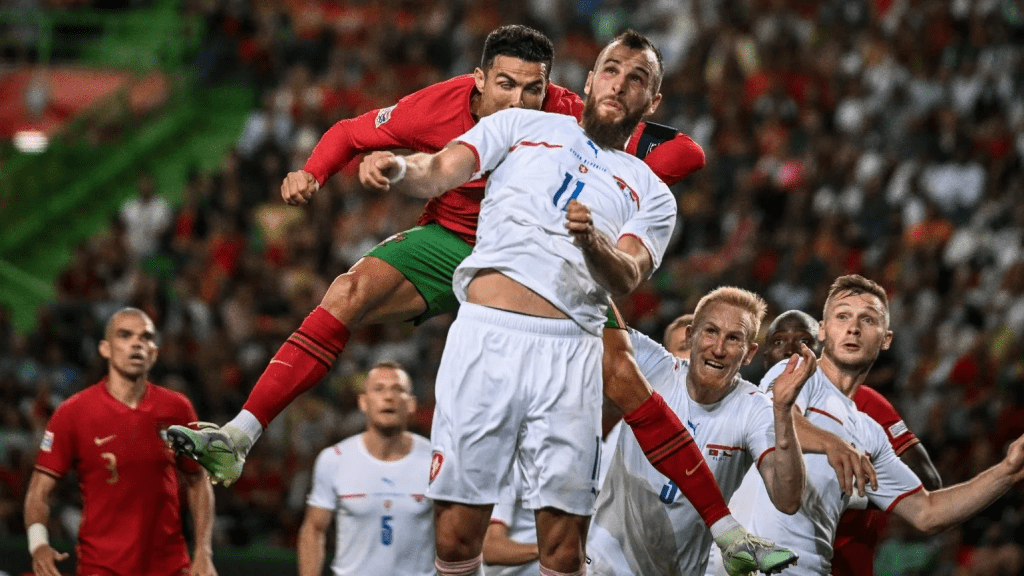
Finally we arrive at the Czech squad. This is a relatively weak Czech team compared to what we might’ve seen in Euro’s past, there are no Pavel Nevded’s in this year’s team. However, there is still some solid talent, with Leverkusen duo Adam Hlozek and Patrik Schick leading the attack. Fiorentina midfielder Antonin Barak adds quality to midfield alongside West Ham stalwart Tomas Soucek. Soucek’s teammate Vladimir Coufal offers veteran leadership in defence alongside some solid young talent. The player to watch for me is Sparta Prague midfielder Ladislav Krejci, who recently moved from CB to midfield at club level and has thrived in a tempo-controlling role. The Czechs can absolutely qualify from this group, but I find it tough to see a path far into the knockouts for them. A Round of 16 appearance will be seen as a success.
Realistic Best Possible Finish: Round of 16
-
Return of the Traditional #9
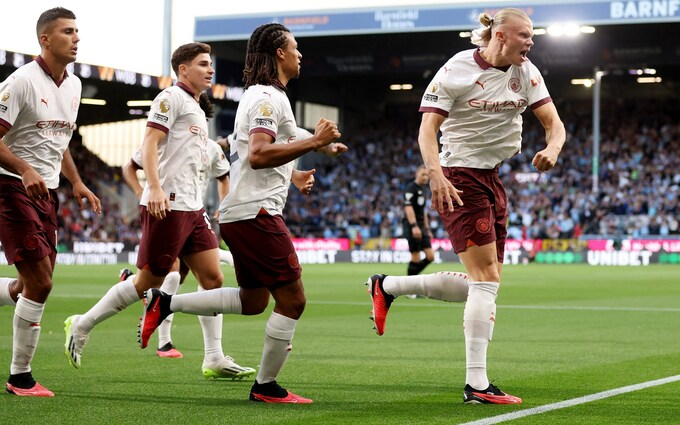
Hello again football fans,
This past season I noticed the further emergence, or re-emergence, of a tactical trend, and thought it would be worth a discussion. Across Europe, it seems as if the days of the False 9 are over for now, as many sides have reverted to using a more traditional out and out #9. Why is this the case? Have managers just gotten nostalgic for the “good old days” where a striker’s job was simply to put the ball in the back of the net and win aerial duels? Was Sean Dyche right all along? Why are playmaking #9’s less effective at Europe’s top level now? I believe there are several reasons for this.
Reason 1: Pressing
High-intensity pressing is the norm more than the exception now, especially in the Premier League. When Jurgen Klopp joined Liverpool nearly 10 years ago now in October 2015, he brought his “gegenpress” style to England, and at the time this was a unique approach. Many teams preferred to sit deeper in a mid or low block, and look to build counter attacking moves from their own half. Now, the value of winning the ball high up the pitch has become apparent: the closer to the opposition goal you win the ball, the less distance there is to cover to get to goal, and generally less offensive actions are required before a scoring chance is created. More and more modern managers are selecting this approach, whether they are a title challenger or a relegation-battling club. When teams press you high up the pitch, there are generally two options: try to play through the press, which risks turning the ball over close to your goal with more of your players committed up the pitch, or attempt a long ball to bypass the press entirely. While most teams prefer to play from the back (thanks Pep), having the outlet long ball pass be available is a handy “get out of jail free card” when under pressure. This is one reason why the traditional #9 is being used more. Erling Haaland at Manchester City is a prime example. Now this past season, Mikel Arteta adjusted his pressing approach vs City to not commit as many players forward to the press. He learned this lesson in Arsenal’s 4-1 defeat to City on April 26, 2023. Look how the first City goal was created:
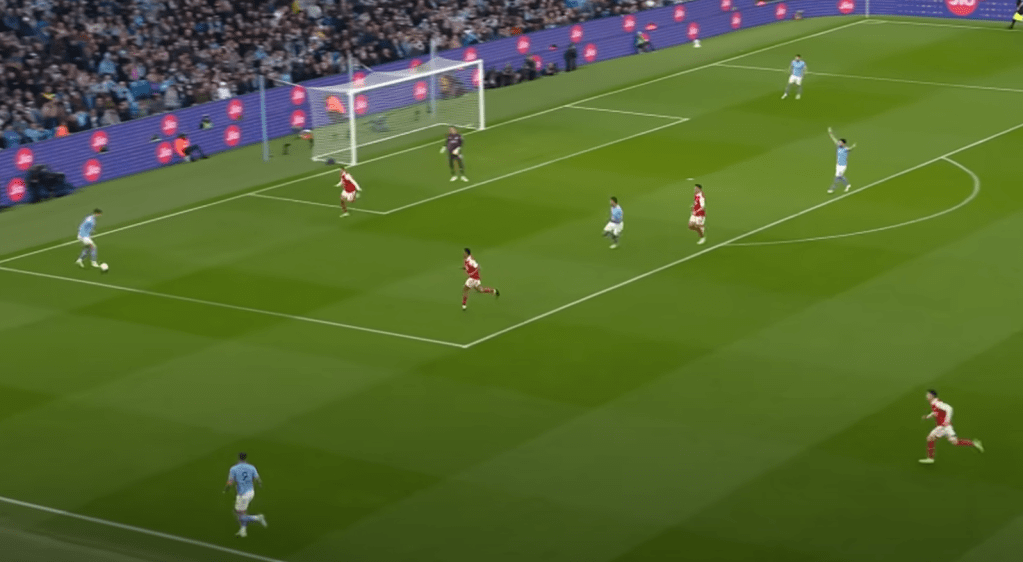
Ederson plays the ball out wide to John Stones, who is immediately under pressure from Martinelli and Jesus. He opts not to pass short to Walker, but waits until the Arsenal players close him down more, before opting for a long ball.
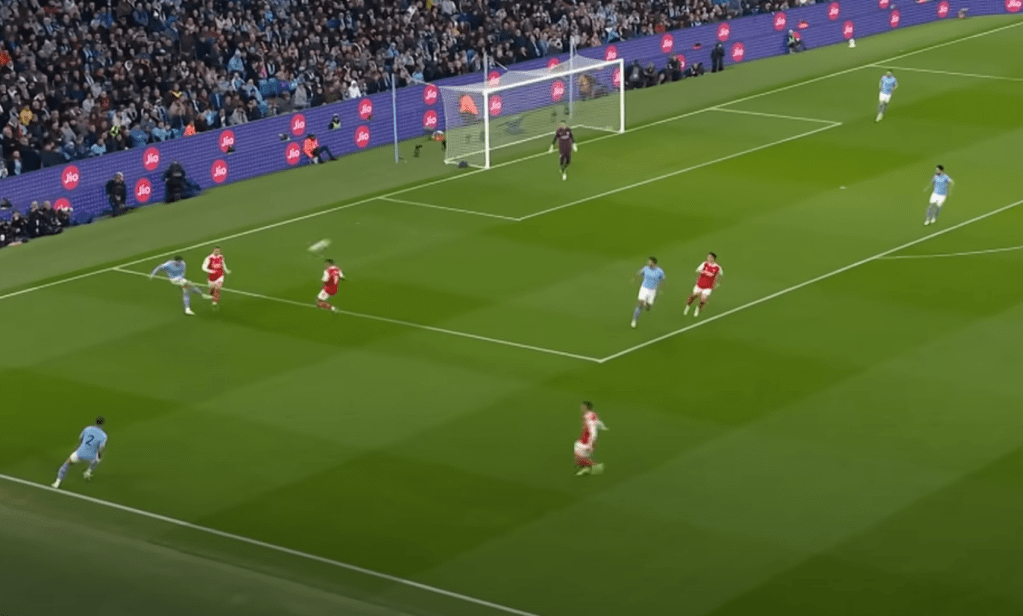
The target of this long ball? Erling Haaland of course. You can see how as the ball comes in to Haaland, he has gotten body positioning on Rob Holding and is able to control the ball down and make a pass to Kevin de Bruyne, who has slipped past Thomas Partey with his run through midfield:
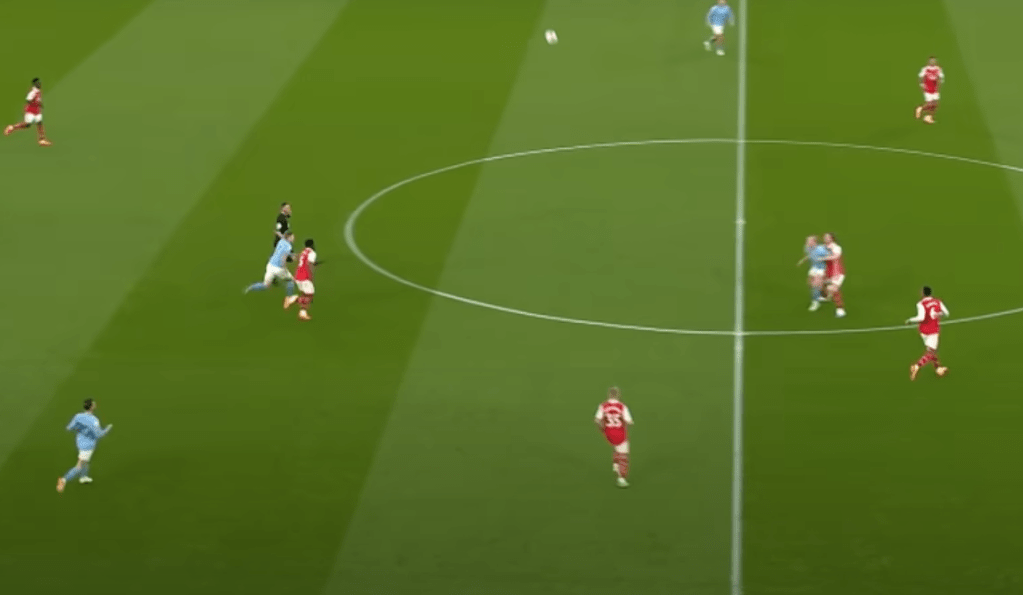
Seconds later, de Bruyne runs towards the edge of the box and unleashes a low strike into the bottom corner. 1-0 City.
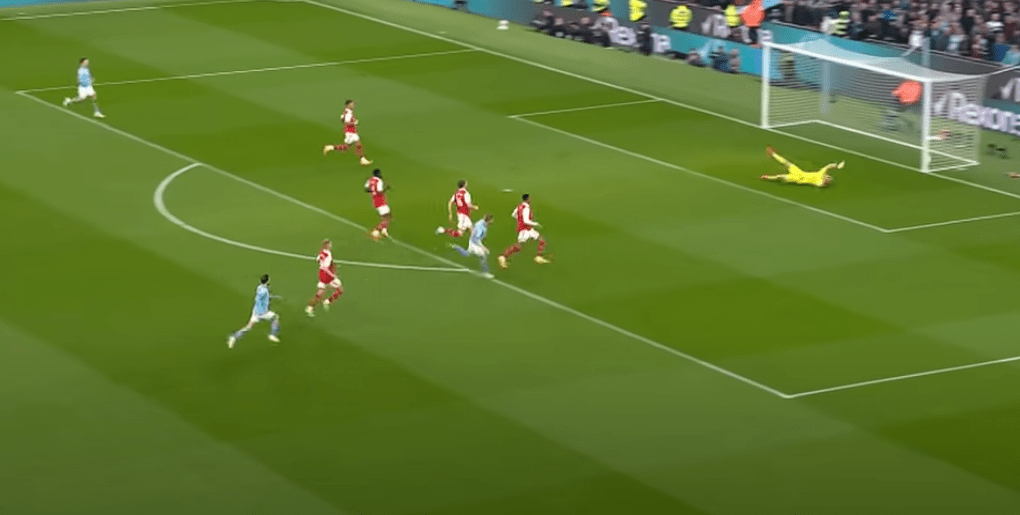
If Manchester City still had Gabriel Jesus, or even Sergio Aguero as the lone striker, they would be much less likely to win the aerial duel vs Arsenal’s CB and retain possession. Having the option to both play short through a press or send a long ball to the ST to hold possession, allowing midfielders to make supporting runs for a pass forward gives teams more unpredictability in their buildup, and forces the opposition to think twice about committing so many players forward to the press. This past season, Postecoglu’s Spurs encountered this difficulty, with Richarlison being their best forward equipped to perform this role. When he was not fit and Son Heung-Min played in the #9 role, there was a noticeable difference in Spurs’ ability to retain the ball when under high pressure in their own end of the pitch: teams could cover the short passing options, with some degree of confidence that a long ball towards their CB’s would be dealt with and the ball would be won back. Now I used this as an example because Son is clearly a world class player, but holding up the ball under physical challenges is not his biggest strength, one of the reasons he is more effective off the left wing. Having a physical striker able to win duels vs opposing CB’s offers a lifeline when the opposition is committing a lot of players up the pitch to press and at the same time, will offer more space to play out from the back, as the risk of the long ball needs to be considered by the defence before pressing.
Reason 2: Structured Defences
In current-day football, teams are more structured than ever and are well drilled defensively to protect their box when under attacking threat. Arsenal, one of the best teams in world football at the moment, have encountered the issue of not being able to convert extreme amounts of attacking threat to shots on goal and goals scored. They would frequently make several passes in the box before a shot attempt was taken, which allowed defenders to close them down, and any backtracking players to arrive in the box to help. With defences being as well organized as they are now, it is more imperative than ever to generate chances quickly, and take the opportunities when they present themselves instead of overpassing or trying to be too fancy dribbling around the box. This is the same reason why high-pressing has become so popular, it allows your team to get the ball in a good offensive position, with the least amount of opposition players in position to defend. So for this reason, having a physical striker who can operate at times like a pure poacher is more valuable than it has been in past years. Not to overuse Haaland as an example, but just think, how many times have you seen Haaland receive the ball in the box and try to make an extra pass, or dribble a defender before shooting? His job in the final third is to put the ball in the net, so when he is in a position to shoot, he does so immediately, while also offering an aerial threat of any subsequent set pieces that might arise from a blocked shot or defensive clearance.
This is more than a trend in the Premier League however. La Liga’s top two scorers this year? Girona’s Artem Dovbyk, and Villareal’s Alexander Sorloth, two imposing strikers who are aerial presences and not so much known for their dribbling or playmaking ability. In Serie A? 6 of the top 8 goalscorers fit this player profile, all being physically strong and primarily looking to score when in the box (Lautaro, Vlahovic, Osimhen, Giroud, Zapata and Lukaku). The leading goalscorers of the Liga Portugal and the Eredivisie? Viktor Gyokeres and Luuk de Jong. It seems that now more than ever, the most efficient way to play against modern defences is to bring back the traditional #9. Small, agile, skillful players are showing to be much more effective on the wings or through midfield, while leaving the physicality to be brought by the striker in attack.
Now like always, I don’t want you to take my word for it but rather consider my ideas with what you yourself have seen in European football this year compared to previous years. In addition, keep an eye on the ST transfers this summer to see what teams are prioritizing for their #9. Do you agree that there has been a larger shift back to the traditional #9, and how long do you think this may continue before there is a defensive change to the game that continues the constant tactical evolution in football?
Thanks for reading, I hope you found some insight in this article. I’ll be looking to publish a preview of the summer’s Euros and Copa America tournaments in the coming days, so stay tuned!
-LM
-
A Strange Year for Managers in England

Hello again, apologies for the delay in posting, I just moved and have finally gotten settled and internet set up! Just in time too, because I couldn’t wait any longer to talk about today’s topic: has this been the strangest year in recent memory for managerial changes in England?

Vincent Kompany
The most unpredictable of the bunch, and the main reason why I felt there was enough evidence to look at this as a larger-scale trend, is the links between Bayern Munich and Vincent Kompany. Now this is very much in part due to the state of Bayern Munich, which is chaotic to put it nicely. Bayern memorably sacked Julian Nagelsmann last year because they wanted to bring in Thomas Tuchel, while Nagelsmann had been doing quite well at Bayern. In the end, Bayern decided to move on from Tuchel faster than they had from Nagelsmann! The German’s departure from the Allianz at the end of the 2023/24 season was announced with months still to play in the year, and the Bayern hierarchy has been trying to attract his successor since. In a strange deviation from what we are used to, Bayern have experienced nothing but rejection from every manager they’ve approached so far. Some managers that have rejected Bayern have been Xabi Alonso – who opted to remain at Leverkusen after their title-winning campaign, Julian Nagelsmann – who was not jumping at the chance to come back to Bayern, Ralf Ragnick – who preferred to remain as the Austrian national team manager, and Oliver Glasner – who was undesired by Bayern for years as he coached Eintracht Frankfurt, but was approached mere months after joining Crystal Palace. This wild goose chase of a search for a manager has finally led the Bavarians to approaching Vincent Kompany after he saw his Burnley side get relegated from the Premier League in their first season back up. Results aside, Kompany also made some serious mistakes, potentially assuming Burnley’s safety from relegation was assured. Kompany continued to play a possession, attacking style of football that worked well when he had one of the best squads in his league (in the Championship) but was heavily exposed at Premier League level. The choice of player transfers was very much for the future, with several young, unproven players coming in ahead of this past season. Some key deficiencies in the squad (like at LB for one) were not addressed, and Kompany stubbornly refused to change his tactics, resulting in relegation. We can argue that Kompany’s style would have more success with a squad like Bayern’s, who are indeed one of the best in their league, but the more concerning part for Bayern fans should be Kompany’s unwillingness to alter his approach when it was clearly not working well enough. This also goes to show that while football has evolved past the thought that a former great player will be guaranteed to be a great manager, but Kompany’s playing career and the reputation he gained from it is absolutely a factor in Bayern approaching him.
Steve Cooper
Onto other strange managerial changes: the first one this year was Steve Cooper’s dismissal from Nottingham Forest. Yes Nottingham Forest were 17th at the time, but the sales of key players (Brennan Johnson for one) and their injury situation played a big part in this. Over his Forest tenure, Cooper averaged 1.43 points per match, a very respectable number. His replacement? Nuno Esperito Santos, coming off a stint managing Saudi Pro League side Al-Ittihad. Nuno’s best work came at Wolves, where he did objectively great work at the Midlands side, averaging 1.68 points per match across 199 matches in the Championship and Premier League. His short time at Spurs was not inspiring, and after his appointment at Forest, he averaged 1.15 points per match, and Forest barely survived relegation, ending the season in the exact same place they were in when Steve Cooper apparently deserved to be sacked. Whether this really has more to do with the Forest management is unknown, but the change was not a noticeable improvement!

Mauricio Pochettino
I think most football fans were surprised to see Chelsea parting ways with Mauricio Pochettino at the end of the Premier League season. Yes, the side struggled early on in the season, but it cannot be argued how much they improved in the second half of the season, winning the 4th most points in the league in 2024, behind only the clear cut top-3 of Man City, Arsenal, and Liverpool. The squad of young players had finally shown some chemistry and will to fight for results, and Pochettino had clearly won over the dressing room. At the end of the season, Chelsea finished in 6th place (compared to 12th last year), and only missed out on Europa League qualification due to Manchester United winning the FA Cup final from 8th place in the league. The Chelsea players were noticeably unhappy about Pochettino’s departure, with many first team players expressing sadness on social media about the change. If there were a handful of elite managers available for hire at the end of this year, I would’ve been able to understand letting Pochettino go, but there isn’t a wealth of options. The 4 main candidates were Roberto de Zerbi (we’ll get to him later), Kieran McKenna from Ipswich, Brentford’s Thomas Frank, and Leicester City’s Enzo Maresca. Recent reports by the Athletic indicate that Chelsea have chosen Enzo Maresca as their preferred replacement for Pochettino, leaving Chelsea and neutral fans alike not knowing what to expect. The criticisms of Enzo at Leicester this season, with the most expensive squad the Championship has ever seen, were valid; his side were 11 points clear in the automatic promotion spots on January 1st with only 3 losses in 25 matches. Since then, Leicester lost 8 of their final 21 games, finishing with the 5th highest points total of 2024 but hanging on to the Championship title and automatic promotion in the end (helped by some poor form at the end of the year from promotion rivals Leeds and Ipswich). Often showing a possession game that consisted of a horseshoe of passing around the opponent’s box without any penetrative passes to speak of, Leicester fans have been left frustrated on more than a handful of occasions by Enzo’s approach. Chelsea suffered from the same problems this year – often lacking the penetrative passes into the box to produce goals and passing around in the opponent’s half without much threat. As it stands, it does not seem likely that Enzo will solve those problems for Chelsea unless he changes his approach. In the end, Chelsea targeting Championship managers feels a long way off from their recent history. If there is any Championship manager I think has the most potential, it is Ipswich’s Kieran Mckenna, who was informed recently he was no longer being considered for the Chelsea job.
Roberto de Zerbi
I said we’d get to Roberto de Zerbi later, and now we will. The Brighton manager who took England by storm after replacing Graham Potter and improving on what was already seen as a fine job done by Potter with Brighton, achieving Europa League qualification last season. Brighton’s results this year were not nearly as successful, but losing Moises Caicedo and Alexis Mac Allister without finding suitable replacements for them was always going to cause issues. Add in long term injuries to key players such as Kaoru Mitoma, and it makes sense why Brighton finished 11th this year with the added European schedule. With de Zerbi being linked to several jobs over the past year due to his impressive performances with Brighton, it seems likely that his departure “by mutual consent” was a decision by the club to let him go before he left them for another job. Now Brighton have the whole summer to decide on his replacement, instead of de Zerbi potentially accepting another job weeks before the start of the new season leaving Brighton scrambling for a new manager. As previously mentioned, de Zerbi does not appear to be the preferred candidate for the Chelsea job so it is unknown where he might end up next.

Erik ten Hag
Finally we will address Erik ten Hag’s potential departure from Manchester United. While not officially announced by the club, The Guardian reported that ten Hag’s future had been decided by new owners INEOS, with the Dutch coach to be sacked following the FA Cup final, regardless of the result of the final. As we now know, Manchester United won the FA Cup, which could give INEOS and Sir Jim Ratcliffe a tougher decision to make, but press conferences by ETH around the FA Cup final did not offer any assurance that his future was secured. He notably said : “If they don’t want me, I will go anywhere else and win trophies. That is what I do.” So if he is sacked, he certainly doesn’t feel like he deserves to be, but it is hard to predict. Looking at ten Hag’s record with United, including his transfers, sacking him makes sense to me. However like with some of these other managerial changes, sacking him with the currently available pool of managers does not make sense, with no clear cut improvement available. United could just be victims of another trigger happy managerial change, with ETH’s replacement not faring any better, but only time will tell.
Thanks for joining me on this look back on what has undoubtedly been a strange year for managers in English football. Stay tuned for the next article!
-LM
-
The Football Map of Europe
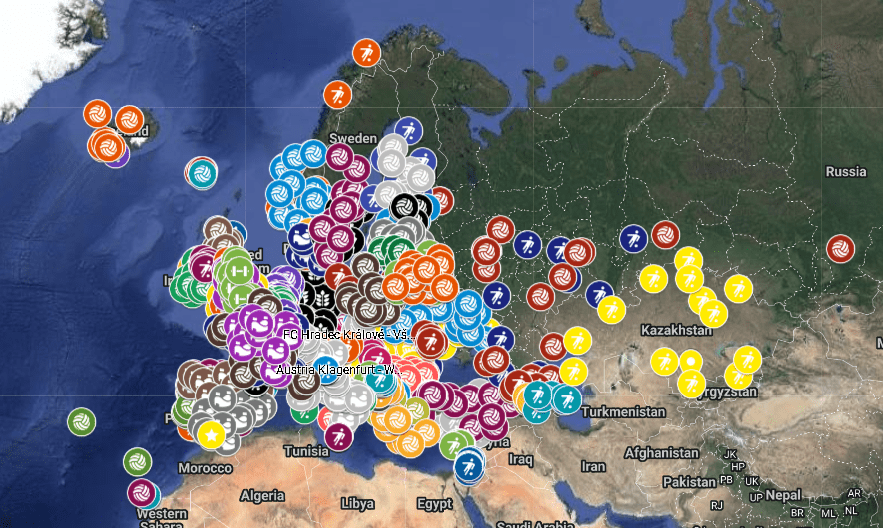
Hello football fans, wherever you might come from! I’m excited to introduce the latest project that I am working on. As someone who loves maps and geography (as well as football, obviously), I’ve always wanted something specific that wasn’t out there: a map showing the locations of football clubs in every country, in every league. Why, you ask?
Seeing the geographical distributions of football clubs in a country can often explain a lot about the power balance in the league. You might wonder why a certain team has won a league year after year, only to find they call the country’s largest economy hub and population center home. An interesting example is Germany, where every Bundesliga winner comes from western Germany, or more specifically, from what was formerly West Germany. Two separate countries existed simultaneously before the fall of the Berlin Wall, with two independent economies and governments. The impacts of that period are still evident in modern German football: a team from the former East Germany has never won the Bundesliga. This is no curse, but rather simple finances and population differences. The top 5 German states by Gross Regional Product, to represent the size of economy, all hail from former Western Germany and together made up 71% of the total GRP of Germany in 2022.
(Source: https://en.wikipedia.org/wiki/List_of_German_states_by_GRP)
In terms of population, the six largest regions are all from western Germany, with over 60 million inhabitants. Comparatively, the six regions that make up eastern Germany have just over 16 million inhabitants. This imbalance has translated through to football for as long as the Bundesliga has existed, and is just one example of the interesting connections you could make by looking at the game of football from a map. I encourage you to go down a rabbit-hole and see what you might find!
Eventually, my goal is to create one map for the entire world. Due to current software limitations, I am restricted to only putting a certain amount of layers on per map, so I’m separating the map into continents. Finally, I’ve finished all UEFA member nations and their domestic leagues, even San Marino and Gibraltar! This means I can happily share my map with you for the first time, embedded below.
The Football Map of Europe:
To read this map properly, there are a few things to know:
The different icons used represent the level of league within that particular country. Using Denmark as an example, the green icon of the football player represents top-division clubs. The football player icon will represent top division clubs in every country, with the color changing to provide better contrast between neighboring countries. In Denmark, the 2nd division clubs are marked with the yellow football icon. This ball icon will represent 2nd division clubs in every country. Third division clubs are represented by the “stadium” icon, shown in Denmark in navy blue.

Most countries will not have more than the top 3 divisions on the map, with England being one exception, having the 4th and 5th divisions on the map. Just remember, two of the same icon with different colors near one another means the two clubs are in different countries. For example, I’ll show you the border between France, Spain, and Andorra.
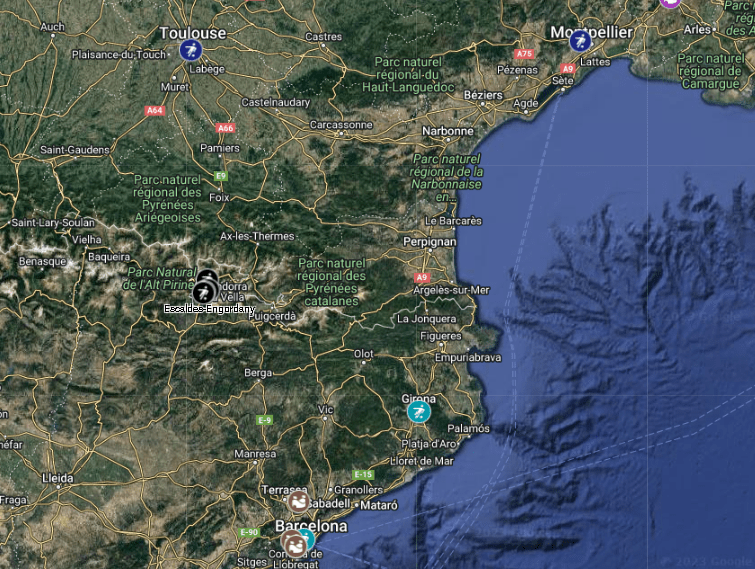
Notice the identical icon for 1st division clubs, the footballer. In France, this icon is a navy blue. In Andorra, this icon is black, and in Spain, the icon is a teal/turquoise color.
Clicking on any icon on the map will bring up the description, which includes the full club name, the league they compete in currently, and a link to their Wikipedia page if it was available. Below, I’ve listed all countries and domestic leagues included on this map. I hope you enjoy this resource, and please feel free to leave any comments on corrections if I’ve made any errors! Feel free to bookmark the map link for future reference and share with any friends who might appreciate it!
Contents of Map:
Country: Leagues Included on Map: Albania (1): Kategoria Superiore Andorra (1): Primera Divisió Armenia (1): Premier League Azerbaijan (1): Premier League Belarus (2): Premier League, First League Belgium (2): Jupiler Pro League, Challenger Pro League Bosnia and Herzegovina (1): Premier League Bulgaria (2): First Professional League, Second League Croatia (2): First League, Second League Cyprus (1): First Division Czechia (2): Fortuna Liga, National League Denmark (3): Superliga, 1st Division, 2nd Division England (5): Premier League, Championship, League One, League Two, National League Estonia (2): Meistriliiga, Esiliiga Faroe Islands (2): Premier League, 1.deild Finland (2): Veikkausliiga, Ykkonen France (3): Ligue 1, Ligue 2, Championnat National Georgia (1): Erovnuli Liga Germany (3): Bundesliga, 2.Bundesliga, III.Liga Gibraltar (1): Premier League Greece (2): Super League, Super League 2 Hungary (2): NB1, NB2 Iceland (2): Besta Deild Karla, Lenjudeildin Israel (1): Premier League Italy (3): Serie A, Serie B, Serie C Kazakhstan (1): Premier League Kosovo (1): Superleague Latvia (2): Higher League, First League Lithuania (2): A Lyga, I Lyga Luxembourg (1): National Division Malta (1): Premier League Moldova (1): Super League Montenegro (1): First League Netherlands (2): Eredivisie, Eerste Divisie North Macedonia (1): First League Northern Ireland (1): Premiership Norway (2): Eliteserien, First Division Poland (2): Ekstralasa, 1.Liga Portugal (2): Liga Portugal, Liga Portugal 2 Ireland (2): Premier Division, First Division Romania (2): Liga I, Liga II San Marino (1): Campionato Sammarinese di Calcio Scotland (2): Premiership, Championship Serbia (1): Superliga Slovakia (2): First Division, 2.Liga Slovenia (1): Prva Liga Spain (3): La Liga, La Liga 2, Primera Federacion Sweden (2): Allsvenskan, Superettan Switzerland (2): Super League, Challenge League Turkey (2): Super Lig, First League Ukraine (2): Premier League, First League Thanks for checking out the map! If you find any interesting observations through your time exploring the map, please let me know!
-
Jake Tabor: the next Jamie Vardy?
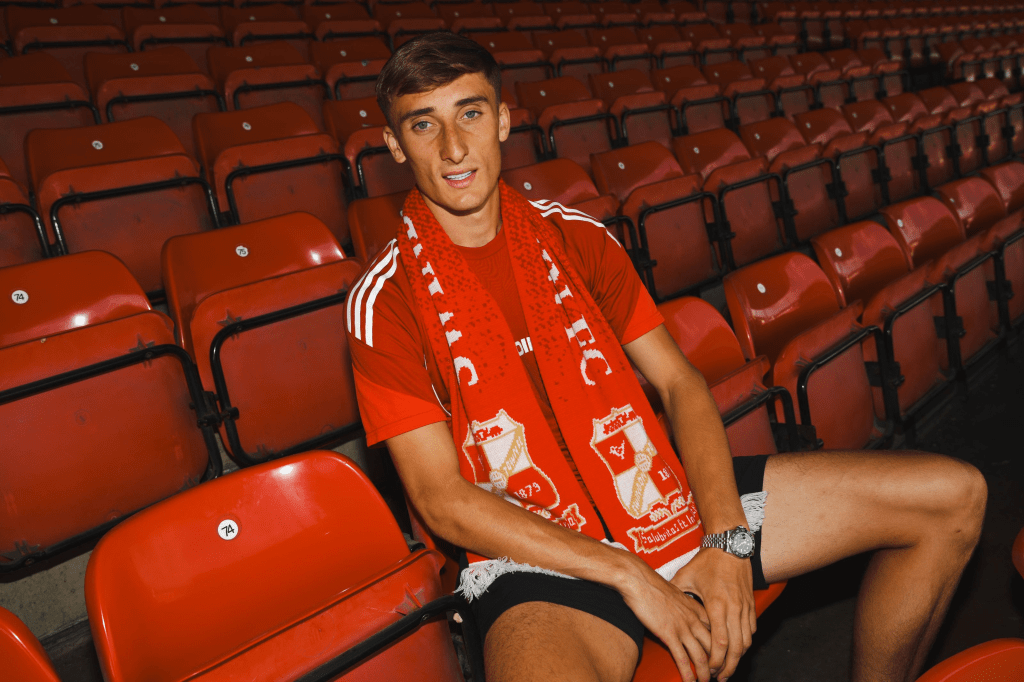
The path from non-league to the Premier League isn’t dead yet, maybe. Swindon Town look to be trying their luck at identifying the next Jamie Vardy – 22 year old striker Jake Tabor. Tabor was playing in 9th and 10th tiers of English football in the Combined Counties league for the past four seasons. Most recently, with Amersham Town, he scored 127 goals in 91 appearances over the past two seasons. This return lead Tabor to be the subject of a fair bit of attention (for the 9th tier of English football), and several professional contract offers.
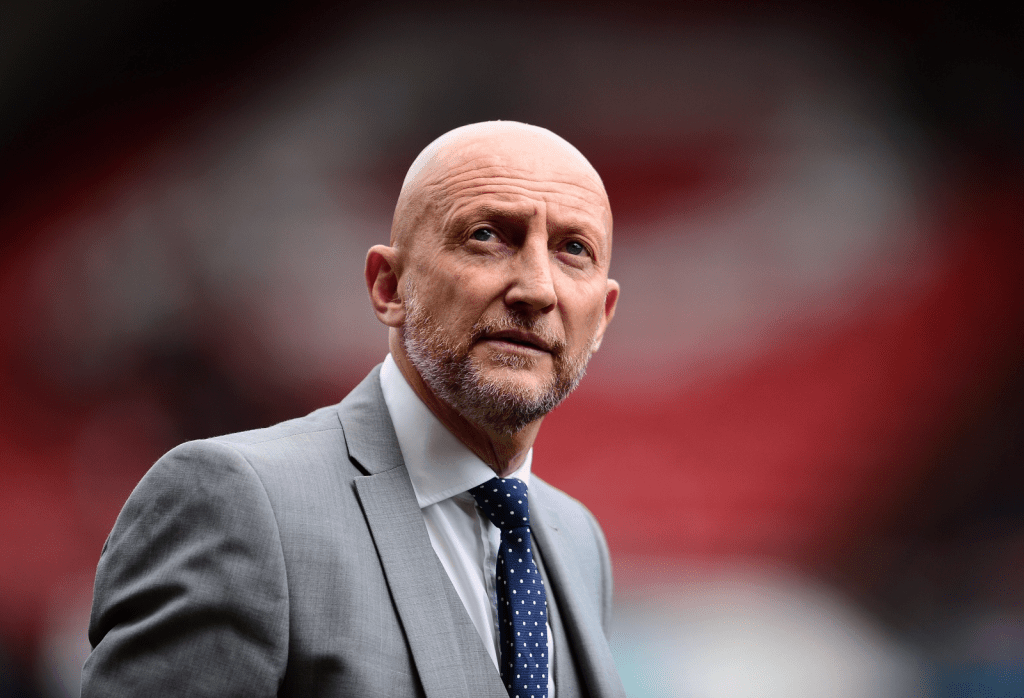
One of the interested clubs was Swindon Town, managed by former Premier League gaffer Ian Holloway. Tabor’s agent gave Holloway a phone call, simply told him that his client scored 51 goals in the league last season, and a trial was set up. Interestingly, Holloway’s former assistant manager knew Tabor, and told him that this was a good kid ready to work hard. For many managers, Holloway included, it is the person they look to sign, not the player. After hearing this, and witnessing what he called “the best trial I’ve ever seen”, Jake Tabor was signing for Swindon Town FC.
The immediate jump to playing for a professional club in League Two was enough to take Tabor by surprise, who admitted in his first interview since joining the club that he is not yet used to having things like a full kit, or water bottles ready at halftime. A true grassroots player who has just jumped 5 tiers up the English football pyramid and will get his chance in the EFL next season.
This is a rare story these days, and my love for football wants Tabor to succeed and make it all the way to the Premier League. After all, he is just 22 years old. As much as we are desensitized by 16 year old wonderkids debuting, 22 is still plenty young enough to improve even further. Tabor will now be enjoying the best coaching and facilities of his career, which should only help his chances to develop. Keep an eye out on how he fares, because this could end up being a very special story.
Jake Tabor, One to Watch.
-
2025 Eliteserien Mid-Season Review

Hello all, it’s past time for an update on the Norwegian Eliteserien, as we are about halfway through the 2025 season. Let’s take a look at the table to start.
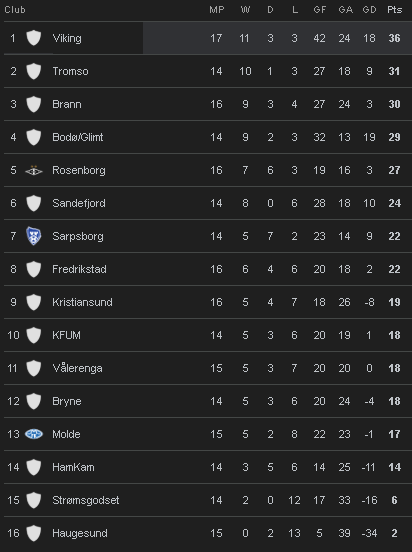
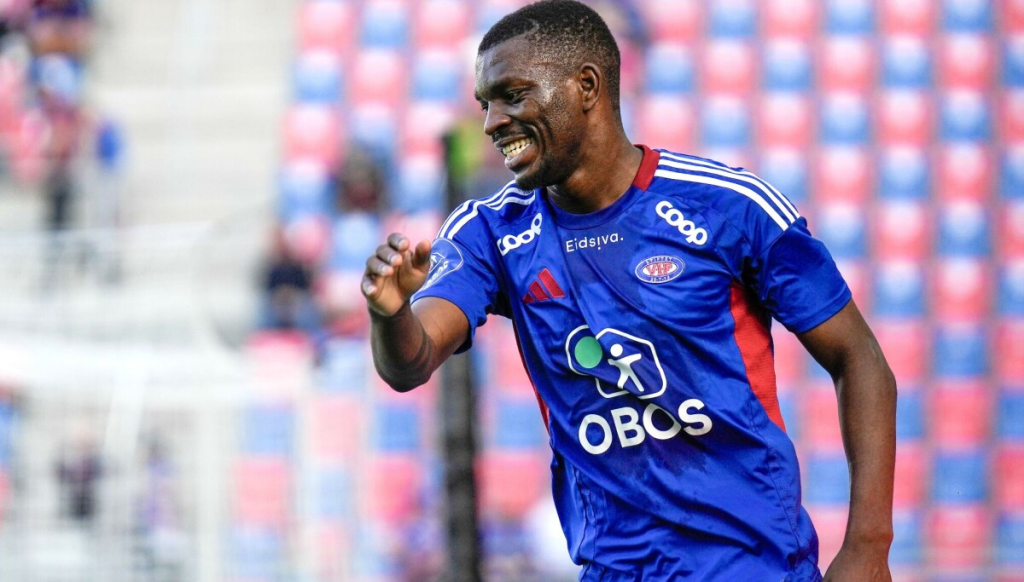
So to start off near the bottom, it is definitely worth noting the success that both of the newly promoted teams have found this season: Valerenga and Bryne. Valerenga suffered a shock relegation in the 2023 season, before they won the OBOS-ligaen in 2024 and returned to Norway’s top flight. A key player for them has been Cameroonian Fidel Brice Ambina in midfield. Ambina was purchased by Valerenga ahead of their 2024 season in the 2nd tier, and after helping them return to the Eliteserien, has been their best player. Moving from Cape Town City FC to Norway, Fidel Brice Ambina has potential to improve significantly, at only 23 years old. Bryne has also found themselves with a significant cushion over the relegation zone, with 18 points from 14 matches.
Stromsgodset and Haugesund are having truly terrible seasons so far, accumulating just 6 and 2 points, respectively. A miraculous turnaround would be required for either of these teams to escape relegation. The only real standout player here who is showing that he could have a future in the Eliteserien even if his team gets relegated is Marko Lawk Farji. The 21 year old Iraqi winger became a first team regular for Stromsgodset last season, and has been performing quite well for a forward on a struggling team.
Molde is a surprising name to see so close to the bottom of the table, although they did sell several key players from last year such as Kristoffer Haugen (to Viking). Of their 5 wins, 4 came against teams in the bottom 6 of the table, along with a surprising 3-0 win over Brann. Molde will likely not be in danger of automatic relegation, but they could well end up in the relegation playoff place if they do not improve performances soon. Molde have been in the top division of Norway since 2008, and a relegation would be a real shock to the division.
There are definitely signs that the difference between the Eliteserien and the best teams in the OBOS-ligaen (2nd division) is narrowing. I am happy to see both KFUM Oslo and Frederikstad, both teams promoted in recent years, becoming stable Eliteserien clubs. Both clubs are still in position to challenge for European places, and Frederikstad have proved to be a serious challenge for the top teams in the league.
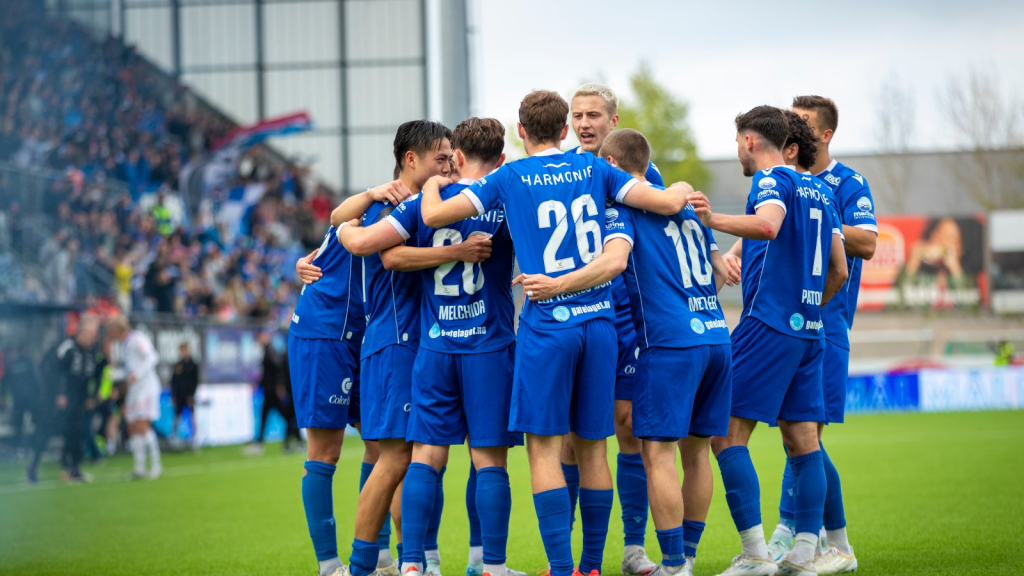
Sandefjord is also having a great season for their standards. They have not finished in the top 10 of the Eliteserien since 2009, and are on pace to do just that this season. They have assembled a very fun young squad, with key players this season such as Christopher Cheng at LB (23), Stefan Ingi Sgurdarson at ST (24), Evangelos Patoulidis on the RW (23), and Zinedin Smaljovic at CB (21). This is a promising approach for Sandefjord, who will be able to use a strong league finish this year to make significant profit on player sales.
Rosenborg have rebounded from their disappointing year last season, and are firmly in European contention now. Sander Tangvik is having a strong season in goal, Tomas Nemcik from Slovakia is enjoying a breakout season in the defensive line as well. Ole Selnaes is the heartbeat of this team though, and Rosenborg generally go as Selnaes goes, especially after wonderkid Sverre Halseth Nypan was sold to Manchester City. If his form stays strong, then Rosenborg will have a strong push for the European places, although they will have to balance Conference League qualifiers with the league matches.
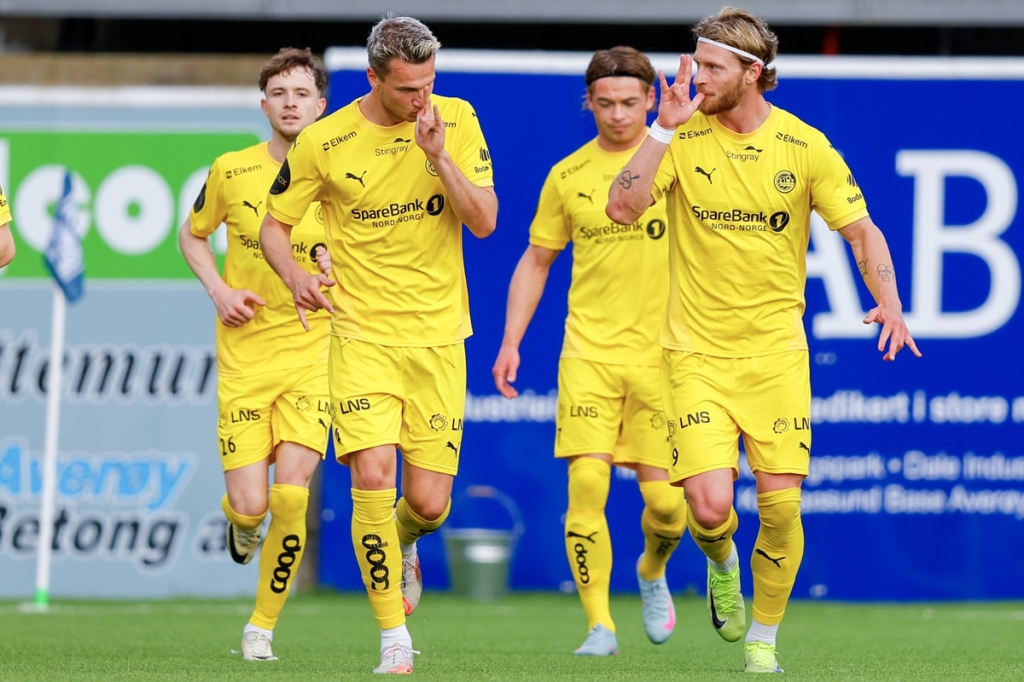
Bodø/Glimt have had significant fixture congestion over the first half of the season, due to their outstanding run to the Europa League semi-finals. This period saw them drop 8 points, enough for Glimt to be significantly behind the league leaders. Knutsen’s men look to be returning to fitness and form now though, having tallied three strong wins in a row over Sandefjord, Frederikstad, and Viking. Brann (A), Rosenborg (A), and Tromso (H) are the biggest fixtures remaining for Glimt and their final league position. As of today, they are 7 points back of leaders Viking, with 3 games in hand, and the league title is within their control if they win their matches. New reinforcements have joined in the summer window, most notably Magnus Riisnaes from Valerenga, a very exciting young winger.
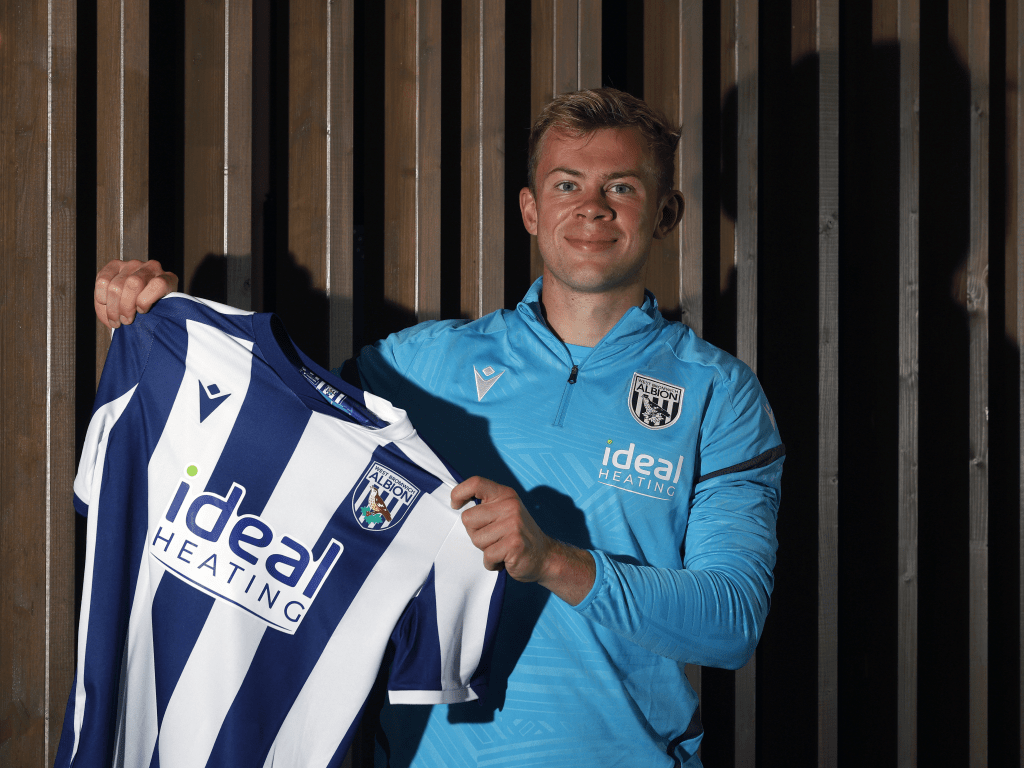
Brann are pushing for the title yet again, after finishing 2nd the past two seasons. Young striker Aune Heggebo, who came through their academy, had another very good start to the season, but looks to have been sold to West Bromwich Albion in the English Championship. This is a player I’ve known for a long time, and do see potential in. Brann will have to hope that Bard Finne, their veteran striker, can fill the void left by Heggebo. Finne scored 16 league goals in the 2022 and 2023 seasons, but only managed 6 last year, and is underperforming his xG significantly. If Brann do not reinvest some of the ~8M fee for Heggebo, they may be resigning themselves to another year of missing out on the Eliteserien title.

Tromsø is performing much better than expected this season. Runar Norheim is a very exciting talent; the 20 year old LWB has been one of Tromsø’s best players this year and a major part of the team’s chance creation. Leo Cornic has found his form again after leaving Rosenborg, and is enjoying a good season opposite Norheim at RWB. If there’s a name you want to remember though, it is Abubacarr Sedi Kinteh. The 18 year old Gambian CB is playing his first season in Europe, and performing incredibly well for Tromsø. Kinteh is a ball playing defender, who dribbles with the ball well and creates chances. From a tactics perspective, this team is interesting, as in their 5-3-2, the midfield does not actually do that much chance creation, more focused on winning the ball and retaining possession. The wingbacks and overlapping CB’s provide a significant amount of Tromsø’s chance creation. I may publish a more in depth look at their tactics following the derby match vs. Glimt.
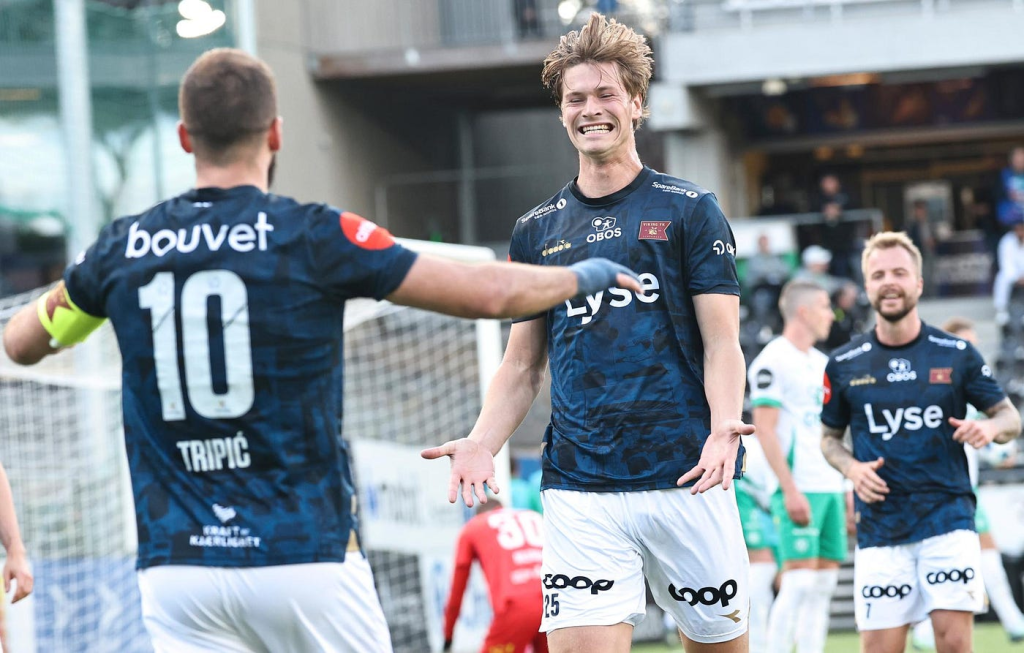
Finally, the league leaders Viking. While having played more matches than the other clubs (both Tromso and Bodo/Glimt could pass Viking for 1st by winning their 3 games in hand), Viking still deserve credit for putting themselves in this position. They will also be playing in European qualifiers starting this week, which could impact their league form. Viking still have the ability to push on and win the league, but it will require sacrificing the European games to do so. That is a tough decision, as the European competition prize money for reaching the League Phase and further is serious money for Norwegian clubs.
If you look at the table overall, keep an eye on the number of games played by each club. The points gap from 1st place to 6th place could be a mere 3-4 points in a few weeks’ time. This is setting up to be one of the most exciting finishes to a title race in Norway, as there have not been so many teams in contention for the title at the halfway point in past seasons. Keep an eye out for it!
If you do want to watch Eliteserien matches, they are free to stream on OneFootball.com, with a free account (this is not a promo, it’s just how I watch matches). Here are some fixtures to mark on your calendar if you want to see some of the best matches the Eliteserien has!
Fixtures to Watch For:
27th July 2025: Rosenborg v. Tromsø
9th August 2025: Bodø/Glimt v. Tromsø
10th August 2025: Sandefjord v. Viking
16th August 2025: Tromsø v. Brann
24th August 2025: Brann v. Frederikstad
31st August 2025: Sandefjord v. Bodø/Glimt ; Viking v. Rosenborg
21st September 2025: Rosenborg v. Bodø/Glimt
28th September 2025: Brann v. Bodø/Glimt
19th October 2025: Tromsø v. Viking
22nd November 2025: Tromsø v. Rosenborg
30th November 2025: Bodø/Glimt v. Frederikstad
That’s all for the mid-season review/end of season preview! I hope to keep spreading interest in the Eliteserien and Norwegian football in general.
Thanks,
LM
-
El Hadji Malick Diouf – from Dakar to East London
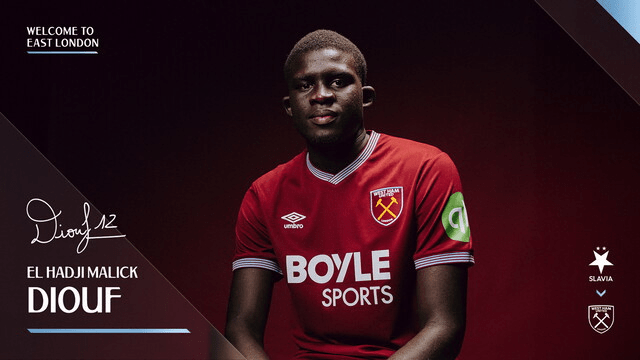
As you may have seen, West Ham have completed the signing of El Hadji Malick Diouf from Slavia Prague for a fee of £19m. However, you may be asking “Who?” – which is why I’m here today. I’ve been watching this player develop ever since I first spotted him playing for Tromsø in Norway’s Eliteserien, and always felt like he had the potential to make a transfer like this. Time to learn some more about West Ham’s new signing.
Diouf is a native of Dakar, Senegal, where he first played at the Galaxy Football Academy, followed by the Académie Mawade Wade (both Senegalese academies). After impressing scouts enough to earn a trial, Diouf performed so well at his trial that he was signed to Eliteserien club Tromsø in February of 2023, shortly after turning 18 years old. He took some time to acclimate, (understandable given that Tromsø is the northernmost top-flight football club in the world), but finished the season with 21 appearances for the club, and became an important player at Left Wing-Back.
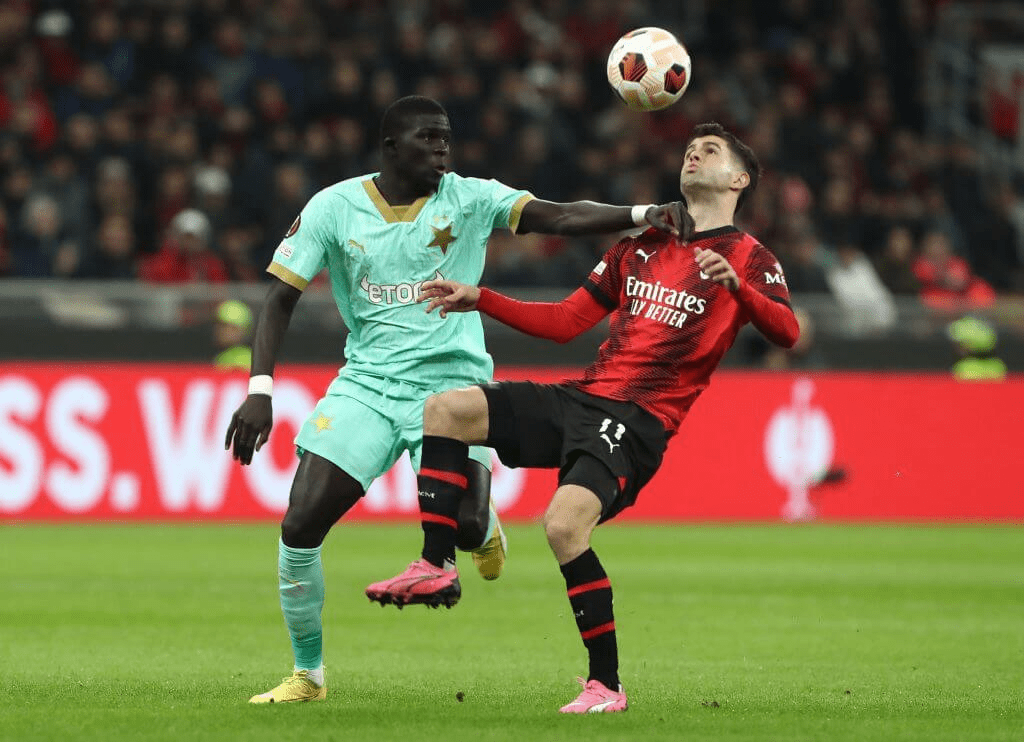
Photo: Marco Luzzani/Getty Images This was enough for Slavia Prague to take a chance on Malick Diouf, who moved to the Czech capital in January of 2024. With limited game time in the league for the remainder of the 23/24 season, he performed well for Slavia, after spending some time playing for their reserve team. This season also gave him his first experience in European play, in the Europa League. 2024 also saw Diouf receive his first caps for the Senegalese senior team.
He would take a big step forward in the 24/25 season with Slavia, contributing 7 goals and 3 assists while playing an overall strong game. His performances in the Europa League also improved, with Diouf being one of Slavia’s best players in the competition. His season would result in the reward of starting at LB in Senegal’s 3-1 win over England at Wembley in June. This match might have been what put him on West Ham’s radar, although the Hammers do have somewhat of a history of scouting the Czech league – you might remember longtime players Tomáš Souček and Vladimír Coufal. A month after his strong performance at Wembley, El Hadji Malick Diouf is a West Ham player.
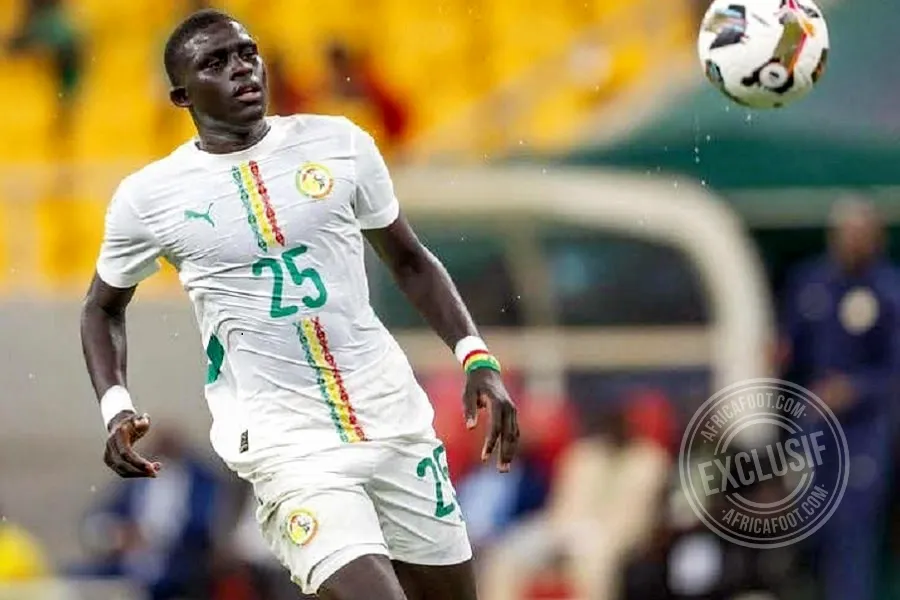
In terms of the type of player he is, Diouf profiles as an attacking fullback, and can play as a winger in midfield as well. Since he is coming from the Czech league, which is a top 15 league in Europe but of a significantly lower standard than the Premier League, his stats from the Czech league will likely not translate directly to the Premier League. However, using his Europa League stats (the highest level competition he has played in) from the past season, Diouf is one of the best attacking fullbacks in the competition. He ranked in the 95th percentile or higher in non-penalty xG, shots, xA, shot creating actions, progressive passes, and progressive passes received. See FBRef’s player profile below:
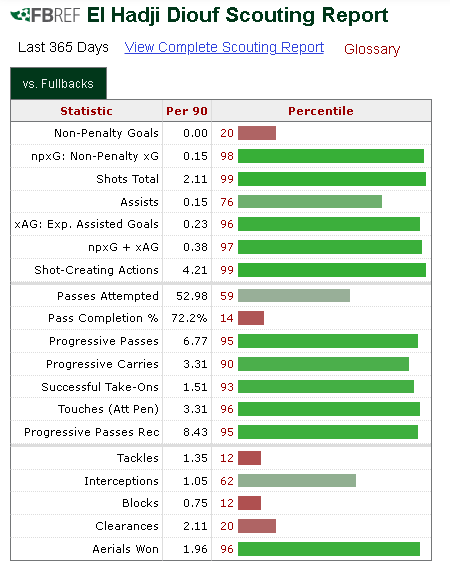
Now, Diouf only played 600 minutes in the Europa League this season, which is just over 6.5 full 90’s. I believe this is enough of a sample size at a high level of competition to show that his performance was not a fluke. A very physically gifted, attacking-minded full-back, Diouf is already playing at a high level and at only 20 years old, has plenty of time to improve even further.
I believe this will turn out to be a great signing for West Ham, and they could well be selling Diouf to another Premier League team for significant profit in a few years. I am very excited to see how Diouf’s game translates to the Premier League, especially as another player to come through the Eliteserien on their way to Europe’s top leagues. Yet another reason to keep an eye on Scandinavian football, plenty of future stars are making a name for themselves.
I’ll leave you with the words of his now former manager, Jindrich Trpisovsky, in regards to Malick Diouf moving to London: “I had it in my head that he wouldn’t be here. I was already resigned to it. It was a matter of days. The club’s management did a great job. Slavia got what they wanted.” His manager at Slavia clearly saw the same things I did in Diouf as a player, continuing on to say: “No one knows exactly what Malick is still capable of achieving … I’ll miss him as a football player, but above all as a person. The boy is extraordinary and will be even better. His potential is brutal.”
El Hadji Malick Diouf, certainly One to Watch.
-LM
-
Latest Transfers: July 11th
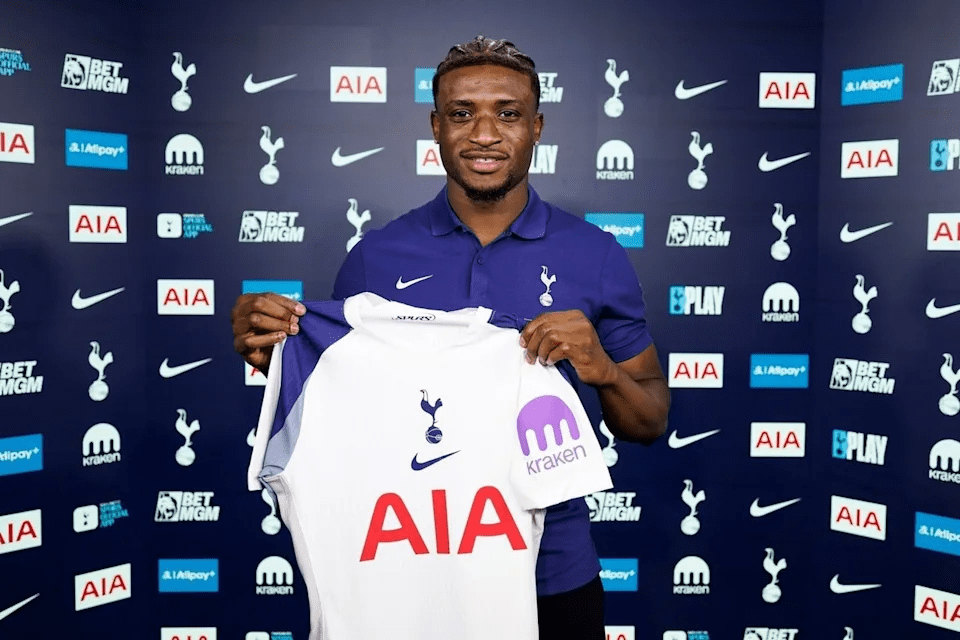
Hello everyone, had a bit of a busy workweek after the U21 Euro reports came out, so back today to go over some recent interesting transfers around the world.
The biggest transfer of the summer so far has been Mohammed Kudus to Tottenham for 55M pounds, or around 64M euros. Spurs have needed a capable dribbler, and Kudus is just that, leading Europe’s top 5 leagues over the last two seasons in completed dribbles. His versatility will mean he will primarily play on the wing, but could play in midfield if required. Kudus adds an element to Thomas Frank’s new Spurs team that was missing, a true gamebreaker on the ball. I am excited to see how he fits in with Dominic Solanke, James Maddison, and other new signing, Morgan Gibbs-White in attack.
After impressing in limited minutes at the U21 Euro, Thierno Barry is on his way to Everton for 30M euros. A very large, imposing striker, standing at 195cm tall with a strong build, Barry definitely suits the mould of an Everton striker. In some ways, this reminds me of a young Romelu Lukaku going to Everton, Barry is a similar player to Lukaku and could fit in very well at Everton. He should challenge Calvert-Lewin and Beto for a starting spot soon.
After a long stay in Milan, Theo Hernandez is departing Italy for Al-Hilal in Saudi Arabia. Over 6 years in Milan, he appeared in 264 matches for the club, scoring 34 goals from left-back in the process. This will certainly leave a void in the Milan squad, both on and off the pitch, but new boss Massimiliano Allegri likely needed a sale to raise funds. Keep an eye on who Milan bring in next.
Another player who impressed me at the U21 Euro and is now on the move was Ruben van Bommel. A very direct winger with a bit of trickery to him, he was mainly deployed down the left wing but likes to cut inside. In a lot of ways, van Bommel reminded me of a young Gareth Bale when I saw him play live. PSV Eindhoven have snapped him up for a 16M euro fee from AZ Alkmaar, which looks to be a promising move for his development. We might be seeing him make another big transfer in a few years time.
Arsenal have acquired another defensive midfielder. Stop me if you’ve heard this one before? Christian Norgaard is the latest #6 to make his way to Arsenal. To be fair, Jorginho is showing his age, and a certain midfielder who should have been internally suspended years ago has finally left the club, so a new face in the position is not hoarding. I’m not sure this will make the difference between Arsenal winning the league or not without some attacking signings, but it is a start.
Experienced Croatian defender Borna Sosa has agreed to join Crystal Palace, providing much needed depth for Tyrick Mitchell at the LWB position. I’ve always admired Sosa’s game, and this is a very good pickup for a Palace side that will be entering European play this coming season.
Finally, Ivorian star Simon Adingra has left Brighton to join newly promoted Sunderland for a 24M euro fee. Adingra has impressed in spells over the past few seasons, and especially impressed in the 2023 AFCON tournament, but clearly is not in Fabian Huerzeler’s plans, so a move to the Stadium of Light could suit him. Adingra has the chance to be a star player at Sunderland, and is a strong acquisition.
Thanks for reading, more updates will be coming soon!
LM -
Eirik Granaas: The Eliteserien’s Youngest Player
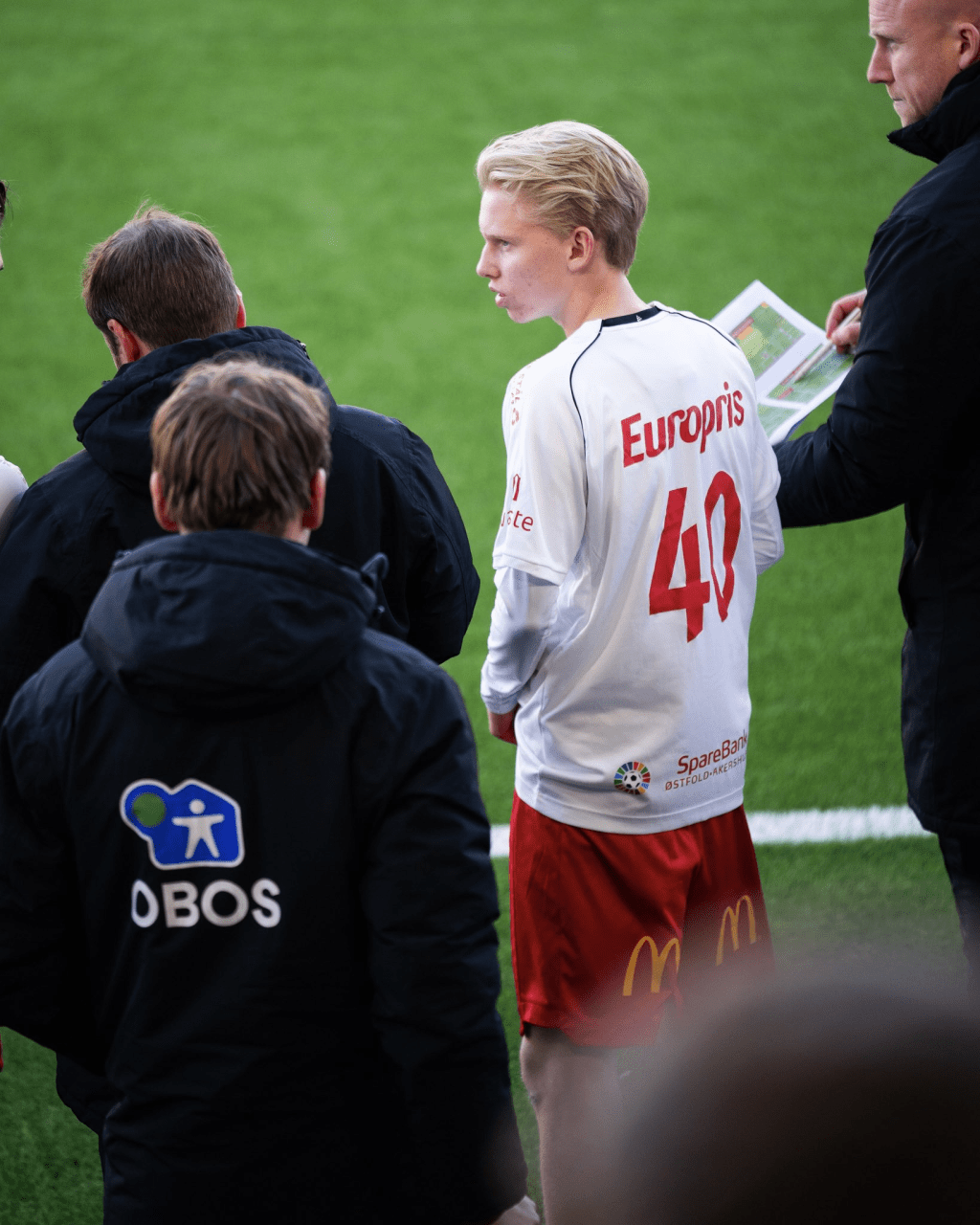
There’s a fun story out of Norway recently, when Eirik Granaas became the youngest ever Eliteserien player at 15 years and 90 days when he made his debut as a late substitution for Frederikstad last week. This made him 27 days younger than Martin Ødegaard, the previous record holder who debuted in 2014.
The young midfielder actually made his unofficial debut at 14 years old in a friendly match for Frederikstad. While I obviously haven’t been able to see much of the kid yet, the staff at Frederikstad clearly see something special in him. His older brother Sondre, is already making regular appearances for Molde at 18 and recently impressed at the Euro U19 tournament for Norway. Now this is no guarantee obviously, but we OFTEN see the younger sibling of multiple that play a sport turn out to be the better one. Playing against his (clearly skilled) older brother for his whole life in their yard will have done numbers for Eirik’s development, and it does make sense why Eirik seems to be ahead of his age group. This is a full footballing family, their father Lars was a former player for Mjøndalen and is their current manager. Both boys came through the Mjøndalen youth system before their transfers to Molde and Frederikstad.
Even if he is only getting a few minutes per match, this still means that Eirik has earned his coach’s trust enough to be getting subbed on in Eliteserien matches. He would have to be performing well in training against fully grown professionals to have been given that chance, which is a very promising sign. A full scouting report is not yet available, but I will be tracking Eirik Granaas’s progress very closely, and will look to watch him play when he starts being given more than a handful of minutes per match.
11 years after Martin Ødegaard set Norway’s record for youngest ever player, coming on as a promising young midfielder for Strømsgodset, Eirik Granaas has broken it in much the same circumstances. He is certainly one to watch, and I will keep you updated on his progress!
LM -
U21 Euro: Team of the Tournament
As a very exciting U21 Euro tournament ended yesterday, I can share my team(s) of the tournament. For me, most “Best XI” teams for tournaments are mostly based on the team results, but for mine I prefer to look at simply the performance of the players. Yes, performing well in the biggest matches and moments makes an impact, but the team won’t be entirely English and German players (the two finalists). If a player performed at the highest level for his position in the tournament, he was considered for the Team of the Tournament, regardless of team result. With that said, here are my 1st and 2nd Team of Euro U21 2025.
First Team:
Forwards: Clement Bischoff (DEN), Nick Woltemade (GER), Raul Moro (ESP)
Midfielders: Djaoui Cissé (FRA), Tomáš Rigo (SVK), Rocco Reitz (GER)
Defenders: Quentin Merlin (FRA), Oliver Provstgaard (DEN), Castello Lukeba (FRA), Tino Livramento (ENG)
Goalkeeper: Noah Atubolu (GER)
I have already published a report on many of these players, if you want to read more in depth about them. I’ll give a brief summary of each player here.
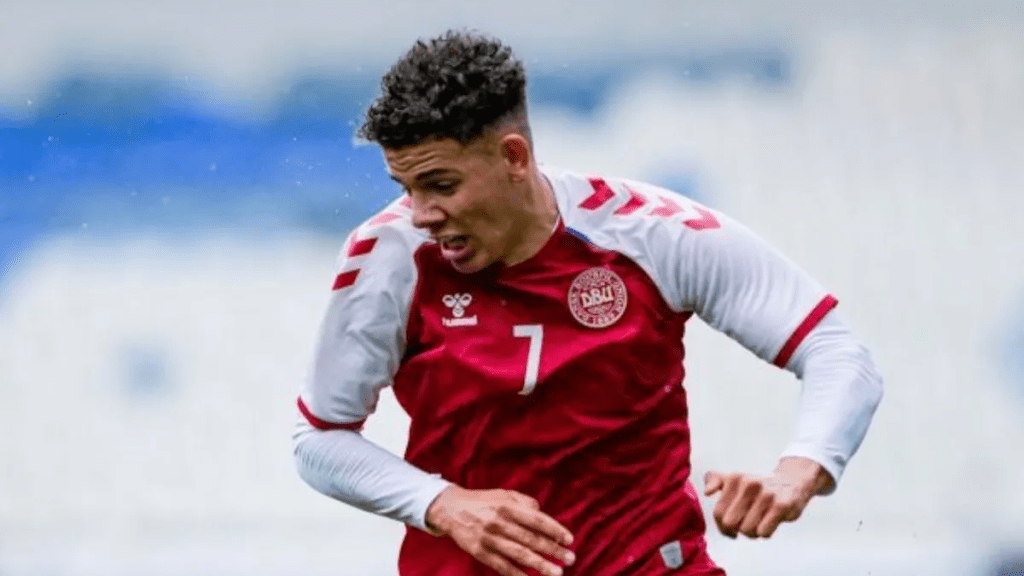
Clement Bischoff, a 19 year old winger from Brøndby IF, was spectacular for Denmark. Averaging 1 goal and 0.5 assists per 90, with a >70% dribble success rate, Bischoff was a consistent offensive catalyst for Denmark. He showed strong passing range, great offensive awareness/positioning, and was remarkably effective out of possession.
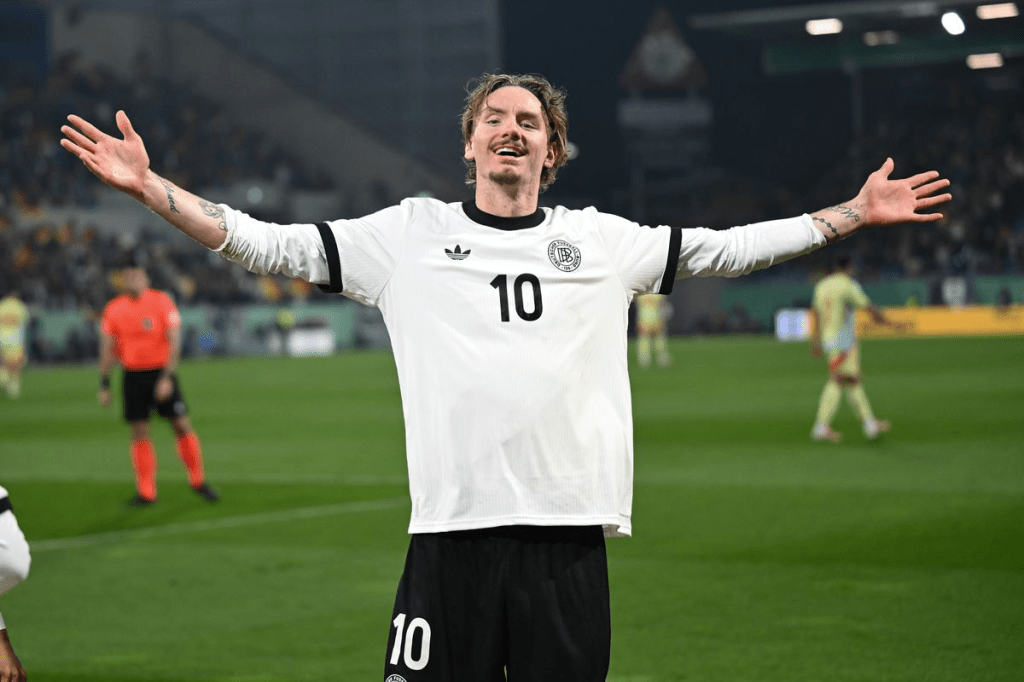
Nick Woltemade really established himself as a top-level striker prospect at this tournament, finishing with 6 goals and 3 assists (leading the tournament in both categories). A 198cm tall striker who has incredible mobility and technical ability for his size, Woltemade was a danger to defenses whenever he was on the ball.
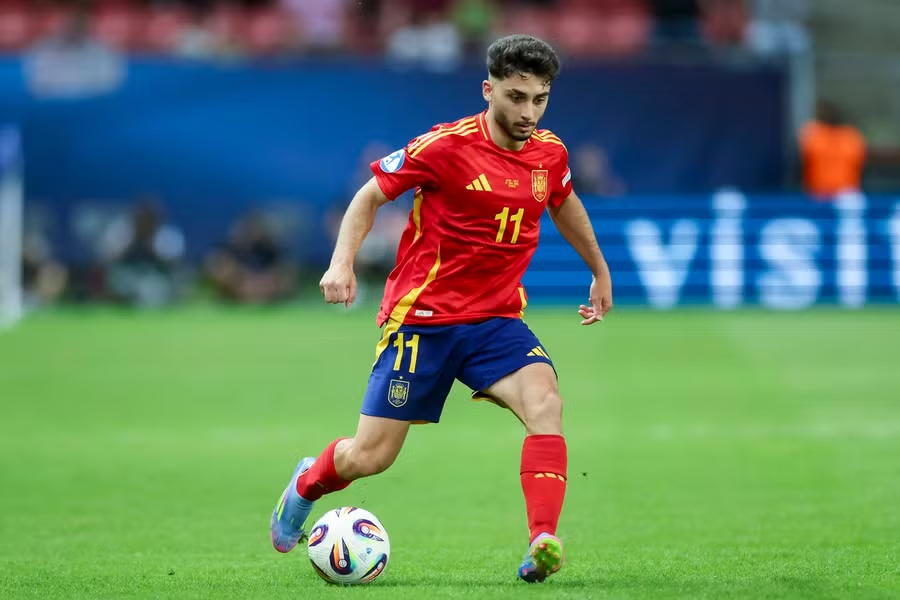
Raul Moro was a pure chance creating machine whenever he got the chance to play for Spain. However, his manager never seemed to treat him as a starter despite averaging over 4 successful dribbles and chances created per 90. No winger at the tournament was better at turning dribbles into chances created, and Moro was very good at both. One of the most fun players to watch here.
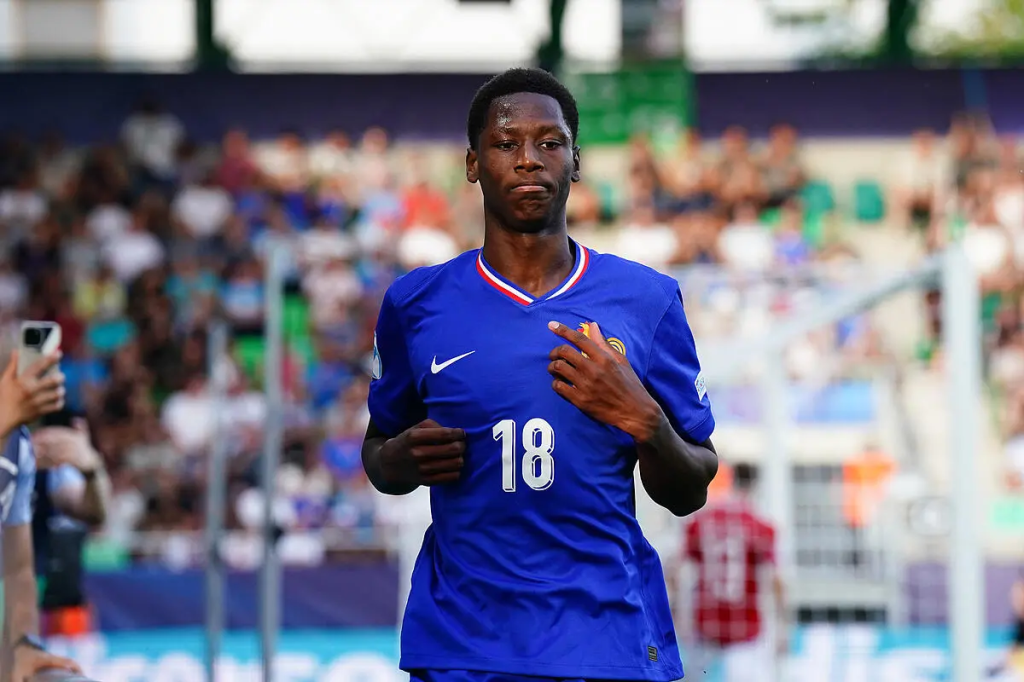
You might have already heard me rave about Djaoui Cissé (see the article published on him), but if not, he was fringe addition to the French squad before going on to be their most important midfielder. A real all around midfielder with a scorer’s touch, I liken him to a bigger Pape Matar Sarr. Cissé was a joy to watch and has world class potential.
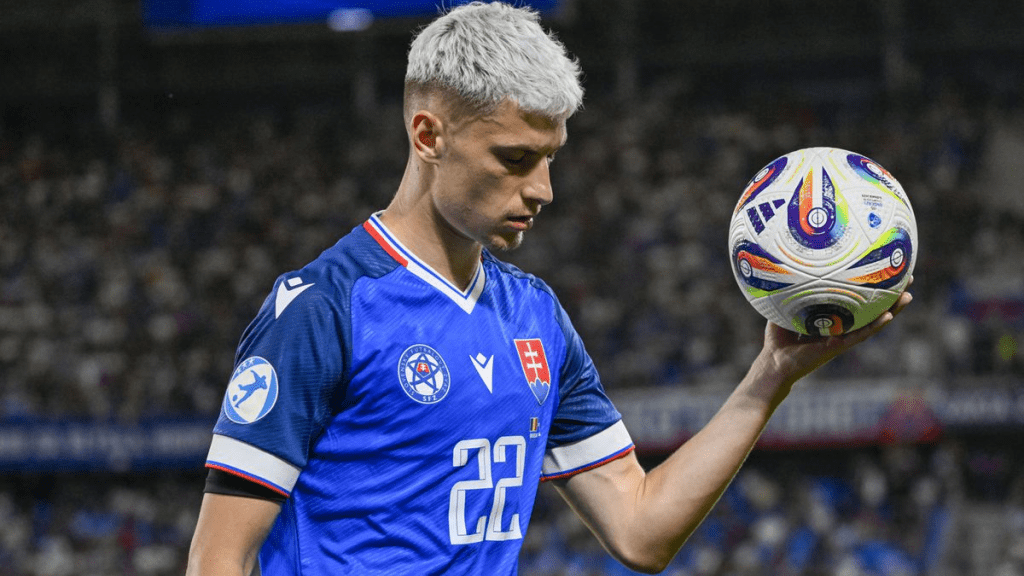
Tomáš Rigo was a true midfield standout for hosts Slovakia. He created the most chances of anyone in the tournament (despite only playing 3 matches). He generally opts not to attempt dribbles, but is very effective at driving forward into space and picking out a pass. Rigo was an effective creator with both short and long passing, from central and wide areas. He is certainly ready to take a step up from Banik Ostrava in the Czech league.
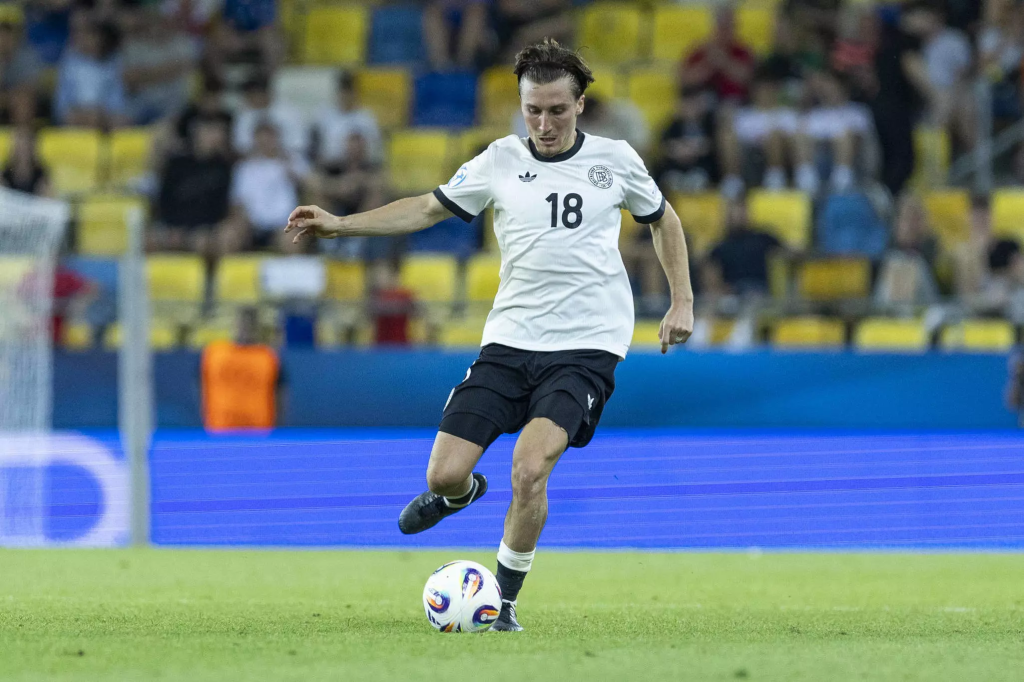
Rocco Reitz is the type of midfielder that perhaps doesn’t get a lot of credit. He did the work that needed to be done to make Germany thrive. He will move around the pitch to wherever he is needed, and is the midfield conductor of his side. His switches of play and crosses were very impressive (28% cross completion rate, 3.4 successful long balls p90), and could also boast impressive ball retention with a 75% dribble success rate and having very rarely been dispossessed.
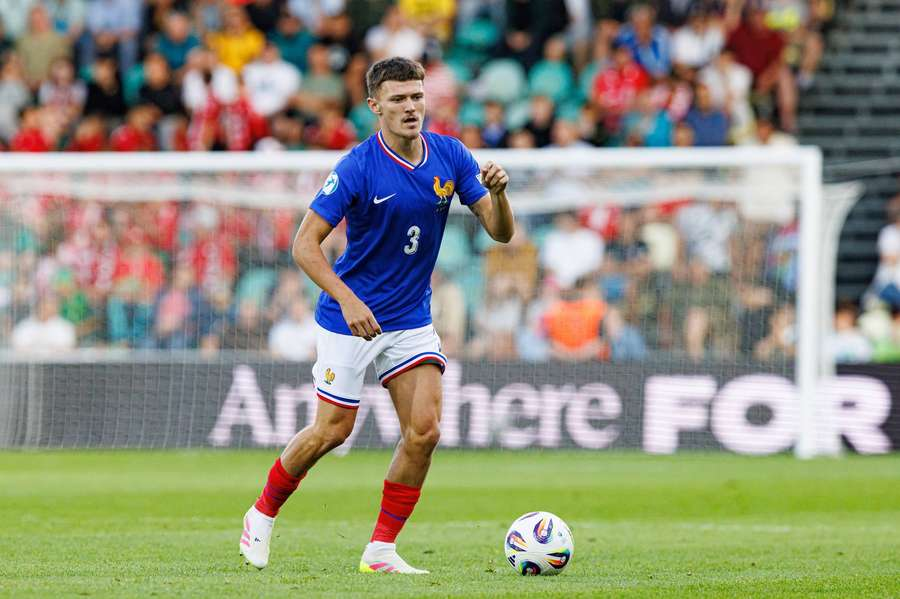
Quentin Merlin from France was without a doubt the standout left-back at the U21 Euro. He can already boast nearly world-class level of delivery, with a sneakily quick cross that defenders cannot block off reactions. With high work rate and stamina, he could surely play at a higher level than Ligue 1, it’s just a matter of when.
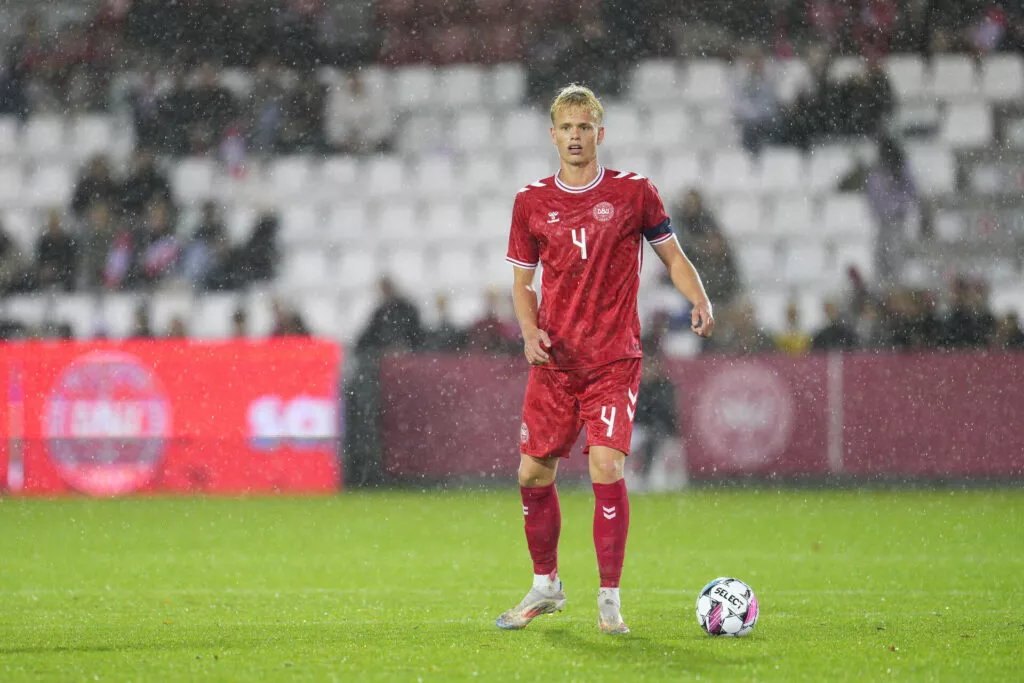
Oliver Provstgaard was a favorite of mine to watch at this tournament. This is a centre-back with all the makings of a future world-class player. A very strong box defender, who is comfortable on the ball, and has a level of focus and determination throughout the 90 minutes that is second to none. He was a huge reason why Denmark performed so well at this tournament. A breakout season at Lazio is likely forthcoming if he gets the opportunity.
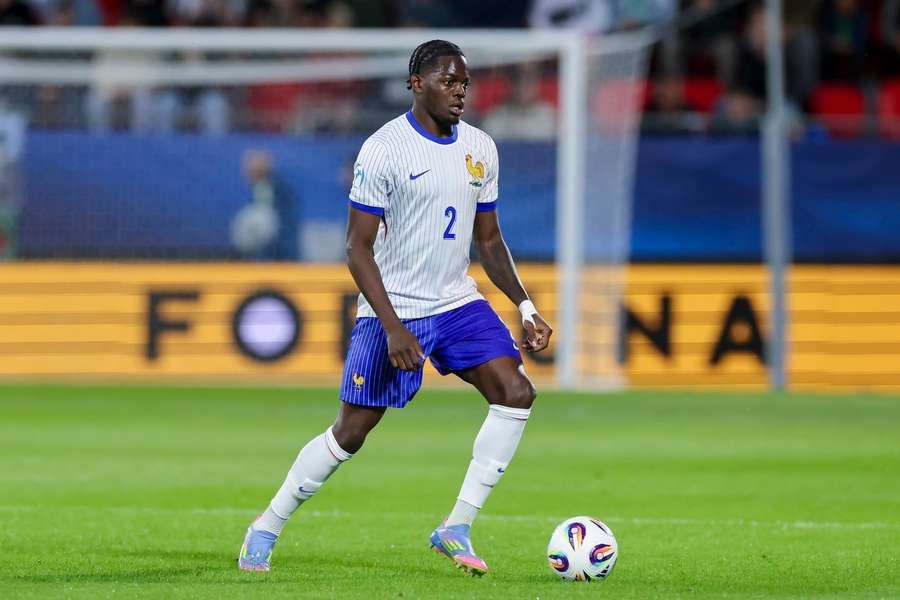
Castello Lukeba from France is a player most of you will already know, but that’s no reason to not include him. The Leipzig CB had a very strong tournament for France, commanding at the back, very strong in his duels, and even picked up two assists. His performance against the Danish strikers Osula and Harder was a critical factor in France’s quarterfinal victory over Denmark.
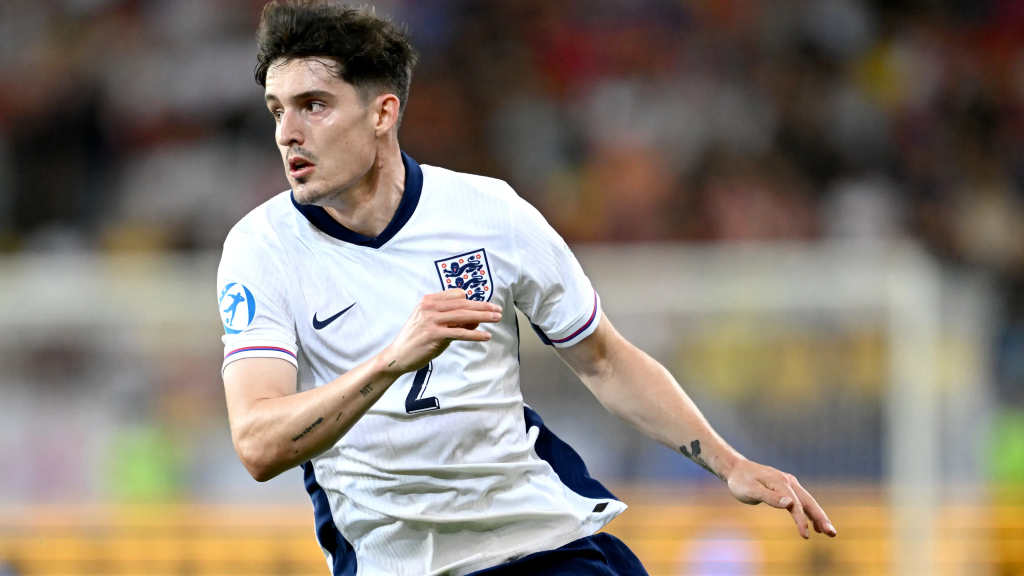
The right-back of choice is Tino Livramento from England. Another player who is no hidden gem, Livramento showed his quality in several full-back roles. His movement and quick interplay with teammates in buildup is at a very high level, and can comfortably operate in both central and wide areas. Newcastle did very well to snatch him up, and he will be an England senior team player for years to come.

Finally, in net, I’ve chosen Germany’s Noah Atubolu. Already an established Bundesliga player, Atubolu looked like he was too experienced for this tournament. He was a rock at the back for Germany, recording two clean sheets, a 71% save percentage, and having a monster game against France in the semifinal with 7 saves. Keeping THIS France side off the scoresheet is a tremendous achievement in itself. His distribution was also very good, completing a tournament best 40 long balls (8 per match).
There’s your Team of the Tournament! Now here are the players I selected for the 2nd Team all-Euro U21.
Second Team:
Forwards:
William Osula (DEN)
Nelson Weiper (GER)
Geovany Quenda (POR)
Midfield:
Alex Scott (ENG)
Oliver Sorensen (DEN)
Eric Martel (GER)
Defenders:
Irakli Azarovi (GEO)
Adam Obert (SVK)
Bright Arrey-Mbi (GER)
Nnamdi Collins (GER)
Goalkeeper:
Samuel Soares (POR)All of these players had great tournaments as well, with 17 year old Geovany Quenda a particularly interesting player to see.
This has been an extremely enjoyable tournament from both a scouting and entertainment perspective. If you have any questions or would like to request a scouting report on a player, feel free to contact me at scouting.futbird@gmail.com.
LM
-
U21 Euro Ones to Watch: Quentin Merlin
Today’s highlighted player from the U21 Euro tournament is France’s left-back, Quentin Merlin. The 23 year old defender became a regular starter for Marseille in Ligue 1 over the past season, and has carried that momentum into the U21 Euros. The quick summary that you came here to see is that this is the best chance creating fullback in the tournament.
Over the course of four 90’s this tournament, Merlin is averaging 2.72 chances created per 90, which is the highest in the tournament both overall and per 90. This comes from an average of 2.5 successful crosses per match and a 23% cross accuracy rate. While this does not seem particularly high, it is very impressive. If nearly 1 in 4 of Merlin’s crosses reach a teammate of his in the box, that is very good delivery. Crosses that are recorded as “unsuccessful” can still cause problems for the defense and lead to a corner kick, or are cleared back out to Merlin’s teammates. Also near the 90th percentile in the U21 Euros for successful dribbles per 90, this starts to paint the picture of the type of player Merlin is.
Merlin is very intelligent with where to position himself when his team has the ball. He identifies space to be exploited, and times his runs well to provide a passing outlet that can quickly be turned into a chance created. His short passing and buildup is no weakness, and he can comfortable help his team move the ball up the pitch with shorter passing. His greatest strength, and the ability that impressed me the most, was definitely his crossing. More specifically, it was how he delivered his crosses. Often in football, it can be rather predictable when a wide player is going to look to put a cross in. Defenders watch for their wind up and will attempt to block the cross. Merlin’s delivery is so quick that it was near impossible for a defender to block his crosses through reaction time. He does not have a big wind up with his leg, and the time from when he starts a crossing motion to when it is on its way under a half second every time. This caused significant problems for the defenders that France faced in this tournament. To prevent Merlin from getting crosses in, they would need to be tightly marking him before he receives the ball, however, doing so left the likes of Mathys Tel with far too much space to operate in, giving the defence a “lose-lose” decision to make.
While I wouldn’t market Merlin as having Wan-Bissaka levels of defensive ability, he is certainly no defensive liability. He is not the greatest aerial strength, but is an effective counter-presser and interceptor of the ball, averaging 6+ recoveries/interceptions per 90, while only committing 1.3 fouls per 90. At 173cm, Merlin is not a very tall player, but has a strong build that allows him to retain possession and challenge for ground duels rather effectively. His biggest weakness, and the weakness that could be exploited the most, is his aerial ability. A back post cross to a striker would likely cause Merlin difficulty in defending it, and this could be taken advantage of on set pieces.
However, his overall brilliance shown in creating chances and pressure for his team when in possession more than outweigh any minor defensive weakness. Merlin looks to have the potential to become one of the best crossers of the ball in world football, not just the best at the U23 level. His workrate level is high, and is most definitely still young enough to have room to grow. I would be very surprised to see him stay at Marseille much longer, as his performance at the U21 Euro’s was very impressive and showed his capability to perform at an even higher level. There is certainly a future for Merlin in the French senior national team, as I do not believe they have a player of his type available at LB right now. He is most suited to play for a possession based team – his incredible on the ball ability and movement would fit perfectly into a squad that is looking to control possession and apply consistent pressure on the opposition defence. I would not be surprised to see the likes of PSG or Bayern Munich take a chance on Merlin, as his delivery is already at a very high level, and could easily fit into their squads. Overall, Merlin was the best LB at the U21 Euro’s, is an elite chance creator, and looks destined for bigger things in the future.
Quentin Merlin, One to Watch.
-
U21 Euro Ones to Watch: Nick Woltemade

Good Morning in the Americas, Afternoon in Europe/Africa, and Good Evening to everyone in Asia! Today’s featured prospect from the U21 Euro’s is Germany’s Nick Woltemade. A true unicorn of a player, Woltemade stands at 198cm tall, has a decently strong frame, and has impressive agility and mobility for someone of his height. To profile him as a target forward because of his height would be a massive mistake, as Woltemade can bring so much more to a match.
It is very difficult to make a player comparison for this type of player, I can’t remember the last time I saw someone of this height moving on the pitch like they thought they were a winger. The best I can do is that Woltemade’s potential lies somewhere in between a Sebastian Haller, and a poor man’s Zlatan Ibrahimovic (that’s a huge compliment, becoming 50% of the player Zlatan was will give Woltemade a successful career). In terms of style though, Woltemade does remind me a bit of a young Zlatan, a physically imposing forward who also has flair and creativity.
Throughout this tournament, Woltemade has been a star man for Germany U21. In 4 matches so far (he sat the final group stage match nursing an injury), Woltemade has produced a hat trick against Slovenia, a goal and two assists against Czechia, another goal and assist against Italy in the quarterfinals, and a goal against France in their recent semifinal victory. So going into the final, Woltemade is averaging 2 goal contributions per 90. After a season with VfB Stuttgard where he scored 12 goals in 28 appearances in the league, along with 5 goals in 5 DFB Pokal matches, Woltemade was one of the older players eligible for this tournament, and has showed his experience.
Off the ball, Woltemade is a strong presser, showing his Bundesliga education. He knows how to angle his runs when pressing to force the opposition into moving the ball where he wants them to, and has an eye for an opportunity to win the ball back high up the pitch. For someone of his size, he is very quick and agile. So far, Woltemade has recorded 13 recoveries and two tackles won, while committing just 6 fouls and receiving no cards.
In duels, Woltemade has been best in the tournament. Most duels won in the tournament so far (26), along with the most aerial duels won in the tournament (11). He has won 10 fouls, and only been dispossessed 7 times on 165 touches. He showed very impressive strength (the one thing I thought could be lacking in such a tall player), in the semifinal vs France, often holding onto the ball while being fouled and retaining possession under pressure for Germany.
On the ball, Woltemade wants to create scoring chances, either for himself or his teammates. He is a very direct player, always looking for the quickest route to a shot on goal. He can dribble his man very effectively, and has a good eye for a pass. Woltemade set up the shot that eventually turned into Germany’s first goal against France, though he won’t be credited with an assist. I really cannot stress how much his mobility and technical ability impressed me as a player with his size and stature. We see a lot of physically imposing strikers, and their weakness is usually technical. With Woltemade, this is not the case. Even in the Bundesliga against fully grown men, Woltemade averaged a very respectable 0.58xG per 90, exceeding this with his xGoT of 0.72 per 90. This indicates that Woltemade regularly produced higher chances to score with his finishing ability than the shot was worth. Based on his expected numbers, Woltemade was producing an expected goal every two matches, and an expected assist every 5 matches. This prorates to ~ 26/27 goal contributions in a 38 match season. Woltemade had a dribble success rate of 46%, putting him above average for Bundesliga forwards, and was in the 97th percentile in the Bundesliga for touches in the opposition box (averaging 10 per 90).
Mentally, Woltemade looked a determined and motivated player. If his potential is to be a poor man’s Zlatan, then I can almost assure that he will be a more coachable player than Zlatan was (lol). The danger here is if Woltemade becomes another in the long list of misprofiled Bundesliga forwards joining a Premier League team. Sebastian Haller, one of the other better comparisons for player type, was doing fantastic in the Bundesliga playing as the second striker off the #9, until he went to West Ham in the Premier League who saw a strong striker, and tried to force him into a target man role. Woltemade is NOT a target forward, I cannot stress this enough. He can play as an inside forward off the left very effectively, as a lone striker, or in a strike pairing. Given his technical ability and chance creation, combined with the significant aerial advantage that he would have over most fullbacks, I think long term the inside forward role off the left side is Woltemade’s best role. While he can effectively receive long balls under pressure and play hold-up in the centre of the pitch, I think combining Woltemade with another aerially-competent striker could be very dangerous. In the semifinal against France, the Germany coach showed what this could look like, starting Woltemade on the LW, and Nelson Weiper (192cm tall, strong striker) up top. Each player would draw several defenders to them, opening up space for the other. It was near impossible for France to effectively defend both Woltemade and Weiper without leaving Ansgar Knauff wide open off the RW.
There have been rumours throughout this tournament that Chelsea are looking to buy Woltemade. Given their current striker depth of Liam Delap, Nicolas Jackson, and Marc Guiu, I can confidently say that Woltemade would be an immediate upgrade on Guiu as a 3rd striker, and very well could find himself surpassing Jackson in the pecking order if he does join Chelsea. With the right development, and if he is played in a role suiting his abilities, I believe Nick Woltemade can become a top top striker in Europe. Having already been given his first senior team callup, his performance at the U21 Euro will only cement Julian Nagelsmann’s decision to include Woltemade in his plans.
A truly unique type of prospect, with potential to be the closest player to Zlatan that we have seen since the big Swede retired. I do not believe that Woltemade is dependent on the additional time and space afforded to him in the half spaces that is a trend in the Bundesliga, and could translate his game effectively to the Premier League, La Liga, or Serie A.
Nick Woltemade, absolutely One to Watch.
-
U21 Euro Ones to Watch: Raul Moro (Ajax’s Next Star?)
Today’s standout player from the U21 Euro is Spain’s Raul Moro. A 22 year old winger who plays for Real Valladolid, and came through the Barcelona and Lazio academies; He seriously impressed when given playing time at this tournament. For reasons known only to the Spanish coach, Moro was used as a substitute in the first two matches, then given a start against Italy where he excelled, before coming off the bench again in the quarterfinals vs England that Spain eventually lost.
In a nutshell, Raul Moro is an elite potential chance creator off the wing. The best dribbler of the ball that I saw at this tournament, he averaged 4.24 successful dribbles per 90 (this puts him in the 97th percentile at the U21 Euro), and that is not including all the times he beat a defender with a clever first touch or dummy (these types of plays aren’t counted as “dribbles”). Moro excels at beating his man and getting the ball into the box. Even when the cross doesn’t reach his teammate, it puts pressure on the defence, often winning Spain a corner kick. He often drew multiple defenders to him due to his dribbling ability, freeing up significant space for his teammates. Moro created 4.24 chances per 90, a number that is only in part coincidentally the same as his dribbles per 90. The eye test confirmed, when Moro beats his man with a dribble, he generally creates a chance for his team.
When subbed on for 24 minutes against Slovakia, Moro created 3 chances (more than anyone else in the match), completed 2/2 dribbles, won 3/4 duels, and put incredible pressure on the Slovak defence, eventually leading to a late Spain winner. I was at this match, and the Slovak defence was looking comfortable until Moro came on and changed the match.
In Spain’s second match against Romania, they found themselves down 1-0 at halftime, when Moro was subbed on. He again created 3 chances, beat his man to find space and deliver 6 crosses into the box, and had 3 shots, putting extreme pressure on the Romanian defence. This culminated in Moro assisting the winning goal by Roberto Fernandez in the 88th minute, yet again being a major factor in Spain securing all 3 points. Only with their spot in the knockouts confirmed was Moro given a start against Italy. I was also at this match, and he was incredible. My 6 year old cousin was there with me watching his very first football match, and Raul Moro was pulling off dribbles that he couldn’t believe were possible (I’m not saying Raul Moro is Neymar, but just remember your first time watching Neymar dribble and how that made you feel. That’s the feeling Raul Moro gave to my little cousin, and it was special). Most dribbles completed in the match (5), 2 chances created, and even won the majority of his duels. Moro assisted Spain’s only goal in a 1-1 draw, and while the goalscorer Jesus Rodriguez was given player of the match, anyone in the stadium would tell you that it was Raul Moro.
Regardless of his incredible performance, Moro was yet again put on the bench to start the quarterfinal match against England. In this match, Spain really struggled to transition to offence when they recovered the ball in their own end, with Juanlu Sanchez struggling to provide an effective outlet on the right wing. Raul Moro was given just 33 minutes in this match, coming on with Spain down 2-1. Even in his limited time, he still created the most chances (3) of any player in the match, including those who played a full 90, and yet again provided a bright spark for Spain on the wing. England would eventually win 3-1, ending Spain’s tournament, but Raul Moro’s performance cannot be forgotten. At only 22 years old and recording a goal contribution every 3 matches for the 20th placed team in LaLiga, Raul Moro could be a relatively inexpensive transfer with extremely high upside. It is difficult for attacking players to look good while playing on a relegation-battling team, and yet Moro is having a very respectable season regardless.
He might not be a winger fit for a gegenpressing team, but for a team that needs a winger who can dribble and create chances, I did not see many prospects better than Raul Moro. He reminded fans why they love the game, and still plays without the robotic nature that many modern day players are forced to adopt. I believe Raul Moro could play for a Champions League level side, and is probably best suited for LaLiga or Serie A. I cannot stress enough how much he impacted the match for Spain whenever he was on the pitch at this tournament.
Update: As soon as I finished writing this article, I noticed that there are reports that Ajax have reached an agreement on personal terms with Moro, and are looking to finalize a deal with Real Valladolid. It looks like the Ajax scouts saw what I did, and I look forward to seeing how he performs at Ajax. This could be special.
Raul Moro, One to Watch.
-
U21 Euro Ones to Watch: Djaoui Cissé
Ready for a fun one today? Perhaps the hidden gem of the French U21 squad, a player many questioned the selection of for this tournament, but a player who has fully silenced all doubters: Djaoui Cissé.
I really cannot stress how much fun Cissé is to watch, he was one of two players (the other is tomorrow’s feature!) who really reminded me why I love football at the U21 Euros.
Djaoui Cissé, a 21 year old French/Malian midfielder who came through the Rennes academy into their first team, was somewhat of a surprise selection to Les Bleus supporters coming into the tournament. He remained on the bench for their first match against Portugal, and then was subbed on with only a minute remaining in the second match against Georgia.
Then, in the final group stage match, he was unleashed on Poland. First, a thundering long shot from Cissé couldn’t be handled by the keeper and was headed in by Nathan Zeze to give France a 1-0 lead, with Cissé being rightfully credited with an assist. Right after the ensuing kickoff, Cissé steals the ball, runs forward, notices the Polish keeper off his line and curls a beautiful shot over the keeper into the top left corner from about 25 yards. Then before the first half could end, Cissé struck again from outside the box, receiving a cross-field pass from the right wing, turning onto his weaker left foot and powering a shot past the keeper at the near post. So in the first half, 3 Cissé long shots turned into 3 goals for France, with him scoring a goal on either foot. Pretty decent debut, no? France went on to be 4-1 winners, with Djaoui Cissé named the man of the match.
In the quarterfinals against a very strong Denmark team, he once again put in an all-around midfield performance, and showed that he doesn’t only rely on long shots to score. In this match, Cissé showed great anticipation and off the ball movement, playing a quick interchange with a teammate while running into the box, before taking the return pass in stride, dribbling a defender, and then calmly slotting home a goal on his left foot.
Cissé has played 181 minutes in the U21 Euro so far, almost exactly two full 90’s. In this time he has recorded 3 goals from 8 shots (5 on target), a 90% pass completion rate along with an impressive 75% long ball completion rate. On the ball, he has yet to be dispossessed, has a 75% success rate in dribbles, tackles, and duels, and has 13 recoveries.
He is truly an all-around midfielder, capable of playing as a 6, an 8, or as the 10. Cissé glides around the pitch when running, looking effortless and with physical levels remaining high throughout a full 90. His positioning sense both in and out of possession is very impressive for a young midfielder. He has high work rate, and hustles back in transition. His high pressing ability was recognizable, and is a good sign for his ability to play at a UCL level club.
When on the ball, he has a bit of that Mousa Dembélé ability to just weave through defenders to progress the ball up the pitch. His first touch and dribbling ability was impressive, along with his sense for where both he and the ball need to go. Cissé is a press resistant midfielder who can use his strong 188cm frame to hold off defenders, and his agility and technical ability to beat them with a quick turn.
A very strong comparison for Djaoui Cissé, both in playstyle and career path, is Pape Matar Sarr. Both players broke into first team football in Ligue 1, Sarr for FC Metz, and Cissé for Rennes. They are midfielders who can truly play any role in midfield, the type of player that managers dream of having. The success of Sarr in the Premier League is a very strong indicator of how Djaoui Cissé might fare. From what I have seen so far, Cissé looks to be a bit physically stronger than Sarr already, which furthers his case for being a potential Premier League star, where physical traits are so important.
Overall, Djaoui Cissé was one of my favorite players I watched at the U21 Euros. With France still to play the semifinals and potentially the final, this will be a great opportunity to further scout Cissé and his performance in the biggest moments of the tournament. From what I have seen so far, I strongly believe that Djaoui Cissé has potential to play for a very top club in Europe. His versatility and general lack of weaknesses in his game would allow him to be coached into the player I believe he can become. Whichever club signs him from Rennes will be given a unique player that if developed correctly, can be come one of the world’s best.
Djaoui Cissé, One to Watch!!
-
Subscribe
Subscribed
Have a WordPress.com account? Log in now.

