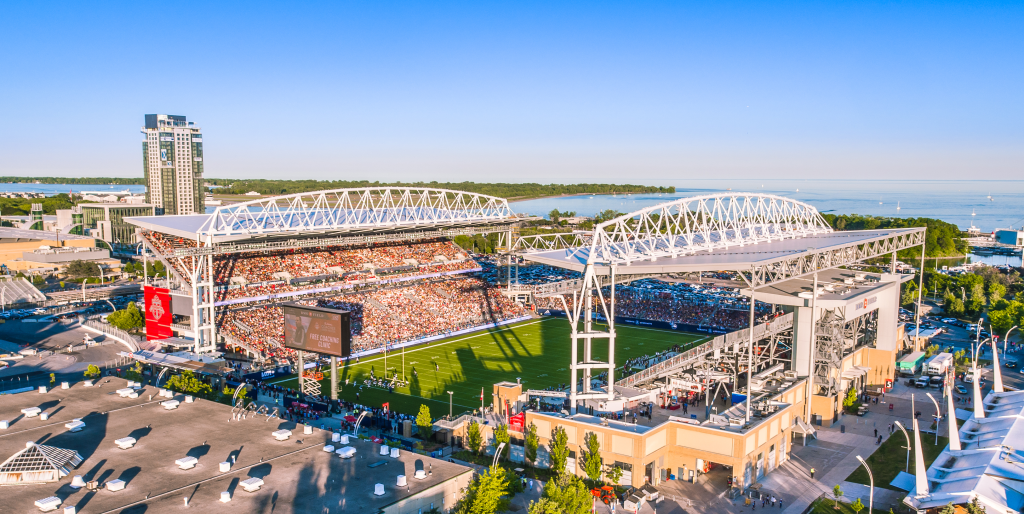
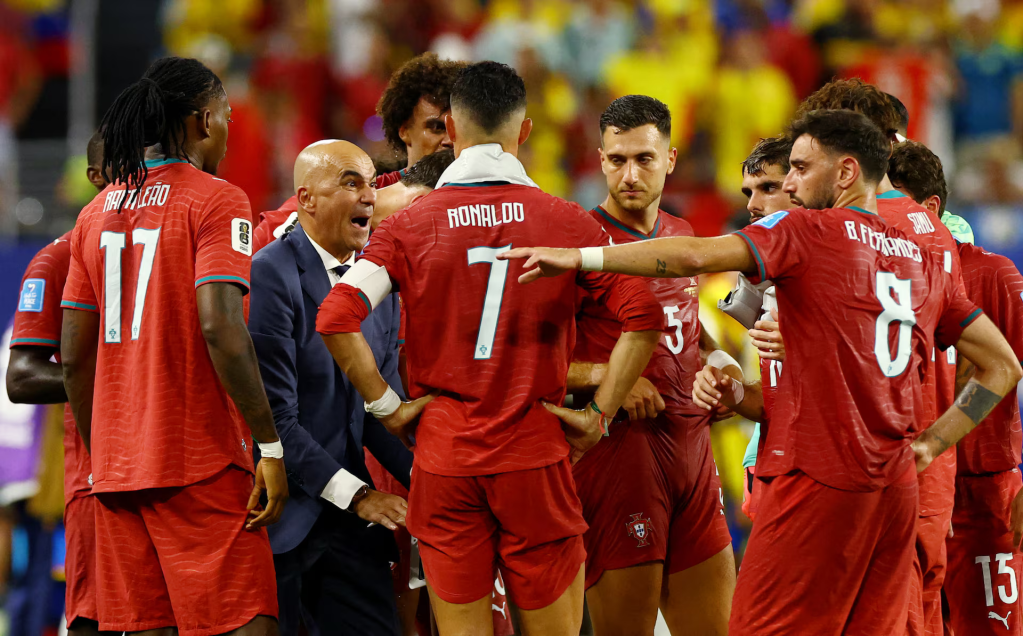
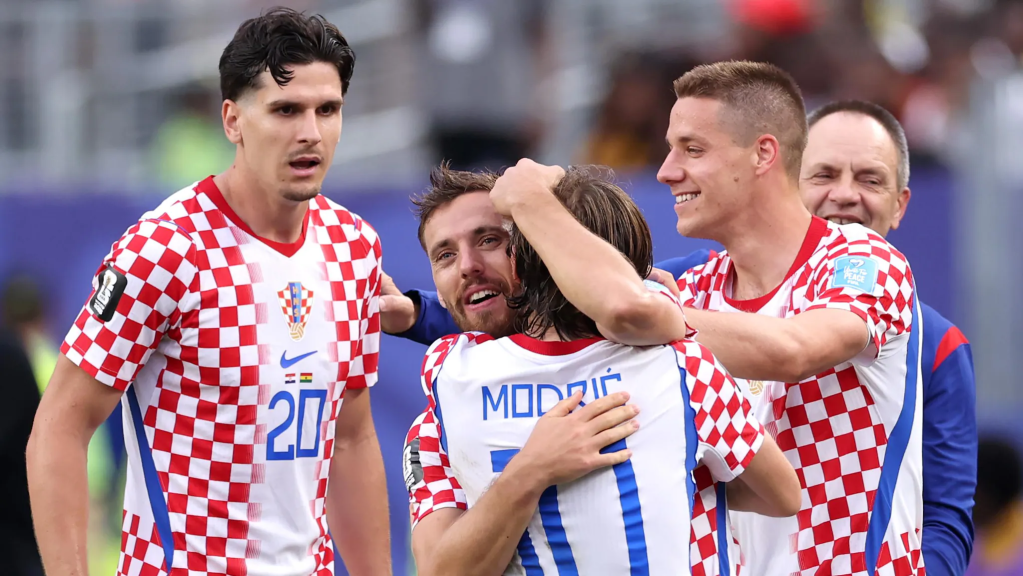
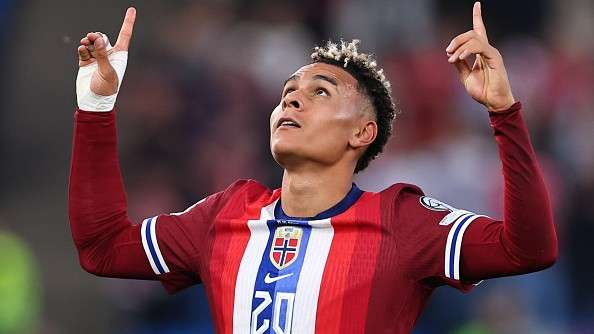
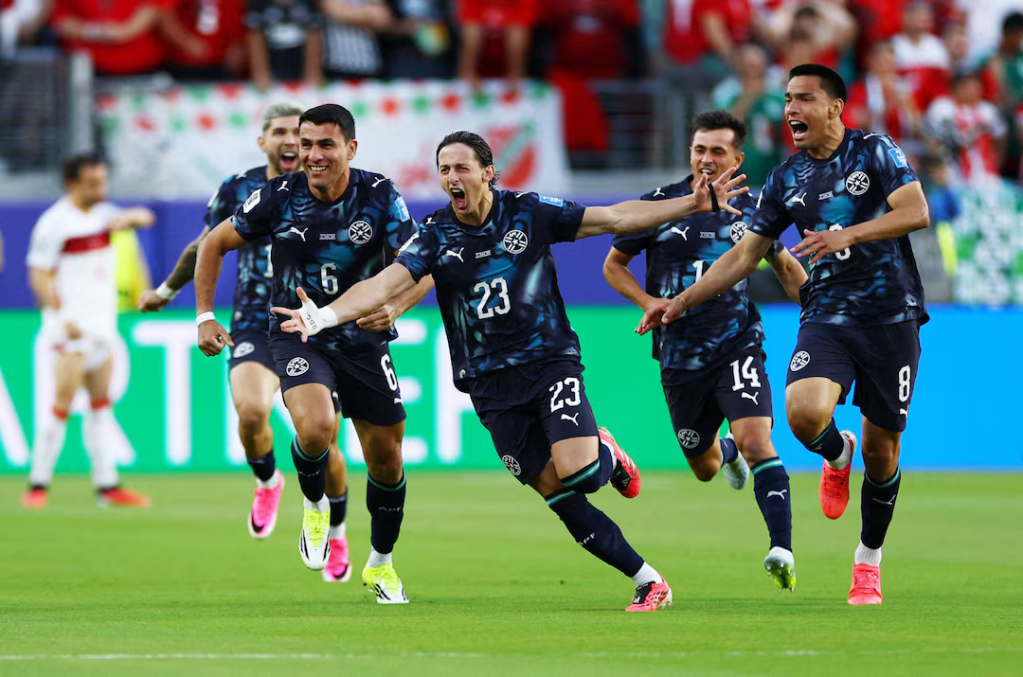
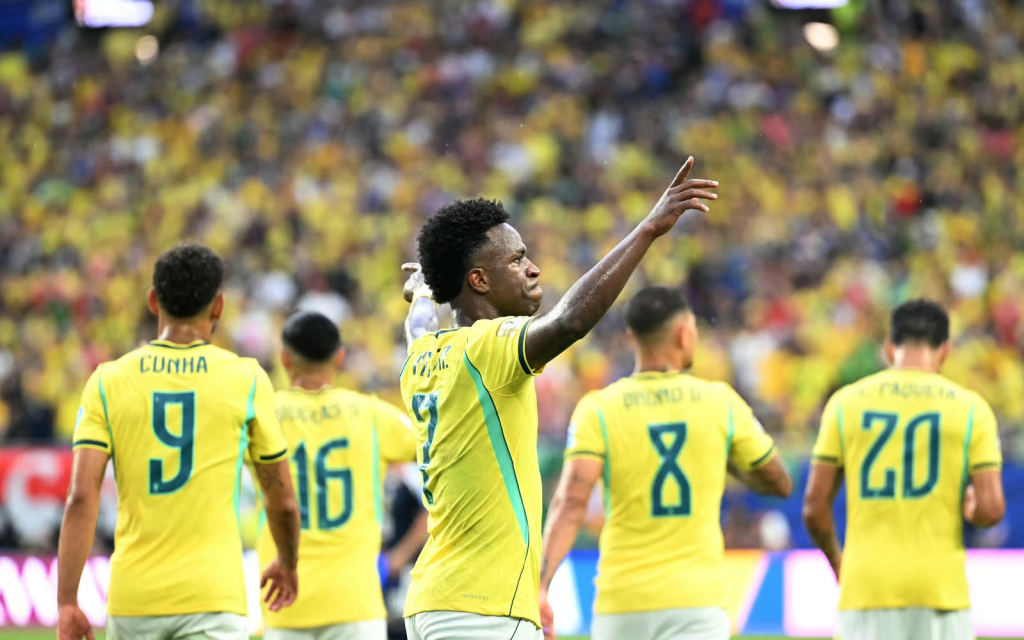
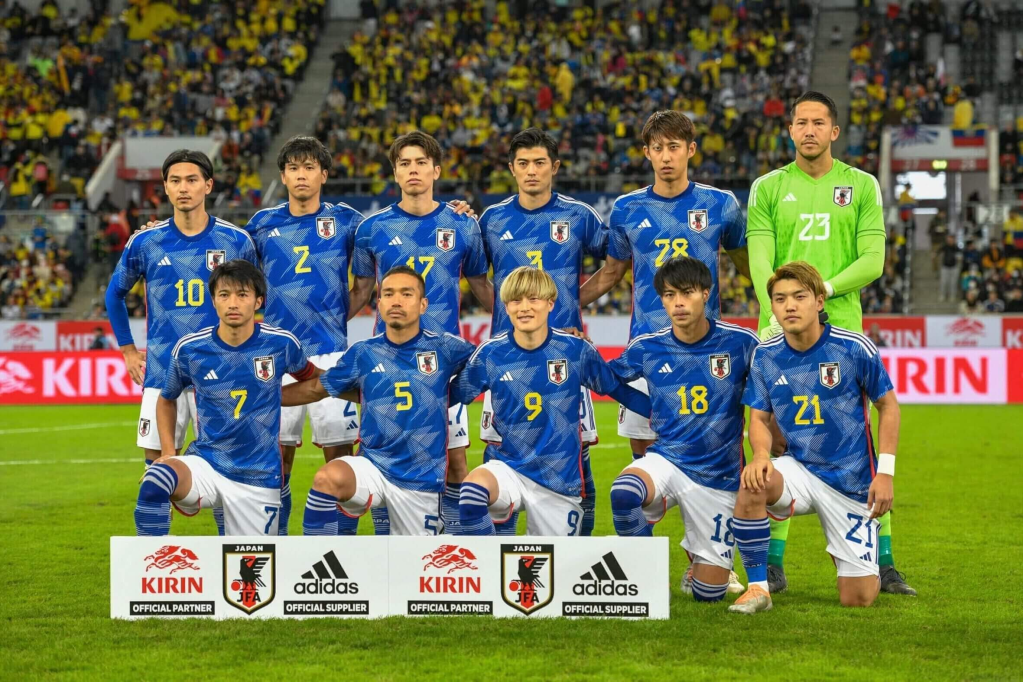
Bonjour/hi and Bienvenue au Canada/Welcome to Canada! This Round of 32 matchup will kickoff by the shore of Lake Ontario in Toronto, Ontario, Canada with two teams sure to garner heavy local support in Portugal and Croatia. Around 300,000 people of Portuguese and Croatian descent live in Toronto alone, with many more within a short trip to Toronto Stadium. Expect the stadium to be packed and loud, with plenty of red! It’s like they’re paying tribute to Canada with the red of Portugal up against the famous red-and-white checkerboard of the Croatian kit. Let’s get into the football:
Toronto Stadium (aka BMO Field), with Lake Ontario in the background.
How They Got Here:
Portugal had one of the more difficult European qualification groups, with very solid Ireland and Hungary sides alongside them (and a less solid Armenia). Portugal topped their group by 3 points, drawing Hungary and losing to Ireland once, but winning their remaining 4 matches. The player formerly known as Cristiano Ronaldo (don’t come for me CR7 fans) led Portugal in scoring over qualification, having scored both goals in their 2-2 draw with Hungary, another against Ireland, and two more against Armenia. Playing as the centre-forward, as he has for some time now ever since Father Time managed to affect him and he’s become less mobile, Ronaldo is the clear focal point of the Portuguese team when he is on the pitch, for better or for worse. More on that later.
Portugal arrived at the World Cup in a group alongside Colombia, DR Congo, and Uzbekistan (making a surprise World Cup appearance!). Portugal’s group stage was anything but dominant. Starting against the DR Congo, Portugal controlled the vast majority of the ball but with little threat. Joao Neves scored a nice headed goal from a late-arriving run to the box to put Portugal up in the 6th minute, and after that Portugal didn’t look like threatening. Bruno Fernandes did his best to create chances, but Portugal’s finishing was very poor, not managing a single shot on target after their opening goal. Yoane Wissa struck for DR Congo in first half stoppage time to level the match, and Portugal maintained possession-without-threat for the remainder of the match which ended 1-1. They handled the Uzbeks 5-0 on MD2 convincingly, with not much to be learned from the match tactically. MD3 saw Portugal take on Colombia, with the winner taking the group while a draw would see Colombia finish 1st. Colombia really had all of the attacking threat in this game. They’re a dangerous side who can go toe-to-toe with any team at this tournament and were the better side. The Portuguese front-3 of Joao Felix, Ronaldo, and Pedro Neto were shockingly poor as Portugal managed just two shots on target from their 13 attempts. Colombia thought they had won the match at the death from Davinson Sanchez’s header at the back post, only for it to be ruled out offside by a single toe’s length. The match finished 0-0 with Colombia deservedly finishing 1st, sending Portugal to Toronto to face Croatia.
Croatia had just the Czechs to contend with in their qualifying group realistically, as the Faroe Islands, Montenegro, and Gibraltar were the remaining opponents. Croatia won all their matches aside from one draw with the Czechs and finished top of the group with ease. They were drawn into a difficult World Cup group, alongside England, Ghana, and Panama. Even the supposedly weakest team in the group, Panama, is no easy match. Croatia began their tournament against England, and despite conceding more chances in the first half, were able to equalize twice for a 2-2 scoreline going into halftime. In the end, England created 3.2xG to Croatia’s 0.7, and came away 4-2 winners in the end, leaving Croatia on the back foot going into MD2. A crucial matchup against Panama awaited and while Croatia did create more chances and hold more of the ball than Panama, it was a relatively cagey even match. Both sides failed to convert their chances, until Ante Budimir managed to break the deadlock in the 54′. Croatia stood strong under a wave of Panama attacks as the match neared its finish and held the clean sheet to secure 3 points.
On 3 points and with a -1 GD, Croatia couldn’t afford to lose their final match against Ghana and hope to advance. The Ghanaian defence was excellent on MD3 and were really a textbook example of how to play a 4-4-2 mid-to-low block. The game was back and forth, with Ghana threatening on the counter when Croatia lost the ball. Petar Sucic struck a lovely daisy-cutter strike from outside the box through a Ghanaian defender to give Croatia the lead in the 31′ against a defence that wasn’t allowing much more than long shots. The game was even after the goal until an extended spell of Ghanaian pressure led to a Luckassen equalizer in the 73′. Croatia’s captain and greatest ever player, Luka Modric, showed that class is permanent though, assisting a Nikola Vlasic header in the 83′ to regain the lead and secure the win for Croatia. They would finish 2nd in their group behind England, setting up this clash against Portugal.
What To Expect(Playstyle):
Expect Portugal to have the majority of possession in this match, and by a good margin. From GK up to Bruno Fernandes at the #10, this Portugal team is world-class. The midfield trio of Neves, Vitinha, and Bruno is probably the best midfield at this tournament. Nuno Mendes is the best LB in the world. Joao Cancelo and Ruben Dias are top-class players who have played on the biggest stage countless times. Diogo Costa in net is as good as any keeper not named Thibaut Courtois. This means Portugal can easily play through a press, retain possession, and dominate the midfield battle. Where they start to falter is in the final third. There’s no beating around the bush here, Cristiano Ronaldo is the main player holding this team back. If he were willing to accept the squad role of the aging veteran who can pass along their knowledge and be a role model for the younger players while coming on for the last 30 minutes of a match when Portugal need a goal, things would be different. That’s never been who Ronaldo is nor a role he would accept. While being very immobile and glued to the opposition CB’s, Ronaldo demands the ball at all opportunities. This is rather predictable and when he’s had shooting chances, they’ve been off-target more often than not. He doesn’t move off the opposition backline to try and draw defenders out of position or open up space for himself. I’m not saying he’s incapable of being an effective centre-forward right now, but that is the case if he continues with his current playstyle. Portugal overall are too predictable in the final third and hold a lot of possession without ever threatening to create a chance. This is what gives Croatia hope.
Croatia has never been a side reliant on dominating a match to win. They never give up and have proven time and time again at major tournaments that they know how to find a way. While the aging stars like Modric, Perisic, and Kramaric have been the faces of this Croatian team for the past decade, they are not without fresh talent. Luke Vuskovic is arguably the best CB of his age right now and is coming off a dominant season in the Bundesliga having only turned 19 years old in February. Luka Sucic (cousin of Petar) is seen as Croatia’s heir to Modric’s midfield role in the national team. The Real Sociedad midfielder has bundles of technique and can be a real difference maker on the ball for Croatia. We could see Josko Gvardiol make a start, a very strong defender already in his prime at Manchester City. Como’s Martin Baturina, formerly of Dinamo Zagreb, has had a great tournament so far and has been a constant in a midfield/wing hybrid role. Croatia will not need extended spells of possession to create chances and score goals. They’re dangerous from outside of the box and on set pieces. If Portugal fail to create chances with their possession, Croatia will have ample opportunity to win this match. Based on what we have seen so far from each side, this seems to be the likely way this match will go.
If Portugal have an uncharacteristically clinical match in the final third, it is possible that they run away with it. Croatia will find it hard to score 3 or 4 goals in the match, which is the rate Portugal is capable of if things fall their way. I do not have confidence in Portugal to be at their best and expect a tight match. Extra time and penalties are a very real possiblity!
Result?:
I back Croatia to advance based on what I’ve seen so far. For the sake of a prediction, I’ll say Portugal 1 – 2 Croatia.
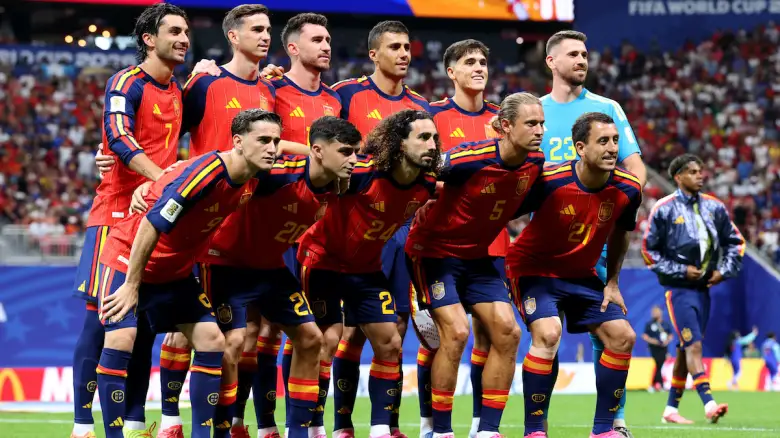
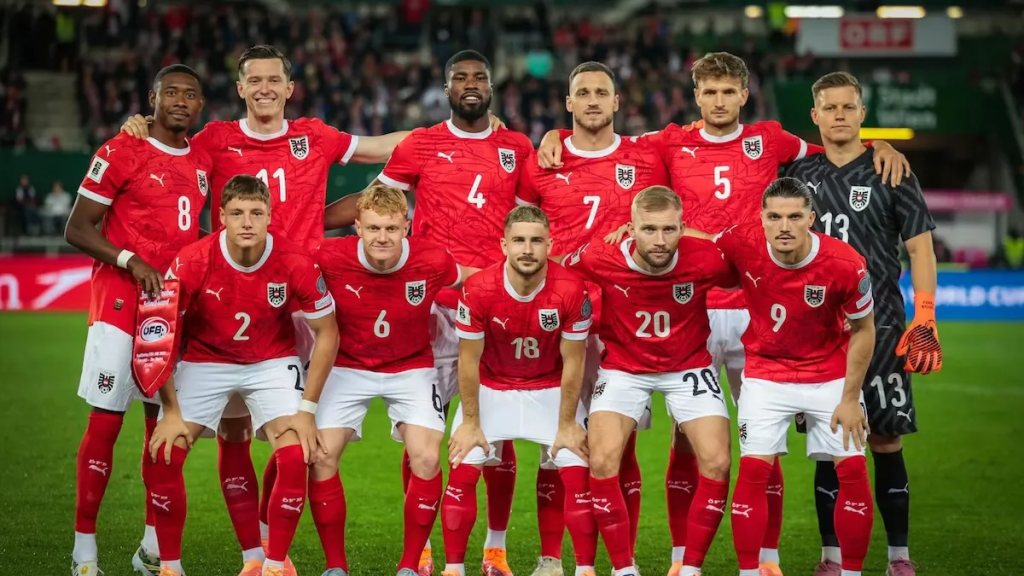
Good Morning/Afternoon/Evening to all, wherever you are reading this from! I’m going to be looking at the upcoming Spain v. Austria R32 match being played out of Los Angeles, California. The winner of the Portugal/Croatia match will meet either Spain or Austria in the Round of 16.
How They Got Here:
Spain breezed through World Cup qualification (as expected), in a group with Turkiye, Georgia, and Bulgaria. Aside from one draw with Turkiye on the final matchday after the group had already been won, Spain obtained max points from all of their matches, strolling into a World Cup group alongside Cabo Verde, Uruguay, and Saudi Arabia. As the favourite to top this group, Spain would look to exert themselves on their opponents in the group stage. Their tournament did not get started as planned though, failing to put a ball past Vozinha in the Cabo Verde net over 90 minutes of offensive pressure. Spain attempted 27 shots (for a total of 2.1xG), put 7 on target, but the 40-year old Cabo Verdean keeper was up to the task. Luis de la Fuente started with Lamine Yamal on the bench: Ferran Torres and Gavi flanked Mikel Oryazabal in a front 3 without a ST, while PSG man Fabian Ruiz joined Rodri and Pedri in midfield. This result would not do, and so in Spain’s next match needing a win against Saudi Arabia, Ferran, Gavi, and Ruiz were swapped out for Yamal, Alex Baena, and Dani Olmo, respectively. Apparently having your star player on the pitch is helpful, as Lamine Yamal scored 10 minutes into the match and Spain never looked back. Mikel Oryazabal, Spain’s hero of Euro ’24, added a brace, while an own goal gave Spain a 4-0 victory and all 3 points. Just a draw against Uruguay in the final match would be enough, and we saw Luis de la Fuente start Mikel Merino in place of Dani Olmo, a much more defensive-minded change. Uruguay did not threaten much at this tournament in general, and once Baena put Spain up 1-0 off a Fernando Muslera error in goal, the result seemed settled. Uruguay would manage one shot on target in the 2nd half and bow out of the tournament unceremoniously. Spain topped the group that they were always expected to, and booked their place in Los Angeles for the R32.
Austria had a more difficult UEFA qualification group, alongside Romania and Bosnia and Herzegovina. The Bosnians were the biggest test for Austria, who handled them well with a win and a draw to top their qualification group. Their World Cup group consisted of Argentina, Algeria, and Jordan. Austria is currently the #24 ranked nation in the world, and were not considerable favourites to qualify ahead of Algeria (#28). Austria’s tournament began against Jordan, their lowest-ranked group opponent. While Jordan created some chances and managed to score a goal, Austria was always in control of this match and ran out 3-1 winners. They would face the reigning holders Argentina on MD2, and frankly were given a reality check. Austria failed to convert the spells of possession they had into scoring chances, and so were punished with a Messi brace that could’ve been a hat-trick if not for a missed penalty. Ralf Ragnick made two changes from his starting XI v. Jordan, bringing in young Paul Wanner to play as the #10, and Michael Gregoritsch at CF. Both players did struggle to have an impact against Argentina, along with Xaver Schlager, who was overrun in midfield. Going into the final matchday, Austria needed a draw or better against Algeria to ensure qualification. This was a weird match, with the winner of the match knowing that their reward would be Spain in the R32, while the loser of this match would go to Vancouver to play Switzerland in the R32. There was legitimate incentive for Austria to lose this game and avoid Spain in the R32, although trying to lose in order to get a “favourable” draw has never really worked out for a team in the past. Algeria dominated possession in this match, knowing they needed to win and holding 65% of the ball over the 90 minutes. Ragnick went for his most defensive lineup yet, playing a “fake” 4-2-3-1 that deployed defensive midfielders as the wingers in Sabitzer and Laimer. While capable playmakers, neither player is a winger, and this formation looked primed to drop into a 4-4-2 block and try to avoid losing. This game was back-and-forth, with Austria opening the scoring through Arnautovic in the 28′, and adding a second from Sabitzer in the 55′, getting pegged back by Algeria on both occasions before a 93′ goal from Riyad Mahrez looked to send Algeria on their way to 3 points and a date with Spain. Late substitute Sasa Kalajdzic equalised for Australia in the 90+6′, which gave them 2nd place in their group and this matchup against Spain.
What To Expect:
While starting lineups are not confirmed yet, we have seen the various team selections of Luis de la Fuente for different match-states, and will be able to tell what approach he is taking today with his starting XI. I expect a front 3 of Baena, Oryazabal, and Lamine, which looks to be de la Fuente’s first-choice by now after the unfortunate injury to the brilliant Nico Williams who would certainly start at LW. In midfield, Rodri and Pedri are near locks to start, with the question being who will join them? Option A: Fabian Ruiz, Option B: Dani Olmo, or Option C: Mikel Merino. (Gavi and Martin Zubimendi are available for selection, but I do not expect them to start in midfield today). The backline has been unchanged at this tournament, so it is relatively safe to expect a back-4 of Cucurella, Laporte, Cubarsi, and Llorente in front of Unai Simon in net. Expect Marc Cucurella at LB to constantly get forward in possession and leave significant space behind him that can be exploited in transition. If Austria are smart, they will not press Aymeric Laporte in the backline and only apply pressure to Pau Cubarsi. Laporte is very likely to turn the ball over by himself if left in space and is the worst of the Spanish backline at build-up. Marcos Llorente at RB will get forward, but have a much more defensive role than Cucurella. He has the engine to run up and down the flank all match and is a valuable player for Spain. The Spaniards will look to control possession and the match, without playing too high-tempo or directly. The midfield trio are favoured to retain possession against Austria’s press, and they will be looking to feed passes to Baena and Yamal on the wings often. In attack is really where Spain have the most potential to be stopped. They are not playing with a true #9 and have no real attacking focal point for crosses and balls into the box (however, playing sans-striker wasn’t an issue from 2008-2012 when Spain won 3 straight major tournaments doing so). Much of Spain’s final third chance creation comes down to individual players winning their 1v1 matchups and drawing in defenders before finding a teammate. The ball will go through Lamine Yamal, a LOT. Spain will try to manipulate the Austrian defensive structure with short passing and interplay, waiting for the ideal passing lanes to open.
Austria on the other hand, know that they will be without the ball for much of this match, and that they will need to pick their moments to press well or risk exposing their backline when pressing high. This 4-2-3-1 with DM’s as wingers could be effective against Spain! In theory, Austria would have Sabitzer (at LW) tracking back to double-team Yamal alongside captain David Alaba (at LB), with a much greater capacity to contribute defensively than a true winger would. Alaba will have the undesirable task of being Lamine Yamal’s primary marker today. If he’s beaten, then considerable pressure can fall to the Austrian CB pairing of Kevin Danso and Philipp Lienhart to leave their positions and press. The decision-making of the Austrian defence in who to mark and when will be very important to their chances of success today. Filling out the backline in front of Alexander Schlager in net, is Como’s Stefan Posch. Posch will likely be Austria’s only forward-thinking FB today, and he has the ability to create big chances for his attackers and contribute with goals himself.
Xaver Schlager and Niclas Seiwald form the double-pivot in midfield. The Leipzig duo has existing chemistry in midfield together and have been solid for Austria at this tournament. Schlager is a little more defensive-minded, while Seiwald is more of a creator from deep who will make forward runs in possession. There will likely be times where Schlager and Seiwald are further forward than Austria’s “wingers”. Romano Schmid, off a fine season with Werder Bremen in the Bundesliga, should start at #10 today and be one of the few Austrians who can think about attacking transition for most of the match (he may be asked to man-mark Rodri for the whole match, keep an eye on this). Up top, we should see Marko Arnautovic, the main man for Austria, provided he is fit to play. Arnautovic suffered an injury in the final group stage match against Algeria. If he is not fit, Kalajdzic or Gregoritsch will likely start.
My concern with Austria’s chances of winning is that I do not see how they will create chances or score a goal against Spain. While their setup does look defensively robust, I think the best it can hope for is taking Spain to penalties. However, keeping Spain out of the net has been a decent strategy so far. Outside of the Saudi Arabia game, Spain scored just 1 goal over their other two matches in the group stage. Austria can play off the fact that Spain do not have a target forward or true #9 starting (while Borja Iglesias off the bench can provide this profile), allowing one CB to be free from marking Oryazabal and able to apply pressure to Spain’s other threats. When they manage to win the ball back, I don’t see a consistent path to goal for Austria. They will likely rely on a moment of magic (or a mistake by the Spanish defence) to score in regulation, unless Spain plays poorly today and cannot retain possession as expected.
My concern with Spain’s chances of winning are that they’ve already struggled to create chances against Uruguay, and struggled to convert them against Cabo Verde. If one of the Spanish players can’t produce a moment of individual brilliance to create a goal, this could be a stalemate that goes into extra time. If Spain manage to score early, this game is essentially over. Austria are very poorly set up to chase this game if they go behind.
Result?:
I predict a tight match, but one dominated by the Spanish. Austria will make life difficult for them, but I think it would take something special for Austria to win today. Keeping Spain off the board for potentially 120′ would be an incredible achievement, and one that is not impossible.
Today we have another exciting matchup between FIFA’s #33 and #31 ranked nations: Côte d’Ivoire and Norway. In a matchup without a clear favourite, where neither side has extensive World Cup knockout experience, there is potential for brilliance, mistakes, and a lot of scoring chances.
How They Got Here:
Côte d’Ivoire steamrolled a CAF qualification group that was no guarantee, with the likes of Gabon, Gambia, and Kenya alongside them, picking up 8 wins and 2 draws while scoring 25 and conceding 0. That’s right, Côte d’Ivoire did not concede a single goal in qualifying. It doesn’t matter what team, federation, or opponents, keeping 10 straight clean sheets shouldn’t be realistically achievable. Their scoring was also impressively by committee. Top scorer Seko Fofana had just 3 goals in qualifying, while another eight players had 2, and six more Ivorians contributed a goal over their qualifying run. That’s fifteen different goalscorers, which is very enviable depth scoring going into a major tournament where it is needed more than ever. Côte d’Ivoire are the real deal, and have potential to go far in this tournament if they win today. They’re very solid in defense, and can hurt you in endless ways in attack.
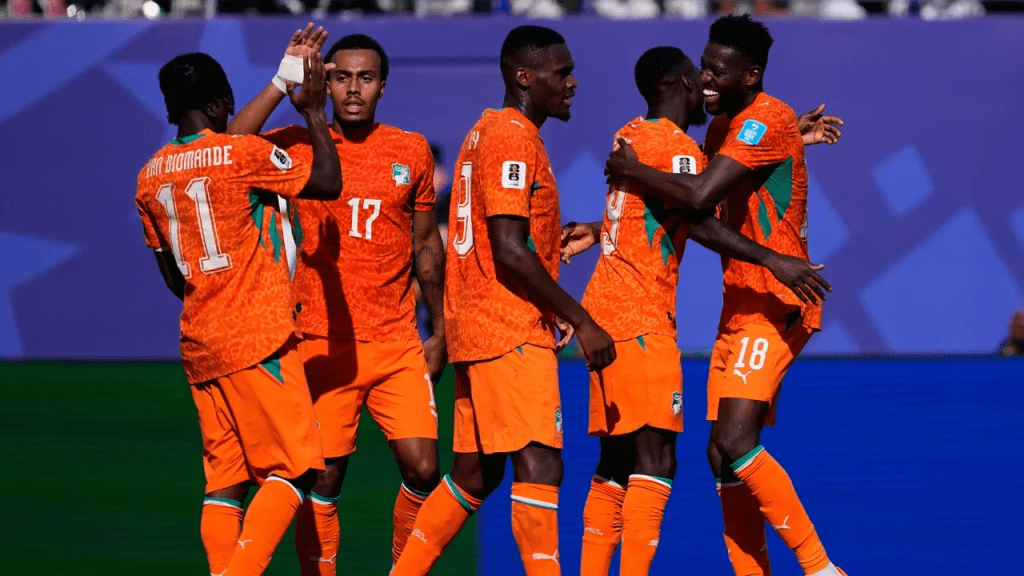
The Ivorians were drawn into a group with Germany, Ecuador, and Curaçao, with most initial predictions having them and Ecuador in a close race for 2nd place in the group. Starting the tournament against Ecuador, Côte d’Ivoire were the clearly better side in what was a back-and-forth game at times. Both goalkeepers made fantastic saves, but Amad Diallo found the back of the net in stoppage time to give Côte d’Ivoire a 1-0 victory. In their second match against Germany, Côte d’Ivoire were the marginally better side in the first half despite having only 39% possession. While Germany attempted to double-team the Ivorian “golden boy” Yan Diomande (as his team refers to him) for the entire match, Leroy Sané failed to track back on one key occasion, leaving Diomande 1 on 1 with Joshua Kimmich. While a legend of the game, there was no way Kimmich could keep up with Diomande at his age, and the Ivorian winger beat him to the goal-line before lashing a ball across the box that would’ve been an assist had Germany not made a goal-line block on the initial shot. However the ball fell to Franck Kessié who made no mistake, putting the Ivorians up. The second half saw Côte d’Ivoire attempt to protect their lead, which if you read the Germany preview, ended in the Denis Undav show, 2-1 Germany. The Ivorians needed a result against Curaçao to advance, which they obtained comfortably by the margin of 2-0. Ecuador’s draw to Curaçao gave Ivory coast 2nd place in the group, only losing out to Germany on the H2H matchup result.
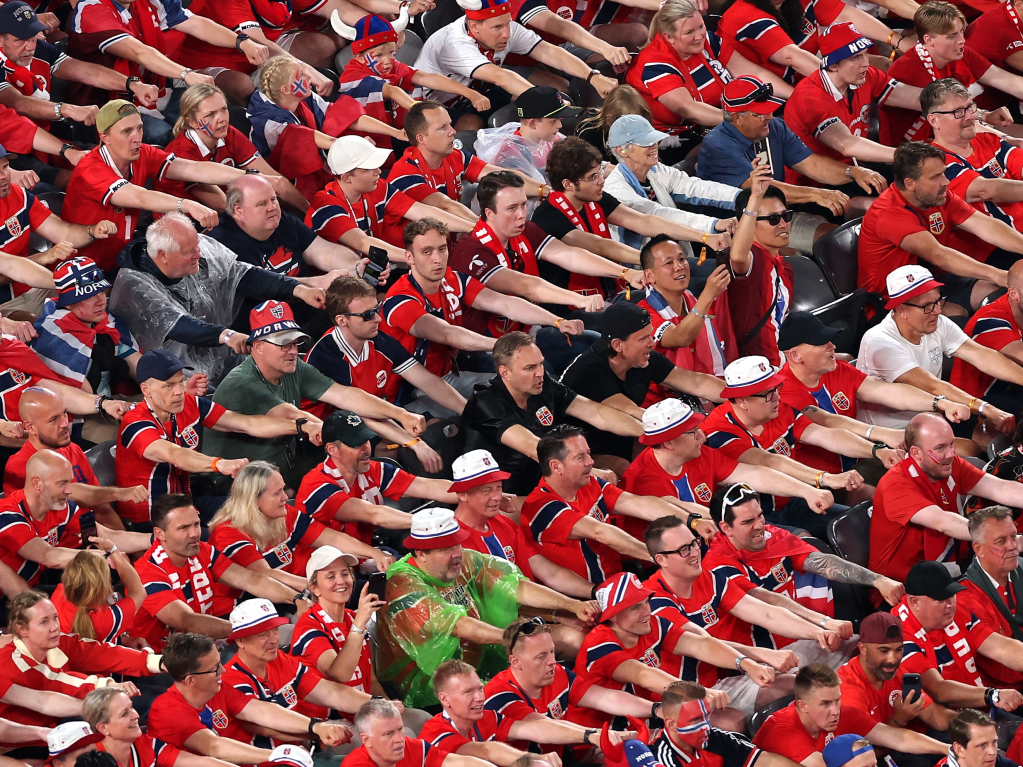
Norway had a much less-certain path to qualification, something that has not been the norm for Norway in recent editions of the World Cup, where they have often stumbled at this UEFA qualification hurdle. This year was different and Norway had a point to prove. In a group with Italy, who many favoured to qualify, Norway were perfect. 8-0-0 with a +32 goal differential over fellow European nations such as Italy, Estonia, and Moldova, and the vikings were en route to the World Cup. Norway arrived to what many saw as one of the tournaments “Groups of Death”, alongside France, Senegal, and Iraq. Both France and Senegal have considerably more World Cup experience than Norway and this group would prove a good test. Norway got a bit of schedule-benefit, starting their tournament against Iraq, and dominating with a 4-1 win. This set up a crucial clash with Senegal on MD2, with the winner of this game being in pole position to qualify in 2nd place behind France. Norway showed both their strengths, going up 2-0 just after halftime, but also the cracks in their team, conceding a goal just 5 minutes later to bring the result back into doubt. Erling Haaland was on form in this match, and he struck again 5 minutes after the Senegal goal to restore Norway’s 2 goal lead. This lead would prove crucial as Ismaila Sarr would add another goal in the 90+3′, but Senegal’s comeback would fall just short and Norway took a thrilling 3-2 victory that ensured their qualification to the knockouts in 2nd place at worst. Manager Stale Solbakken decided that winning the group against France on the final day was unachievable and rested 10/11 starters, including the keeper. “Norway B” if you will, performed admirably against France but there was a gulf of a difference in class between Ousmane Dembélé and any Norwegian defender who tried to challenge him. A hat-trick for the Frenchman and Norway finished 2nd in their group, setting up this clash against Côte d’Ivoire.
What To Expect (Playstyle):
Côte d’Ivoire’s success is built upon their strong defensive foundation. They have the players to start multiple backlines of World Cup-quality, and have a very strong defensive record. Franck Kessié and Ibrahim Sangaré offer good protection for the backline in rest-defence and break up plenty of opposition counter-attack before they reach the Ivorian final third. They can play direct, or build out from the back. Look for Guela Doué to get forward down the right flank from his RB position and overlap for Nicolas Pepe at RW, who will be looking to cut inside onto his left. Young target-man Ange-Yoan Bonny of Inter Milan starts up top, and will look to be the attacking focal point for crosses and balls into the box.
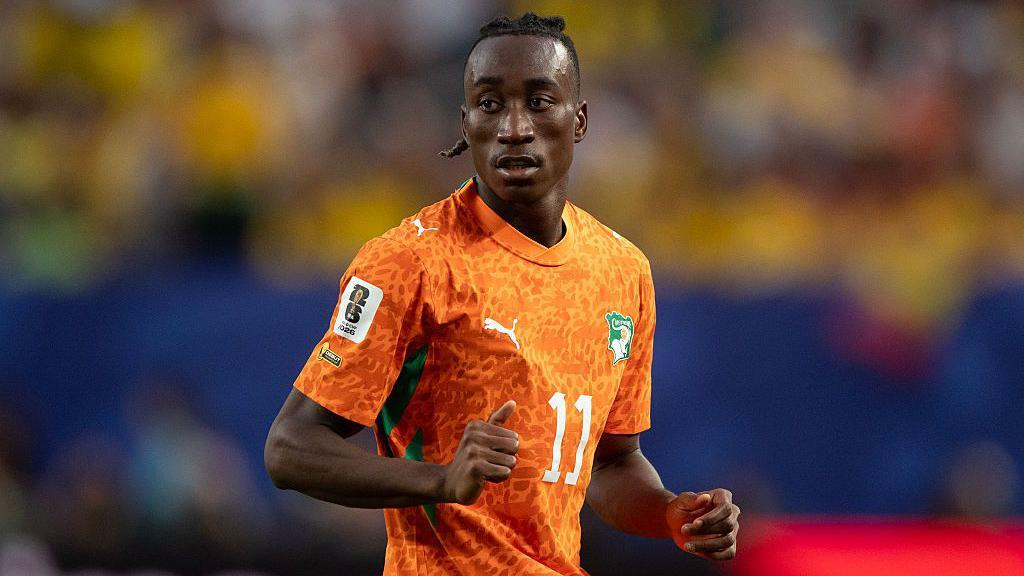
At LW is Yan Diomande, the danger man for Côte d’Ivoire. A 1v1 dribbling specialist, Diomande will require constant double-teams from the Norwegian defence. Côte d’Ivoire like to create chances through their wide players, with the wingers looking to get balls into the box as often as possible. The midfielders crash the box very well and will be in position to be a threat on second phase balls. If Norway look to double-team Diomande, keep an eye on how this affects the rest of their defensive structure.
Norway will play this match in a 4-3-3 formation, which is really more of an offset 4-4-2. Haaland and Sorloth are the two strikers, with Sorloth playing at RW and being the main man for Norway as an outlet. They’ll look to direct defensive clearances his way, with Sorloth operating as a wide target forward. Antonio Nusa is a very exciting winger who starts on Haaland’s left, and is the only natural winger in the Norway starting XI. He will look to have a lot of the same impact as Yan Diomande will for the opposition and get past Guela Doué in their 1v1 battles. Patrick Berg, Sander Berge, and Martin Odegaard start in midfield. Expect Odegaard to get forward and also to drift onto the RW in possession as Sorloth moves centrally. He is Norway’s primary chance creator, and if he receives the ball in space he has the ability to send Haaland in alone on goal. Berg and Berge (two different players, yes) will play more as a double-pivot, with Berge as the 6 and Patrick Berg as the 8. Patrick Berg is a natural 6 for Bodo/Glimt, but can get forward in attack and showed his ability in assisting Haaland’s 2nd against Senegal.
In defense, Norway will rely a lot on their FB’s, David Moller Wolfe and Marcus Holmgren Pedersen, both to defend the dangerous Ivorian wingers, and to get forward in attack to send crosses into the box. The partnership between Moller Wolfe and Nusa on the left has been very good this tournament, with both players showing strong chemistry with one another. Holmgren Pedersen replaces the injured Julian Ryerson, and will be the man tasked with Yan Diomande. Torbjorn Heggem and Kristoffer Ajer are the CB pairing who will have plenty of decisions to make in box defence against the waves of attack that Côte d’Ivoire bring.
This match will come down to how well Norway can get the ball to their front players in space to make an impact, and how well they can defend the Ivorian wingers. If Côte d’Ivoire can prevent Norway’s midfield from sustaining possession and contributing to more controlled buildup, then their backline will have a good chance to win duels on Norways direct aerial balls. Norway will have to push players forward to break this Ivorian defence, unless Haaland can play at the inhuman level he is capable of. They will be very exposed in transition and I do expect Côte d’Ivoire to take advantage of this. Côte d’Ivoire likely want this game to remain low-event and scoreless for as long as possible, sap the Norwegians confidence, and strike late with impact subs. It really could go either way. Both teams have a point to prove in the World Cup knockouts without the experience of having been here before.
Result?:
With the obvious disclaimer that this is a match who’s result is up in the air, my prediction is a 1-goal victory for Côte d’Ivoire, either 1-0 or 2-1.
One of the biggest heavyweight matchups of the R32 sees FIFA’s #7 and #8 ranked nations go up against one another when the Netherlands take on Morocco. This has potential to be one of the best R32 matches at the 2026 World Cup and I would not recommend missing it!
How They Got Here:
The Netherlands were able to qualify through UEFA with relative ease, in a group alongside Poland, Finland, Lithuania, and Malta. An undefeated 6W, 2D qualification run saw the Dutch top the group, 3 points ahead of Poland. Goal-scoring was the theme of the Dutch qualifying run, finishing 4th in UEFA qualifying for team goals scored, led by Memphis Depay’s 8 and Donyell Malen’s 4 goals. This led them into a World Cup group with Tunisia, Sweden, and Japan. Opening the tournament against a very strong Japanese side, the Netherlands were able to dominate possession (as expected), but struggled to break through the Japanese defence regularly, creating just 0.7xG from 10 shot attempts. Virgil van Dijk showed that he’s still a formidable presence on set pieces with a goal from a corner kick, before Crysencio Summerville announced his arrival to the Oranje with a lovely solo effort. Japan managed to peg them back each time including a 88′ Kamada equalizer which left the Dutch feeling like they had let 2 points slip away. With no room for error left if they wanted to top the group, Ronald Koeman’s side came out very strong against Sweden in a match that was more end-to-end and open than the first. This suited the Dutch well, who did very well with only 50% possession, creating 2.6xG and putting 5 past Sweden en route to a 5-1 victory. Brian Brobbey and Cody Gakpo both had a brace, with Summerville adding the 5th. A win over Tunisia would put the Netherlands in good position to top the group on goal differential over Japan. Brobbey struck again after an early own-goal gave the Dutch the lead, and the Netherlands won relatively comfortably, 3-1 the final. Japan’s draw with Sweden saw the Netherlands win the group and move on to the R32 today.
Morocco were given a fairly easy qualification group for a team of their standard, alongside Niger, Tanzania, Zambia, and (People’s Republic of the) Congo. Eight matches, eight wins, 22 goals scored and only 2 conceded. This was no real test for arguably the best side in Africa, and the Atlas Lions strolled into the World Cup finals to a group alongside Brazil, Haiti, and Scotland. In their opener against 5-time champions Brazil, Morocco made a massive statement. Ismael Saibari, a standout on this Morocco squad coming off a fine season at PSV Eindhoven, got Morocco off to a dream start with his goal in the 21′. While Morocco held Brazil at arm’s length for most of the match and fully dominated the midfield, one moment of Vinicius magic was enough to get Brazil a draw they frankly did not deserve. Morocco was very close to winning this match at the death if it wasn’t for a double-save from Alisson. In their second match against Scotland, Morocco started quickly with a goal in the 2′ from Saibari again, which against this Scotland side meant the game was fully in their grasp. Morocco showed their ability to hold a lead and prevent their opposition from generating scoring chances, coming away with a 1-0 win, before dominating Haiti 4-2 to finish the group. Morocco would end up finishing 2nd in the group behind Brazil on goal differential, leading us to look back at Alisson’s performance to earn Brazil that draw against Morocco and in turn, the group.
What To Expect (Playstyle):
For the Dutch, the name of the game has been and likely will be “Total Football” for years to come. In essence, this means that roles and positions on the pitch can be filled by any player, so long as all required roles are filled. Fullbacks and wingers need to be able to interchange seamlessly with one another, their #6 can drop into the backline to cover for a forward-running CB, and the front 3 attackers can and will rotate with one another often.
Today, Koeman will likely start Cody Gakpo and Donyell Malen on either side of Brian Brobbey up top. Brobbey is the physical target man who will cause chaos in the box, Malen is the pacey inside-forward who threatens space in-behind and can contribute goals, while Gakpo is the main attacker in this side. While he might not always have the best returns for club, Gakpo has been at his best putting on the orange shirt in recent international tournaments. Off the left, he’ll be looking to constantly cut inside onto his right foot and get shots away. Behind them in midfield is a trio of Tijani Reinders, Frenkie de Jong, and Ryan Gravenberch. Reinders is a very good footballer, don’t get me wrong, but he is the weak link of this midfield. Frenkie de Jong is one of the most press-resistant midfielders on the planet and an ideal #6 for how the Netherlands want to play, while Gravenberch has developed into one of the better box-to-box midfielders in the Premier League. Micky van de Ven, arguably the fastest player in the world (and certainly the fastest defender) starts in his usual LB role for the Dutch, while being a natural CB at club level. His pace and progressive carrying of the ball can be very impactful moving forward, but his natural CB profile allows him to seamlessly tuck in alongside van Dijk and van Hecke to form a back-3 (the 3-4-3 system has always been popular in the Netherlands for its versatility and application to Total Football). Denzel Dumfries at RB is a more natural wingback and will get further forward more frequently. The Inter Milan man is a constant threat down the right flank and will require Morocco’s LW’s to track back often, limiting their potential to get forward. Bart Verbruggen is between the sticks, having been the Netherlands’ clear #1 for some time now.
For Morocco, Ismael Saibari starts up top and has been the main man for Morocco all tournament. He is a considerable goal threat and will demand elite defending out of the Dutch backline. Brahim Diaz and Bilal El Khannouss should flank Saibari in attack, providing plenty of pace and creativity in support. Both Diaz and El Khannouss are natural #10’s who can also play W, so you can expect them to be very comfortable moving across the width of the pitch to affect the play anywhere. There is a very hard-working and talented midfield behind the front 3: Azzedine Ounahi glides across the pitch with little effort and can cover every blade of grass in the match. He will start as Morocco’s #10 but will put in a lot of work out of possession. Behind him alongside Roma’s Neil El-Aynaoui is the star of the Morocco midfield: Ayyoub Bouaddi. Still only 18 years old, Bouaddi switched over from the French youth system to be named into the Morocco World Cup squad before he had even made his senior debut for the country. He’s that good, and Morocco knew it. Bouaddi oozes composure and class on the ball, is very strong from box-to-box, and can unlock the defence with dangerous long passes. This midfield battle today will be excellent to watch.
Morocco have very capable FB’s who have played at the top level for years in Mazraoui and Hakimi, who will be tasked with defending Gakpo and Malen today. Morocco’s biggest weakness in their team is at centre-back. Fulham’s Issa Diop and Crystal Palace’s Chadi Riad start for Morocco. Neither player was a regular starter in the Premier League this past season, and compared to the wealth of talent Morocco have elsewhere on the pitch, this is a relative weakness. Brian Brobbey has a very solid chance of wreaking havoc on Diop and Riad today, and Morocco will need to ensure that El-Aynaoui stays in front of his backline and doesn’t venture too far upfield in possession.
The Dutch will attack with versatility and numbers. It will be up to Morocco to track their offensive rotations and ensure that enough defensive support is provided to their CB’s. Set pieces will be another area that I anticipate the Dutch to have an advantage in and be able to score goals from. If this game gets open and starts going end-to-end, this suits Morocco much better.
It’s almost impossible to predict the outcome of this match. Can the Dutch find a way to stop Ismail Saibari and win the midfield battle? Or will we see Ounahi and Bouaddi frustrate the Netherlands’ attempts to get the ball up to Gakpo and Brobbey? Either way, expect a lot of this match to be played between the half-spaces, with both teams looking to pack the middle of the pitch in attack, employing wide players who like to cut inside. We should be in for a good one. Short Summary:
Netherlands 4-3-3 with heavy rotations in-possession, looking to create chances from around the edge of the box and on set pieces.
Morocco 4-2-3-1, FB’s getting forward in possession, both wingers tucking inside, midfield in support, weakness at CB.
Result?:
While this is a very close matchup that could go either way, I see the Netherlands winning narrowly if the game finishes in 90 minutes, but Morocco taking the victory if it goes to extra-time / penalties.
Next up, we have FIFA’s #10 ranked nation Germany up against #41 ranked Paraguay in the third R32 match of this 2026 World Cup. Germany are the heavy favourites heading into the match but as we all know, anything is possible!
How They Got Here:
Germany, after being eliminated in the group stages of the 2018 and 2022 World Cup, had a clear point to prove to themselves, their country, and the world, going into this World Cup qualification cycle. However it did not start off as planned (let me have this one, please) with a historical defeat at the hands of Slovakia in Bratislava, putting Germany’s qualification out of their hands on MD1. Germany took this defeat personally it seems, won all of their remaining qualifying matches (while Slovakia lost to Northern Ireland, sigh), and got revenge on Slovakia with a 6-0 win on the final day of qualifying to top their group and automatically advance to these World Cup finals.
Drawn into a group alongside Curaçao, Côte d’Ivoire, and Ecuador, Julian Nagelsmann’s squad started their tournament against the World Cup debutants of Curaçao. Six minutes in, Felix Nmecha opened the scoring and just about everyone watching thought we were on our way to a true “Welcome to the World Cup” moment for the small island nation (the smallest population to ever qualify for the World Cup). In the 21′, Livano Comenencia sent Willemstad into a frenzy as his edge of the box strike found the back of the net past Manuel Neuer, a goal surreal to its scorer, who was seeing Neuer outside of a FIFA video game for the first time in his life. After the incredible product of American innovation known as the “Hydration Break”, where Germany got time to regroup and make tactical changes, the game resumed with all of Curaçao’s historical momentum having been lost in service of television advertisements. When the full-time whistle blew, the scoreboard read: Germany 7 – 1 Curaçao. Welcome to the World Cup indeed. Germany struggled in their second match against Côte d’Ivoire, failing to make use of their chances and going down 1-0 to a Franck Kessié goal in the 30′. In the 60′, Julian Nagelsmann subbed off Jamal Musiala for Denis Undav, and the Stuttgart striker turned this match into his own. Just eight minutes later, Undav volleyed a cross into the net to level the match, before snatching all 3 points for Germany at the death with a beautiful combination of off-ball positioning and a first touch to set up the winning strike. Germany notably lost Nico Schlotterbeck to a ligament injury in this match, likely to be out for the rest of the tournament. That is their starting LCB down, with the veteran Toni Rudiger stepping into his place. After the Côte d’Ivoire match, Germany had clinched top spot in their group and had little to play for against Ecuador except preparing for the knockouts. After scoring in the 2′ thanks to Leroy Sané, Germany let off the gas pedal and allowed Ecuador to get back into the match, conceding the equaliser in the 9′ before a late goal by Gonzalo Plata send Ecuadorians into delirium, as they had just narrowly escaped being eliminated in the group stage by beating Germany. While Germany showed some moments of dominance in the group stage, they have not looked unassailable, which Paraguay will be hoping to take advantage of today.
For Paraguay, the World Cup journey started in the formidable CONMEBOL qualification, almost certainly the most difficult federation to qualify for the World Cup in. Qualification takes place over three calendar years. One group of all 10 South American teams, each team plays the others home and away, at the end the Top 6 advance to the World Cup, while #7 gets a chance in the inter-continental playoff. Paraguay sits firmly behind the South American “Big 5” if you will, of ARG, BRA, COL, ECU, and URU. This means they needed to be the “best of the rest” to get automatic World Cup qualification, which they did, finishing level on points with Brazil in qualifying and only losing out on Goal Differential. Paraguay achieved draws away to Colombia, Bolivia, Ecuador, and Uruguay, while beating Argentina, Brazil, and Uruguay at home en-route to qualification. This team is certainly no joke.
Paraguay were drawn into the host USA’s group, alongside Australia and Turkiye. Their tournament started with a stumble, a 4-1 loss to the USA in which Paraguay were in all aspects of the match, dominated. This could’ve rattled the side and sent them spiraling out of the group, but Paraguay showed resilience, earning their first 3 points of the tournament against Turkiye having held a 1-0 lead for 88 minutes, while down to 10-men for the entire 2nd half. This was a massive result for Paraguay who would certainly advance to the knockout stages with a draw or win against Australia on the final day. This match was probably the biggest “Biscotto” of the group stage, as Australia and Paraguay were both guaranteed qualification with a draw. The teams did not even combine for 1 xG in total as a goalless draw played out to send both sides through. As the 3rd place finisher in Group D, Paraguay earned the right to play Germany today.
What To Expect (Playstyle):
Germany will likely hold the vast majority of the ball and the attacking possession in this match. This German team is very balanced and can play in various styles. Today, Nagelsmann starts a backline of Nathaniel Brown, Rudiger, Tah, and Kimmich in front of Manuel Neuer. Nathaniel Brown is a very exciting young talent who I got to watch dominate the U21 European championship in 2025, his last matches playing as a youth international before Nagelsmann called him up to the senior team, and will be heading to Bayern Munich after the World Cup. Brown is a defensively capable player who’s real joy is found getting forward and creating chances. He can invert into the midfield without an issue alongside Aleksandar Pavlovic to allow the other member of the double-pivot, Felix Nmecha, to get further forward in possession. Rudiger and Tah provide a very physically imposing CB pair for Paraguay to try and attack today: aerial duels are not the way to success. At RB, the ever-present Joshua Kimmich will provide a more reserved attacking output, focusing on the teams rest-defence and early progression.
In front of the midfield pivot, Jamal Musiala has been dropped from the starting XI in favour of Denis Undav, with Kai Havertz moving back into the #10 role from ST to make space for Undav up top. Florian Wirtz, realistically another #10 himself, starts on the LW but will be drifting inside to the half-spaces often to combine with teammates around the box. Leroy Sané on the RW provides a more direct threat to space in-behind with his pace and goal-scoring ability. Germany will look for controlled buildup and generally don’t attempt to threaten space in-behind during early buildup (unless it is to Sané’s side of the pitch). The Paraguay press will have a very difficult task trying to disrupt Germany in-possession. Once they’ve gotten into the final third, Germany will look for shorter passes in-behind the lines to Undav, or out wide to setup a cutback. Germany will look to exert control over the match in all phases of play with their well-rounded 4-2-3-1 system.
Paraguay meanwhile, will be expected to spend much of the match in their mid-to-low block 4-4-2 shape. This is a favourite out-of-possession shape of managers playing as the underdog for many reasons. Paraguay will attempt to reduce the space in-between their lines as much as possible to limit the area players like Havertz and Wirtz have to operate in. This 4-4-2 shape may drop into a 4-5-1 in settled defence, with Julio Enciso dropping from ST into a LW position. Paraguay’s CB’s will need to have one of their best matches if they’re to handle the threat of Denis Undav, who has looked like a man possessed at this tournament. When they regain possession, Miguel Almiron on the right flank will get forward quickly in support, while Enciso will play more as a second-striker/LW, dropping off the frontline into space. Paraguay have a natural midfielder in Matias Galarza starting at LW today, and I would expect him to move centrally to form a 3-man midfield in-possession. Manager Gustavo Alfaro has opted for Junior Alonso at LB, who is more of a CB/LB hybrid player and not a natural wingback. Alonso will have the task of defending Leroy Sané. At 33 years old, it’s a question of if Alonso has the legs for this task, as he certainly has the veteran savvy to do a job.
In midfield, Damian Bobadilla is a very fun player who can provide goals as a late-arriving player to the box. He will certainly be the more forward-thinking of the two, with Andres Cubas taking up the defensive midfield role. Bobadilla and Galarza will both play as #8’s in front of Cubas at times. Anchoring the frontline between Enciso and Almiron is veteran target man, Gabriel Avalos. Standing at 1.91m tall, Avalos is the one Paraguayan attacker who might be able to challenge Tah and Rudiger in the air and will certainly be a focal point for crosses into the box. Paraguay have the ability to create chances and goals against this Germany side if the Germans aren’t careful. I don’t see Paraguay scoring more than 2 goals at most today though, so they will need to keep Germany at arm’s length for most of the match to come out on top.
Result?:
If Germany come to play today, then this will not be very close, 3-0 Germany is a very possible outcome. If Paraguay manage to nick a goal first however, then everything changes and we will start to see what this German team is made of in high-pressure moments. The longer this game stays 0-0, the more belief Paraguay will have, and belief is a dangerous weapon.
Good Day to all, we’re back with our next World Cup R32 matchup preview: Brazil against Japan. This is one of the heavyweight R32 matchups that we’re seeing at this 48-team World Cup, with FIFA’s #6 and #18 ranked nations going up against each other for a spot in the R16.
How They Got Here:
I won’t sugarcoat it, this Brazil squad is a shadow of the dominant sides that have graced past editions of the World Cup. In many positions on the pitch, the 2026 team is literally the shadow of past squads, with many aging Seleçao stars being called up by Carlo Ancelotti for the tournament. Over the group stage, the Brazil starting XI had an average age of 30, behind only Iran and Cape Verde at this World Cup for the oldest starting XI. Please don’t take this Brazil squad as a representation of Brazilian football at the moment. There are many talented players who did not receive a call for the World Cup, and I strongly believe there was a much better Brazil team available for selection. Regardless, Ancelotti went for experience, which was painfully evident in their group-opener against Morocco, who have one of the youngest starting XI’s at WC’26. Morocco dominated this game from start-to-finish, with only a moment of magic from Vinicius Jr. earning Brazil a point. This was a common trend for Brazil throughout the group stage. After a more convincing 3-0 victory over World Cup debutants Haiti, Brazil needed a win over Scotland on the final matchday to win the group. Brazil were never tested in this match. Scotland gifted Vinicius a goal in the 7′ from a miscommunication at the back and never looked like threatening. Another rather generous gift for Brazil made it 2-0 at halftime before finishing 3-0. In the end, Brazil won their group over Morocco on goal differential, which in my opinion is one of the most undeserved group wins we saw at the World Cup based on performance. In Brazil’s only real test of the group against Morocco, they failed on all accounts and were extremely lucky to come away with a draw. Going into the match against Japan, Brazil do not look prepared for a tough knockout match yet. The team as a whole is noticeably slow and lacking that Brazilian creativity and flair we know and love. At this moment, they are still overly reliant on Vinicius Jr. to be one of the best players in the world and create goals on his own. How will this approach will fare against one of the most structured, disciplined, teams at the tournament? Only time will tell.
Japan on the other hand, had a more difficult group at the World Cup after they dominated AFC qualification, winning 23 of 30 possible points, while scoring 30 goals and conceding just 3. In their tournament opener against the Netherlands, Japan played out a very even match against the #8 ranked nation in the world, conceding the majority of the ball but producing the same amount of xG threat as the Dutch. They showed great resilience to come back on two separate occasions in the match, with Keito Nakamura (one of my favourite players at this tournament, not just on Japan) washing out Virgil van Dijk’s opener, before Daichi Kamada scored in the 88′ to level the match again and earn a 2-2 draw. Moving on to Tunisia, a match where Japan was heavily favoured, Moriyasu’s men made a statement. Limiting Tunisia to just two shot attempts all match, Japan was truly the only side playing football in this match as Tunisia desperately tried to keep the ball out of their net. Another Kamada goal, a brace for Ayase Ueda, and the finisher from Junya Ito gave Japan a 4-0 win, putting them in with a good chance of winning the group. On the final day, Japan would face Sweden in a match where both sides knew they would advance with a draw. The Italians call this type of match a “biscotto”, an endearing term I enjoy, essentially meaning both teams just take a break and have some cookies together. While it wasn’t obvious that these teams were playing for a draw, there was a noticeable lack of intensity and an overall conservative mindset from both managers. Daizen Maeda and Anthony Elanga each grabbed a goal for their country, and this one finished 1-1, leaving Japan in 2nd place in Group F which set up their R32 clash with Brazil.
What To Expect (Playstyle):
With any Ancelotti team, we can expect a certain degree of “hands-off” management, something Ancelotti has found a great deal of success using when managing elite teams full of players with big egos. He provides general guidelines, but leaves the “how” to his players on the pitch to figure out. This is why when Brazil are struggling to exert themselves in a match, we are likely to see the ball forced to Vinicius Jr. as often as possible. It’s a very predictable and basic strategy, but when Brazil have a player of Vinicius’s quality, it can work. The loss of Raphinha for the tournament severely hurts Brazil’s versatility in attack, as he provided a much needed focal point on the right flank to balance out Vinicius. Ancelotti has turned to young Bournemouth attacker Rayan to take Raphinha’s place, one of only two teenagers on Brazil (the other being Endrick). In the Scotland match, Rayan showed his value and was Brazil’s best pressing forward (not something Vinicius and Matheus Cunha are excellent at). It was his pressure that led to Scotland gifting Vinicius the early goal, and Rayan created more chances vs. Scotland than any other player on the pitch. If Matheus Cunha and Rayan are playing to their strengths, this may be a long, grueling match for Japan’s defence. Brazil will have Lucas Paqueta in the #10 role supporting the front 3, and likely Bruno Guimaraes playing as the #8 alongside Casemiro but getting forward to support the attack. Casemiro is where we start getting to Brazil’s issues. The 34-year old United man is well past his best, and as the type of player who’s greatest attributes were his ability to cover ground, make tackles, and break up the play, he has not been allowed to age as effectively as a midfielder like Luka Modric for example, for whom physicality is not his main tool. Casemiro will be having nightmares trying to stop Japan on the counter when they break with numbers and pace. The aging FB pair of Douglas Santos (32) and Danilo (34) will certainly be at a risk of being taken advantage of if they try to get forward in support of the attack. I’m expecting Nakamura and Ritsu Doan in the wide roles of Japan’s 3-4-2-1 system, and I would put my money on both players getting the better of Brazil’s FB’s today. Brazil’s shape in possession should essentially be a 4-1-5/2-3-5 if the FB’s push up slightly. There will often be a large gap between Brazil’s forward and defensive lines, which is space Japan can exploit in transition if they play between the lines and force Brazil to come out of their defensive structure to press.
I do really like Japan’s tactical setup that we are likely to see against Brazil today. It’s a 3-4-2-1 that can quickly shift into a 5-4-1 in defence or a 4-3-3 in attack. If you remember watching Japan at the last World Cup under Moriyasu, the team rotations and shifts between phases of possession were well-drilled and executed to near-perfection. To handle the Vinicius problem, Ritsu Doan (RM) will be asked to track back constantly and provide a double team on Vini alongside Takehiro Tomiyasu at RCB. This leaves Japan with 2 centre-backs free to matchup alongside Rayan and Cunha, additional left-flank support in Nakamura, along with the double-pivot of Ao Tanaka and Kaishu Sano in midfield screening the defence. In terms of numbers, Japan will have the superiority when they are defending. If Brazil want to match the number of Japanese defenders with their attackers, they will need to commit several additional players forward (who do not have the recovery pace to effectively do so). If Casemiro or the Brazil FB’s get forward in attack, the Brazilian backline will be terribly exposed in transition. Not only will Brazil need to win their 1v1 attacking duels to produce chances, they will often have to win 1v2 attacking duels. Japan know that they have an incredible pace advantage over Brazil across the entire squad. This is why they will be able to happily commit more players to defending than Brazil can comfortably commit to attack. If this game starts getting very transitional and going end-to-end, I think this generally suits Japan better. Japan can execute some beautiful team moves, their off-ball runs and team chemistry is really impressive, and I think they have potential to score several goals today. The narrow front-3 will cause Brazil’s backline and Casemiro problems, as full commitment to marking out these players will allow Japan to walk into the final third down the flanks. If Brazil try to focus on Nakamura and Doan in possession, they’ll be exposed centrally. Ancelotti has a very difficult defensive gameplan to prepare.
Result?:
While there are many factors at play, this match really will boil down to whether Japan can stop Vinicius Jr. They effectively need to score more often than they fail to defend Vinicius, or the tactical advantage Japan have is gone. If Vinicius gets free from his defenders and can get into scoring positions 2 or 3 times in this match, that could be enough to win it. Assuming Vinicius neither has the greatest game of his career or the worst game of his career, I see this match going to extra-time, being decided by extremely tight margins. The record World Cup-winners Brazil will face their toughest test yet against Japan. Overcoming this challenge could galvanize Brazil to push on and make a run at this tournament, but Japan simply refuse to be overlooked. Doubt them at your peril. (Prediction for the sake of it: 3-2 to Japan)
Hello everyone and happy world cup knockouts! Sorry, it’s been a while since I’ve posted. I’ve been doing a lot of scouting work for a Canadian Premier League club this season which has taken up a lot of my time, but also been fantastic experience! Anyways, I’m going to publish previews of the WC knockout matchups, as there are quite a lot more this year and possibly some teams you may not be familiar with! Today we start with the first KO game to be played, South Africa vs. Canada.
Their Path to the R32:
For South Africa, it has been some time since Bafana Bafana brought excitement, belief, and joy to their supporters. This is only the fourth World Cup finals that South Africa have played in, with the previous editions being 1998, 2002, and 2010 (when they hosted). This means that South Africa were absent from the last three world cups, building up a palpable level of anticipation ahead of today’s match.
In AFCON qualifying, South Africa surprised most by finishing top of their group ahead of Nigeria, Benin, Lesotho, Rwanda, and Zimbabwe, with a 5-3-2 record. Having drawn both matches against Nigeria, it was their head-to-head results against the “weaker” sides in the qualification group that decided top spot, with South Africa picking up just 1 additional point over Nigeria.
Once arriving at the World Cup Finals, South Africa were drawn into a group alongside host nation Mexico, Czechia, and South Korea. When I say nearly all predictions included South Africa finishing bottom of this group, I’m not exaggerating. They got off to a rough welcome at the hands of Mexico, looking a little shell-shocked and affected by the occasion, losing 2-0. In their second match against Czechia, South Africa conceded early in the 6th minute before really impressing with how much they dominated the ball for the remainder of the match. Bafana Bafana ended up holding 62% possesion, creating 1.38xG, and attempting 17 shots, while it looked all for naught until a Czech hand-ball gave Teboho Mokoena the opportunity to level the match from the penalty spot, and he made no mistake to earn his country their first point of this WC campaign. Going into Matchday 3 of the group stage, the standings saw Mexico having already clinched top spot, and Korea as the favourite to take 2nd in the group. Both Czechia and South Africa went into their last match on 1 point knowing that only a win would allow them to progress. While the Czechs fell to Mexico, handing the hosts a perfect group stage, South Africa had no such plans against Korea. This match, they would be on the other end of Korea’s 68% possession and need to show their defensive organization to get a result. While being under pressure for most of the match, South Africa created more shooting opportunities, more shots on target, and crucially, more goals than South Korea. A fast break opportunity for Thapelo Maseko was the difference, as he found space to cut inside onto his left foot and find the bottom-right corner for the match’s only goal. This result catapulted South Africa from bottom of the group into 2nd place, and what led to their matchup against Canada today.
Canada on the other hand, did not go through qualification as a host nation (although in CONCACAF, qualification is never really in question for the three host nations). Instead they prepared with friendly matches, playing WC sides such as Australia, Colombia, Ecuador, Tunisia, and Uzbekistan. Canada only lost one of these pre-tournament friendlies, to Australia 1-0 in Montreal. Coming into the tournament, Group B was jokingly dubbed “The Group of Life” (as opposed to the more commonly used term, Group of Death), due to its composition of Switzerland, Canada, Bosnia and Herzegovina, and Qatar. This really was the best opportunity Canada could have asked for to qualify for the knockout rounds at a home world cup, and they just about managed to do it.
The home tournament clearly provided additional pressure on the Canadian side, who are generally not used to having expectations at a major international tournament such as the world cup. They started slow against Bosnia on MD1, went behind early and had to salvage a 1-1 draw thanks to Cyle Larin’s late deflected strike. This draw meant the next match against Qatar was a mandatory 3 points. Canada came out flying against the previous World Cup hosts, and were up 3-0 at halftime. The overarching story of this match however was a major loss for Canada. Star midfielder Ismael Koné (who currently plays for Sassuolo in Serie A) suffered a gruesome tibia-fibia fracture following a mistimed tackle by Qatar’s Assam Madibo (who for what it’s worth, looked very clearly distraught and horrified at the result of his tackle, this was not intent-to-injure). After a lengthy delay, Koné was carried off on a stretcher, giving a thumbs-up to the packed Vancouver crowd while inhaling supplemental oxygen through a mask.
Koné’s replacement? None other than fellow CF Montréal academy graduate, Nathan Saliba. Saliba is a player I watched make his debut for CF Montréal and instantly had a very strong feeling he would be a Canadian senior international soon. He provides more defensive cover and stability in midfield than Koné, with a little less of that game-breaking creativity and 1v1 ability Koné shows on the ball, and will be taking the starting spot in midfield for the rest of the tournament. Saliba proved his worth almost immediately, scoring a free kick after play resumed to make it 4-0 Canada and revive the crowd, who had fallen understandably silent after the Koné injury. Canada would go on to finish with a 6-0 win, including a Jonathan David hat-trick, and set themselves up to win the group on the final day with a draw or better against Switzerland. However, Canada’s dreams of winning the group and getting to potentially stay in Vancouver through the R16 were not to be. Canada essentially lost this group over a 10 minute span at the start of the second half against Switzerland. Seemingly not yet prepared to start the game after halftime, Canada made two costly errors leading to 46′ and 57′ goals from Vargas and Manzambi, and were suddenly chasing the match. Promise David managed to pull one back in the 76′, and Canada pushed very hard for the equalizer but fell just short, leading to the Swiss topping the group, and Canada travelling to Los Angeles to face South Africa.
What to Expect (Playstyle):
This R32 match bills Canada as the favourite, ranked ~30 spots higher than South Africa coming into today. While this might sound incredible to Canadian fans who were expecting a matchup against South Korea, it’s not as much of an advantage as it would seem. Canada is rarely the favourite in matches, only realistically when they play smaller CONCACAF nations. Of the three host nations, Canada is the only one not in FIFA’s top 20. This Canada side under Jesse Marsch are much less comfortable when they need to hold the majority of possession and try to break down a low block. Canada’s natural preference is to play in the mid-block 4-4-2, look to counter with pace and numbers, and get as many crosses into the box as possible. I cannot say with confidence that they are prepared to win a match of this magnitude, having to play as the favourites. I don’t expect South Africa to willingly concede 65-70% possession, and there will be spells where they have control of the ball. Canada’s toughest test will be how they break down the South African block in settled defence. For a cross-heavy side, Canada’s chance creation attempts may be a little hopeful today, sending crosses in as often as possible, hoping to create a chance. The loss of a player like Koné will be felt in a match like this one more than others. Assuming we will see a double pivot of Stephan Eustaquio and Nathan Saliba for Canada, much of the responsibility to unlock the defence will fall to Canada’s wide players. We should see a solid rest-defence of 4 or 5 players for Canada, with Richie Laryea more likely to get further forward than Alistair Johnston at FB. Meanwhile the likes of Tajon Buchanan, Ali Ahmed, and Jonathan David will have significant responsibility to win their 1v1 battles and help create final third entries on the flanks. Jonathan David specifically will likely need to drop off the frontline and play as a #10 to help provide overloads against the South Africa block.
South Africa will be relying on their centre-backs to deal with the Canadian crosses, with Mbekezeli Mbokazi being one to watch in the South African backline. The 20-year old CB is having a great season with Chicago Fire in MLS after making the move from Orlando Pirates in South Africa in the winter transfer window. He’s dominant in defensive duels and is South Africa’s primary man for interceptions, clearances, and overall defensive contributions. Their FB’s, #20 Mudau and #6 Modiba, like to get forward in possession and will need to be very conscious of their rest-defence responsibilities and track back consistently hard today, else Canada will find joy in the wide areas during transitional moments. South Africa have been playing a 4-2-3-1 or 4-3-3 system so far, with head coach Hugo Broos seeming to have settled on the 4-2-3-1 with a double pivot of #5 Mbatha and #13 Sithole. Mbatha gets further forward and will act as a #8 in possession, while Sithole has been a very effective presence screening his defence. South Africa have struggled so far at this tournament tracking late runs in-behind the defence. Back-post runs are going to be something Canada want to attempt and take advantage of as much as possible.
South Africa are a considerable threat on counter-attacks. They can go direct and use their pace, or opt for a more fluid counter-attack using shorter progression while packing the centre of the pitch with numbers. Canada needs to be very careful when counter-pressing in transition, one lost duel and South Africa can be in with a chance. With the status of Moise Bombito, Canada’s best CB, still in doubt, Derek Cornelius and Luc de Fougerolles will need to stay sharp and avoid costly lapses in concentration.
Result?:
I believe this has potential to be a much closer match than many people anticipate. Both teams are playing in their first-ever World Cup knockout match. Not a player on the pitch will have experienced the atmosphere, occasion, and pressure of today’s match before. So in other words, anything can happen.
If Canada play their best football and take South Africa very seriously, then they are capable of controlling this match, limiting South Africa in transition, and advancing to the R16. However it is far from a foregone conclusion, and South Africa has every chance to produce another upset at the World Cup. This will be a game of moments and decision-making. Whichever side can deal with the occasion best and stay composed for 90 minutes will come out on top.
The winner of this match will advance to play the winner of Netherlands vs. Morocco in the R16.
As the sound of the song “USA” by Dubioza Kolektiv rang through the Zenica stadium at full-time of Bosnia’s dramatic win over Italy to reach the World Cup, the cameras panned to their 40-year old captain, Edin Džeko, who dropped to his knees in relief and exhaustion. He would get his final chance to play in a World Cup after that penalty shootout, and for many, this was the story-line. However, I thought I saw a different kind of relief on Džeko’s face: the relief of knowing that the next generation had just taken the torch and he no longer had to shoulder the weight of an entire nation on his own. It was fitting, that Džeko (presumably Bosnia’s scheduled 5th penalty taker in this match) didn’t even have to take his penalty kick, as Esmir Bajraktarević converted the 4th spot kick to send Bosnia to the World Cup after Kerim Alajbegović scored just prior. Alajbegović, an 18-year old German-born, Bosnian winger, received his first cap for the Bosnian senior team last year, with the match vs. Italy acting as his 8th cap for country, having already become a mainstay. With the score 1-0 to Italy at halftime, Sergej Barbarez subbed off a defender (Sead Kolasinac) for Alajbegović in an attempt to take advantage of the Bastoni red card and get back in the match. The difference was immediately obvious. Bosnia were struggling to create in their 4-4-2 shape, with their strikers being isolated and marked by the Italian defence. Once Alajbegović took up his position on the left wing, the Italians were in for a long 2nd half. Averaging ~ 1 touch per minute on the pitch, the attacking focus for Bosnia shifted to “get this kid the ball”.
Given the moment and stakes of the match, along with the situation he found himself being subbed into, I cannot say enough good things about the mentality and character shown by Kerim Alajbegović in this match. Time and time again he got open to receive the ball, and turned his attention to attacking the box. He was not scared of the moment, but attacked it without hesitation. This is not a winger who wants to hug the touchline and play backwards passes, he wants to create with the ball at his feet, even under the kind of pressure that would make many players lose their nerve. Never dispossessed and having completed 44/46 passes in this match, Alajbegović showed outstanding composure and vision. More than that, he was able to recognize that the Italian defence would eventually wear down under enough pressure, and delivered 15 cross attempts and 7 more corners in limited minutes. While looking at just the stats would tell you that 1/15 crosses were “accurate”, your eyes tell you the impact an “inaccurate” cross can have in the final third. While not reaching a teammate, Alajbegović’s crosses were not simple clearances that didn’t make it past the first defender, they had pace, whip, and really asked a lot of questions of the Italian CB’s, who often “cleared” these crosses right to Bosnian players around the edge of the box. While I will say that Alajbegović does seem to be more of the type of winger to try and carve out shooting opportunities for himself, his vision and creating is no weakness.
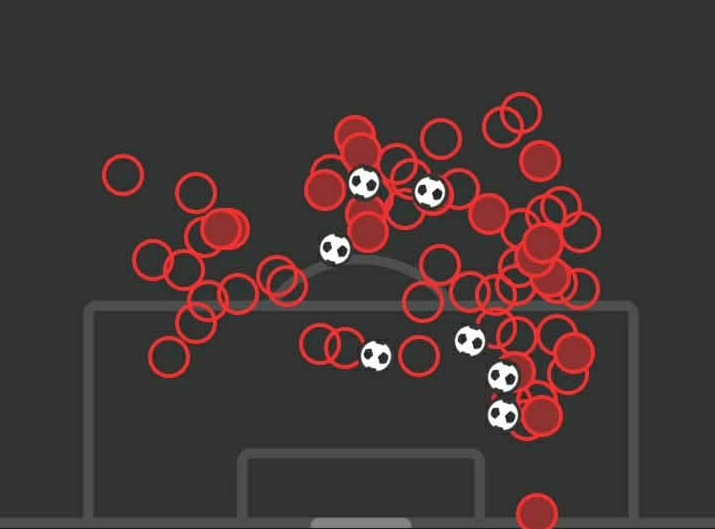
For his player profile, Alajbegović is best operating as an inside forward, from a left-wing position. The closest high-level player comparison I could make based on style is similar to Liverpool’s Cody Gakpo. He identifies central space around the edge of the 18-yard box well and really takes joy out of cutting inside onto his right foot. At times he will keep cutting across the box until you blink and he’s delivering a cutback from the RW’s position on the goal-line. He prefers shorter interplay to get into the box vs trying to get crosses in from the sideline. Note his Bundesliga season shot map below. Not only is it clear how much Alajbegović enjoys cutting inside around the edge of the box, but also my other point mentioned – he ends up on the far side of the pitch in the final third fairly often:
Alajbegović is a right-footed player, but is not weak on his left, having shown several technically strong left-footed strikes in the matches I watched. Alternatively, I could see him operating as a ST in a striker pairing, with the agency to move around the pitch freely. So far this season, Alajbegović has 9 goal contributions in the Austrian Bundesliga with RB Salzburg, having played almost 1400 minutes. He is definitely a volume shooter, averaging ~4.5 shots per 90 for club, and 71 touches per 90, which is fairly high for a forward. While perhaps not the most aesthetically pleasing player with every touch, Alajbegović knows what he wants to do and is very efficient in achieving his goal. You might not get hypnotizing dribble moves out of him, but he can create enough space for himself to do what he does best: shoot.
Alajbegović says his dream is to play for Real Madrid (“but if it’s Barcelona, that’s ok too!”) and given the player he is now at 18, I don’t believe that’s an unrealistic dream. At the very least, he has all the tools necessary to become an impactful player on European football’s biggest stages, and will not be staying at RB Salzburg any longer than this season. Bayer Leverkusen have already exercised their buy-back clause on Alajbegović, willing to pay Salzburg a 6M profit just for giving Alajbegović the playing time to develop. The Bosnian national team attack will almost certainly be lead by Alajbegović and Bajraktarević (their other bright young star, 21-year old RW currently at PSV) for the next decade or so. If Alajbegović can continue his very strong form for his country, then this summer’s World Cup could be his breakout tournament where he becomes a household name.
Get ready for a breakout season, starting at this summer’s World Cup, continuing upon his return to Leverkusen. Kerim Alajbegović is without a doubt, One To Watch.
In the UEFA World Cup Playoff Semifinal, Slovakia lost 4-3 to Kosovo, ending their 2026 World Cup hopes. The result is surprising, and the combination of many things coming together in the wrong way for the home crowd in Bratislava. First, manager Francesco Calzona, after having repeatedly worked miracles with his 4-3-3 system, switched to a 5-back system to start this match for the first time in years. This was a confusing decision. Huge match at home as the slight favourites, and Slovakia were set up in their most defensive system I have seen under Calzona, a 5-2-3 that fell into a 5-4-1 out of possession. This allowed Kosovo to get more possession than expected in this match and really feel like they had the opportunity to create. After Martin Valjent opened the scoring for Slovakia in the 6th minute, they sat back and let Kosovo have the ball. In the first half, Kosovo held the majority of possession, yet were down 2-1 thanks to a Haraslin direct free kick goal.
The loss of Leo Sauer early in the first half was undeniably a huge blow to the Slovak offence. The recent 3-time Slovak Young Player of the Year winner is one of the most talented players on the team despite being just 20 years old and Slovakia struggled to create after he left the match.
Kosovo scored in the 47′, again in the 60′, and again in the 72′ to go up 4-2 and effectively end all hopes of a Slovak victory. A David Strelec goal one minute before full-time was but mere consolation, as the hosts were knocked out of WC contention. This also could have been the last match played in a Slovak kit for Martin Dubravka, which could leave some huge shoes to fill. Marek Rodak has 25 caps to his name as the most experienced replacement for Dubravka in net, while Dominik Takac is 27 without an official cap for the senior team yet. Other options might include L’ubomir Belko, who recently moved to Viking FK in Norway from Žilina, or his successor in northern Slovakia, Jakub Badzgon. The point is, there’s a huge experience void that will be present when Dubravka retires from the national team and we cannot expect Slovakia to maintain a similar level to the past 10 years in net.
Stanislav Lobotka will be 33 by the next Euro and 35 by the next World Cup. Perhaps the most important player in the Slovak team, Lobotka is the midfield conductor and heart of the Slovak possession play. Ondrej Duda, regular set piece taker and midfield colleague of Lobotka, is the same age. The two have 163 caps combined. Peter Pekarik has 132 on his own, and has already been playing long past when he should’ve been allowed to rest due to a lack of depth at RB. The time is probably now to start giving the next generation the experience they’ll need to qualify for the next Euro tournament. Tomas Rigo and Mario Sauer are both really positive players in midfield and should becoming much more prominent in the squad.
As for Calzona, does he stay for at least another 2 years through the next Euro cycle? I honestly couldn’t say. If he does decide to step down, there would be a massive appointment to be made by the Slovak FA, crucial to the next generation of the Slovak national team developing. If all goes well, Slovakia should have a good chance of qualifying for Euro 2032 and WC 2034. As for the near future, Nations League C awaits. Improving their Nations League standing is important, as we saw this year in the WC qualifiers, with teams being guaranteed WC playoff places for performing well enough in the Nations League. A season in Nations League C could be good for the opportunity to develop younger players.
Overall, this loss to Kosovo was a missed opportunity: a chance to qualify for the first World Cup since 2010, with the last overlap of two generations of national team players. By the next cycle, the older generation will likely not be regular starters, and the Slovak team will have some growing to do before they might reach the heights we saw at Euro 2024. Ďakujem za prečítanie 🙂
Hello everyone, been busy, sorry for the brief absence. A full 2026 Eliteserien season preview awaits you today, so if you need to know more about the Norwegian top-flight, look no further!
Promotions/Relegations:
Last season, we said goodbye to three clubs who were relegated to the OBOS-ligaen, the Norwegian 2nd tier. For FK Haugesund, it was almost a foregone conclusion from the midway point of the season, finishing with just 9 points from 30 matches. Strømsgodset had a slightly better showing with 20 points, but were also automatically relegated. For Bryne, it was by narrow margins – finishing just 2 points shy of safety in their first season up, and having to play the promotion/relegation playoff against Aalesund. This was not very close, finishing 4-1 to Aalesund on aggregate, who gained promotion to the Eliteserien after a two year absence! Joining them coming up from the OBOS-ligaen are Lillestrøm, who ran away with the league, winning it by 25 points and going unbeaten. IK Start needed to win on the final day of the season to guarantee automatic promotion and did so comfortably, with a 3-0 win.
Promoted: Lillestrøm, Start, Aalesund
Relegated: Haugesund, Strømsgodset, Bryne
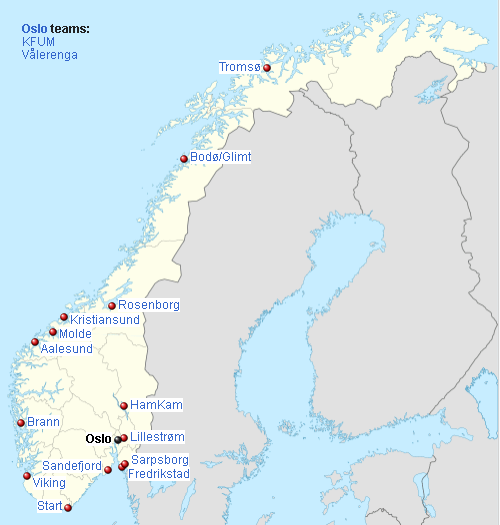
Map of Participating Clubs:
The Eliteserien remains a very southern-biased league in its composition, which is fair enough given the already cold climate in Norway. Bodø/Glimt and Tromsø, the northern rivals, remain the only two northern teams in the league for yet another season. Only two clubs represent the capital city of Oslo: KFUM Oslo and Vålerenga. and the longest away day depends on how you look at it! As the crow flies, it is Start-Tromsø. However if you were driving, the trip from Stavanger, the home of Viking, is actually longer due to the possible routes.
Here is a breakdown of each 2026 Eliteserien club last season, their transfers, and what we might expect from them this season:
Aalesund FK:
Last season, Aalesund played mostly a 3-5-2 formation under their manager Kjetil Rekdal. The midfield 3 combine for a lot of goals. Mathias Christensen scored 6 (10 assists), Hakon Hammer scored 6 (1 assist), and Henrik Melland scored 11 (4 assists) last season for Aalesund. Their current main scoring threat up front is Danish striker Paul Ngongo Iversen, who scored a goal every 3 matches in the OBOS-ligaen last season. However, they have brought in a relatively unknown striker in Ivan Djantou, from Sönderjyske in Denmark. He doesn’t have a prolific scoring record, but is another tall forward added to Aalesund’s squad. They appear to be preparing for a relegation scrap, with their other most notable signing being the Viking goalkeeper, Kristoffer Klaesson. Now, in terms of Goals Prevented, and some of Klaesson’s other numbers, you can see why Viking were happy to sell him. (Their new keeper signing from Slovakia will be mentioned later on). However, acquiring a keeper who won the league literally last season is experience that a newly promoted club rarely gets the opportunity to acquire. I think this is a win-win for both parties here, and Klaesson may have a breakout season getting to face more shots and be the undisputed #1 with Aalesund. I’m not sure if Aalesund have added enough offensive firepower to have a strong chance at a top-half push, but they could well do enough to avoid relegation.
FK Bodø/Glimt:
Last season, Glimt missed out on the title by a very narrow margin. In a way, they are suffering from their European success, domestically. A deep Europa League run that coincided with the start of the 2025 season, followed by participating in the Champions League during the later stages of the Eliteserien season. As a result, you might think that they would have looked to bring in some more players to manage the increased fixture congestion. However, that appears not to be the case! With no signings in January, Kjetil Knutsen will be heading into the start of the 2026 Eliteserien season with the team he finished last year with – aside from the departure of Mathias Jorgensen to Blackburn.
The lack of a sale of Kasper Hogh could more or less be considered a signing, as there was ample interest in the Danish striker from the UK following his impressive UCL performances. All bids were rejected, and Hogh will be seeing out the Champions League season with Glimt. A summer departure is not off the table.
Longtime veteran and Glimt mainstay at CB, Brede Mathias Moe, retired following the end of the 2025 season. Young Villads Nielsen of Denmark will be looking to pick up some more minutes and fill that gap, while Odin Bjortuft and Jostein Gundersen are the starting CB pair for now. It will be interesting to see the season that Mikkel Bro Hansen, the 17 year old striker, has – if Kasper Hogh leaves, he is really the only other natural striker on the team, and I would expect his minutes to increase this season. Aside from that, expect a motivated and hungry Glimt side who will be looking to reclaim the Eliteserien title amidst balancing Champions League play.
SK Brann:
Brann had a strong season last year, but have lost some key players ahead of this season. Most notably, their young star CB Eivind Helland was sold to Bologna for a sizeable 7M euro fee. They also lost Aune Heggebo during the summer window, who was one of the league’s best strikers before departing. Midfield regular Emil Kornvig was sold to Lodz in the Polish Ekstralasa, while CB Japhet Sery Larsen was sold to Philadelphia in the MLS. So what have Brann done in response?
Danish midfielder Jacob Lungi Sorensen was signed from Norwich City, where he’d spent the past 5 seasons, even gaining some Premier League experience. I expect him to have a solid impact in the Eliteserien this season and be a big player for Brann. Former Lillestrom LB Vetle Dragsnes was brought back to Norway from Union Charleroi, while promising 19 year old Ghanaian CB Nana Kwame Boakye was signed from Sheriff Tiraspol in Moldova. Boakye and Sorensen both have Europa League experience, which should help Brann as they will play in European competition this season. Striker Noah Holm was signed to replace Heggebo, a Rosenborg academy product who has shown flashes of good potential. Finally, Icelandic midfielder Kristall Mani Ingason was signed from Sönderjyske.
Overall I think there are some very good signings in this bunch, especially given the experience that Brann have added. The squad might take some time to gain chemistry, but I would expect Brann to be up in the Top 5 competing for European places again this season. Watch for Boakye to potentially have a breakout season for Brann.
Frederikstad FK:
After a surprise 6th place finish in their first season back in the Eliteserien, Frederikstad gained some experience in UEFA competitions last season against good opposition: falling to FC Midtjylland and Crystal Palace in the qualifying rounds. They finished the 2025 Eliteserien season in 8th place, and will be looking to challenge for the European places again this season.
Frederikstad had some trouble scoring last season, averaging just 1.3 goals per match, but also had the 2nd best defence in the league, conceding just 1.2 goals permatch. They are a low possession, direct side who often play on the counter. Having sold Maxwell Woledzi, their standout CB, to Nashville SC this winter, Frederikstad had some money to bring in reinforcements.
In comes Max Nilsson from Landskrona in the Swedish Superettan for a 500k euro fee: a versatile midfielder/WB who has been a regular starter for Landskrona since he was 18. Now 20 years old, Nilsson and Frederikstad will be hoping he can take the next step in his career in the Eliteserien. Continuing the trend of younger talent being brought in, Stabaek duo Aleksander Andresen (LB, 20 years old) and Joachim Nysveen (RB, 19 years old) were both brought in for free.
Most exciting was the signing of Chris Irénée Ntamack Pondy. A high-potential, 18 year old Cameroonian CB, Pondy was wanted by some of Europe’s biggest clubs, before Frederikstad hijacked the deal and brought in the youngster. They can offer playing time that say, Chelsea, can not, and this is a smart move for Pondy to develop further while playing regularly.
Overall, I’m not sure if Frederikstad have done enough to address their goal production issues, but if the defending remains as strong as last year, they will have a good chance to finish in the top 6.
Hamarkamaratene (HamKam):
HamKam had a disappointing season last year, finishing 11th, 6 points above the relegation places. Stay up though, they did, and have made some moves to improve their starting XI before the 2026 season. Promising young CB Ethan Amundsen-Day was brought back to Norway from the Aston Villa youth system, while Martin Gjone was acquired for 120k from Sandefjord. Experienced Swiss attacking midfielder Loris Mettler was also brought in from Sandefjord, along with Ian Hoffman, a 24 year old RM/RWB from Lech Poznan. All four players started in HamKam’s recent cup fixture against Lillestrom.
Expect a back-heavy tactical setup from HamKam, a 3 CB backline is a staple, and the 3-5-2 formation will likely be seen often. HamKam will rely on veteran goalkeeper Marcus Sandberg yet again, who was one of the better keepers in the Eliteserien last season. Give the new-look team some time to gel, and HamKam may surprise with a mid-table finish, though the 9th-12th range does seem more reasonable.
KFUM Oslo:
KFUM Oslo were promoted to the Eliteserien ahead of the 2024 season, and have managed to stay up in each of their first two seasons: 8th place in 2024, followed by a more nervous 12th place finish in 2025, just 4 points above relegation. KFUM were busy in the offseason, signing 8 new players permanently along with the loan of Lech Poznan keeper, Krzysztof Bakowski. Three of the new signings made their first starts for KFUM in their recent cup win over Tromso: RW Rasmus Eggen Vinge, signed for 500k from Stabaek after recording 5 goals and 4 assists in the OBOS-ligaen last season. Left-back Eirik Saunes was signed from Bryne for 250k, and Tore André Sørås debuted for KFUM after his move from HamKam. Very experienced AM/ST Magnus Wolff Eikrem was brought in from Molde FK. With 264 league appearances and 76 goals for Molde FK, Eikrem brings invaluable Eliteserien experience to this KFUM Oslo side. The reinvigoration of the side with new signings should help propel KFUM back into the fight for a top-10 place in the Eliteserien this season.
Kristiansund BK:
Kristiansund came even closer to the drop than KFUM, finishing just 2 points clear in 13th place last season. Excluding Haugesund, who were an outlier in how poor they were last season, Kristiansund had the worst attack, and 2nd-worst defence in the league. These are considerable issues to fix in one transfer window, and it does not appear as if Kristiansund has been able to address them. Without a sale in the January window to bring in money for new signings, Kristiansund were limited to what they could do with free transfers. Young midfielder Heine Gikling Bruseth was signed from San Diego FC (MLS), alongside fellow midfielder Jesper Isaksen, from Stabaek. Alexander Munksgaard was signed as a new RB from Banik Ostrava, along with a few more free signings. Regular starter at CB, Marius Olsen, signed with GKS Katowice on a free, while fellow CB Axel Guessand moved to Pafos. In addition, Mikkel Rakneberg, a regular at LB last season, moved to VfL Bochum. It is hard to say that Kristiansund won’t be battling relegation this year. At best, we can say that they replaced the numbers in the squad that they lost, but should struggle to avoid a bottom-3 finish.
Lillestrøm SK:
Lillestrøm are returning to the Eliteserien after their shock relegation in the 2024 season, going unbeaten in the OBOS-ligaen to win automatic promotion. They were able to cash in on young Senegalese ST Moctar Diop, receiving a 1M euro fee from Gent. Their starting keeper ,Mads Hedenstad, has signed with Aarhus GF on a free transfer, while LB Kristoffer Tønnessen moved to Start on a free. A new keeper in Pontus Dahlberg was signed from IFK Göteborg for 250k. The almost 2m tall, 27 year old keeper will look to do his part in keeping Lillestrøm up this year. Swedish-Palestinian winger Camil Jebara was signed from Elsborg for 260k, rounding up the paid transfers. A mix of youth and experience was added through free transfers, including the likes of LB John Kitolano joining from Aalesund, and young Gustav Nyheim joining from Molde. Given last seasons results, it is clear that Lillestrøm are no ordinary “newly promoted” side, and I do expect them to avoid a relegation battle this season to reclaim their regular Eliteserien spot.
Molde FK:
Molde are seriously loading up their squad ahead of the 2026 season. From 2017-2022, Molde finished in the Top 2 places in the Eliteserien. The next two seasons, they finished a respectable 5th place. However last season, Molde plummeted to a 10th place finish, their worst since the 2010 season. They are acting like they want to remedy that, having spent over 8.5M euros on new signings since the 2025 summer window opened, with 6M of those signings coming in the winter window that just closed. The marquee signing is 21-year old Ghanaian ST, Jalal Abdullai. Signed for a 3M euro fee from Elfsborg, Abdullai will have the responsibility of being Molde’s main main up top. To support him in attack, highly rated Liverpool youngster Trent Kone-Doherty was signed permanently for 750k. This will be Kone-Doherty’s first full season at senior level, having made 2 senior appearances for the Reds over the last two seasons. In defense, 23-year old CB Sivert Sira Hansen was signed from IK Start for 1M, Fredrik Kristensen Dahl was brought in for 430k, and a new keeper was signed from Anderlecht in Mads Kikkenborg. This should be a fun attacking side to watch this season, and I do think they have everything they need to get back up into the European spots this season.
Rosenborg BK:
Rosenborg has made some significant cash following their 7th placed finish last season. Wonderkid Sverre Halseth Nypan went to Manchester City for 15M euro, while young RW Marius Broholm moved to Lille for 6M, and keeper Sander Tangvik was bought by Hamburger SV for 2.6M. Starting ST Noah Holm was sold to Brann for 1.3M, while veterans Ole Saeter and Erlend Dahl Reitan left on free transfers.
After signing Slovak David Duris during last season to boost their attack, Rosenborg have found an interesting loan signing at ST: Amin Chiakha, a 19-year old Algerian-Danish player from Copenhagen. In midfield, 2M was spent on 20-year old Danish midfielder Mads Bomholt, a very promising chance-creator coming off of a strong season with Aalborg BK in the Danish 2nd tier. Johan Bakke was signed for a 400k fee to join Bomholt in midfield from Strømsgodset, while veteran RB Jonas Svensson returned home from Besiktas on a free. Also interesting is the return of Leopold Wahlstedt to Norway. While playing for Odds BK, Wahlstedt was THE standout keeper in the Eliteserien, before a move to Blackburn Rovers didn’t quite pan out. After two seasons with Aarhus GF in Denmark, Wahlstedt is returning to the Eliteserien. This should help to replace Tangvik in net, though it remains to be seen if Rosenborg’s new outfield signings can replace the talent they lost. I think Rosenborg’s final league position could vary considerably: I would be surprised to see them in the Top 3, and I would also be surprised to see them in the bottom half.
With the budget acquired from their sales very much not depleted, Rosenborg can continue looking to rebuild themselves back to their former glory, when they were the class of Norwegian football in the 80’s and 90’s.
Sandefjord:
After a 5th place finish in last year’s Eliteserien, Sandefjord are looking to build upon it and challenge for Europe this year.
New signings Nikolaj Moller (ST) and Jakob Vester (CM) were brought in from Dundee United and Viborg, respectively, while new CB Xander Lambrix joined from TOP Oss in the Dutch 2nd tier. Sandefjord have also invested in another homegrown CB in Håkon Krogelien, a 21 year old defender signed from Jerv. A relatively unknown quantity as of right now, Sandefjord have one to watch with their singing of 18-year old Ghanaian winger Foster Apetorgbor. Apetorgbor will get his first experience playing in Europe with Sandefjord, and with the amount of talented attacking players who have come from Africa through the Eliteserien in recent years, I will certainly be keeping an eye on Foster Apetorgbor.
In terms of sales, Stefán Ingi Sigurdarson (ST), Christopher Cheng (LB), Martin Gjone (CB), and Loris Mettler (AM) were all sold for a combined total of almost 4M euros. Sigurdarson and Cheng were two of Sandefjord’s top players last season. Sandefjord only spent ~1.2M on new signings, meaning they still have money in the budget for a summer signing without having to sell any players. I think a top 4 position will be difficult to achieve, but certainly possible if Sandefjord have a good season.
Sarpsborg 08:
Some might say that the “08” in Sarpsborg 08 represents their league finishing position after the last four years. Sarpsborg has finished 8th, 8th, 9th, and 9th, very consistently staying in the mid-table while never being in a real relegation battle. English manager Martin Foyston was appointed just before the end of last season, after getting Osters IF promoted to the Allsvenskan over two seasons there. Foyston achieved an average of 1.7 points per game after joining Sarpsborg, which if pro-rated over a full season, would have been good enough for 5th place in the Eliteserien. This could be the start of Sarpsborg 08’s journey out of mid-table into fighting for European places.
24-year old winger Noa Williams was signed from Kongsvinger for 500k euro, after a 15 goal contribution season in the OBOS-ligaen. Champions League experience was also added to the squad with 26 year old midfielder Chris “Chriso” Kouakou, from Qarabağ. Veteran CB Sigurd Rosted was brought back home from Toronto FC in MLS. Finally, promising young Belgian-Moroccan winger Camil Mmaee was signed from Maastricht after he recorded 8 goal contributions in just over 1000 minutes played in the Eerste Divisie. I genuinely like the transfer business done by Sarpsborg 08. If they can continue their progress under Foyston this season, I could very well see them finishing in a Top 6 spot.
IK Start:
After a 2nd place finish in the OBOS-ligaen last year, IK Start earned promotion back to the Eliteserien after a 5-season absence. Experience was their priority in transfers, adding a trio of 28-year old players: Erlend Dahl Reitan (RB, Rosenborg), Kristoffer Tønnessen (LB, Lillestrom), and Erlend Segberg (DM, Trapani). Jesper Cornelius, a 24-year old striker from Lyngby BK in Denmark, was also added, alongside Valencia youth product Alexander Gurendal, a 20-year old LW. We might even see Jasper Torkildsen (GK) make his Elitserien debut for Start after a loan to Stromsgodset last year.
Regular CB Sivert Sira Hansen joined Molde FK for a 1M euro fee, as Molde looked to snap up the 23 year old CB with hopes he could improve further. Start did not see many more departures though, leaving them with a bolstered squad. I believe Start will likely be in a relegation battle, although I will not pick them as a surefire favourite to go down.
Tromsø IL:
Tromsø are also enjoying the Northern-Norway era of dominance in the Eliteserien, recording their second 3rd-place finish of the past three seasons. After seeing top prospect Runar Norheim sold to Nordsjaelland for 2.25M, as well as Jakob Napoleon Romsaas moving to Royal Charleroi for 1.5M, Tromsø brought in CB Mathias Tønnessen from KFUM Oslo for 1.1M, 19-year old AM Troy Nyhammer from Haugesund for 930k, Jesper Grundt (CM, 23-years old) from Kongsvinger for 850k, and young Swedish-Thai RB Alexander Thongla-lad Warneryd from Västerås SK for 750k. Four more transfer fees were paid out, along with the free signing of Mauritanian national team goalkeeper Abderrahmane Sarr. Tromsø have a proven track record of both scouting and developing African players in the Eliteserien, and Sarr joins Mamour Ndiaye as another exciting African keeper in Norway. A major factor in Tromsø’s season is whether they will be able to keep Abubacarr Sedi Kinteh at the club amidst interest from the likes of Chelsea and Manchester United. Kinteh has been one of the best CB’s in the league since he joined and will be moving on soon, it’s just a question of when.
Overall, this Tromsø squad has been improved from the team that finished 3rd last season, and I think they will yet again finish on the podium in a Top 3 place.
Vålerenga IF:
Vålerenga were relatively quiet in the transfer market after their 6th place finish last season. Their only paid signing was Magnus Westergaard, a 27-year old Danish CM joining from Wycombe Wanderers for 400k euro. Veteran ST Ole Saeter joins from Rosenborg, bringing valuable experience and at 29, some good years left in him. Considering how many of the teams around them in the table have really tried to improve their squads, it feels like Vålerenga have regressed slightly in comparison. While they should be good for a top half finish again, I would be surprised to see them competing for European places by the time the season comes to a close.
Viking FK:
Last (alphabetically), but certainly not least, are the reigning champions Viking. They have returned almost their entire squad from last season, while adding a few new signings to the mix. Not wanting to disrupt the team chemistry there was, Viking have kept the incoming players to a minimum.
L’ubomir Belko, the 23-year old Slovak keeper out of Zilina, was signed to be the new starter for a 1M fee. As is usual, some of the best Slovak players can be acquired for relatively low fees. From their academy in Africa (named “African Viking”), 18-year old LW Kelvin Frimpong is making the move to the Eliteserien for a 200k fee. Another unknown quantity as of right now, it is always exciting to see a player get his first chance in Europe while playing in the Eliteserien. The start of several strong careers has happened in Norway. As for departures, it is mostly just goalkeeper Kristoffer Klaesson, who moves to newly promoted Aalesund in a bid to help keep them up. Without any key player departures, Viking will be a threat for the league again this season.
Their biggest challenge may well be balancing the Champions League qualifying rounds with league play once the summer arrives. With the offset of the Norwegian schedule relative to UEFA competitions, the qualifying rounds for UEFA competitions begin midway through the Eliteserien season. This has proven to be a hurdle for almost every Norwegian club who competes in European competitions, and will be especially if Viking qualify for one of the UEFA competitions proper. If Viking go out early in the UEFA qualifying rounds, then they will have little to no fixture congestion this season, unlike what Bodø/Glimt will be dealing with. This was a main factor in their title win last year, having gone out of European competition early while Glimt were making a UEL semi-final run, then playing UCL League Phase matches during the 2025 Eliteserien season.
Overall Prediction:
Here are my general predictions for which clubs might be battling for different positions in the Eliteserien this season.
Teams Competing for Title: Bodø/Glimt, Viking, Tromsø
Teams Competing for Europe (Top 4): Brann, Molde, Rosenborg, Frederikstad, Sandefjord
Teams Battling Relegation: Kristiansund, Aalesund, Start, KFUM
The Eliteserien remains a very exciting league to follow, with local Scandinavian talent combining with promising international players to create a great environment to find new talent in. After Glimt’s UCL success this year, there will likely be more eyes on the Eliteserien than ever before this year, and you know who to go to if you need to know more. As always any scouting requests or questions can be directed by email to scouting.futbird@gmail.com.