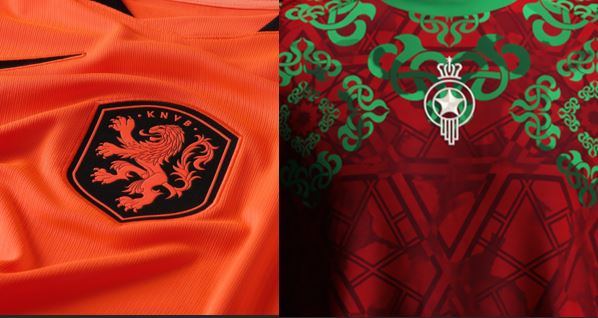
One of the biggest heavyweight matchups of the R32 sees FIFA’s #7 and #8 ranked nations go up against one another when the Netherlands take on Morocco. This has potential to be one of the best R32 matches at the 2026 World Cup and I would not recommend missing it!
How They Got Here:

The Netherlands were able to qualify through UEFA with relative ease, in a group alongside Poland, Finland, Lithuania, and Malta. An undefeated 6W, 2D qualification run saw the Dutch top the group, 3 points ahead of Poland. Goal-scoring was the theme of the Dutch qualifying run, finishing 4th in UEFA qualifying for team goals scored, led by Memphis Depay’s 8 and Donyell Malen’s 4 goals. This led them into a World Cup group with Tunisia, Sweden, and Japan. Opening the tournament against a very strong Japanese side, the Netherlands were able to dominate possession (as expected), but struggled to break through the Japanese defence regularly, creating just 0.7xG from 10 shot attempts. Virgil van Dijk showed that he’s still a formidable presence on set pieces with a goal from a corner kick, before Crysencio Summerville announced his arrival to the Oranje with a lovely solo effort. Japan managed to peg them back each time including a 88′ Kamada equalizer which left the Dutch feeling like they had let 2 points slip away. With no room for error left if they wanted to top the group, Ronald Koeman’s side came out very strong against Sweden in a match that was more end-to-end and open than the first. This suited the Dutch well, who did very well with only 50% possession, creating 2.6xG and putting 5 past Sweden en route to a 5-1 victory. Brian Brobbey and Cody Gakpo both had a brace, with Summerville adding the 5th. A win over Tunisia would put the Netherlands in good position to top the group on goal differential over Japan. Brobbey struck again after an early own-goal gave the Dutch the lead, and the Netherlands won relatively comfortably, 3-1 the final. Japan’s draw with Sweden saw the Netherlands win the group and move on to the R32 today.

Morocco were given a fairly easy qualification group for a team of their standard, alongside Niger, Tanzania, Zambia, and (People’s Republic of the) Congo. Eight matches, eight wins, 22 goals scored and only 2 conceded. This was no real test for arguably the best side in Africa, and the Atlas Lions strolled into the World Cup finals to a group alongside Brazil, Haiti, and Scotland. In their opener against 5-time champions Brazil, Morocco made a massive statement. Ismael Saibari, a standout on this Morocco squad coming off a fine season at PSV Eindhoven, got Morocco off to a dream start with his goal in the 21′. While Morocco held Brazil at arm’s length for most of the match and fully dominated the midfield, one moment of Vinicius magic was enough to get Brazil a draw they frankly did not deserve. Morocco was very close to winning this match at the death if it wasn’t for a double-save from Alisson. In their second match against Scotland, Morocco started quickly with a goal in the 2′ from Saibari again, which against this Scotland side meant the game was fully in their grasp. Morocco showed their ability to hold a lead and prevent their opposition from generating scoring chances, coming away with a 1-0 win, before dominating Haiti 4-2 to finish the group. Morocco would end up finishing 2nd in the group behind Brazil on goal differential, leading us to look back at Alisson’s performance to earn Brazil that draw against Morocco and in turn, the group.
What To Expect (Playstyle):
For the Dutch, the name of the game has been and likely will be “Total Football” for years to come. In essence, this means that roles and positions on the pitch can be filled by any player, so long as all required roles are filled. Fullbacks and wingers need to be able to interchange seamlessly with one another, their #6 can drop into the backline to cover for a forward-running CB, and the front 3 attackers can and will rotate with one another often.
Today, Koeman will likely start Cody Gakpo and Donyell Malen on either side of Brian Brobbey up top. Brobbey is the physical target man who will cause chaos in the box, Malen is the pacey inside-forward who threatens space in-behind and can contribute goals, while Gakpo is the main attacker in this side. While he might not always have the best returns for club, Gakpo has been at his best putting on the orange shirt in recent international tournaments. Off the left, he’ll be looking to constantly cut inside onto his right foot and get shots away. Behind them in midfield is a trio of Tijani Reinders, Frenkie de Jong, and Ryan Gravenberch. Reinders is a very good footballer, don’t get me wrong, but he is the weak link of this midfield. Frenkie de Jong is one of the most press-resistant midfielders on the planet and an ideal #6 for how the Netherlands want to play, while Gravenberch has developed into one of the better box-to-box midfielders in the Premier League. Micky van de Ven, arguably the fastest player in the world (and certainly the fastest defender) starts in his usual LB role for the Dutch, while being a natural CB at club level. His pace and progressive carrying of the ball can be very impactful moving forward, but his natural CB profile allows him to seamlessly tuck in alongside van Dijk and van Hecke to form a back-3 (the 3-4-3 system has always been popular in the Netherlands for its versatility and application to Total Football). Denzel Dumfries at RB is a more natural wingback and will get further forward more frequently. The Inter Milan man is a constant threat down the right flank and will require Morocco’s LW’s to track back often, limiting their potential to get forward. Bart Verbruggen is between the sticks, having been the Netherlands’ clear #1 for some time now.
For Morocco, Ismael Saibari starts up top and has been the main man for Morocco all tournament. He is a considerable goal threat and will demand elite defending out of the Dutch backline. Brahim Diaz and Bilal El Khannouss should flank Saibari in attack, providing plenty of pace and creativity in support. Both Diaz and El Khannouss are natural #10’s who can also play W, so you can expect them to be very comfortable moving across the width of the pitch to affect the play anywhere. There is a very hard-working and talented midfield behind the front 3: Azzedine Ounahi glides across the pitch with little effort and can cover every blade of grass in the match. He will start as Morocco’s #10 but will put in a lot of work out of possession. Behind him alongside Roma’s Neil El-Aynaoui is the star of the Morocco midfield: Ayyoub Bouaddi. Still only 18 years old, Bouaddi switched over from the French youth system to be named into the Morocco World Cup squad before he had even made his senior debut for the country. He’s that good, and Morocco knew it. Bouaddi oozes composure and class on the ball, is very strong from box-to-box, and can unlock the defence with dangerous long passes. This midfield battle today will be excellent to watch.
Morocco have very capable FB’s who have played at the top level for years in Mazraoui and Hakimi, who will be tasked with defending Gakpo and Malen today. Morocco’s biggest weakness in their team is at centre-back. Fulham’s Issa Diop and Crystal Palace’s Chadi Riad start for Morocco. Neither player was a regular starter in the Premier League this past season, and compared to the wealth of talent Morocco have elsewhere on the pitch, this is a relative weakness. Brian Brobbey has a very solid chance of wreaking havoc on Diop and Riad today, and Morocco will need to ensure that El-Aynaoui stays in front of his backline and doesn’t venture too far upfield in possession.
The Dutch will attack with versatility and numbers. It will be up to Morocco to track their offensive rotations and ensure that enough defensive support is provided to their CB’s. Set pieces will be another area that I anticipate the Dutch to have an advantage in and be able to score goals from. If this game gets open and starts going end-to-end, this suits Morocco much better.
It’s almost impossible to predict the outcome of this match. Can the Dutch find a way to stop Ismail Saibari and win the midfield battle? Or will we see Ounahi and Bouaddi frustrate the Netherlands’ attempts to get the ball up to Gakpo and Brobbey? Either way, expect a lot of this match to be played between the half-spaces, with both teams looking to pack the middle of the pitch in attack, employing wide players who like to cut inside. We should be in for a good one. Short Summary:
- Netherlands 4-3-3 with heavy rotations in-possession, looking to create chances from around the edge of the box and on set pieces.
- Morocco 4-2-3-1, FB’s getting forward in possession, both wingers tucking inside, midfield in support, weakness at CB.
Result?:
While this is a very close matchup that could go either way, I see the Netherlands winning narrowly if the game finishes in 90 minutes, but Morocco taking the victory if it goes to extra-time / penalties.
Prediction: 2-1 Morocco (A.E.T.)

