-
Euro 2024 Preview

Auf Wiedersehen, football fans! It is the eve of the summer tournament hosted by Germany, the 2024 Euros. Now I’m sure everyone reading this knows at least a little bit about the England, France, Germany, and Portugal squads that I would consider favorites to win this tournament. What about the other 20 squads competing for Europe’s greatest international prize, and does anyone else have a good chance to win the whole thing? I wanted to take a brief look at each squad today and give my prediction on how far they could “realistically” go. Realistically is in quotation marks because as we all know, this is football and anything can happen! So for example, if I say a country’s realistic best finish would be a Round of 16 exit, that does not mean I do not think they have any chance to win the tournament but rather that I think it would be a surprise if they were to advance further. With that said, let’s get right into it.
Group A: Germany, Scotland, Hungary, Switzerland
We start with the host nation Germany and Group A. Under Julian Nagelsmann, I expect to see Germany use a 4-2-3-1 formation. Ever-present German international Joshua Kimmich will likely start at RB, with a CB pairing of Antonio Rudiger and Jonathan Tah alongside Stuttgart LB Maximilian Mittelstaedt, who is coming off a very strong Bundesliga season. A double pivot in midfield of Robert Andrich and Toni Kroos seems to be Nagelsmann’s preferred duo to start, with Jamal Musiala, Ilkay Gundogan, and Florian Wirtz set up behind striker Kai Havertz. Florian Wirtz is likely to play as a left winger on the team sheet, which is a departure from his usual #10 role at Leverkusen, however the fluidity of this front 4 means that Wirtz will be able to drift inside of the pitch to form a 4 man midfield alongside Gundogan, allowing for overlapping runs from Mittelstaedt and for Jamal Musiala to drive forward from the right wing more. Germany should top this group unless a shock result happens, and I believe they have the talent to go all the way. The home crowd behind them will surely be a massive boost to the players who will be very motivated to bring home their first Euro championship since 1996.
Realistic Best Possible Finish: Winners
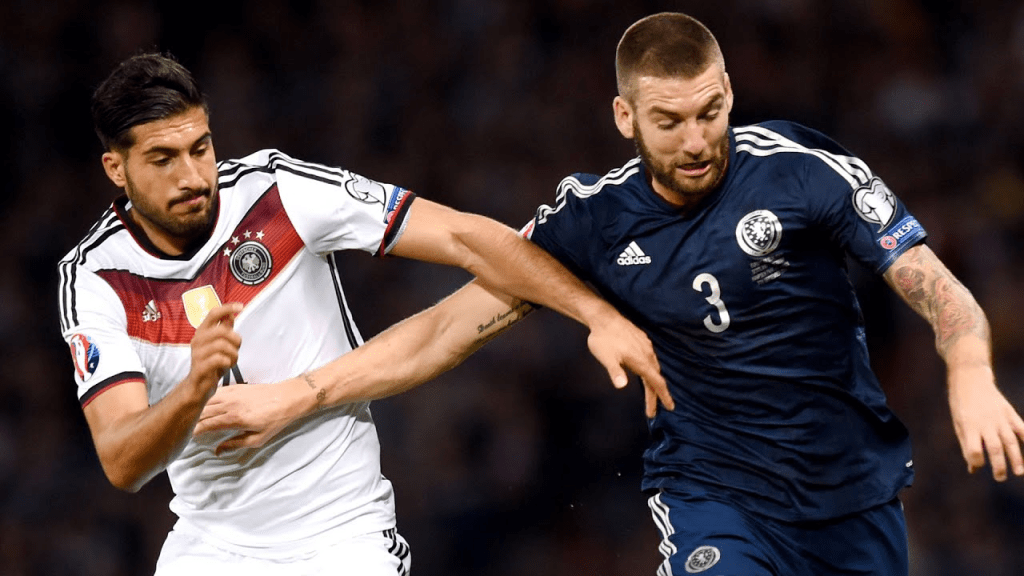
Scotland and their Tartan Army will be bringing all of the good vibes to Germany this summer, with the travelling fanbase being one of the most welcomed at international tournaments due to their passion. Scotland manager Steve Clarke may well have a few tricks up his sleeve, and he will need to in order to get the best out of his star players. Scotland have two standout left-backs in Andrew Robertson (who will be captaining the side) and Kieran Tierney. John McGinn will be asked to play a big role all over the pitch, while we may see Scott McTominay deployed in the most Libero of Libero roles. Clarke has experimented with McTominay playing as a right sided CB in a back 3, with full license to roam upfield and crash the box in attack. We are likely looking at a 5-4-1 formation, with Billy Gilmour and Celtic’s Callum McGregor as a midfield pair to provide stability while McGinn and McTominay roam around the pitch. While not guarantees to make it out of this group, I do believe Scotland can qualify for the Round of 16 if they bring their best football, but find it difficult to see them making it too much further into the knockouts
Realistic Best Possible Finish: Round of 16
The Hungarian side is also a bit of a tough prediction. On one hand, they have an aging defence, anchored by Leipzig man Willi Orban, and Omonia Nicosia defender Adam Lang, both 31 years of age. On the other hand, they have a very competent attacking trio who will set up narrowly in this 3-4-2-1 formation, with Liverpool star man Dominik Szoboszlai and Freiburg’s Rolland Sallai in the 10 positions behind Ferencvaros striker Barnabas Varga. Young Milos Kerkez, playing at AFC Bournemouth, will play an important role for this Hungarian squad out wide, being asked to contribute on both ends of the pitch. This Hungary side also have a good amount of young talent coming off the bench, with the chance to change the game with their energy and make their mark on the international stage. I believe Hungary should be favorites to finish 2nd behind Germany in this group, but if not will likely advance as one of the top 4 third place teams. If they advance and get a favorable matchup in the Round of 16, there is every chance they can win a knockout match.
Realistic Best Possible Finish: Quarter-finals
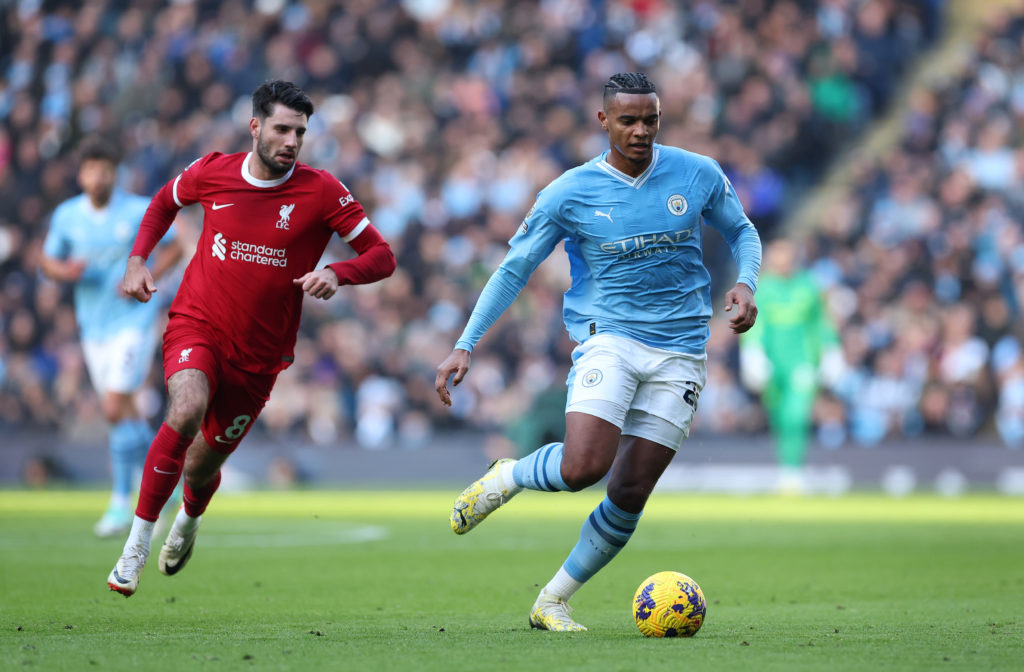
Finally we come to Switzerland. Just like Mexico keeper Memo Ochoa, who seems to come out from hiding every time the World Cup rolls around, Xherdan Shaqiri always seems to bring his absolute best form to the Swiss national team at the Euros. Expect the Swiss to also line up in a 3-4-2-1 formation. Granit Xhaka, fresh off a Bundesliga title-winning season at Leverkusen, will anchor the Swiss midfield alongside Bologna’s Remo Freuler. Manuel Akanji and Ricardo Rodriguez with his 115 caps will be at the centre of the backline providing a strong defensive base. Young Burnley striker Zeki Amdouni is prepared to make his arrival on Europe’s biggest stage and will be hoping to provide the attacking punch his team needs, although he will be competing with Noah Okafor and Kwadwo Duah for this position. Young, highly rated defender Leonidas Stergiou is also primed to make his appearance partnering Akanji and Rodriguez in defence. I believe this Swiss team has a relatively low floor (could very well not progress from the group stage), but if they do progress to the knockouts they should not be taken lightly. Peril has come to those who have made that mistake in the past.
Realistic Best Possible Finish: Quarter-Finals
Group B: Spain, Croatia, Italy, Albania
We begin the chosen “Group of Death” with the Spanish. While the Spanish are again a bit of an unknown in terms of how they will deal with the best teams at this tournament having only played Andorra and Northern Ireland in the final 2 friendlies before the Euros begin, they certainly have the talent to go far. Alvaro Morata will captain the side and start up front, most likely alongside Lamine Yamal and Nico Williams. Lamine and Nico are one of the most exciting winger duos to watch at this tournament, having both had standout seasons at Barcelona and Athletic Club Bilbao respectively. They will play in front of what is a very strong midfield with Pedri and Fabian Ruiz playing in front of Rodri, the best defensive midfielder in the world right now (and I don’t think there is much debate about that). Defence is where Spain’s weakness might lie. The experience of UCL winners Dani Carvajal and Nacho Fernandez will certainly be a big boost, the latter likely to start at CB alongside Ben Le Normand. Alejandro Grimaldo, who might just have been the best performing LB in Europe this season at Leverkusen (10 goals and 13 assists in the Bundesliga for the champions), should start at LB with Marc Cucurella as his backup. Surprisingly, Pedro Porro did not make Luis de la Fuente’s final Euro squad after a stellar season for Spurs, leaving the aging Carvajal and the already aged Jesus Navas as RB options. However, de la Fuente has experimented with Atletico’s Marcos Llorente at RB, who is naturally a midfielder but is extremely versatile in all parts of the game. Through midfield and attack, Spain have very solid depth which may help them gain an edge late in close matches. The likes of Dani Olmo, Alex Baena, Mikel Merino, Martin Zubimendi, Ferran Torres and Fermin Lopez are all available for de la Fuente to call upon. Overall the weakness of this Spain team may be as it has been in past years, a true goal threat at striker. Alvaro Morata is no bad player just to be clear, but we have often seen Spanish sides dominate possession in the opposition’s final third without being able to convert that dominance into goals. If Spain can produce balanced scoring from midfield and wing, they could go all the way.
Realistic Best Possible Finish: Winners
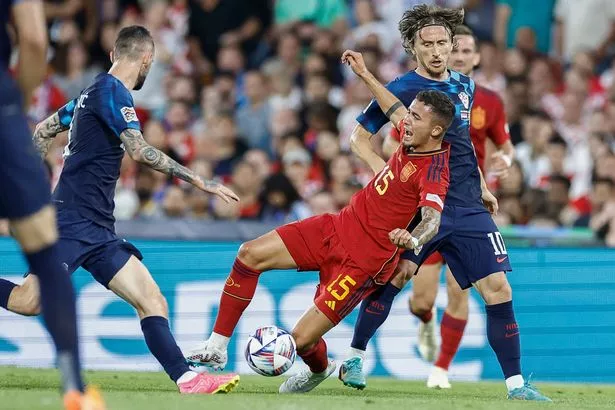
Forgive me if I sound emotional when talking about Croatia, as this is almost certainly the last international tournament for Croatian legend Luka Modric. The motivation to make the most of this tournament will be strong amongst the Croatian side, with a very strong team throughout ready to punch above their weight yet again. While I am unsure what Zlatko Dalic’s exact starting lineup will be for their first game of the Euros, there are some positions I can expect to know the starters ahead of time. The midfield will most likely be Modric and Kovacic on either side of Marcelo Brozovic, with the next generation of Croatian midfielders ready to be called upon in needed. Luka Sucic and Martin Baturina will make their first major tournament appearances, with Sucic having been touted as Modric’s successor in the national team for a few years now. Josip Stanisic and Josko Gvardiol will most likely start at either full-back position having both enjoyed very strong seasons at club level this year. There is a strong veteran cast to select from at forward, with the likes of Andre Kramaric, Ante Budimir, Lovro Majer, and Ivan Perisic available. Having made it to the finals of the UEFA Nations League last summer, only losing out to Spain on penalty kicks, there is every reason to believe that this Croatia team is still built for knockout games in international tournaments. I would not be surprised to see them knock out a tournament favorite in the quarterfinals, although I would be surprised to see them win the entire tournament (but not disappointed).
Realistic Best Possible Finish: Finalists
Then on to the Azzurri, who are not widely considered favorites to win this Euros, but have often performed at their best in such circumstances. An injury issue has come up late for Luciano Spalletti, with Giorgio Scalvini, Francesco Acerbi and Nicolo Fagioli all picking up injuries in the leadup to the tournament. Scalvini and Acerbi will miss the entire tournament, while Fagioli is confirmed to be out for the first match against Albania. That being said, Italy still have a strong squad and should be considered one of the best-of-the-rest, in the sense that they are not a tournament favorite. Expect to see a starting lineup of Donnarumma in net, a back 3 of Darmian, Buongiorno and Bastoni, di Lorenzo and diMarco at wingbacks on either side of Jorghino and Barella, with Federico Chiesa and Pellegrini/Frattesi behind Scamacca up top. Spalletti looks to be choosing a 3-4-2-1 formation that most of his players will be comfortable in rather than using his 4-3-3 tactics that worked so well for him at Napoli. I believe that the Azzurri will only have a better chance at surprising everyone by taking home the trophy because they do not have the pressure of being a tournament favorite on them. I expect them to qualify from this group without much worry, and have the potential to make a deep knockout run. We should not be utterly shocked if Italy do go on to win this years tournament, although I am not saying that is the most likely outcome.
Realistic Best Possible Finish: Winners
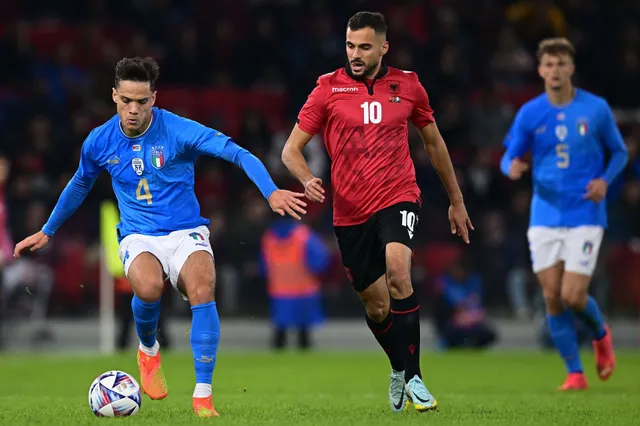
Finally we come to Albania. This is truly a case of poor luck, as they have been drawn into the toughest group they could have imagined. Albania was in great form in Euro qualifiers, topping their qualification group over the lies of Czechia and Poland. They have not had their chance to test themselves vs one of Europe’s best teams yet though, with pre-euro friendlies against Liechtenstein and Azerbaijan to prepare them for the tournament. It is no disrespect to the Albanian side to say that they are almost certainly going to finish last in this group, despite having some decent talent with the likes of Armando Broja, Kristjan Asllani, and Berat Djimsiti in the squad. I only hope to see Albania score some goals in this group (hopefully the first goal of the game to put some nerves onto their opposition) and give their travelling fans something to celebrate.
Realistic Best Possible Finish: Out in Group Stage
Group C: Denmark, England, Serbia, Slovenia
Let’s start Group C by taking a look at the Denmark squad, who are returning several players from their Euro 2020 semi-final appearance. Kasper Schmeichel is still going strong at age 37 and will be backstopping this Danish team yet again. Bright fullback talents Alexander Bah (Benfica) and Victor Kristiansen (Bologna) will play alongside Joachim Andersen and Jannik Vestergaard/Simon Kjaer in defence. Captain Pierre-Emile Hojbjerg has a very active role in this Danish team, especially in attack where he moves up the pitch much more often than he does at club level for Spurs. Alongside Hojbjerg in midfield will be Sporting CP standout Morten Hjulmand, who offers great defensive workrate alongside progressive passing. The third member of this midfield is most likely to either be Andreas Christensen in a holding role, allowing Hojbjerg and Hjulmand to move further up the pitch, or Christian Eriksen in a 10 role, with the double pivot covering more defensive ground. Young Manchester United striker Rasmus Hojlund will lead the line, accompanied by Andreas Skov-Olsen and Mikkel Damsgaard. Expect to see the likes of Jonas Wind, Thomas Delaney, Joachim Maehle, Kasper Dolberg, and Yussuf Poulsen feature prominently as well for Kasper Hjulmand’s squad. I believe the Danes should be favorites for a top 2 spot in this group securing them automatic qualification for the Round of 16, but from there it all depends on the draw. An unfavourable draw could see them up against it to qualify for the Quarter-Finals, but avoiding one of the giants in the first knockout round could see this team have another shot at making it as far as a semi-final.
Realistic Best Possible Finish: Quarter-Finals
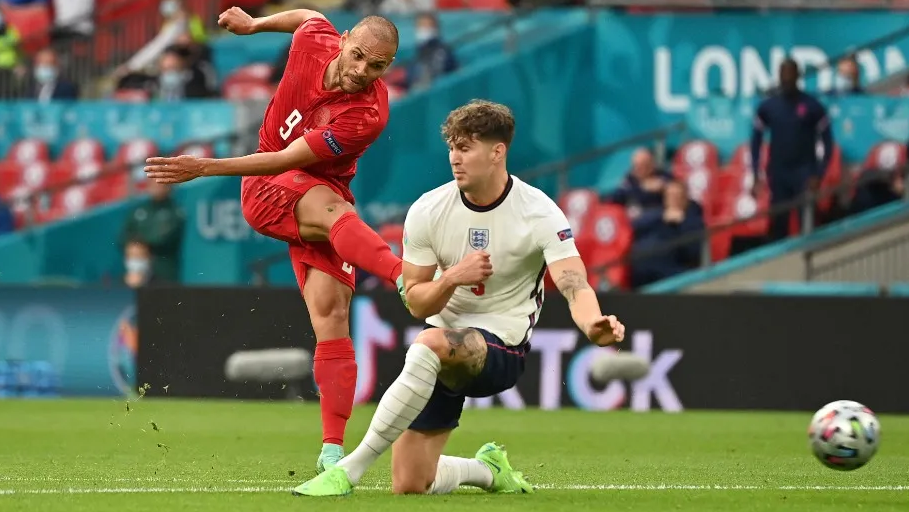
England. Oh England, what to expect from you? With arguably the most talented player pool to pick from this year, England are considered strong favorites to win this year’s Euros. That being said, Gareth Southgate is still Gareth Southgate, who has struggled to make the most of this “golden generation” of England players, with his best result being the Euro 2020 final where they memorably lost to Italy at Wembley, on penalties. Criticism can be made of Southgates squad selection and tactics, especially in the biggest matches where he often opts to play very defensive. The notable absences of Jarrad Branthwaite, Jack Grealish and James Maddison could prove to be hurtful to England’s chances in international play, where they are much more likely to come across a strong defensive side than one that is willing to press them high up the pitch (which would benefit England). Several young faces are making their first appearance at a major tournament for England including Adam Wharton, Kobbie Mainoo, and Eberechi Eze. I think England is most set up to struggle against Serbia due to the way the Serbians will set up. Expect to see a 4-2-3-1, with Pickford starting in net, Walker, Stones, Guehi, and Trippier across the defensive line, Trent Alexander-Arnold partnering Declan Rice in midfield, with Jude Bellingham being the offensive focal point as the 10. Harry Kane is obviously going to be the starting striker, leaving the most uncertainty around the wing positions. When playing with 2 wingers who like to cut inside and drop deep to receive the ball, this can play into the hands of a team setup to defend their box with numbers and crowd the middle of the pitch (like Serbia). Will we see Phil Foden on the left and Bukayo Saka on the right, or will Eze, Gordon, or Cole Palmer get a start? This I cannot answer, but England should be favorites to top this group. How far they can go? Well that’s up to Southgate.
Realistic Best Possible Finish: Winners
Now for Serbia, who I definitely think can progress from this group, either in 2nd place over the Danes or as one of the best 4 third placed teams. Specifically, I believe their match against England will be a very tactically interesting match. Serbia are likely to set up in a 5-3-2, with a very strong strike duo of Dusan Vlahovic and Aleksandr Mitrovic. For games against teams that are considered favorites, this will mean 8 players defending around the edge of their box, stacking the middle of the pitch and making it extremely difficult to play through Serbia with some quick one touch passing. When they win the ball back, Serbia will rely on support in attack from their wingbacks. On the left side this will be one of two Filip’s, either Kostic (Juventus) or Mladenovic (Panathanaikos). On the right this should be Dusan Tadic or or PAOK’s Andrija Zivkovic. The midfield 3 shouldn’t see more than 2 players join in attack, as they have a lot of defensive tendencies. There is enough talent in midfield to have solid depth options, and expect the Serbian team to defend as a unit in numbers. I think if the Serbs advance from this group (which I expect them to) they will provide a very difficult challenge for any team to face them in the Round of 16. It was not so long ago that we saw Neymar completely taken out of the game by this Serbian defence in the last World Cup. If there is one thing you can expect from this Serbian team, it is effort. They will leave everything on the pitch and should make this group’s qualification race quite interesting. I expect England to struggle the most against this side, and the game with Denmark should also be a tight contest.
Realistic Best Possible Finish: Quarter-Finals
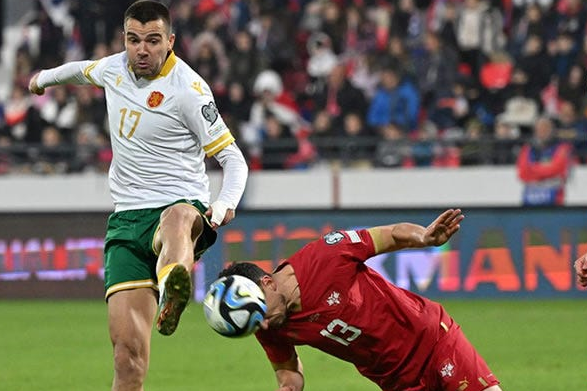
Finally to Slovenia, the last team in this group. They are also, barring any shock results or truly all-time performances from Benjamin Sesko, likely to finish last in the group table. It is no disrespect to the Slovenes, who have done brilliantly to qualify for this tournament. They have alternated between using a 4-4-2 during the Euro qualifiers, to a 4-3-3 formation in the most recent friendlies. A useful data point for the predictions were Slovenia’s matches in qualifying vs Denmark, their group-mates here. Those ties ended 1-1 in Slovenia, and 2-1 to Denmark in Copenhagen, showing that this (potentially unknown to many) Slovenia side is no pushover. This is in great part due to the their keeper, Jan Oblak. Oblak is approaching his 10th season at Atletico Madrid, and has accumulated 333 appearances for Diego Simeone’s men in his career at the highest level, as well as 65 caps for his national team. Slovenia’s lack of appearances at major international tournaments is the only reason Oblak does not have more caps, as he has been a nailed on starter in net for over 10 years now. A strong goalkeeper can win you games, or at the very least prevent you from losing them. Oblak will be protected by standout defender Jaka Bijol, who at age 25 has already earned 49 caps for Slovenia, and currently plies his trade at Udinese in Serie A. The rest of the defence is well experienced for the national team but perhaps lacks that bit of quality that comes from not playing at the top level of European football. Erik Janza at LB currently plays for Polish side Gornik Zabrze, Bijol will be partnered at CB with likely either Vanja Drkusic or David Brekalo, who play in Russia and the MLS, respectively. Right-back Zan Karnicik has spent most of his career playing domestically in Slovenia. In the 4-3-3, the midfield will be comprised of Jasmin Kurtic, Tomi Horvat, and Adam Gnezda Cerin to start matches, which follows the trend of lesser known names but a strong blend of experience and youth, with 129 NT caps between these three. Kurtic is the veteran presence in midfield, having earned 91 of those caps himself. On the wings, Andraz Sporar and Jan Mlakar will likely line up on either side of Slovenia’s starboy, Benjamin Sesko. The RB Leipzig striker has scored 14 goals in his first season in the German Bundesliga after playing for Austrian Red Bull side Salzburg beforehand, and was wanted by many of europe’s biggest clubs (with the most interest from Arsenal) before he re-signed at Leipzig, committing to at least one more year in Germany. He is a strong all-around striker, equally adept at finishing in the air or on the ground. Slovenia will heavily rely on Sesko to be clinical if they are to realize their dreams of making it out of this group. I must give a shoutout to my favorite club, Bodo/Glimt’s only representative at this tournament (thanks to Norway not qualifying), Nino Zugelj! After significantly upping his game this season for the Norwegian champs, Zugelj received his first national team cap in the leadup to this tournament, and has been selected in the final squad. He will be looking to change the game off the bench at the RW position if called upon. In short, this team is Jan Oblak, Benjamin Sesko, and several industrious players to play between them. Slovenia will not be an easy game for any team in this group, but chances are they could fail to win a match in this group stage and see an early exit. However, I won’t count them out right away, as in a 3 match group stage, 1 win could mean everything to qualification.
Realistic Best Possible Finish: Round of 16
Group D: Poland, Netherlands, Austria, France
To start off with Group D, I will be looking at the team that likely has the worst chances of qualifying from the group: Poland. After having been touted as a tournament dark horse for much of the past decade and failing to deliver on that promise, Poland’s key players are approaching the ends of their career, and with a late injury picked up by Robert Lewandowski, they will have a mountain of a challenge to qualify from the group. Wojciech Szczesny, now age 34, is still between the sticks for Poland, and he will likely have either a 5-2-3 or 5-3-2 in front of him for this tournament. There is not an absence of young talent in this squad however, with the next generation of Polish players having made their way into the senior team. The standout player of this generation of players has to be Roma’s Nicola Zalewski, who will play as a LWB in this setup, but also can play up front as a LW. Brighton’s Jakub Moder will be looking to be called upon in midfield, and Arsenal’s Jakub Kiwior is already a nailed on starter at the LCB position. Poland should be difficult to break down in defense, but the real question lies in where their goals will come from, especially if they are without record goalscorer Robert Lewandowski for the entire group stage. Being in the same group as France and the Netherlands, alongside a very underrated Austria side will make the Polish task difficult. They have the talent to take a result against any team, but likely can not be relied upon to do so. While it is not impossible for Poland to qualify from the group, it is also not impossible that they finish with 0 points from this group stage. I find it hard to see Poland qualifying from the group, and if they do harder to see them winning a knockout stage game. The Polish faithful will be praying for Lewandowski’s return as early as possible.
Realistic Best Possible Finish: Out in Group Stage
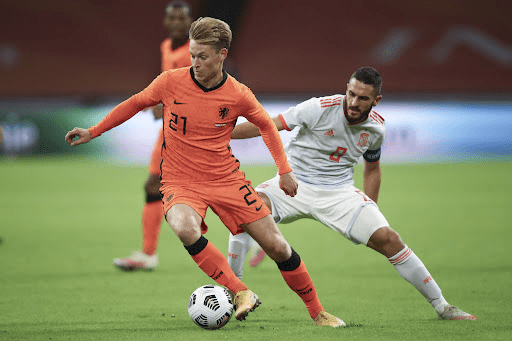
Onto the “Oranje”, Ronald Koeman’s contingent from the Netherlands. They suffered two major injuries in the lead up to the Euro’s opening matches in their midfield, with standout performers Frenkie de Jong and Teun Koopmeiners both out for the tournament. The Dutch have a vast player pool to select from, and both Ian Maatsen and Joshua Zirkzee have been called up to fill the vacant spaces in the team. Given the midfield injuries, I would expect to see the Dutch play a 4-2-3-1 formation, allowing their attacking talent to fill the space left by the midfield losses. Alternatively, Koeman may use a 3-4-2-1 formation. In classic Netherlands fashion, there is a wealth of CB talent available, and we will likely see a CB playing at LB in this team. Nathan Ake would be the first choice here, with young Spurs star Micky van de Ven ready to offer his blistering pace when Ake begins to tire in a match. Denzel Dumfries offers impressive output at both ends of the pitch at RB, and will likely be backed up by versatile Feyenoord defender Lutsharel Geertruida. Virgil van Dijk and Stefan de Vrij will likely start at CB, with Matthijs de Light and Daley Blind offering cover. In midfield, Ryan Gravenberch will be asked to carry a lot of the load now, and will likely be partnered by one of the PSV duo of Schouten or Veerman. In attack, the Dutch have strong depth, and we are likely to see Leipzig star Xavi Simons at the heart of it as the 10. Leverkusen RWB Jeremie Frimpong will play up front as a RW, with Cody Gakpo taking a left inside forward role behind Memphis Depay. If no further injuries occur, this Dutch team definitely has the talent to go all the way, but like always it depends on the knockout round draw. Expect the match between France and the Netherlands to be the highlight of this group featuring a plethora of very good footballers.
Realistic Best Possible Finish: Winners
Ralf Ragnick has transformed this Austria team into what can only be described as a team greater than the sum of its parts. His high pressing philosophy is well suited to this Austria side, and even without star defender David Alaba, will present an unwelcome challenge to any opponents. Experienced striker Marko Arnautovic leads the line, supported by a wealth of young talent in attacking midfield behind him: Patrick Wimmer, Christoph Baumgartner, and Roman Schmid were all selected for Austria’s pre-tournament friendly win over Serbia, with all 3 being 24 years of age or younger. Nicolas Seiwald adds to this trend from midfield, providing a creative spark. Seiwald should be partnered by veteran Konrad Laimer to provide a good balance for their double pivot. In defence, Ragnick has not given much away in terms of his selection, using two entirely different back 4 combinations in the two pre-tournament friendlies. The goalkeeper selection is also uncertain, with Heinz Lindner and Patrick Pentz are the more established keepers, while young Niklas Hedl (Football Manager addicts like myself will recognize that name), is the future of the Austrian national team in net and might just make an appearance at this tournament. If everything clicks, this Austrian team will at worst be a team no favourite will want to be drawn against in the knockoutst, and at best could make a strong run at this summer’s Euros.
Realistic Best Possible Finish: Semi-Finals
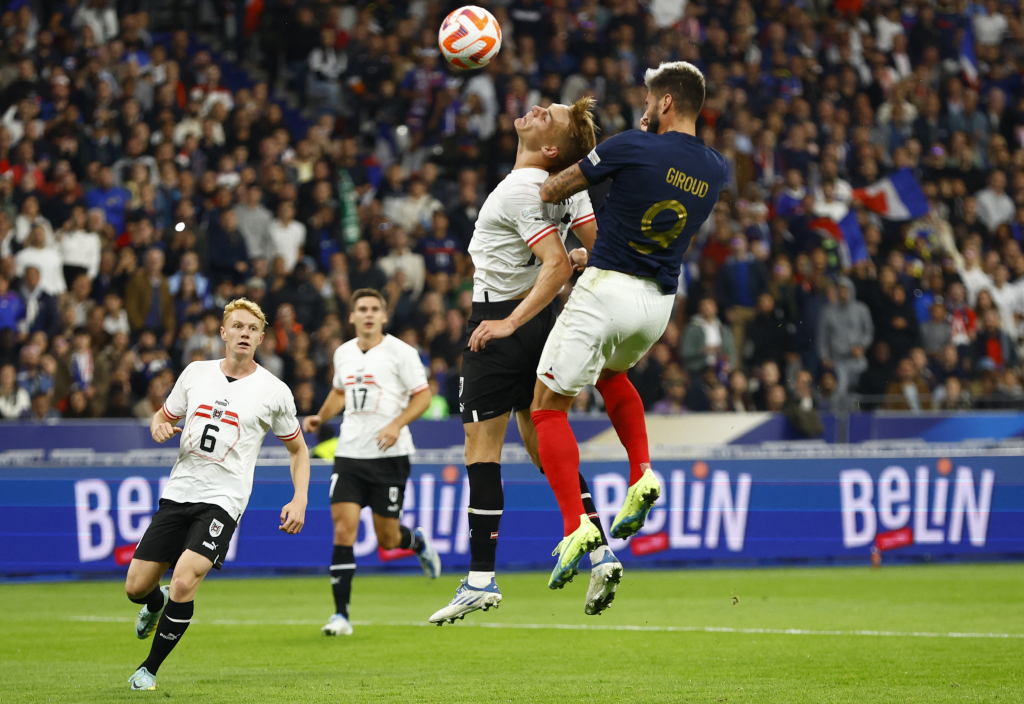
Finally, France. I probably have the least insight to offer here, as this French team is very well known, having won the 2018 World Cup and reached the finals of the 2022 World Cup. Didier Deschamps’s managerial credentials cannot be doubted, although perhaps his loyalty to his top performers of past tournaments may start to affect the peak this France team can achieve in the coming years. Ibrahima Konate will likely partner Dayot Upamecano at CB, despite William Saliba having become one of the best CB’s in the Premier League. Jules Kounde and Theo Hernandez are pretty nailed-on as starters at the fullback positions, but now for my favorite part of France’s team this year: N’GOLO N’GOLO, KANTE! The constantly smiling French midfielder makes his return to the national team for this year’s Euros as perhaps the biggest surprise of Deschamps team selection. France and neutral fans alike had no complaints, as we all love seeing Kante on the pitch. Kante, Camavinga, Youssouf Fofana, and young PSG star Warren Zaire-Emery are the players competing for the two midfield places in this team, and I would expect Deschamps to default to experience, starting Kante and Camavinga until shown a reason not to. Ousmane Dembele, Antoine Griezmann, Kylian Mbappe and Olivier Giroud will make up the attacking quartet, with a wealth of talent off the bench. Bradley Barcola, Randal Kolo-Muani, Kingsley Coman and Marcus Thuram are all available for Deschamps to call upon if needed. There’s no mincing words on this squad, they are arguably the strongest in the tournament, and if you include the manager in your assessment, they are very likely the strongest squad at this summer’s tournament. Nobody would be surprised if Mbappe and Co. take home the big prize.
Realistic Best Potential Finish: Winners
Group E: Belgium, Slovakia, Ukraine, Romania
This group offers a lot of unpredictability, which is my way of saying the favourites on paper (Belgium) have noticeable weaknesses. They’ve played 3 different formations in their most recent 3 matches, so it is hard to predict what will be used for their opening match vs Slovakia. Instead, lets look at the talent they have at their disposal. In attack, Romelu Lukaku or Lois Openda are the main two striker options, with Charles de Ketelaere as another choice. Jeremy Doku, Leandro Trossard, Johan Bakayoko and Yannick Carrasco offer support from the wings. Group E fullbacks will have their work cut out for them dealing with this group. Andre Onana and Kevin de Bruyne should both play prominent roles in midfield, with up and comers such as Arthur Vermeeren and Aster Vranckx joining the national team for this tournament. The weakness of the Belgium team is in defence: no Thibaut Courtois available due to injury, so Koen Casteels will start in net. Zeno Debast, the young Anderlecht defender with 8 caps by age 20, and Arthur Theate are the only defenders with reasonable pace in this side which is full of veterans in defence (while only 26, Wout Faes can hardly be described as pacey and has the pace of 37 year old Jan Vertonghen). Axel Witsel is still in the squad, while Thomas Meunier and Timothy Castagne make up the rest of the defensive options. Belgium will rely on a potent attack to outscore opponents, and will not pick up many clean sheets in this tournament I believe. However their attack is so good it should still give them the edge to finish first in this group, though I think any of three teams could top this group depending on how the group stage plays out.
Realistic Best Possible Finish: Semi-Finals
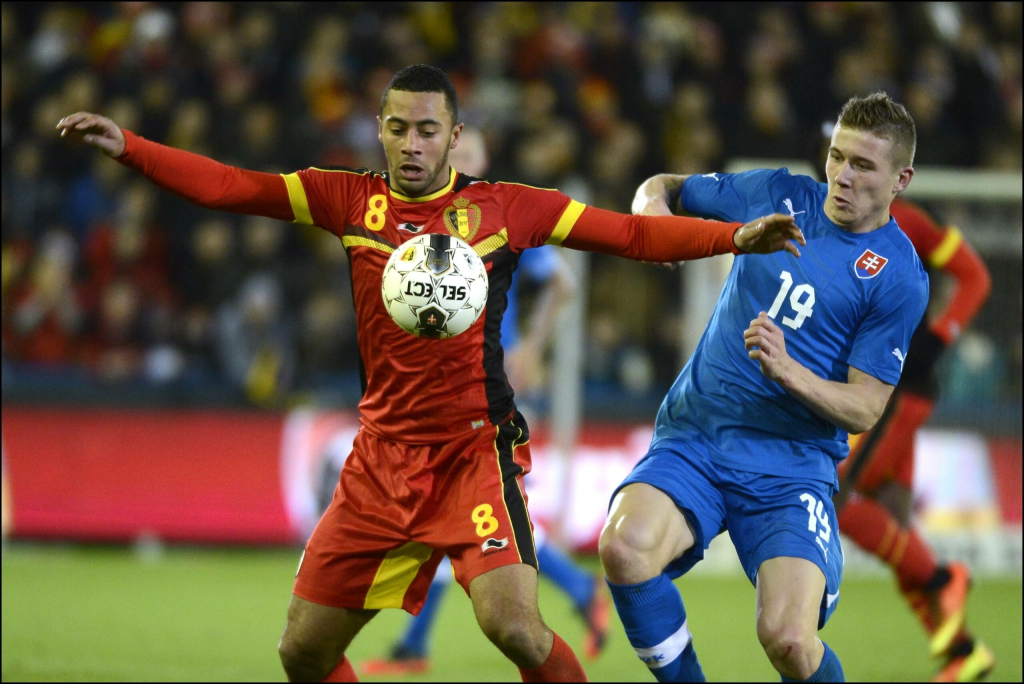
Before I begin discussing Slovakia, I should offer a disclaimer so you can decide whether what I say is in any way biased: I am Slovak-Canadian and am indescribably excited for Slovakia to begin their third ever Euro tournament with great optimism. HOWEVER, I’ll start off with the weaknesses of this slovak side to try to be unbiased. Aside from the retirement of possibly Slovakia’s greatest ever player Marek Hamsik (who joins this squad as the assistant coach), that weakness is scoring goals. In the lead-up to the Euro’s starting, Slovakia recorded back to back 4-0 wins over San Marino and Wales though. Given that those two teams are not the toughest competition in Europe, we should not overreact to the scoring, but Slovakia scored 17 goals and conceded 8 across the Euro qualifiers under Francesco Calzona, with half of the goals conceded coming to tournament favorites Portugal. In those two matches, only a goal separated Slovakia from Portugal, with a 1-0 loss in Bratislava followed by a thrilling 3-2 loss in Portugal. This bodes well for Slovakia’s ability to play against the best teams, as if it was their day both of those matches could’ve gone the other way. Slovakia likely have the best defence in this group, with Martin Dubravka in goal, and Milan Skriniar anchoring a defensive unit that should include Copenhagen CB Dennis Vavro, who has shown great ability on the ball in the lead-up to this tournament, and current active highest cap-holder Peter Pekarik at RB. Pekarik, 37 years old now, has amassed 127 caps for the Slovak national team and joins a defence full of experience. At LB, and for me the player who could potentially be Slovakia’s player of the tournament, is David Hancko. Hancko is a bit of a unicorn. Tall, physically strong, good pace and with great ability on the ball, Hancko is comfortable playing CB as well as LB, so he will offer defensive coverage as well as some beautifully whipped crosses into the box. The Slovak midfield 3 of Calzona’s 4-3-3 formation will be comprised of 234 national team caps between holding midfielder and Napoli man, Stanislav Lobotka, with Juraj Kucka and Ondrej Duda on either side of him. Keep an eye out for Slovakia on set-pieces, especially Duda’s deliveries. This is not bias but deserved praise when I say Duda’s corner delivery is better than many Premier League level players, able to put the ball in with pace and height to get past the first defender, before showing the ability to drop the ball right on the head of the first Slovak player at the near post. Excellent set piece delivery and having 3 CB-sized players in the backline makes for a dangerous recipe for defenders. Genk’s Patrik Hrosovsky and Hamburg’s Lazslo Benes will be the first options of the bench in midfield, with 21 year old Tomas Rigo potentially getting his first taste of major action. Up front young Boavista striker Robert Bozenik will start as the main man up front, with Sparta Prague’s Lukas Haraslin being a sure starter on the left wing. At right wing, Ivan Schranz is likely to start matches, where he often contributes just as much in tracking back and winning the ball as he does in attack which could be invaluable to a Slovak side that will not be able to be a possession dominant team in this tournament. 22 year old Tomas Suslov (Duda’s teammate at Hellas Verona in Italy) and David Duris are both solid options to be subbed on for Schranz. The one player in attack that I hope you all get the chance to see play is 18 year old Feyenoord winger Leo Sauer, who is without a doubt the best attacking prospect Slovakia has produced in my lifetime. Sauer moved to Feyenoord at 16 and became a regular squad player under (now Liverpool boss) Arne Slot this past season. In March, Sauer became the youngest ever player to play for the Slovak senior national team, and has his second cap from the recent pre-tournament friendlies. I believe the top 3 teams in this group will all have a chance to win the group and all 3 will advance to the knockouts, meaning a favourable knockout draw could see Slovakia surprise many. Realistically from what I’ve seen of the possible knockout matches, Slovakia will face a tournament favorite in the quarter-finals should they make it there, which I believe they absolutely have a solid chance to do.
Realistic Best Possible Finish: Quarter-Finals
Onto another potential surprise at this summer’s tournament: Ukraine. This is a very strong Ukraine squad and could be one of the 3 teams that I believe have a chance to come 1st in this group. Led by La Liga top scorer Artem Dovbyk up front, with his Girona teammate Viktor Tsygankov and Chelsea speedster Mykhailo Mudryk on the wings, the Ukraine attack is about as good as it has been in recent memory. Shakhtar Donetsk star midfielder Heorhiy Sudakov provides the vision and passing from the centre of the pitch. Several Premier League players populate the Ukrainian defence, with Vitaliy Mykolenko and Ilya Zabarnya sure to play prominent roles, while Arsenal’s Oleksandr Zinchenko is more likely to play as a holding midfielder. Real Madrid’s Andriy Lunin, fresh off backstopping Madrid to the Champions League final and La Liga title, will take the start between the sticks. Like the other top contenders from this group, there is a lot of unknowns. Whichever team of Belgium, Slovakia, or Ukraine brings their best form will likely finish 1st, while I believe all 3 will advance. Depending on the draw in the knockouts, I think it not impossible that Ukraine could win a knockout match as well, though I see it difficult for them to reach the semi-finals.
Realistic Best Possible Finish: Quarter-Finals
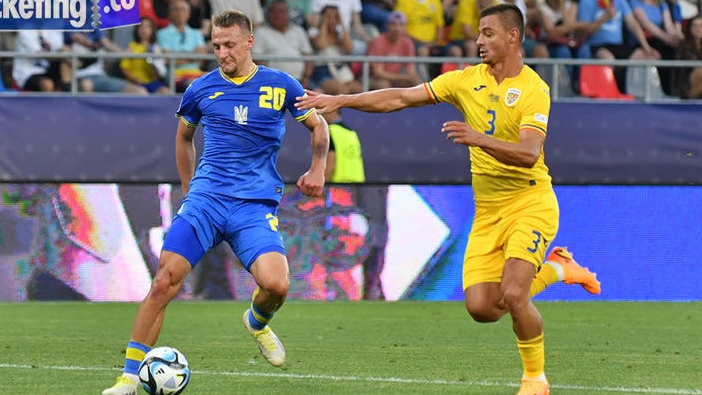
Finally, Romania, who seem the weakest team in this group by a fair margin, especially considering form coming into the tournament. The Romanians achieved a 1-0 victory over Switzerland in the final match of Euro qualifying, but since then in their friendlies before the tournament have drawn Northern Ireland, lost to Colombia, and had back to back 0-0 draws against Bulgaria and Liechtenstein. None of the European teams they drew against have qualified for this Euros, with Liechtenstein being the smallest European country outside of San Marino. It does not bode well for Romania’s chances to advance from this group. The star of this team is the 22 year old Spurs CB, Radu Dragusin. Captain Nicolae Stanciu and his 70 caps (active leader for Romania), will lead this side from an attacking midfield role, alongside Alaves midfielder Ianis Hagi, (yes, that’s Gheorghe Hagi’s son). The majority of this Romania squad plays their club football in Romania, Turkey, or the Italian Serie B. Lacking the same top-level talent as the other teams in this group, Romania could unfortunately end up without a point, while a draw is likely their best outcome from any of these matches. Dragusin is also the youngest player in this team and the only player younger than 24, so the experience of playing at this Euro’s will not benefit most of the younger generation of Romanian players who will be called upon in future years. Let’s hope they can give their passionate fans something to cheer for.
Realistic Best Possible Finish: Out in Group Stage
Group F: Turkey, Georgia, Portugal, Czechia
Time for the last group, Group F. This group should be relatively easy for a strong Portugal side to finish 1st in, while the 2nd place qualification spot is up for grabs.
Starting with Turkey, who have some talent on this team but do not look to be in the best form coming into the tournament, having not won a match since November 2023. A draw to Wales, losses to Hungary and Austria (the latter by a 6-1 scoreline), a draw to Italy and a loss to Poland in their last 5 matches do not give too much room for optimism, but this group still offers a decent chance to qualify if the Turks can turn it around. Led by youth at the front, either 18 year old Besiktas striker Semih Kilcsoy or 19 year old Juventus up-and-comer Kenan Yildiz will be called upon to bring the goals. I expect Kerem Akturkoglu, Orkun Kokcu, and Arda Guler to start behind the strikers in a 4-2-3-1 formation, which offers a good attacking punch. Turkey legend and captain Hakan Calhanoglu, who is still performing for Inter Milan at age 30, will offer the playmaking from the midfield while paired with Dortmund defensive midfielder Salih Ozcan. Recently in defence, the back 4 has been chosen with a defensive mindset, with Roma’s Zeki Celik (a CB/RB hybrid player) and Mert Muldur (also a CB), are playing at the fullback positions. Abdulkerim Bardakci is likely to start at CB, with his partner not seemingly set yet, but I think Samet Akaydin from Panathinaikos is likely to start. New Manchester United #2 keeper Altay Bayindir is likely to get the start, although Besiktas Mert Gunok could start if Vincenzo Montella prefers the veteran presence in net. If Turkey can perform against Czechia and Georgia, they are in with a solid chance of qualifying, though I doubt their credentials to go deep in this tournament.
Realistic Best Possible Finish: Round of 16
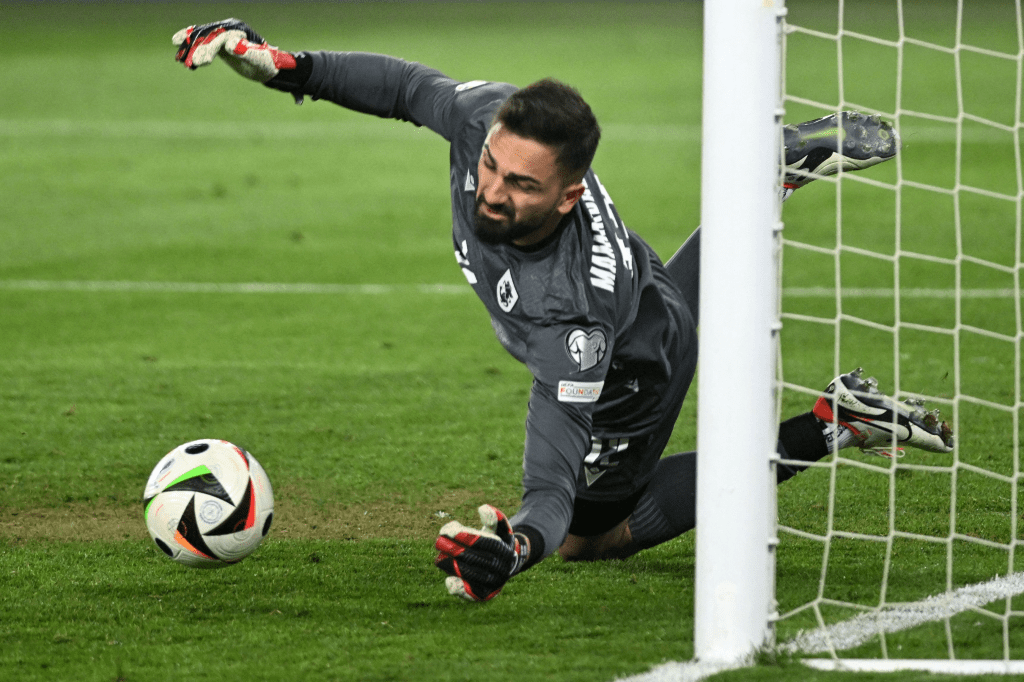
Next, to Georgia, who had to run the gauntlet to qualify for this year’s tournament after not securing automatic qualification from their group. A 2-0 win over Luxembourg and a dramatic penalty shootout win over Greece booked their tickets to Germany, with keeper Giorgi Mamardashvili becoming a national hero for his saves in that shootout. Mamardashvil is a top keeper in my opinion, and has had another solid season in La Liga with Valencia. Georgia is in ways similar to Slovenia: one of their best players is their keeper, and the other is a forward. That forward being Kvicha Kvaratskhelia, who has an impressive 15 goals in 30 caps while playing as a winger for the national team. If “Kvaradona”, as he is affectionately nicknamed by the Napoli faithful, can produce some magic in this group stage, there is no reason to believe Georgia cannot continue this dream run just one step further. Winning a knockout game will prove to be a very tough task if they do qualify.
Realistic Best Possible Finish: Round of 16
Onto a tournament favorite, Portugal. The greatest weakness of this Portugal team is honestly their manager. Roberto Martinez is one of the most successful managers in the world at failing upwards – after underperforming with Belgium’s “golden generation”, culminating in a massive fallout within the squad at the last World Cup, he has somehow landed the Portugal job. This is a case where the players may need to just ignore the manager and do what they know is best in games, as there is the talent to go all the way. Porto’s Diogo Costa, who is seen as the next big thing for European keepers, will start in net, finally getting the #1 spot over aging Rui Patricio. Portugal have switched between a 4 and 5 back formation in their 2 pre-tournament friendlies, with the back 5 being used to allow talented young defenders Antonio Silva and Goncalo Inacio to play alongside veteran Pepe, who looks an ageless wonder still able to perform at top level while 41 years old. Diogo Dalot, Joao Cancelo, and Nuno Mendes are all very strong wingback options. In midfield, there are several options to use, with Bruno Fernandes, Joao Neves, Joao Palhinha, and Vitinha being the major candidates to start (depending on formation). Bernardo Silva, Rafael Leao, Joao Felix and Goncalo Ramos are all candidates to start up front, with Cristiano Ronaldo likely to play a super-sub role in his final Euro tournament. This team has so much talent available to them, we should not be surprised if they do go all the way.
Realistic Best Possible Finish: Winners
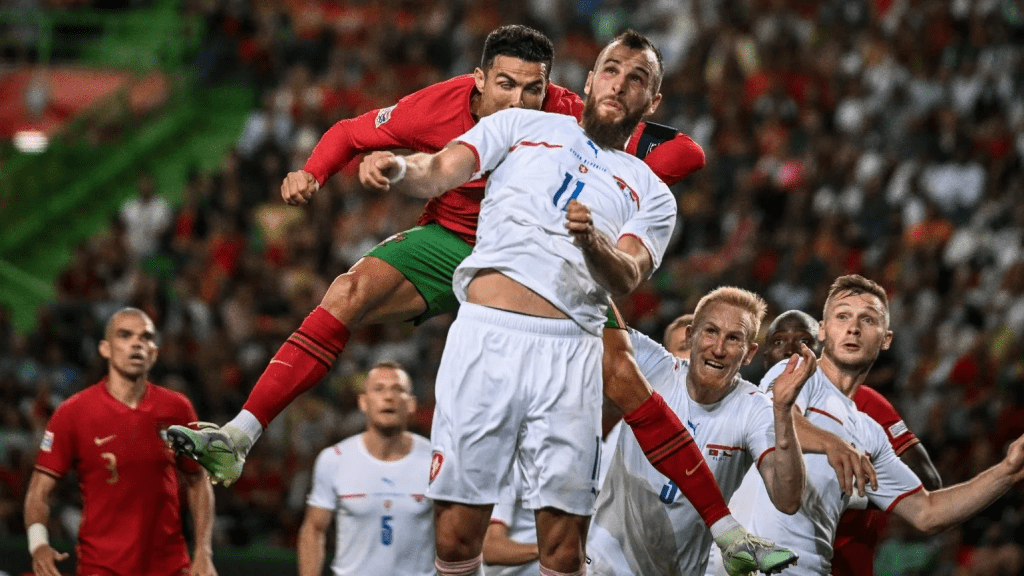
Finally we arrive at the Czech squad. This is a relatively weak Czech team compared to what we might’ve seen in Euro’s past, there are no Pavel Nevded’s in this year’s team. However, there is still some solid talent, with Leverkusen duo Adam Hlozek and Patrik Schick leading the attack. Fiorentina midfielder Antonin Barak adds quality to midfield alongside West Ham stalwart Tomas Soucek. Soucek’s teammate Vladimir Coufal offers veteran leadership in defence alongside some solid young talent. The player to watch for me is Sparta Prague midfielder Ladislav Krejci, who recently moved from CB to midfield at club level and has thrived in a tempo-controlling role. The Czechs can absolutely qualify from this group, but I find it tough to see a path far into the knockouts for them. A Round of 16 appearance will be seen as a success.
Realistic Best Possible Finish: Round of 16
-
Return of the Traditional #9
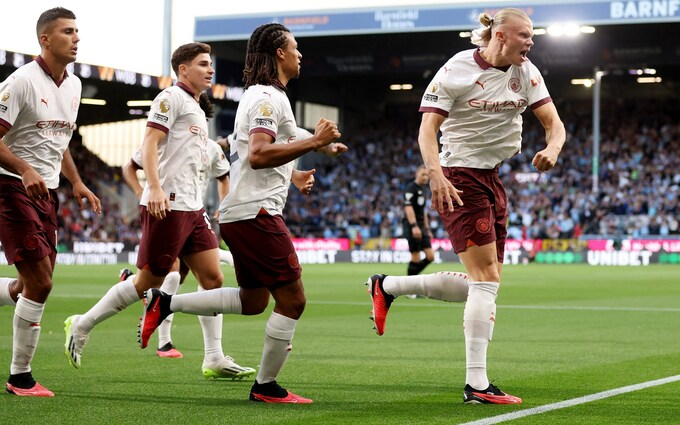
Hello again football fans,
This past season I noticed the further emergence, or re-emergence, of a tactical trend, and thought it would be worth a discussion. Across Europe, it seems as if the days of the False 9 are over for now, as many sides have reverted to using a more traditional out and out #9. Why is this the case? Have managers just gotten nostalgic for the “good old days” where a striker’s job was simply to put the ball in the back of the net and win aerial duels? Was Sean Dyche right all along? Why are playmaking #9’s less effective at Europe’s top level now? I believe there are several reasons for this.
Reason 1: Pressing
High-intensity pressing is the norm more than the exception now, especially in the Premier League. When Jurgen Klopp joined Liverpool nearly 10 years ago now in October 2015, he brought his “gegenpress” style to England, and at the time this was a unique approach. Many teams preferred to sit deeper in a mid or low block, and look to build counter attacking moves from their own half. Now, the value of winning the ball high up the pitch has become apparent: the closer to the opposition goal you win the ball, the less distance there is to cover to get to goal, and generally less offensive actions are required before a scoring chance is created. More and more modern managers are selecting this approach, whether they are a title challenger or a relegation-battling club. When teams press you high up the pitch, there are generally two options: try to play through the press, which risks turning the ball over close to your goal with more of your players committed up the pitch, or attempt a long ball to bypass the press entirely. While most teams prefer to play from the back (thanks Pep), having the outlet long ball pass be available is a handy “get out of jail free card” when under pressure. This is one reason why the traditional #9 is being used more. Erling Haaland at Manchester City is a prime example. Now this past season, Mikel Arteta adjusted his pressing approach vs City to not commit as many players forward to the press. He learned this lesson in Arsenal’s 4-1 defeat to City on April 26, 2023. Look how the first City goal was created:
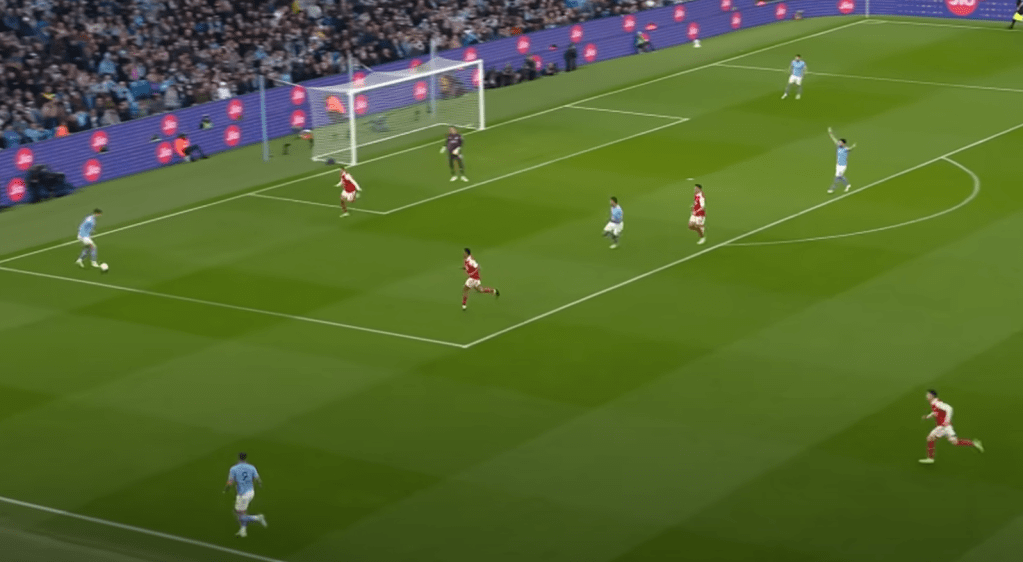
Ederson plays the ball out wide to John Stones, who is immediately under pressure from Martinelli and Jesus. He opts not to pass short to Walker, but waits until the Arsenal players close him down more, before opting for a long ball.
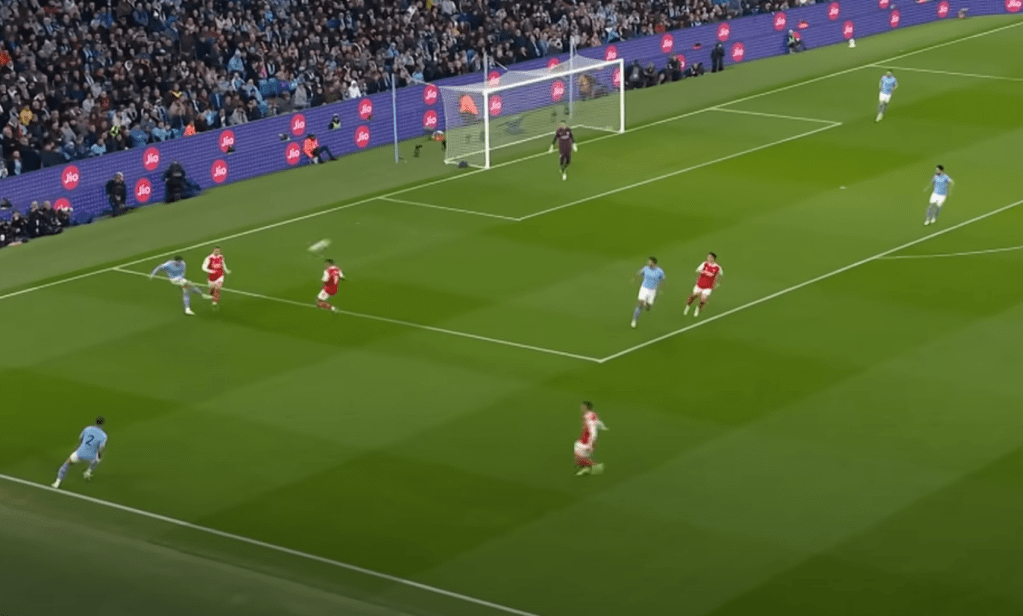
The target of this long ball? Erling Haaland of course. You can see how as the ball comes in to Haaland, he has gotten body positioning on Rob Holding and is able to control the ball down and make a pass to Kevin de Bruyne, who has slipped past Thomas Partey with his run through midfield:
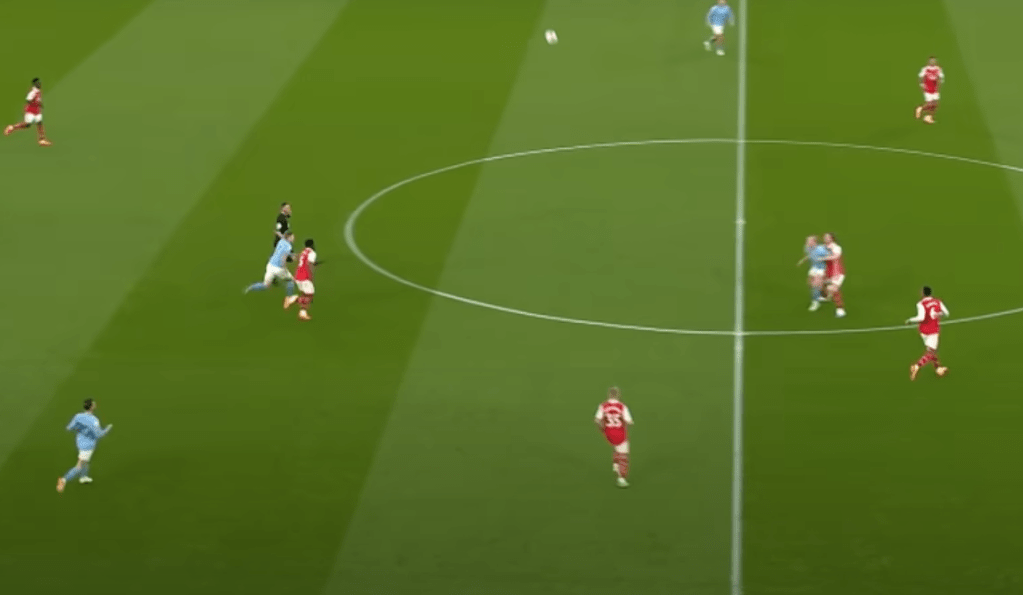
Seconds later, de Bruyne runs towards the edge of the box and unleashes a low strike into the bottom corner. 1-0 City.
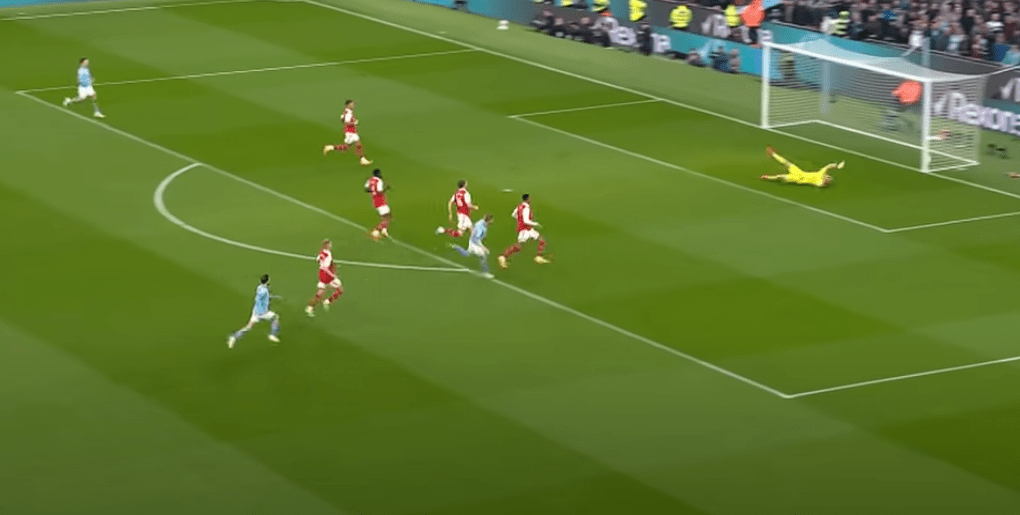
If Manchester City still had Gabriel Jesus, or even Sergio Aguero as the lone striker, they would be much less likely to win the aerial duel vs Arsenal’s CB and retain possession. Having the option to both play short through a press or send a long ball to the ST to hold possession, allowing midfielders to make supporting runs for a pass forward gives teams more unpredictability in their buildup, and forces the opposition to think twice about committing so many players forward to the press. This past season, Postecoglu’s Spurs encountered this difficulty, with Richarlison being their best forward equipped to perform this role. When he was not fit and Son Heung-Min played in the #9 role, there was a noticeable difference in Spurs’ ability to retain the ball when under high pressure in their own end of the pitch: teams could cover the short passing options, with some degree of confidence that a long ball towards their CB’s would be dealt with and the ball would be won back. Now I used this as an example because Son is clearly a world class player, but holding up the ball under physical challenges is not his biggest strength, one of the reasons he is more effective off the left wing. Having a physical striker able to win duels vs opposing CB’s offers a lifeline when the opposition is committing a lot of players up the pitch to press and at the same time, will offer more space to play out from the back, as the risk of the long ball needs to be considered by the defence before pressing.
Reason 2: Structured Defences
In current-day football, teams are more structured than ever and are well drilled defensively to protect their box when under attacking threat. Arsenal, one of the best teams in world football at the moment, have encountered the issue of not being able to convert extreme amounts of attacking threat to shots on goal and goals scored. They would frequently make several passes in the box before a shot attempt was taken, which allowed defenders to close them down, and any backtracking players to arrive in the box to help. With defences being as well organized as they are now, it is more imperative than ever to generate chances quickly, and take the opportunities when they present themselves instead of overpassing or trying to be too fancy dribbling around the box. This is the same reason why high-pressing has become so popular, it allows your team to get the ball in a good offensive position, with the least amount of opposition players in position to defend. So for this reason, having a physical striker who can operate at times like a pure poacher is more valuable than it has been in past years. Not to overuse Haaland as an example, but just think, how many times have you seen Haaland receive the ball in the box and try to make an extra pass, or dribble a defender before shooting? His job in the final third is to put the ball in the net, so when he is in a position to shoot, he does so immediately, while also offering an aerial threat of any subsequent set pieces that might arise from a blocked shot or defensive clearance.
This is more than a trend in the Premier League however. La Liga’s top two scorers this year? Girona’s Artem Dovbyk, and Villareal’s Alexander Sorloth, two imposing strikers who are aerial presences and not so much known for their dribbling or playmaking ability. In Serie A? 6 of the top 8 goalscorers fit this player profile, all being physically strong and primarily looking to score when in the box (Lautaro, Vlahovic, Osimhen, Giroud, Zapata and Lukaku). The leading goalscorers of the Liga Portugal and the Eredivisie? Viktor Gyokeres and Luuk de Jong. It seems that now more than ever, the most efficient way to play against modern defences is to bring back the traditional #9. Small, agile, skillful players are showing to be much more effective on the wings or through midfield, while leaving the physicality to be brought by the striker in attack.
Now like always, I don’t want you to take my word for it but rather consider my ideas with what you yourself have seen in European football this year compared to previous years. In addition, keep an eye on the ST transfers this summer to see what teams are prioritizing for their #9. Do you agree that there has been a larger shift back to the traditional #9, and how long do you think this may continue before there is a defensive change to the game that continues the constant tactical evolution in football?
Thanks for reading, I hope you found some insight in this article. I’ll be looking to publish a preview of the summer’s Euros and Copa America tournaments in the coming days, so stay tuned!
-LM
-
A Strange Year for Managers in England

Hello again, apologies for the delay in posting, I just moved and have finally gotten settled and internet set up! Just in time too, because I couldn’t wait any longer to talk about today’s topic: has this been the strangest year in recent memory for managerial changes in England?

Vincent Kompany
The most unpredictable of the bunch, and the main reason why I felt there was enough evidence to look at this as a larger-scale trend, is the links between Bayern Munich and Vincent Kompany. Now this is very much in part due to the state of Bayern Munich, which is chaotic to put it nicely. Bayern memorably sacked Julian Nagelsmann last year because they wanted to bring in Thomas Tuchel, while Nagelsmann had been doing quite well at Bayern. In the end, Bayern decided to move on from Tuchel faster than they had from Nagelsmann! The German’s departure from the Allianz at the end of the 2023/24 season was announced with months still to play in the year, and the Bayern hierarchy has been trying to attract his successor since. In a strange deviation from what we are used to, Bayern have experienced nothing but rejection from every manager they’ve approached so far. Some managers that have rejected Bayern have been Xabi Alonso – who opted to remain at Leverkusen after their title-winning campaign, Julian Nagelsmann – who was not jumping at the chance to come back to Bayern, Ralf Ragnick – who preferred to remain as the Austrian national team manager, and Oliver Glasner – who was undesired by Bayern for years as he coached Eintracht Frankfurt, but was approached mere months after joining Crystal Palace. This wild goose chase of a search for a manager has finally led the Bavarians to approaching Vincent Kompany after he saw his Burnley side get relegated from the Premier League in their first season back up. Results aside, Kompany also made some serious mistakes, potentially assuming Burnley’s safety from relegation was assured. Kompany continued to play a possession, attacking style of football that worked well when he had one of the best squads in his league (in the Championship) but was heavily exposed at Premier League level. The choice of player transfers was very much for the future, with several young, unproven players coming in ahead of this past season. Some key deficiencies in the squad (like at LB for one) were not addressed, and Kompany stubbornly refused to change his tactics, resulting in relegation. We can argue that Kompany’s style would have more success with a squad like Bayern’s, who are indeed one of the best in their league, but the more concerning part for Bayern fans should be Kompany’s unwillingness to alter his approach when it was clearly not working well enough. This also goes to show that while football has evolved past the thought that a former great player will be guaranteed to be a great manager, but Kompany’s playing career and the reputation he gained from it is absolutely a factor in Bayern approaching him.
Steve Cooper
Onto other strange managerial changes: the first one this year was Steve Cooper’s dismissal from Nottingham Forest. Yes Nottingham Forest were 17th at the time, but the sales of key players (Brennan Johnson for one) and their injury situation played a big part in this. Over his Forest tenure, Cooper averaged 1.43 points per match, a very respectable number. His replacement? Nuno Esperito Santos, coming off a stint managing Saudi Pro League side Al-Ittihad. Nuno’s best work came at Wolves, where he did objectively great work at the Midlands side, averaging 1.68 points per match across 199 matches in the Championship and Premier League. His short time at Spurs was not inspiring, and after his appointment at Forest, he averaged 1.15 points per match, and Forest barely survived relegation, ending the season in the exact same place they were in when Steve Cooper apparently deserved to be sacked. Whether this really has more to do with the Forest management is unknown, but the change was not a noticeable improvement!

Mauricio Pochettino
I think most football fans were surprised to see Chelsea parting ways with Mauricio Pochettino at the end of the Premier League season. Yes, the side struggled early on in the season, but it cannot be argued how much they improved in the second half of the season, winning the 4th most points in the league in 2024, behind only the clear cut top-3 of Man City, Arsenal, and Liverpool. The squad of young players had finally shown some chemistry and will to fight for results, and Pochettino had clearly won over the dressing room. At the end of the season, Chelsea finished in 6th place (compared to 12th last year), and only missed out on Europa League qualification due to Manchester United winning the FA Cup final from 8th place in the league. The Chelsea players were noticeably unhappy about Pochettino’s departure, with many first team players expressing sadness on social media about the change. If there were a handful of elite managers available for hire at the end of this year, I would’ve been able to understand letting Pochettino go, but there isn’t a wealth of options. The 4 main candidates were Roberto de Zerbi (we’ll get to him later), Kieran McKenna from Ipswich, Brentford’s Thomas Frank, and Leicester City’s Enzo Maresca. Recent reports by the Athletic indicate that Chelsea have chosen Enzo Maresca as their preferred replacement for Pochettino, leaving Chelsea and neutral fans alike not knowing what to expect. The criticisms of Enzo at Leicester this season, with the most expensive squad the Championship has ever seen, were valid; his side were 11 points clear in the automatic promotion spots on January 1st with only 3 losses in 25 matches. Since then, Leicester lost 8 of their final 21 games, finishing with the 5th highest points total of 2024 but hanging on to the Championship title and automatic promotion in the end (helped by some poor form at the end of the year from promotion rivals Leeds and Ipswich). Often showing a possession game that consisted of a horseshoe of passing around the opponent’s box without any penetrative passes to speak of, Leicester fans have been left frustrated on more than a handful of occasions by Enzo’s approach. Chelsea suffered from the same problems this year – often lacking the penetrative passes into the box to produce goals and passing around in the opponent’s half without much threat. As it stands, it does not seem likely that Enzo will solve those problems for Chelsea unless he changes his approach. In the end, Chelsea targeting Championship managers feels a long way off from their recent history. If there is any Championship manager I think has the most potential, it is Ipswich’s Kieran Mckenna, who was informed recently he was no longer being considered for the Chelsea job.
Roberto de Zerbi
I said we’d get to Roberto de Zerbi later, and now we will. The Brighton manager who took England by storm after replacing Graham Potter and improving on what was already seen as a fine job done by Potter with Brighton, achieving Europa League qualification last season. Brighton’s results this year were not nearly as successful, but losing Moises Caicedo and Alexis Mac Allister without finding suitable replacements for them was always going to cause issues. Add in long term injuries to key players such as Kaoru Mitoma, and it makes sense why Brighton finished 11th this year with the added European schedule. With de Zerbi being linked to several jobs over the past year due to his impressive performances with Brighton, it seems likely that his departure “by mutual consent” was a decision by the club to let him go before he left them for another job. Now Brighton have the whole summer to decide on his replacement, instead of de Zerbi potentially accepting another job weeks before the start of the new season leaving Brighton scrambling for a new manager. As previously mentioned, de Zerbi does not appear to be the preferred candidate for the Chelsea job so it is unknown where he might end up next.

Erik ten Hag
Finally we will address Erik ten Hag’s potential departure from Manchester United. While not officially announced by the club, The Guardian reported that ten Hag’s future had been decided by new owners INEOS, with the Dutch coach to be sacked following the FA Cup final, regardless of the result of the final. As we now know, Manchester United won the FA Cup, which could give INEOS and Sir Jim Ratcliffe a tougher decision to make, but press conferences by ETH around the FA Cup final did not offer any assurance that his future was secured. He notably said : “If they don’t want me, I will go anywhere else and win trophies. That is what I do.” So if he is sacked, he certainly doesn’t feel like he deserves to be, but it is hard to predict. Looking at ten Hag’s record with United, including his transfers, sacking him makes sense to me. However like with some of these other managerial changes, sacking him with the currently available pool of managers does not make sense, with no clear cut improvement available. United could just be victims of another trigger happy managerial change, with ETH’s replacement not faring any better, but only time will tell.
Thanks for joining me on this look back on what has undoubtedly been a strange year for managers in English football. Stay tuned for the next article!
-LM
-
The Football Map of Europe
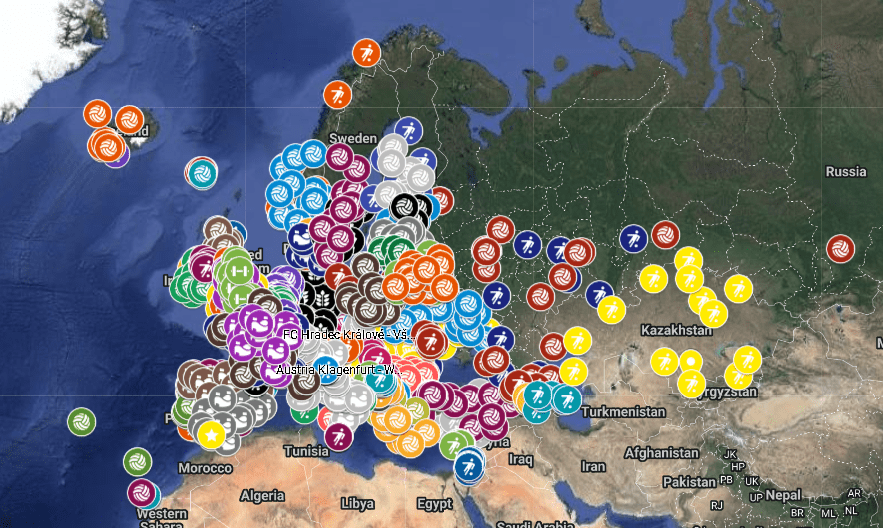
Hello football fans, wherever you might come from! I’m excited to introduce the latest project that I am working on. As someone who loves maps and geography (as well as football, obviously), I’ve always wanted something specific that wasn’t out there: a map showing the locations of football clubs in every country, in every league. Why, you ask?
Seeing the geographical distributions of football clubs in a country can often explain a lot about the power balance in the league. You might wonder why a certain team has won a league year after year, only to find they call the country’s largest economy hub and population center home. An interesting example is Germany, where every Bundesliga winner comes from western Germany, or more specifically, from what was formerly West Germany. Two separate countries existed simultaneously before the fall of the Berlin Wall, with two independent economies and governments. The impacts of that period are still evident in modern German football: a team from the former East Germany has never won the Bundesliga. This is no curse, but rather simple finances and population differences. The top 5 German states by Gross Regional Product, to represent the size of economy, all hail from former Western Germany and together made up 71% of the total GRP of Germany in 2022.
(Source: https://en.wikipedia.org/wiki/List_of_German_states_by_GRP)
In terms of population, the six largest regions are all from western Germany, with over 60 million inhabitants. Comparatively, the six regions that make up eastern Germany have just over 16 million inhabitants. This imbalance has translated through to football for as long as the Bundesliga has existed, and is just one example of the interesting connections you could make by looking at the game of football from a map. I encourage you to go down a rabbit-hole and see what you might find!
Eventually, my goal is to create one map for the entire world. Due to current software limitations, I am restricted to only putting a certain amount of layers on per map, so I’m separating the map into continents. Finally, I’ve finished all UEFA member nations and their domestic leagues, even San Marino and Gibraltar! This means I can happily share my map with you for the first time, embedded below.
The Football Map of Europe:
To read this map properly, there are a few things to know:
The different icons used represent the level of league within that particular country. Using Denmark as an example, the green icon of the football player represents top-division clubs. The football player icon will represent top division clubs in every country, with the color changing to provide better contrast between neighboring countries. In Denmark, the 2nd division clubs are marked with the yellow football icon. This ball icon will represent 2nd division clubs in every country. Third division clubs are represented by the “stadium” icon, shown in Denmark in navy blue.

Most countries will not have more than the top 3 divisions on the map, with England being one exception, having the 4th and 5th divisions on the map. Just remember, two of the same icon with different colors near one another means the two clubs are in different countries. For example, I’ll show you the border between France, Spain, and Andorra.
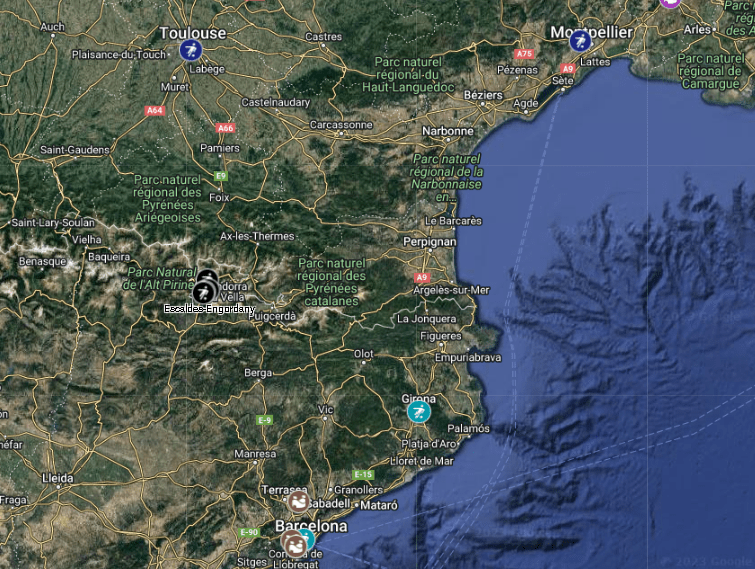
Notice the identical icon for 1st division clubs, the footballer. In France, this icon is a navy blue. In Andorra, this icon is black, and in Spain, the icon is a teal/turquoise color.
Clicking on any icon on the map will bring up the description, which includes the full club name, the league they compete in currently, and a link to their Wikipedia page if it was available. Below, I’ve listed all countries and domestic leagues included on this map. I hope you enjoy this resource, and please feel free to leave any comments on corrections if I’ve made any errors! Feel free to bookmark the map link for future reference and share with any friends who might appreciate it!
Contents of Map:
Country: Leagues Included on Map: Albania (1): Kategoria Superiore Andorra (1): Primera Divisió Armenia (1): Premier League Azerbaijan (1): Premier League Belarus (2): Premier League, First League Belgium (2): Jupiler Pro League, Challenger Pro League Bosnia and Herzegovina (1): Premier League Bulgaria (2): First Professional League, Second League Croatia (2): First League, Second League Cyprus (1): First Division Czechia (2): Fortuna Liga, National League Denmark (3): Superliga, 1st Division, 2nd Division England (5): Premier League, Championship, League One, League Two, National League Estonia (2): Meistriliiga, Esiliiga Faroe Islands (2): Premier League, 1.deild Finland (2): Veikkausliiga, Ykkonen France (3): Ligue 1, Ligue 2, Championnat National Georgia (1): Erovnuli Liga Germany (3): Bundesliga, 2.Bundesliga, III.Liga Gibraltar (1): Premier League Greece (2): Super League, Super League 2 Hungary (2): NB1, NB2 Iceland (2): Besta Deild Karla, Lenjudeildin Israel (1): Premier League Italy (3): Serie A, Serie B, Serie C Kazakhstan (1): Premier League Kosovo (1): Superleague Latvia (2): Higher League, First League Lithuania (2): A Lyga, I Lyga Luxembourg (1): National Division Malta (1): Premier League Moldova (1): Super League Montenegro (1): First League Netherlands (2): Eredivisie, Eerste Divisie North Macedonia (1): First League Northern Ireland (1): Premiership Norway (2): Eliteserien, First Division Poland (2): Ekstralasa, 1.Liga Portugal (2): Liga Portugal, Liga Portugal 2 Ireland (2): Premier Division, First Division Romania (2): Liga I, Liga II San Marino (1): Campionato Sammarinese di Calcio Scotland (2): Premiership, Championship Serbia (1): Superliga Slovakia (2): First Division, 2.Liga Slovenia (1): Prva Liga Spain (3): La Liga, La Liga 2, Primera Federacion Sweden (2): Allsvenskan, Superettan Switzerland (2): Super League, Challenge League Turkey (2): Super Lig, First League Ukraine (2): Premier League, First League Thanks for checking out the map! If you find any interesting observations through your time exploring the map, please let me know!
-
The Best Surprises from Europe’s Top Leagues
Hello football fans, I hope you’ve all been enjoying the interesting start to the season across Europe’s leagues! Today I’d like to look at some of my favorite success stories that were perhaps unpredicted heading into the year. With that, let’s start from the top of UEFA’s league rankings and go from there.
English Premier League: West Ham and Wolverhampton
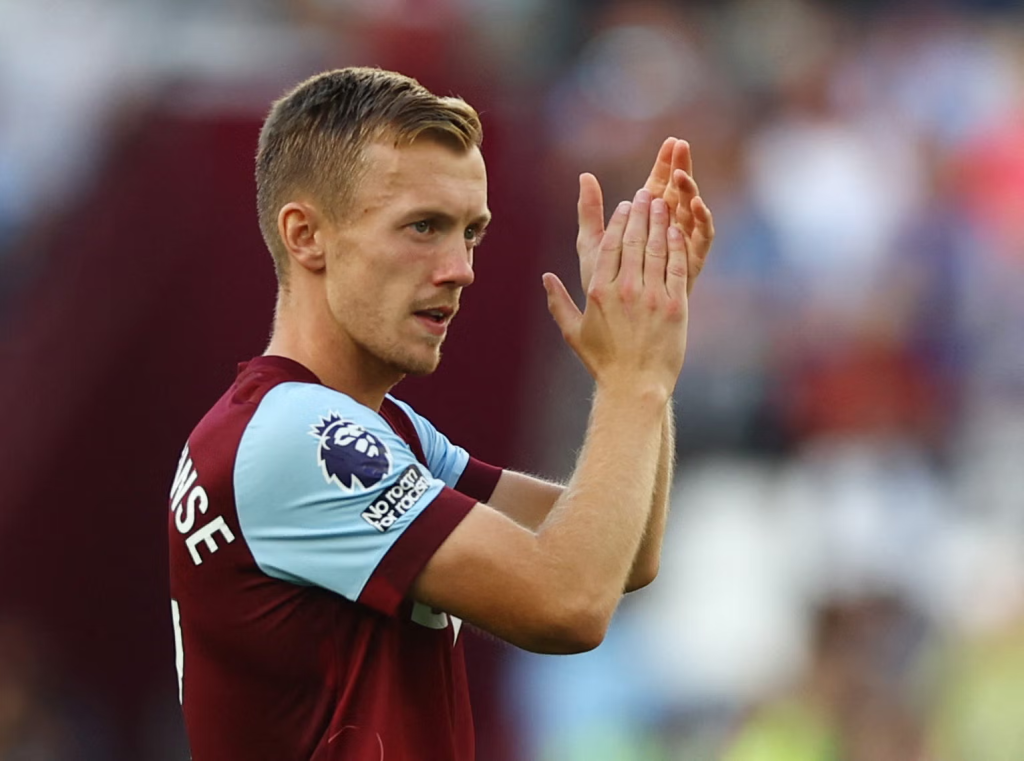
At the start of the season, West Ham and Wolves both had a troubling lack of signings, and there were well-merited concerns that both clubs could be in relegation danger if things did not go their way this year. West Ham addressed their lack of signings, bringing in Mohamed Kudus, Edson Alvarez, and James Ward Prowse. The latter has been as sensational as you would expect the best set-piece taker in the league to be under David Moyes, a set-piece enamored manager. West Ham have marked wins over Chelsea and Brighton to start the season, with their only losses being to Liverpool and Manchester City. After just 7 games, I believe West Ham have shown enough for relegation concerns to be a thing of the past, and they very well might have their sights set on European places again! It will be interesting to see the toll their Europa League campaign takes on their Premier League season.
Wolves on the other hand, did not address their lack of signings, as their financial troubles handcuffed their player recruitment. However, Gary O’Neill deserves plenty of praise for the way Wolves have played to start the season. He has great attacking options in Matheus Cunha, Hwang-Hee Chan, and Pedro Neto, who have proven to be very dangerous breaking in the counter -attack against teams playing a high-line possession game. Wolves were unlucky not to get a point from Old Trafford in the season opener, with THAT Onana non-call robbing them of a last-minute penalty to secure a draw. I must say that they have been inconsistent. Wolves were heavily outplayed by Liverpool and surprisingly Luton Town, but were able to match Manchester United, Brighton, and Manchester City in terms of xG produced during those matches. A win over Manchester City last week is the biggest surprise of the Premier League so far, with few people expecting Guardiola’s men to lose their first game to Wolves. I cannot say that Wolves are guaranteed safety from relegation yet, but their performances have certainly been much better than that of a relegation side. If they can find some more consistency against the lower teams in the table, then I believe Wolves have every chance to stay up, and even finish in a mid-table position.
Honorable Mention: Spurs
(Disclaimer: I support Spurs)
I was optimistic about Spurs entering this season under Ange Postecoglu, especially with the signings of James Maddison, Guglielmo Vicario, and Micky van de Ven. Several problem areas from last season were addressed with those signings and I rate Postecoglu highly as a manager, he seems to be a perfect fit for Spurs so far. That being said, I did not expect Spurs to have this good of a start to the season. Postecoglu’s teams usually take a while before getting into their true stride, but the speed at which this new-look Spurs squad have adapted to his system is truly impressive. Maddison has been a revelation, being arguably the best player in the Premier League so far, producing 2 goals and 4 assists through 7 games. Yves Bissouma looks reborn in midfield, with everyone questioning why on earth Antonio Conte didn’t play him last year. No player across Europe’s top 5 leagues have had a more all-around impact in midfield than Bissouma, who is winning tackles, breaking presses, and making progressive passes constantly throughout each match. Even against strong pressing teams like Arsenal and Liverpool, Bissouma calmly kept possession under a press countless times, showing his class. Currently Spurs sit 2nd in the table, having notched wins over Manchester United and Liverpool, while showing incredible spirit to fight back twice to earn a 2-2 draw at the Emirates in the North London Derby. Squad depth and injuries are a potential issue for the team, but with no other competitions until January, Spurs can be optimistic about their chances of continuing this start into the January transfer window, where more reinforcements will be needed to mount a serious charge for the top spots in the table.
La Liga: Girona

After a 10th place finish last year, and being promoted from the 2nd division of Spain the year prior, I don’t think many expected Girona to start this La Liga season right up at the top of the table. Ukrainian attacking duo Artem Dovbyk and Viktor Tsigankov have been stellar for Girona to start the year, notching 3 goals and 4 assists between them. Savio Moreira, on loan from Troyes, is a promising Brazilian youngster who is the third main man in attack, with 4 goals and 2 assists through 8 games. Youth is a common theme in this team, with 3 out of 4 members of Girona’s most regular starting XI being 22 years old or younger. Veteran Daley Blind leads the young backline, complemented by Eric Garcia on loan from Barcelona, with Miguel Gutierrez and Yan Couto supporting from fullback. The one criticism of the hype around Girona could be their strength of schedule. They have not yet beaten a team that finished in the top half of La Liga last season, drawing Real Sociedad and recently losing 0-3 at home to Real Madrid. Time will tell if this young squad can maintain this blazing start and challenge the established elite in La Liga.
Serie A: Lautaro Martinez
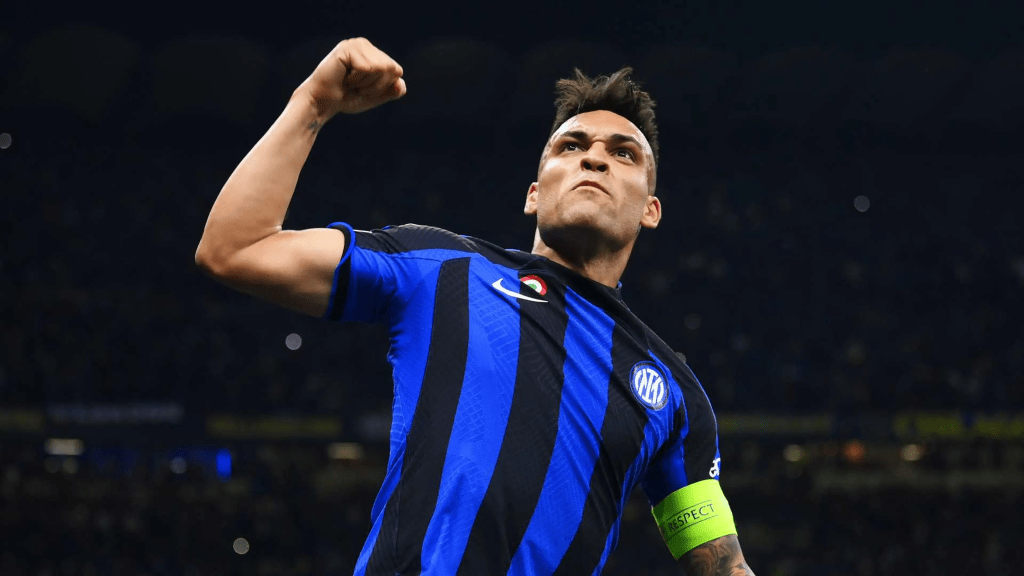
With Romelu Lukaku departing for Roma in the offseason, and Andre Onana heading to Manchester United, Inter Milan needed someone to step up. That someone has been Lautaro Martinez. A whopping 9 goals through the first 7 matches of the Serie A campaign, with an average of 61 minutes played per goal. In addition, Martinez is outperforming his xG significantly, with those 9 goals coming from 4.6 xG. The addition of Marcus Thuram on a free transfer was priceless for Inter in a way, and the frenchman has found an instant chemistry with Lautaro up front in Inzaghi’s 5-3-2 system. Thuram has contributed 4 assists and added 2 goals of his own, to form Italy’s best attacking duo so far. Inter sit first in Serie A, ahead of their rivals AC Milan on goal difference, largely in part to the 5-1 win in the Milan derby. The Nerazzurri do not look to have lost a step from their UCL-final pace of last season, and should be considered early favorites for the Scudetto.
Bundesliga: Bayer Leverkusen
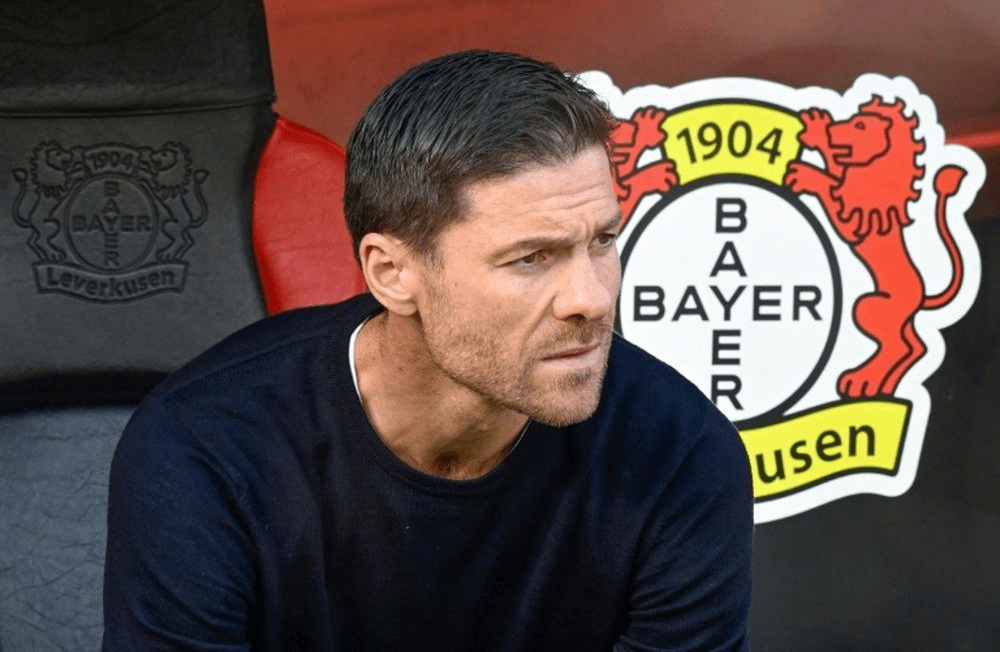
Xabi Alonso’s squad is firing on all cylinders to start the Bundesliga campaign. 5 wins and 1 draw, with the draw being away to Bayern Munich, and Leverkusen sit top of the Bundesliga table after Bayern’s draw with Leipzig. In the match against Bayern, nothing separated the teams, with the usual Bayern dominance seeming to fade. That’s not to say Bayern aren’t playing well, but we aren’t used to seeing legitimate contenders for the German title, in the past Bayern have often already been 5-8 points clear at the top after 6 games. Both Leipzig and Leverkusen look to have the ability to truly challenge Bayern this season, and it may be the most interesting title race Germany has seen in a while.
Honorable Mention: Serhou Guirassy
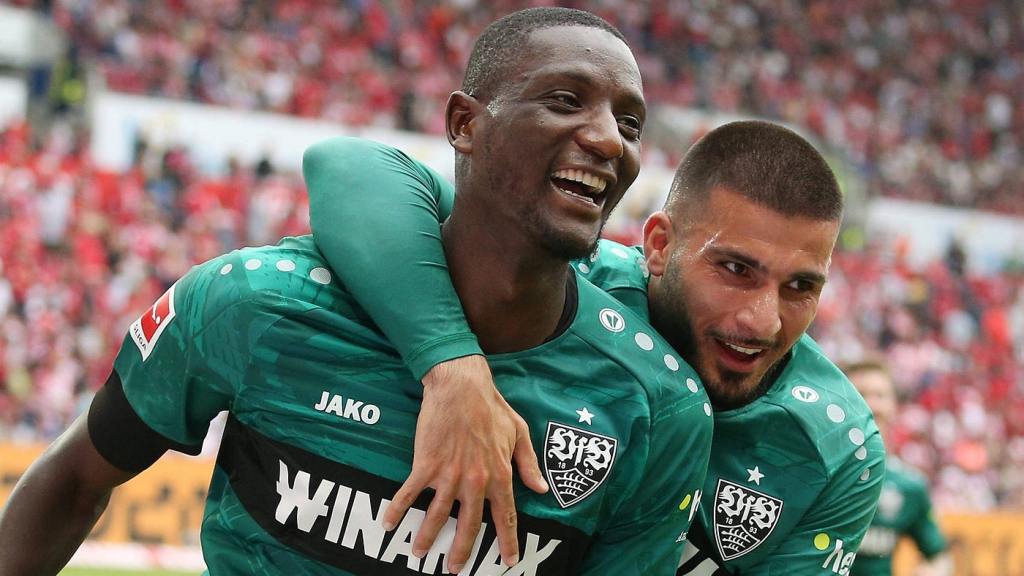
The Guinean striker in his first season as a full time Stuttgart player has almost single handedly willed them to 2nd place in the Bundesliga off his incredible 10 goals through 6 games. Now the only top team played in this stretch was Leipzig, where Stuttgart lost 5-1, but Guirassy scored the only goal. While Stuttgart shouldn’t be expected to maintain their standing in the table, Guirassy has put himself in a place to challenge for the Golden Boot this year!
Eredivisie: Heracles Almelo
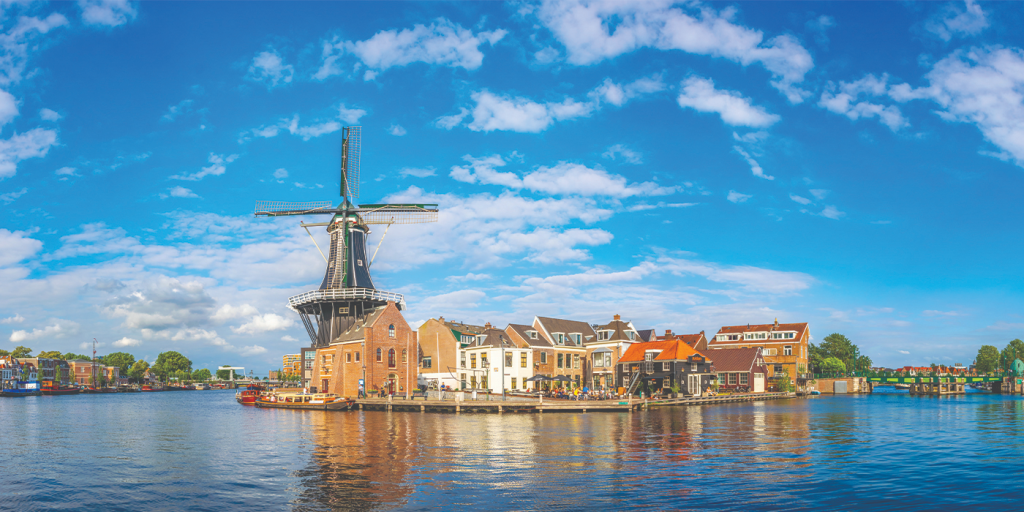
So far, the biggest surprise in the Eredivisie is not a good one, Ajax sitting 1 point above the relegation places after winning just 1 of their first 4 games. That win came against our positive surprise, Heracles Almelo. The newly promoted club from the Dutch 2nd division play in the town of Almelo, home to just over 70,000 inhabitants. This is their first year in the top-flight of Dutch football in 28 years, and they have made the most of it so far! Following their opening day loss to Ajax, Heracles have only fallen to FC Utrecht since then, earning wins against NEC Nijmegen, Excelsior Rotterdam, and PEC Zwolle, in addition to a strong result drawing away to AZ Alkmaar. That is enough to put Heracles in 7th place after the opening 7 games, 7 points clear of the relegation zone. There will be no dreams of a title this year, but Heracles are giving their fans plenty to be happy about, showing that they might be deserving to stay up this season!
Ligue 1: Akor Adams
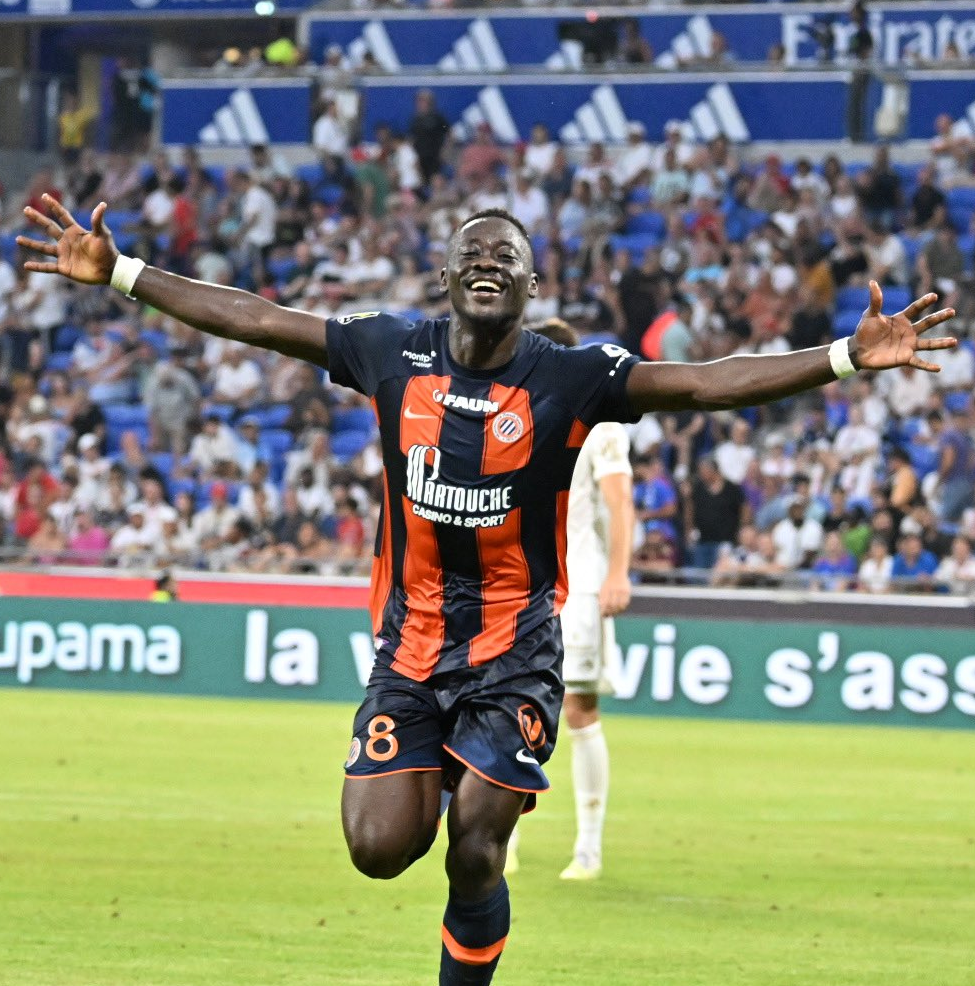
I have to stop and say I told you so on this one, because I told you so. In my previous article on the top talents in the Norwegian league I thought would be getting a transfer soon, leading the list was Lillestrom’s striker Akor Adams. Montpellier noticed his talents and acquired the Nigerian striker for 4.5 million euros entering this season. After Montpellier’s teenage sensation Elye Wahi moved to RC Lens after scoring 19 goals in 33 Ligue 1 games last season, there was a hole to fill. Akor Adams has come in from the Eliteserien and made an instant impact, with 5 goals already in his first 7 matches, on pace to surpass Wahi’s total from the season prior. Adams is just another example of the talent level that’s available to teams in Europe in the Eliteserien, and you can be sure I’ll be flagging the next Akor Adams as soon as I spot him in Norway.
Liga Portugal: Robert Bozenik
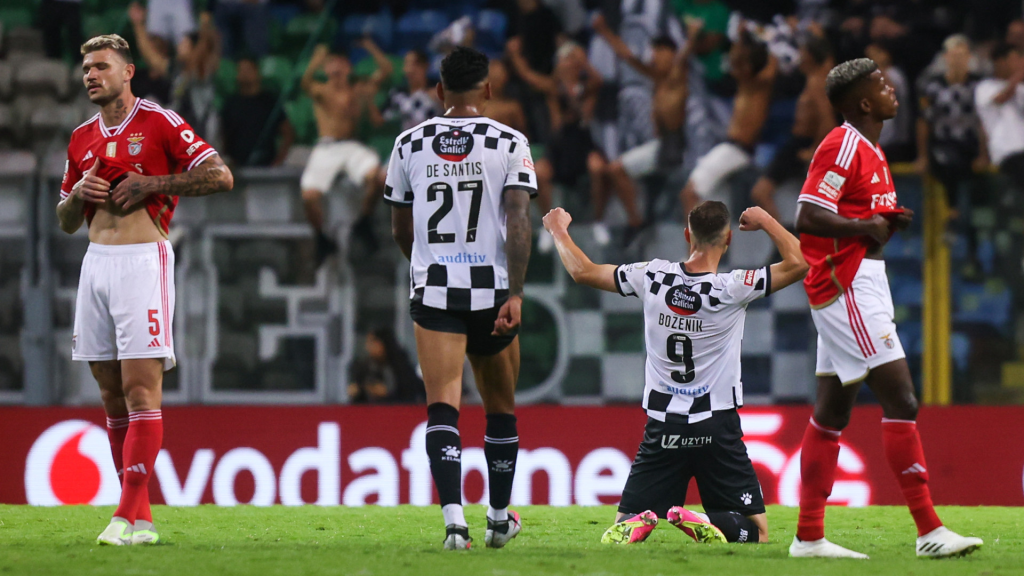
The much needed future of the Slovak national team’s attack, Robert Bozenik is a name that is likely unknown to most of you reading this, which is why I chose him as my best surprise of the season. Already capped 33 teams by the senior national team by age 23, Bozenik has been the best striker option for Slovakia more due to a lack of depth in the position than his goalscoring record. With only 6 goals in 49 games while under contract at Feyenoord, Bozenik was sold to Boavista in the Liga Portugal this summer after spending last season on loan at the club. Last year, Bozenik tallied 4 goals in 27 appearances. This season, he has already surpassed this, with 5 goals in his first 7 matches, including a brace in Boavista’s win over Benfica! The young striker looks to be hitting his stride now, and if he can maintain this form over the season, he will be crucial in Slovakia’s quest to qualify for Euro 2024 and Boavista’s goal of a finish in the European places.
It’s still early in the season, but I thought these players and clubs deserved a mention for their strong starts to the season, despite what was expected of them. Hopefully you’ve heard of a player you didn’t know before, or learned about a new club! Be sure to check back in for more player scouting, game analysis, and overall football discussions. Thanks for reading!
-LM
-
2023/2024 UEFA Champions League Predictions
Hello all, and welcome back for a big one! Today I’ve had the idea to try and predict the full standings of each group in this year’s Champions League. There are some newcomers to the competition in first time participants Royal Antwerp and Union Berlin, as well as some returning clubs who have taken a bit of a hiatus from UEFA’s premier competition in recent years like Arsenal! Will Manchester City repeat as champions of Europe, or will we see a new team take the glory? Below are the results of this year’s Champion’s League draw.

The clear “Group of Death” here is Group F, containing Paris Saint-Germain, Borussia Dortmund, AC Milan and Newcastle United. Manchester City got a typically Manchester City-like draw, with their strongest opponents being RB Leipzig, a team which they smashed 8-1 on aggregate in last season’s Round of 16. Barcelona finally avoided Bayern Munich in the group stage, much to the delight of the culers. Their eternal rivals, and record winners of this competition, Real Madrid, were drawn into an interesting group with post-Spaletti Napoli, Braga, and Union Berlin. Now how will these groups look after the group stage (according to me)?
Group A

Bayern Munich. Ok, we can move on now. This group should be interesting to see if Galatasaray can manage to beat Manchester United to the 2nd qualification spot in this group. I think it’s almost a foregone conclusion that Bayern will top this group, especially with Harry Kane filling the squad’s greatest hole from last season. Early on in England, Manchester United have looked predictable and uninspiring. If Wolves were able to figure out United within the opening 15 minutes of their match, I have little doubt that the likes of Bayern and Galatasaray will be able to do the same. I’m sorry to Copenhagen, as I’d love to see them do well, but I do not see them having a great chance at qualifying to the next round or the Europa League. The matches between Galatasaray and United will likely determine who moves on from this group, so keep your eye on those fixtures.
Group B
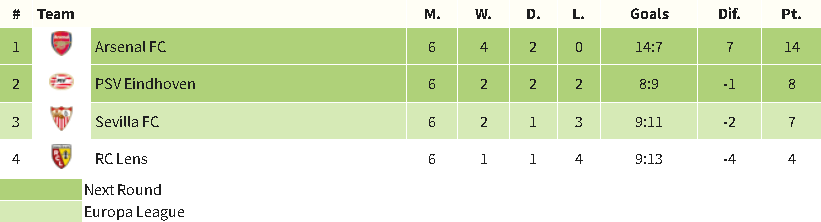
In Arsenal’s return to the Champions League, they have been given a fairly reasonable group with PSV Eindhoven, Sevilla, and RC Lens. PSV Eindhoven have gotten worse since last season, losing several key players including Xavi Simons. Sevilla are the resident Europa League owners, and seem destined to continue the cycle of: Win Europa League, qualify for Champion’s League, finish 3rd in your UCL group and get sent to Europa League, Win Europa League… you get the idea. RC Lens are a very exciting young team that are certainly one to watch, but their task to qualify out of this group is a difficult one. Arsenal should be considered favorites to top this group, with PSV and Lens competing for the 2nd spot. No matter who gets that 2nd spot, Sevilla will finish 3rd and go win the Europa League. It’s just football heritage.
Group C
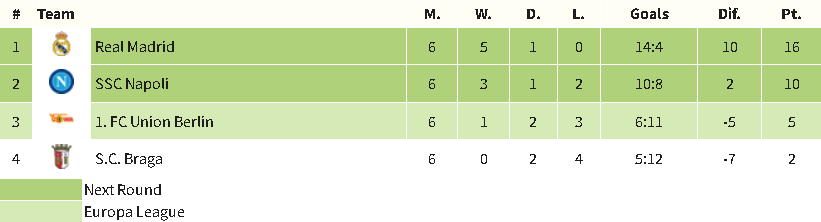
Group C looks to bring exciting football in all of its fixtures. UCL-debutants Union Berlin bring a high-energy style of play, and will look to disrupt the favorites to advance alongside SC Braga and their flair-filled Portuguese squad. The favorites, Real Madrid and Napoli, will both be looking to improve upon last season’s performances: Madrid looking towards the final in Carlo Ancelotti’s last season as manager, and Napoli looking to do themselves more justice than their R16 exit last year. Expect Victor Osimhen to bag the most goals in this group, but for Real Madrid to finish 1st.
Group D
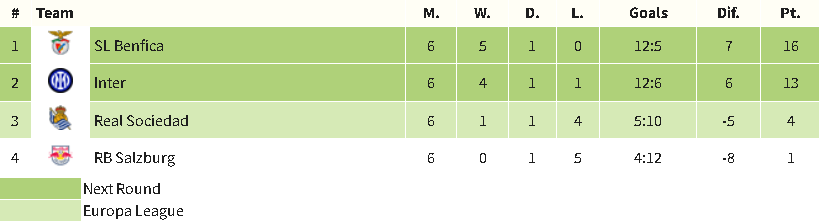
Last season’s finalists, Inter Milan, return to the Champion’s League in a group with Benfica, Real Sociedad, and RB Salzburg. Inter are not the same team they were last year, but look to be a strong team still. Benjamin Pavard, Yann Sommer, Marcus Thuram, Juan Cuadrado, Kristjan Asllani, and Yann Bisseck have all come in to help balance out the losses of Andre Onana, Marcelo Brozovic, Gozens, Dzeko, and Milan Skriniar. Their competition to top Group D are a familiar foe, Benfica, who Inter Milan faced in the quarterfinals of last year’s competition. Benfica have also added some talent to their roster, acquiring Orkun Kokcu from Feyenoord, Arthur Cabral from Fiorentina, as well as David Jurasek, Anatoliy Trubin, Angel Di Maria, and Juan Bernat. Roger Schmidt’s side will be looking to get revenge on Inter, and finish first in this group. I don’t believe Real Sociedad or RB Salzburg should pose much of a threat to the top 2 of Group D.
Group E
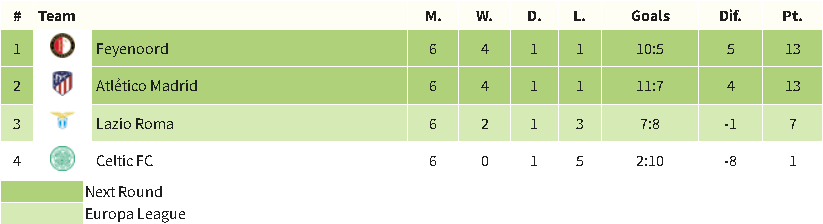
Group E isn’t the most exciting one on paper. Feyenoord is the most appealing side to a neutral fan to watch, with Arne Slot’s side enjoying some attacking football. Atletico Madrid however, are not known for that. Diego Simeone’s squad play to win their battles and get results, not to entertain the fans. I believe they will do just that, and get the results needed to advance over Lazio and Celtic. Celtic look much worse than the side that qualified for this competition, with Brendan Rogers replacing Ange Postecoglu as manager and results falling off as a result. I predict Feyenoord and Atletico to finish tied on points at the top of the group, with just goal differential putting Feyenoord on top.
Group F
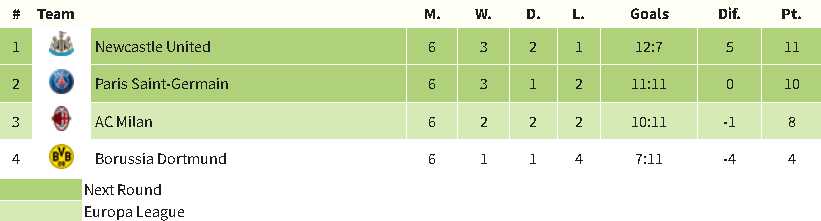
Sandro Tonali’s return to the San Siro, Ousmane Dembele, Alexander Isak, and Christian Pulisic’s returns to Signal-Iduna Park, and two of football’s modern day oil tycoons, Group F has it all. Newcastle United return to the Champion’s League and are immediately given a warm welcome with this draw. It is extremely difficult to predict how this group will turn out, with the only thing I’m sure of being that PSG will not win the Champion’s League. As much as I’m reluctant to praise a team that has a budget higher than many countries GDP, the transfers completed by PSG this summer have been solid business and in my opinion, enough to get them out of this tough group. AC Milan are not the most inspiring side here, still not as strong as their rivals Inter, and unlikely to qualify out of this group after selling their best player (Sandro Tonali) to another team in their UCL group. While it is nothing against Dortmund, they are in a group with 2 clubs owned by an entire country’s government and all the wealth that comes with it, and last seasons semi-finalists. I find it hard to see a future where Dortmund is able to finish in the top 2 here, but they could certainly sneak into the Europa League place in 3rd.
Group G
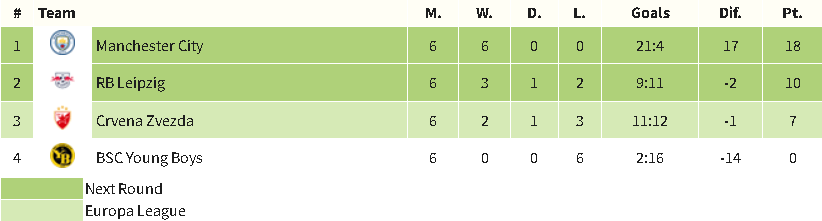
Manchester City were given a gift again by UEFA, and have little to no excuse for not winning 6 of 6 games in this group. Reigning treble-winners and holders of arguably the best squad in the world, RB Leipzig, Crvena Zvezda and Young Boys are going to be up against it. One of these teams will get the 2nd qualification spot, and for me it is between Leipzig and Crvena Zvezda. The away trip to Serbia is difficult for anyone, and Leipzig could struggle, leaving a window for the Serbs to qualify out of this group. Young Boys, representing Switzerland, have a promising team with some exciting young players to watch, but will not be expecting much in this group draw. Here’s hoping Manchester City’s draws for the knockouts won’t be as easy.
Group H
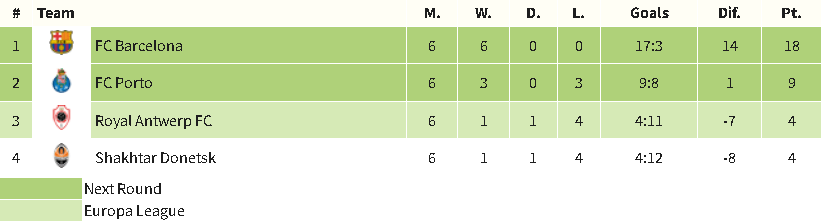
It only seems right that after finally avoiding Bayern in their UCL group, Barcelona will go on to top the group. Porto have a strong team, but have also lost their best player Otavio to the Saudi League, and do not have José Mourinho as manager. It’s not 2004, unfortunately for Porto. I think they will still be strong enough to make it out of the group, although a stumble against Royal Antwerp could give the debuting club a route to the knockouts. Shakhtar Donetsk will simply be happy to be here and taking a trip to the Camp Nou and Estadio de Dragao.
So, there’s my predictions for the group stages. To summarize, here are the teams I think will move on to the knockout stages of the 2023/2024 UEFA Champions League. Since the knockout stages will be drawn following the conclusion of the group stage, I cannot predict what the matchups will be at this point.
Final 16 – UCL
Group A: Bayern Munich, Galatasaray
Group B: Arsenal, PSV Eindhoven
Group C: Real Madrid, SSC Napoli
Group D: SL Benfica, Inter Milan
Group E: Feyenoord, Atletico Madrid
Group F: Newcastle United, PSG
Group G: Manchester City, RB Leipzig
Group H: FC Barcelona, FC Porto
When the knockout stages are drawn, I’ll be writing another prediction article for the rest of the competition! If you had any comments or disagreements, feel free to leave a comment. I hope you’ve enjoyed today’s article, and I’ll see you back soon!
-
Stories from the 2023/24 UEFA Champions League Qualifiers

THE CHAAAAAAAAAAMPIOOOOOOOOOOOONS!
Hello football fans, and I hope you sung that previous line just like I did! The UEFA Champions League qualifying rounds are nearly finished, with only the final legs of the last round to play next week. With that said, let’s take a look at some of the storylines that came from this year’s qualifying rounds, and which teams are starting to dream of making history in the main competition. I wanted to shine a light on the qualifiers specifically, to give some recognition to some of the best teams from the leagues that many likely don’t follow very closely.
History for Faroe Islands!
The first qualifying round of this year’s Champions League was composed of teams from countries all over Europe, with the smallest country represented being the Faroe Islands. While technically part of Denmark, the Faroe Islands compete separately in international and club play, with their own league. The Faroe Islands are home to just over 54,000 people, which leaves a large gap between their population and that of just the individual cities that call the other UCL clubs home. (Their only opponent from a city with a lower population than the Faroe Islands was Molde, a small town in Norway with 30,000 inhabitants). The winners of the Faroese league last year, earning them a spot in the first qualifying round, are Klaksvíkar Ítróttarfelag. Did you catch that the first time? If you also fear the thought of properly pronouncing their name correctly, they are commonly referred to simply as “KI” or “KI Klaksvik”. This is what their home pitch looks like:
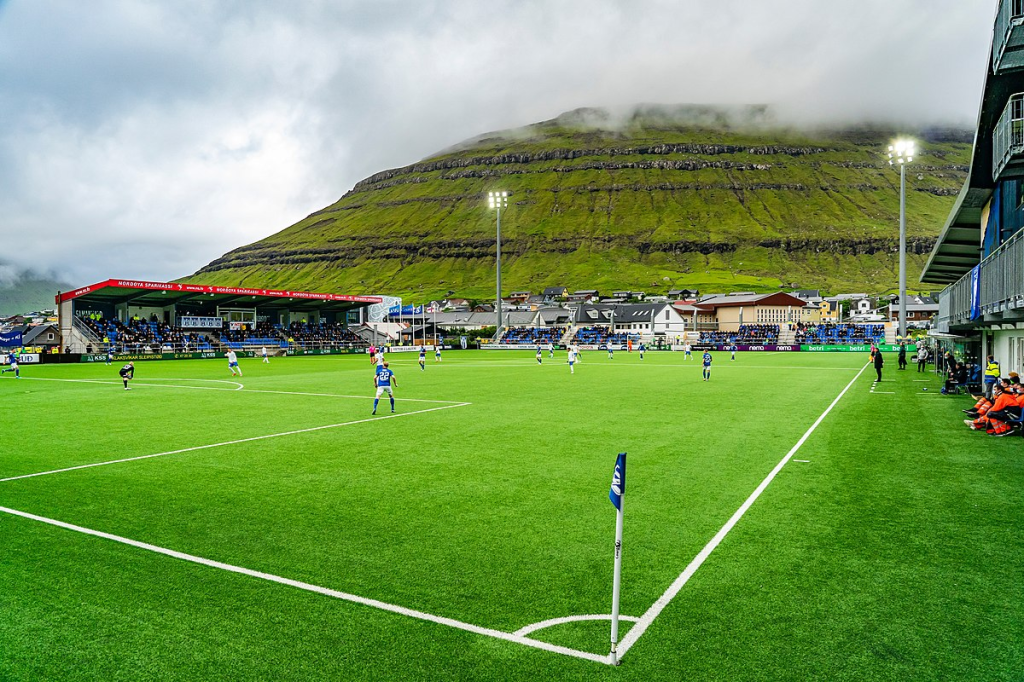
It might be a far cry from the Santiago Bernabeu, but to me it’s just as beautiful. In the first qualifying round, Klaksvik were drawn against Hungarian champions, Ferencvaros. After holding the Hungarians scoreless at home on the islands, KI went on to Budapest for the return leg, and shocked the home crowd with a 3-0 win to move on to the next round! Swedish Allsvenskan winners BK Hacken were next up for the Faroese club, and after back to back draws with an aggregate score of 3-3, KI triumphed on penalties to make it 2 steps from the Champions League, something never achieved by a Faroese club before. In the third qualifying round, Klaksvik came up against Norwegian champions Molde, where 4,584 proud fans watched Klaksvik take a 2-1 win off an 86′ winner from Arni Frederiksburg. Unfortunately, the fairytale run would end in the second leg in Norway, where Molde would win 2-0 to advance. Still, this performance by KI Klaksvik has secured them the Europa Conference League group stage, with a chance still to qualify for the Europa League group stage with a win in the final qualifying round. A wonderful, historical achievement for the small club from the Faroe Islands, where the prize money from their performance in European competitions will surely give them the platform to aim even higher in future years.
An Atypical Family Reunion
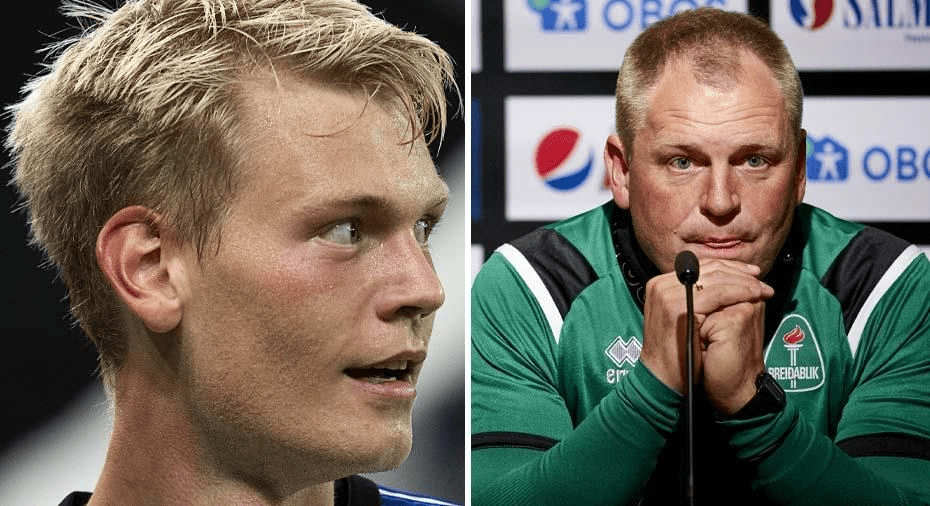
Alright, so imagine you’re Óskar Hrafn Þorvaldsson, a former Icelandic professional footballer who after your playing career ended, decided to settle down and start a family. Your son, Orri Óskarsson, grows up wanting to play football as well, and when you decide to try your hand at management in the Icelandic third tier, give him his senior debut before his 14th birthday. You go on to win back to back promotions, earning you the managerial position at Breiðablik in 2020, one of Icelands top clubs. Your son Orri becomes a highly rated prospect after making his senior debut at age 13, and gets a move to FC Kobenhavn at the same time, joining their youth academy. Fast-forward 3 years, and you’ve won the Icelandic league with Breiðablik, and after beating Shamrock Rovers in the first qualifying round, are drawn against… FC Kobenhavn. Kobenhavn won the first leg away 2-0, and in the second leg are up 5-1 on aggregate. On comes your son Orri, who proceeds to score a second-half hat trick, sealing the victory for the Danish club and knocking you out of Champions League qualifiers. Talk about an awkward dinner the next time Orri comes home for a break. Currently, Breiðablik are still in contention to qualify for the Europa Conference League if they can manage to beat North Macedonian side FK Struga, while FC Kobenhaven are up 1-0 on Polish side Rakow Czestochowa going into the second leg of the final UCL qualifying round. I’m sure Óskar is rooting for Orri to make it into the Champions League group stage now!
New Arrivals to The Champions League?
In the final round of qualifying, 4 teams remain that have never made it into the Champions League group stage: Royal Antwerp, Rakow Czestochowa, Panathanaikos, and Molde. Another Greek club, AEK Athens, is looking to return for the first time since 1994-1995. Currently, Antwerp are up 1-0 on AEK Athens after the first leg in Belgium and Rakow Czestochowa are down 1-0 to FC Kobenhavn after their home leg. Molde have shown a “never say die” attitude, coming back from a first leg deficit in each of their 2 qualifying round wins over Finnish side HJK and the aforementioned KI Klaksvik. In the first leg of their final qualifying round against Galatasaray, Molde fought back from a 2-1 deficit to tie the game in the second half, before Norwegian substitute Frederik Midtsjo scored a 94′ winner for Galatasaray. This will have been especially delighting for Midtsjo, who was a former Rosenborg player and rival of Molde during his time in Norway. In other ties, Panathinaikos go home down 1-2 on aggregate to Portuguese side Braga, Maccabi Haifa and Young Boys produced a scoreless draw, and Scottish runners up Rangers drew 2-2 with PSV Eindhoven in Scotland. The next leg of fixtures will finish next week, wrapping up the qualification campaign for this year.
By the end of August, the teams competing in the 2023-2024 edition of the UEFA Champions League will be set, with the group draw taking place shortly after. I’ll be releasing a full group-by-group prediction once the draw takes place. I hope you enjoyed this article, and will enjoy watching the Champions League this year!
-
Manchester United’s Tactical Dilemma
I’m sure I was not the only one shocked when watching Monday’s game when Manchester United hosted Wolves at Old Trafford, and then proceeded to get completely outplayed but somehow came away with 3 points. Now some might say, “who cares, they got the win”, but ignoring the result there are some concerning takeaways from this game. Here’s how the two teams lined up:
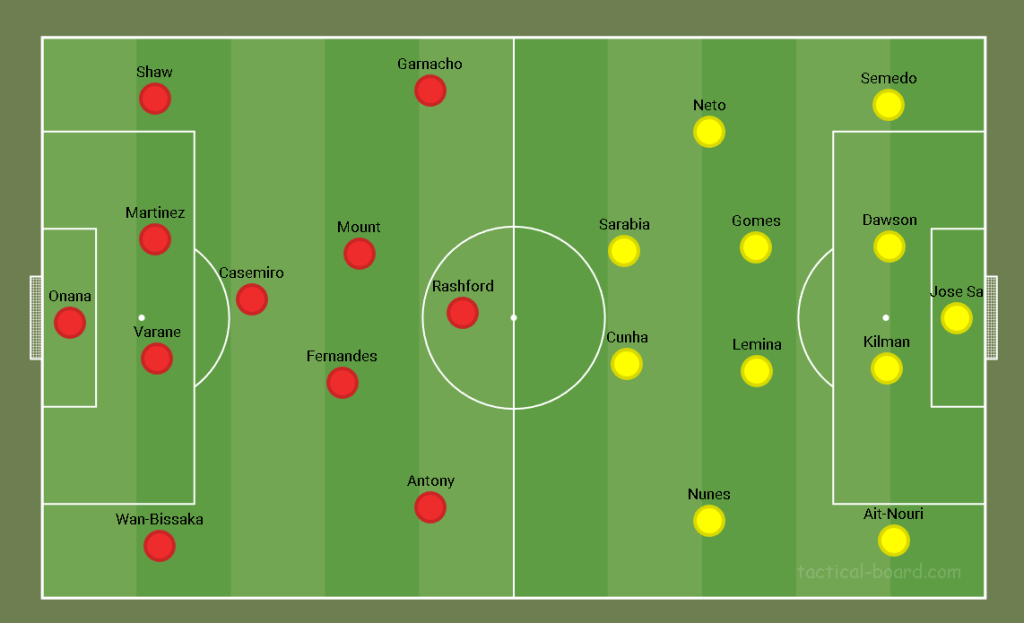
Straight away, this is a squad worth nearly 900 million euros at home against a team worth a shade over 350 million euros who many (myself included) picked as potential relegation candidates this season. This should not have been a close game, never-mind a domination by Wolves in every area except the final score. However, Wolves seemed to have United figured out from minute one, and their pressing tactics proved to be extremely effective in preventing Manchester United from building out from the back.
The first thing to note is that Manchester United had a very small starting lineup, especially in midfield and up front. Marcus Rashford is the tallest of the bunch, at just over 6′ tall. This presents an issue in that Manchester United will have to be predictably one-sided in possession. The biggest risk to pressing high is that the space left behind the defence can be exploited by a long ball to a forward. However, none of Manchester United’s front 5 could reliably be expected to win headers over Wolves’ defenders. This meant that United had to play out from the back, on the ground. With this in mind, Gary O’Neill instructed his side to force United into playing the ball to Wan-Bissaka, identifying him as the weakest on-the-ball player in the United backline. Here is how the Wolves press looked on the pitch:
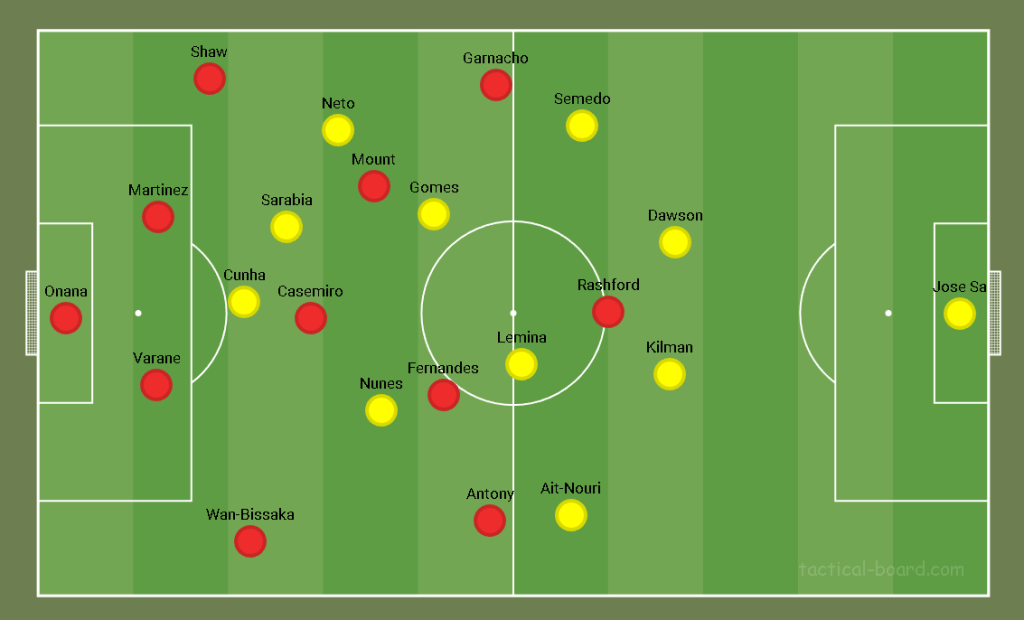
Note the clear shift of the team over to United’s left side of the pitch. Wolves know that United want to try and get the ball to Bruno Fernandes or Mason Mount, through the triangles formed by Casemiro and the defense which are supposed to help break through the initial line of press. On the left flank, Matheus Nunes pulled inside to block the passing lane to Bruno when United had the ball at the back. Pedro Neto positioned himself in a place to block the passing lane to Mason Mount, while being close enough to Luke Shaw to prevent him from becoming a viable passing option. The striker duo of Cunha and Sarabia aimed to further block off Mount and Casemiro, while forcing United to play the ball to the right. When this happened, the Wolves press shifted like so:
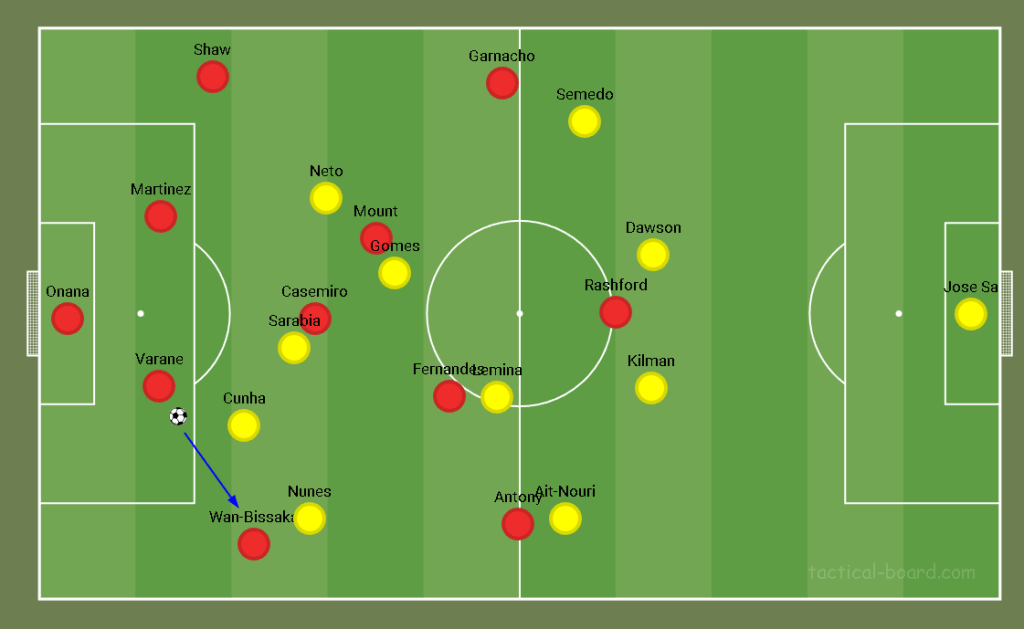
Matheus Nunes instantly charged out to meet Wan-Bissaka as he received the ball, while the strikers moved over to effectively remove the passing lanes to Casemiro and Fernandes. This meant Wan-Bissaka could play a rushed pass to Antony, where Ait-Nouri was waiting to instantly close him down to win the ball back alongside Mario Lemina, or he could pass back to Varane or Onana. Wan-Bissaka generally chose to pass back, and when the ball came back to Onana, the Wolves press had reset to its original position. Essentially, Onana’s only real option to try and progress the ball was to make a quick long-ball pass to Garnacho on the left flank. Garnacho did not have enough support from Mount and Shaw if the ball came to him in this position, as they were pinned back by the Wolves press and forced to stay closer to goal. The header would be won by Semedo or Dawson, and Wolves could generate a scoring opportunity. Just as Wolves exposed the weaker on-the-ball right side of United’s build-up play, most of the attack was targeted down United’s left flank. Luke Shaw and Lisandro Martinez struggled to make an impact in this game, as they were marked out of play in possession, and struggled to contain Pedro Neto out of it.
Now you might be thinking, “Ok, Wolves were better than United when United had the ball, and were better creating chances on the counter, but surely Wolves wouldn’t be able to build out from the back better than United?” Unfortunately, you would be wrong.

Manchester United attempted a similar pressing trap as Wolves, seeming to want the ball to go to the LB, Rayan Ait-Nouri. Wolves would have a numerical advantage playing out from the back, and with a few different passing patterns would be able to work the ball out to the free man, Ait-Nouri. At this point however, neither Bruno or Antony moved to press Ait-Nouri as Matheus Nunes did to Wan-Bissaka. United looked like they wanted to engage around the halfway point of the pitch, in an effort to have more space behind the defence when the ball was won back. Unfortunately for United, they did not win the ball back on that flank very often. Ait-Nouri had space to run, and by the time Wan-Bissaka met him at the halfway line, there was already a triangle with Nunes and Cunha that Wolves used to play around the United defence far too easily. Once the ball came to Cunha specifically, the striker was able to run through the midfield of United with ease, and bring Wolves into the final third by himself very often, setting up Sarabia and Neto for a few good chances. Neto had the best chance of the game and will be regretting not converting it.
So how can Manchester United adapt to avoid being so one-dimensional and predictable? Bring back Wout Weghorst, of course! I joke, but the hole that Ten Hag brought Weghorst in to fill last year still remains void. If United aren’t going to bring in any more signings up front, we can assume that the long-ball won’t be a great option to get away from a high-press. If Ten Hag chooses to start Diogo Dalot at right-back instead of Wan-Bissaka, he would force opposition teams to be wary of the ball playing ability of either full-back and make them unable to force his team to one side before squeezing any space out. The downside to this, is that United would be dropping their best 1v1 defender in the team. Considering next week’s game is against Spurs, who could have any of Son Heung-Min, Ivan Perisic, or Manor Solomon starting on the left-wing, keeping Wan-Bissaka on the bench could make United extremely vulnerable in defense, as Dalot will have a hard time keeping any of those options in check for a full 90 minutes. It is possible that without any new signings, the best way to get rid of United’s biggest weakness in build-up may actually be the most unlikely change to happen. I say this because that change is the abandonment of positional play theory in build-up. Ten Hag is a coach of the Guardiola school, meaning he prefers to instruct his teams in positional play, which in essence is positioning your players to cover as much of the pitch as possible in possession. What I think Ten Hag might benefit from is studying the tactics of the Fluminense manager, Fernando Diniz. Diniz has revolutionized possession football, entirely abandoning positional play structures for something known as “relationism” instead. Diniz does not care about covering as much of the pitch as possible with his players’ positioning, as traditional positional play managers from the Guardiola school prioritize. However, his relationism tactics revolve around player’s positioning in relation to one another, instead of in relation to the space on the pitch. In build-up, you can often see almost the entirety of the Fluminense team shifted to one side of the pitch, to create numerical advantages that would not be possible in positional play. Instead of the set passing patterns of a Guardiola side, Diniz leaves the passing patterns up to his players’ creativity, instructing them to position themselves so that whoever gets the ball has a multitude of passing triangles available to them, so the specific pass is up to the player on the ball. Fluminense orchestrate very fast, intricate build-up moves, with no player holding the ball for longer than 2 seconds, and constant movement and interchanging between players to confuse defenses. With what United lack in size, they can make up for in the natural flair of their attacking players. While perhaps Antony likes to hold on to the ball a bit too long for this style of play and would require coaching into it, players like Garnacho, Sancho, Fernandes, Mount, and Rashford could suit this style perfectly. If United were to try overloading one side of the pitch in build-up, it could look more like this:
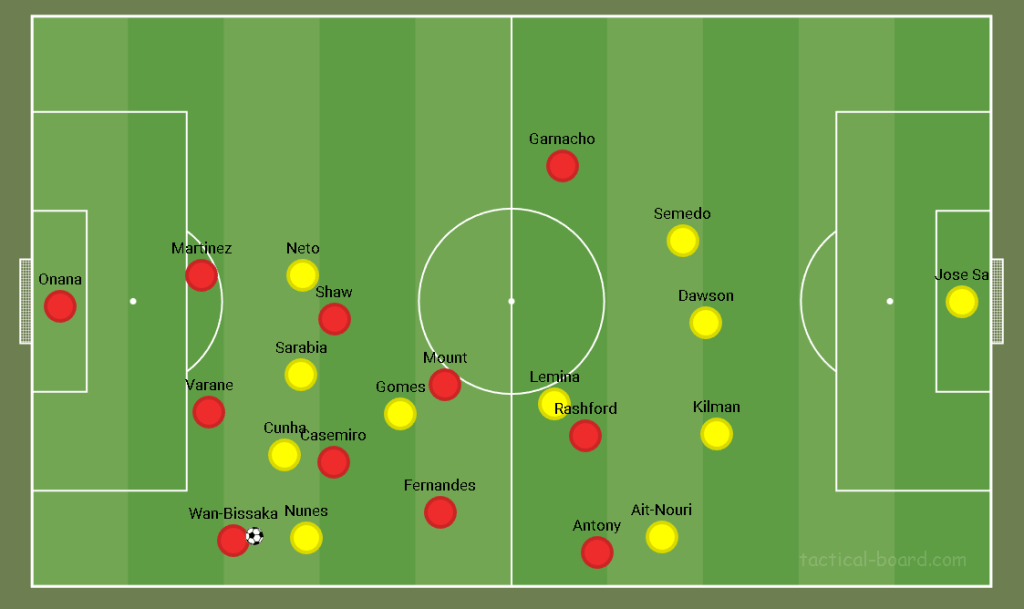
Now in the same situation as earlier, if the ball is played to Wan-Bissaka, his options are no longer only a pressured-pass to Antony, or a back-pass. Once the first open man is found, the players would quickly move to provide say, Casemiro, with a similar variety of passing options. This approach could help get the most out of a smaller team, and force defenders into some difficult decisions that they may not be used to. If the Wolves backline gets caught-up in the action on the right side, then Garnacho may be left open in much more space than he had in this match, and room to receive the ball and run. If you want to see more examples of this “relationism” I’m referring to, search up some Fluminense highlights from within the past year, and notice where the players position themselves in possession.
While admittedly this would be a huge change from the system Ten Hag is used to, I believe positional play is not suiting the current Manchester United squad, and a more relational approach could surprise the Premier League, which has become accustomed to Guardiola’s positional play and similar systems. As it stands, I think United need a tactical change, or need to bring in yet another new signing to make Ten Hag’s preferred system work best. I hope you found this insightful as the kind of article mainstream football media would not cover. Feel free to leave a comment, and check back soon for more football content!
-
Premier League Week 1 Round-up
Game 1: Burnley 0 – 3 Manchester City
Manchester City don’t look to be settling into complacency anytime soon. Erling Haaland opened his account for the season just 4 minutes into the match at Turf Moor. A de Bruyne cross from wide was headed back centrally by Rodri to be smashed into the bottom corner by Haaland. The Norwegian added his second off a first time finish from a Julian Alvarez pass, off the crossbar and in. Burnley were by no means a defeated team, and fought all game valiantly to break through the City defense. Substitutions of Zaroury and Bruun Larsen in the second half energized Burnley and led to some chances created, but in the end the final touch was not there. Josko Gvardiol made his debut as a substitute in the second half, on at LB, but did not get much time to show his quality. Rodri added City’s third of the game off a bouncing ball in the box that he was in the right position to slot home calmly. Zaroury was dismissed late in the second half for a bad challenge on Kyle Walker, who left the game after the tackle. Overall, Burnley showed promising signs, but there is still a significant ways to go before they can challenge Manchester City.
Game 2: Arsenal 2-1 Nottingham Forest
Arsenal started off their season strong in the first half, with intricate passing in build-up, and several chances generated. Mikel Arteta surprised again with his lineup, starting Thomas Partey at RB, playing him in the “John Stones” role from last season. The midfield was composed of Odegaard, Rice, and Havertz, with Eddie Nketiah starting between Martinelli and Saka up front. Nketiah struck first in the 26′, after a beautiful spin into a back-heel assist from Martinelli. Arsenal kept up the pressure, and Saka struck a beautiful ball from outside the box into the top left corner. In the second half, Arsenal started to let up towards the 70′, and after a corner Anthony Elanga and Taiwo Awoniyi broke the length of the field against Arsenal’s defence and scored to make the Gunners nervous for the final 15 minutes. However, there would be no shock result in the end, and Arsenal grab 3 points to get started.
Game 3: Bournemouth 1 – 1 West Ham
Bournemouth showed a new side of their game today, holding 63% of possession against the Hammers. However, chances created were similar, and although Bournemouth had more shots on target, they were unable to make the result show for it. West Ham got off to a great start to the second half with Jarrod Bowen scoring a beautiful curler into the top corner to go ahead. The Hammers were unable to hold their lead, and Dominic Solanke equalised for Bournemouth in the 82′, leading to a draw. New signing Milos Kerkez had a strong game, with a 77% pass completion rate, and 8 passes played into the final third. Had it not been for a wonderstrike from Bowen, Bournemouth might have gotten away with 3 points here, but they weren’t robbed by any means.
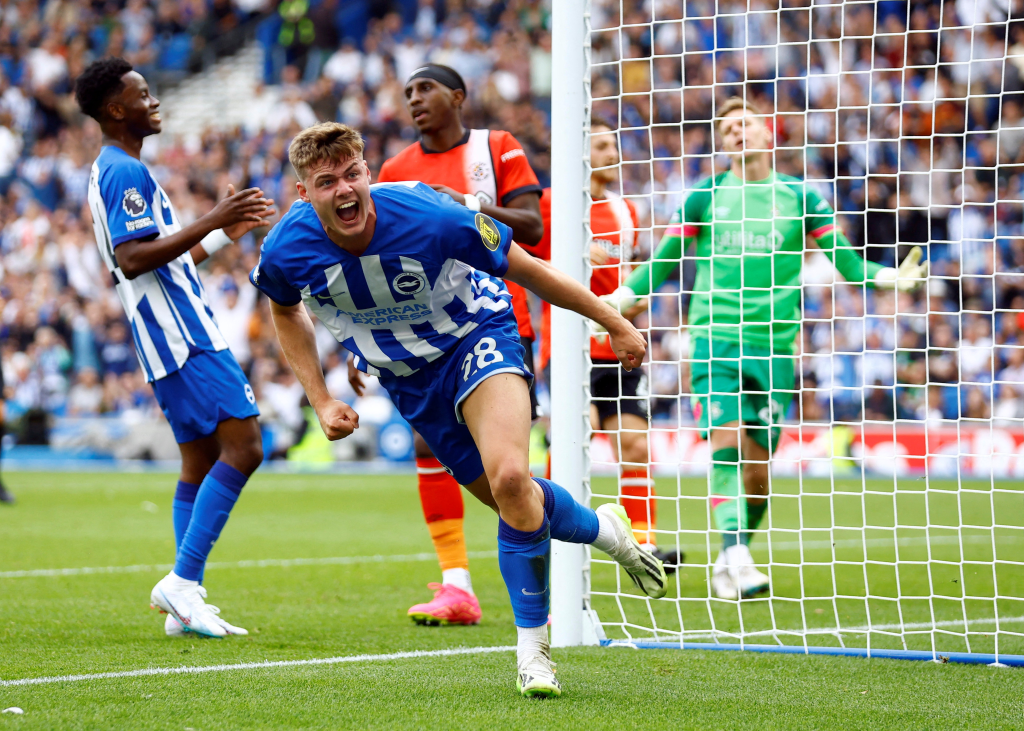
Game 4: Brighton 4 – 1 Luton Town
It was a bit of a baptism by fire for Luton Town on their trip to the South Coast to start their Premier League campaign. The xG created was 4.10 – 1.45 in Brighton’s favour, with the Seagulls accumulating 27 total shots, 12 of them on target. Kaoru Mitoma found Solly March with a tricky right-footed cross to put Brighton ahead in the 36′. Most of Brighton’s shots in the first half were off target, and the score was only 1-0 at halftime. In the second half, Brighton turned it up another notch. Joao Pedro won a penalty after being bowled over by Tom Lockyer, and then converted it himself to make the lead 2. In the 81′, Luton Town were given a glimpse of hope, converting their own penalty to draw within 1, but the hope was short-lived. New arrival Simon Adingra struck in the 85′ to add to Brighton’s lead, and Evan Ferguson finished off the game with a 95′ goal. New signings James Milner and Mahmoud Dahoud had strong first games for Brighton, and the Seagulls don’t appear to have lost a step without Caicedo and Mac Allister.
Game 5: Everton 0 – 1 Fulham
The story of this game was the German keeper, Bernd Leno. Although his side had 59% possession, this was due to Everton’s direct counter-attacking approach, which was able to generate 2.93xG to Fulham’s 1.48 over the game. Leno made 9 saves, and Fulham struck on their own counter-attack, with Mitrovic and Pereira combining before Bobby Decordova-Reid slotted home the cross from inside the 6 yard box. After being under pressure for the majority of the game, Fulham were able to grab a goal against the run of play, and fans will surely be happy to see Aleksandar Mitrovic playing, even if only as a substitute. Still a promising start for Everton, who surely deserved more from this game.
Game 6: Sheffield United 0 – 1 Crystal Palace
The home-field advantage of Bramall Lane wasn’t enough to help Sheffield United to any points on their opening match vs Palace. With no Olise in the lineup due to injury, and new signing Matheus França not available yet, Schlupp and Ayew started on either side of Eberechi Eze on the wings. Eze had a player of the match performance, looking cool under pressure and helping Crystal Palace to 67% possession in this match. The Blades could not create much in terms of chances, being outshot 3 to 1 by Palace, and only managing a lone shot on target. Palace created 2.01xG from 8 shots on target, and could have won by more had it not been for a few goals that were fractionally offside and rightly called back. A strong start for Crystal Palace, even if the scoreline does not reflect that.
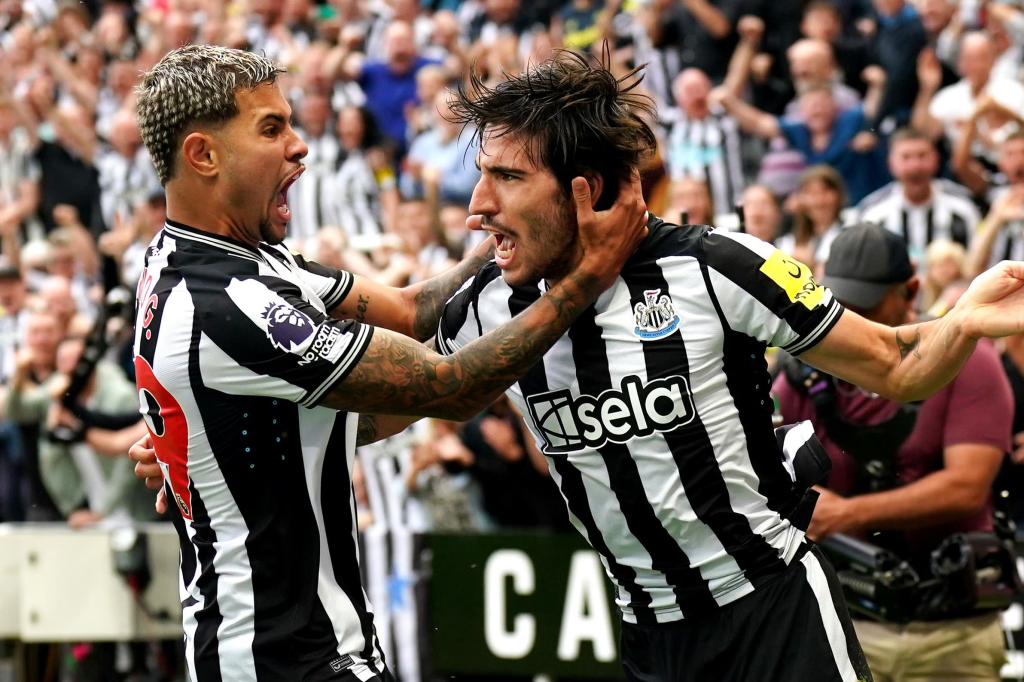
Game 7: Newcastle 5 – 1 Aston Villa
In the most intriguing match of the day, Newcastle hosted Unai Emery’s rising Aston Villa squad. The early game was a story of new signings, with Sandro Tonali putting Newcastle ahead early before Moussa Diaby equalized for Villa inside 11 minutes played. Just after a quarter of an hour, Alexander Isak put the Geordies back in front, stabbing home a centred ball from Botman. Newcastle predictably held the majority of the possession, with their midfield trio of Tonali, Guimaraes, and Joelinton all being extremely press-resistant. Newcastle were vulnerable on the counterattack, especially if Dan Burn ever pushed up on the left flank. The speed of Diaby, Watkins, and Bailey caused problems on the counter-attack, with Villa playing a direct game in the first half. Soon after kick-off in the second half, Alexander Isak grabbed his brace in the 58′, and Newcastle started to run away with the game. Callum Wilson added another in the 77′, assisted by new signing Harvey Barnes, who himself scored in the 91′ to cap off a 5-1 emphatic home victory to start their campaign. Emery will have some lessons to learn from this game, but alarm bells shouldn’t be ringing after game 1.
Game 8: Brentford 2 – 2 Tottenham
The start of a new era of Tottenham Hotspur began with a trip to West London. Ange-ball in full-effect, Spurs held 70% possession in the match, and completed more passes in the opposition half (455) than they had in nearly 20 months of football under Antonio Conte. This was a fresh, exciting look on Spurs, who are no longer playing the dreadfully boring low-block counter approach that Mourinho and Conte insisted on. With this increased focus on attacking though, Spurs are bound to concede goals this season, especially until more centre-back reinforcements arrive. The lack of depth at CB was exposed early, with Cristian Romero having to leave in the 15′ due to a precautionary concussion check, being replaced by Davinson Sanchez. Romero left immediately after scoring a header from a Maddison set piece to put Spurs ahead. There was an immediate drop-off in the stability in which Spurs could play out from the back, and combined with Oliver Skipp having the least notable performance of the Spurs midfield on the right side, there was immediate pressure invited on this half of the pitch. New signing Micky Van de Ven was a sight for sore eyes for Spurs fans, who have been longing for a centreback with his explosive pace and defensive ability to pair with Romero for ages. Brentford was able to take the lead after winning a questionable penalty that was converted by Mbeumo to tie the game, then adding another from Yoane Wissa in the 36′. Spurs tied the game just before halftime, with Maddison dribbling around his marker and slipping the ball to Emerson before being fouled, who took a first time volley into the bottom-left corner. In Postecoglu’s system, the RB Emerson is drifting inside and acting as another centre midfielder in possession, while the #8’s (Maddison and Skipp today) attack the box. The second half was a story of Spurs attacking and generating by far more chances, but with the best chance only being worth 0.12xG. Kevin Schade had Brentford’s best chance of the second half, but missed his attempt in the 87′ that could’ve seen Brentford stealing all 3 points. In the end, it was a very promising start for Ange Postecoglu at Spurs, with his team looking to be one of the most exciting to watch for a neutral fan this season. There will be goals. Lots of goals. Who will score them? We’ll find out.
Game 9: Chelsea 1 – 1 Liverpool
In the 1st edition of the Moises Caicedo derby, the result between Chelsea and Liverpool was the same as usual, but today wasn’t a goalless draw at least! While the Ecuadorian was not playing, just hours before the game he rejected Liverpool’s massive bid for him, telling Brighton that his intention is only to join Chelsea. Chelsea soon found a spare 115 million pounds lying around to sign arguably the hottest defensive midfield prospect in world football right now. This game started surprisingly, with Mauricio Pochettino opting for a 5-back formation for what seems like the first time ever. After using a 4-2-3-1 to great success in pre-season, Pochettino opted for somewhat of a 5-3-2 formation to face Liverpool. I’d guess that this was a reactionary approach to Liverpool’s expected tactics, as Pochettino rarely opts to diverge from his preferred 4-back systems. Liverpool were able to take advantage of the slow start from the Blues and scored 18′ in thanks to Luis Diaz tapping home a Mohamed Salah cross. Before the 30 minute mark, there was another scare for Chelsea, as Salah scored a goal that would be ruled offside after VAR. At this point, Poch seemed to convert his team into a 4-back system, with Levi Colwill acting as the LB, and Ben Chilwell acting more as a LM. Chelsea fared much better, and were clearly the better team for the rest of the game. New arrival (I know that doesn’t narrow it down much) Axel Disasi poked home a deflected ball in the box off a set-piece and equalised for Chelsea in the 38′. In the second half, Chelsea held 64% possession, and generated more chances than the Reds, with Mikhailo Mudryks run in alone on Alisson leading to a Nicolas Jackson chance being the best opportunity of the half. In the end, it is hard to argue either team deserved 3 points, but Chelsea certainly had the run of play for most of the game after their slow start. Liverpool desperately need a defensive midfielder, with Mac Allister acting as their most defensive midfielder in this match. It has been tough to sign one though, with bids for Caicedo and Lavia failing recently, and attempts to sign other players such as Sofyan Amrabat also failing. If Liverpool cannot get this key reinforcement, they could be in for a long season.
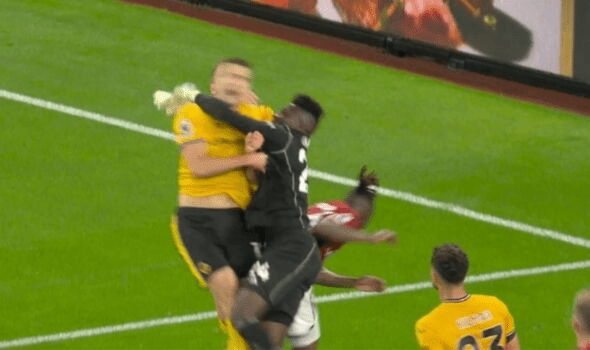
Game 10: Manchester United 1 – 0 Wolverhampton
In the final game of the week, Manchester United kick off their season hosting Wolves at Old Trafford. In the first half, Wolves held their own much better than expected, generating similar xG to United, with the 61% possession being the only thing to really separate the sides in the first half. Pedro Neto caused havoc down the right flank of Wolves, and yellow cards for Luke Shaw and Lisandro Martinez coming as a result. Wolves breaking with 3 forwards seemed to be enough to generate chances vs. United, which should be a concern for Erik Ten Hag. 5 minutes into the second half, Matheus Cunha missed a wide open top-half of the net as the ball was flicked across the 6-yard box to him in space that should have put Wolves in front. Pedro Neto looked unbelievably good this game, dribbling United’s defenders with ease time and time again. Nelson Semedo, a fullback not known for defending, was able to make Garnacho look near-invisible on the left-wing. Mason Mount’s United debut wasn’t the one he would’ve liked, and he was subbed off in the 67′ for Christian Eriksen. Garnacho’s night ended then as well, with Jadon Sancho getting his first minutes. Eriksen immediately made United more of a threat, threading a long ball over the top that was close to Rashford chance. Wolves were able to keep generating chances on the counter, with Cunha doing well to drive the ball forward through the middle of the pitch despite lacking the finish today. Sancho also aided United after coming on, being much more dangerous down the flank. United got a goal a bit out of nowhere, with a chipped ball over the top to Wan-Bissaka, who centred for Raphael Varane to head home and give United the lead despite having generating fewer chances in the game. After the goal, Wolves poured on the pressure, and Manchester United used everything they had to stop the ball from entering their net, including a pitch invader running on the pitch to add a man to the press on Wolves! Onana rushed out to try and meet a cross, missed the ball entirely and smashed into the Wolves player. After a VAR check, a penalty somehow wasn’t given, and Manchester United managed to escape with a 1-0 win against the run of play. A very strong start for Gary O’Neill’s Wolves, who will feel much more confident they can avoid relegation after such a performance. They certainly deserved as least a point from this game.
That makes for all of the matches on opening weekend! This looks to be one of the most interesting Premier League seasons in recent years, so be sure to stay tuned for what’s next! I’ll be providing regular updates as the season goes on.
Thanks,
LM
-
2023/2024 English Premier League Preview
Welcome back football fans, the summer break has ended, the transfer window has been in full swing, and clubs have started their pre-season tours around the world. In this article, I will look at each team’s offseason changes, what we could learn from their preseason games to-date, and my prediction for where they will finish in the league this season. Note that the transfer window is still open until September 1st, meaning we have a full month of possible transfers still ahead. For this reason, I will also explore potential transfers for the clubs that seem to still have some moves to make before the season starts. This article took a lot of time and research to complete, so if you enjoy, feel free to leave a comment!
First, let’s take a look at the map of teams in the 2023-2024 Premier League:
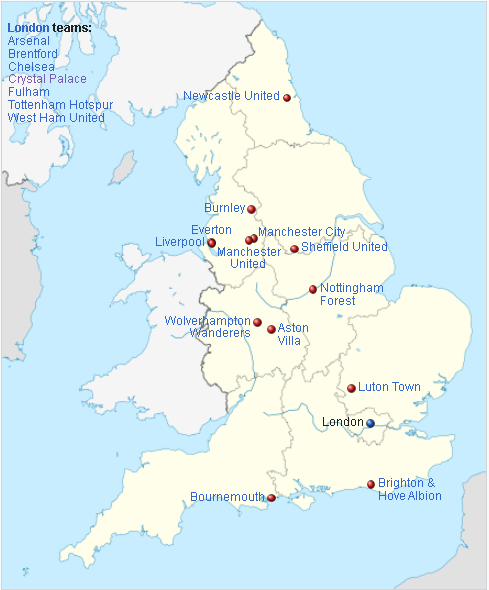
From last season, the Premier League lost Leicester City, Leeds United, and Southampton due to relegation. Replacing them from the Championship are Vincent Kompany’s Burnley, entering the Premier League as winners of the Championship, Sheffield United, making their return for the first time since the 2020-2021 season, and surprise playoff winners Luton Town, who have completed their rise from non-League to the Premier League. The longest away day of the season still belongs to the Newcastle-Bournemouth fixture, while England’s northwest gets two more teams in the region with Burnley and Sheffield United, both similar distances from Manchester. West London remains the area most populated with Premier League clubs, home to Chelsea, Fulham, and Brentford. Now, let’s go through the clubs competing in this Premier League season and explain my predictions.
*All league predictions are based on certain transfers going through, which at this point (August 11, 2023) are not finalized. All incomplete transfers will be underlined and marked with an asterisk*
My predicted final league table of the 2023-2024 English Premier League season is shown below – the European competition in brackets next to some teams indicate those that are competing in the Champions League, Europa League, and Conference League this season:

1) Manchester City (2022-2023 Position: 1st)
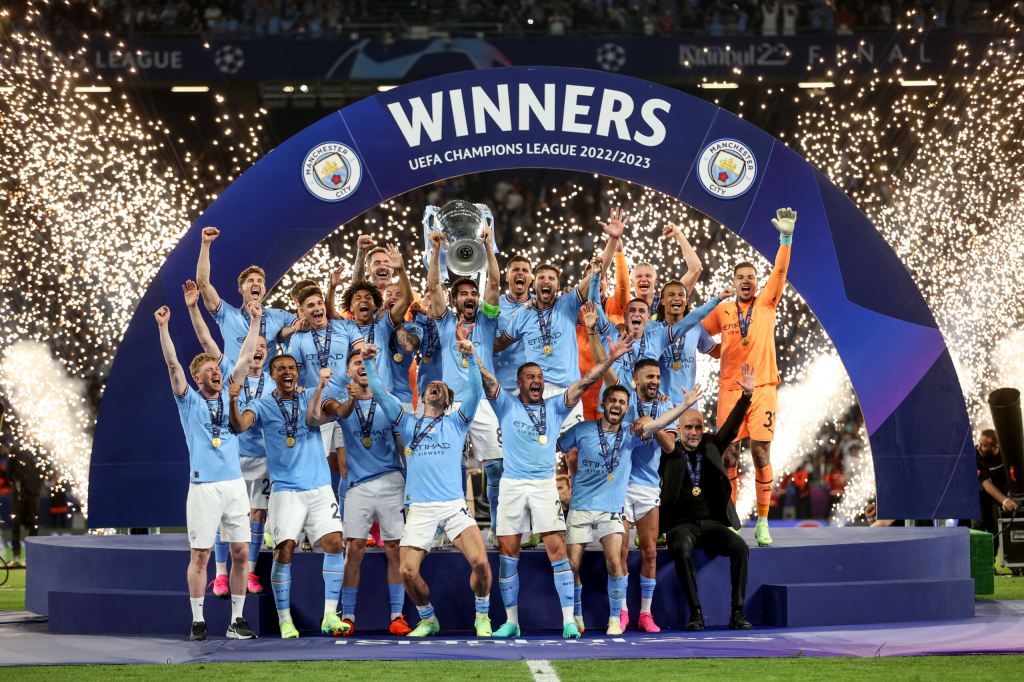
Players Out: Ilkay Gündogan, Riyad Mahrez, Kyle Walker*, João Cancelo*
Players In: Mateo Kovacic, Josko Gvardiol*, Benjamin Pavard*, Michael Olise*
Best Possible XI: Ederson, Gvardiol*, Dias, Stones, Akanji, Rodri, Kovacic, de Bruyne, Grealish, Haaland, Olise*
The champs are back. Fresh off completing the second treble in English football history, Pep Guardiola’s men look to claim their 4th consecutive title this season. While Man City are still big favorites to win the title again this season, there have been some significant squad changes at the Etihad. Captain and arguably the most clutch player of their UCL triumph, Ilkay Gündogan, departed for Barcelona on a free transfer. Riyad Mahrez also left Manchester to join Al-Ahli in Saudi Arabia, leaving 2 large holes in the squad. Also looking increasingly likely is the end of Kyle Walker’s time at City, with the former Spurs RB looking for regular playing time after being dropped to the bench for much of last season. These are players who have been a part of each of the past 3 Premier League titles and will be taking valuable experience with them. So, what does Pep have planned to re-vamp his team for yet another title challenge?
The only official signing of the summer for City is Mateo Kovacic from Chelsea, a UCL winner in his own right, and a solid replacement for Gündogan in terms of playstyle. The main difference is that Kovacic is likely to stay further back and contribute less goals than Gündogan, so expect to see City’s tactics shift to accommodate this change. With a #8 signed, there remains the likely departure of Kyle Walker to address, as well as the confirmed departure of Riyad Mahrez. For the defence, City is heavily rumored to be interested in signing Benjamin Pavard from Bayern Munich, and nearly already completed their deal for Josko Gvardiol before Leipzig seemingly decided to ask for more money as the deal was nearly complete. Why is Gvardiol the highest priority target? First, he can play at LB or CB, letting Pep keep his system of playing 4 CB’s in his backline. With João Cancelo likely to be departing Man City soon as well, the addition of Gvardiol replaces that hole, while allowing Manuel Akanji to return to his preferred right side. Benjamin Pavard is also of this same player profile: experience playing at RB, but also is a CB and will play there frequently. Pavard’s addition would likely be only if/when Kyle Walker leaves, to balance out the backline depth. The final rumored signing that I believe makes a lot of sense for City is Michael Olise from Crystal Palace. If you need a Mahrez replacement, I think Olise is the closest thing we have to it in the Premier League right now. A left-footed right winger who plays inverted, cutting inside the pitch to help the midfield in buildup, and loves to pick out a shot to the far top-left corner.
City already had a fantastic squad, and if they complete the signings of Gvardiol and Olise, I believe they will be good for the title again this season. Good thing Pep won’t be renewing his contract in 2025 right, fans of every other team?
Predicted Finish in 2023/2024: 1st
2) Liverpool (2022/2023 position: 5th)

Players Out: Jordan Henderson, Roberto Firmino, Naby Keita, James Milner, Alex Oxlade-Chamberlain
Players In: Alexis Mac Allister, Dominik Szoboszlai, Sofyan Amrabat*
Best Possible XI: Alisson, Robertson, Konaté, Van Dijk, TAA, Amrabat*, Mac Allister, Szoboszlai, Gakpo/Diaz, Darwin, Salah
As Anfield prepares for another season, its beloved Reds have had to do more re-building than we are used to over the past few seasons. Though it hasn’t been a full squad overhaul, the players that were brought in are very exciting, and will help Klopp implement his new system. The original “heavy-metal football” that Klopp joined the Premier League with has taken a toll on the players who have been at the club for some time. This past season, Klopp successfully switched his tactics into more of a mid-block in defense, preventing his team from being caught on the counter as much, as well as moving Trent inside the pitch, almost playing the same role in build-up that John Stones was playing for Man City. First, Liverpool signed Alexis Mac Allister from Brighton for a bargain fee of 42 million euros (in today’s market, that is a huge bargain). Mac Allister is a versatile midfielder who can play as any of a #6, #8, or #10. His penetrative passes from deep will unlock Liverpool’s extremely fast front 3, all while providing added support in midfield for Fabinho, who no longer has the stamina and pace to cover the entire midfield in defence like he used to unbelievably do. Trent’s inversion into midfield is another way of shoring up the defense in front of the back 4. As we saw last season, the box midfield was the most used tactic in buildup for strong teams. These 4 players are the foundation of the team’s buildup, and if they develop chemistry with one another can destroy defences. For next season, Liverpool will slot Mac Allister in as the left, more advanced of the midfield box, where he is quite comfortable and will cut inside before picking a pass or shooting. The last member of this midfield box that will be at the centre of Liverpool’s offense next season is my personal favorite transfer: Dominik Szoboszlai. The Hungarian from RB Leipzig can play across the front 4, or in midfield. Best used as an attacking midfielder, making runs into the box and being the main goal threat from midfield, Szoboszlai is also a set-piece specialist and a mentality monster. The poise with which he carries himself on the pitch is that of a 35 year old veteran, not a rising star. This combination of Szoboszlai and Mac Allister is going to bring some much needed energy and creativity to the Liverpool midfield.
On their ways out of Anfield are some of the aging squad members who were a part of Liverpool’s 2019 Champions League triumph. Captain Jordan Henderson joins Steven Gerrard at Al-Ettifaq, Roberto Firmino heads the same way to Al-Ahli, Naby Keita is off to Werder Bremen, and James Milner signed with Brighton. Alex Oxlade-Chamberlain is a free agent now as well, yet to sign with a club. This may seem like a significant number of players, but Liverpool already had replacement plans that were carried out in previous seasons: Luis Diaz, Darwin Nunez and Cody Gakpo came in to aid the forward line, Ibrahima Konaté has proven to be an excellent CB partner for Van Dijk, and youngsters Harvey Elliott and Stefan Bajcetic became established first-team members. The only signing I can see Liverpool making before the upcoming season is a defensive midfielder to replace Fabinho as the starter, but not someone who will block Stefan Bajcetic’s path to the starting XI one day. Fiorentina’s Sofyan Amrabat is one player who fits that profile perfectly. One of the best players of the 2022 world cup, the Moroccan was a space-eating defensive midfield vacuum and a large reason why Morocco made the semi-finals. Currently 26 years old, he is a player who could play 2-3 seasons for Liverpool as a starter in his prime before Bajcetic takes the reins, as he looks like the future for Liverpool.
I believe Liverpool will have a very strong season coming up. Anfield will be a fortress, and I do not expect the Reds to drop many points at home. Their hopes on a title challenge may balance on their away performances, and how well Liverpool can keep pace with Man City’s away results.
Predicted Finish in 2023/2024: 2nd
3) Arsenal (2022/2023 position: 2nd)
Players Out: Granit Xhaka, Ainsley Maitland-Niles, Pablo Mari
Players In: Declan Rice, Kai Havertz, Jurrien Timber, Folarin Balogun (back from loan)
Best Possible XI: Zinchenko, Saliba, White, Timber, Thomas, Rice, Ødegaard, Martinelli, Jesus, Saka
After a season that surprised most, including Arsenal fans, Mikel Arteta’s men fell just short at the final hurdle to win the Premier League. In the end, the biggest issue seemed to be the injury to William Saliba, and the lack of squad rotation leading up to that injury. Rob Holding and Jakub Kiwior were thrown into the fire with hopes that they would not burn, and although they cannot be blamed for Arsenal not winning the league, one can only imagine what might have been had Saliba not gone down.
In the summer, Arteta has gone out to address his squad depth in hopes that a stronger title challenge can be mounted this year. The only major departure is Granit Xhaka to Leverkusen, who played 37/38 matches in the league for Arsenal. To replace him, Arsenal have splashed a record transfer fee to pull Declan Rice away from West Ham, where he has played his entire career to-date. Also joining the midfield, while also being able to supplement the attack up front, is Kai Havertz from Chelsea. The 75M euro fee paid for Havertz seems a bit excessive when looking at his on-pitch production and not just at the fact that he has won a Champions League. I expect Havertz to play mostly in the midfield alongside Ødegaard in a 4-3-3, but also could see Arteta playing a 4-2-3-1 to allow both Rice and Thomas to play as double pivots, in which case Havertz/Ødegaard would play as the #10. Finally, Jurrien Timber has come in to bolster the backline, such that a major injury to Gabriel/Saliba/White would not grind the title challenge to an immediate halt. Arteta’s biggest challenge will be balancing squad rotation (looking long-term) with getting results and keeping up with what will likely be a very high standard set by Manchester City. I believe playing in the Champions League this year will have an impact on Arsenal’s league performance, and for that reason have given Liverpool the nod for 2nd, as Liverpool are more likely to prioritize the Premier League over the Europa League than Arsenal are to prioritize the Premier League over the Champions League.
Predicted Finish in 2023/2024: 3rd
4) Manchester United (2022/2023 position: 3rd)

Players Out: David de Gea, Anthony Elanga, Alex Telles, Phil Jones
Players In: Rasmus Højlund, Andre Onana, Mason Mount, Leon Goretzka*
Best Possible XI: Onana, Shaw, Martinez, Varane, Dalot, Casemiro, Mount, Bruno, Rashford, Højlund, Antony
Manchester United are also back in the Champions League after several seasons finishing outside the top 4! Some might argue it was Liverpool, Spurs, and Chelsea all having poor seasons that allowed United back into Europe’s elite competition, but one cannot blame United for taking advantage of their rivals slipping. The Erik Ten Hag rebuild continues with a level of spending expected of Man U, with over 190M euros spent on the acquisitions of Onana, Højlund, and Mount. Onana replaces longstanding starter David de Gea, as the Spaniard finally departs Old Trafford after 12 years at the club. The Cameroonian keeper has played very well, both domestically and in the Champions League, for both Ajax and Inter Milan, leading Ajax to the semi-final and Inter to the final this past year. Onana reunites with his former boss Ten Hag, and hopes to give United supporters more confidence when playing out from the back this year, as a true sweeper keeper.
Mason Mount joins from Chelsea, able to help in the midfield or on the wing, giving Ten Hag some tactical flexibility if one of Rashford or Antony is injured. Yes, the fee was very high at over 64M euros, but a “Manchester United” tax is to be expected. Ten Hag will be hoping that this addition can help give Christian Eriksen more rest, as well as provide his team with UCL-winning experience. The final acquisition confirmed is that of Atalanta striker Rasmus Højlund. Højlund is a player I have had my eye on for years now, and have touted as the best striker to come out of Scandinavia since Erling Haaland. However, we should not be comparing the two players, as that will likely only lead to Højlund being unfairly criticized for not scoring at the record-breaking levels that Haaland has. What United now have is a true #9, a powerful left-footed striker who will certainly score more than Wout Weghorst last season. If given a few years, I believe Højlund has the potential to become one of the best strikers in the Premier League.
Overall, I believe that Manchester United have improved their squad enough to maintain their top-4 finish from last year, although this could be their last year in the top-4 for a few seasons if the club keeps spending so much every transfer window, especially given the trajectory of Newcastle, as well as the rebuilds of Liverpool, Chelsea and Spurs.
Predicted Finish in 2023/2024: 4th
5) Newcastle United (2022/2023 position: 4th)

Players Out: Allan Saint-Maximin, Chris Wood
Players In: Sandro Tonali, Harvey Barnes, Yankubah Minteh, Tino Livramento*
Best Possible XI: Pope, Burn, Botman, Schar, Trippier, Guimaraes, Joelinton, Tonali, Barnes, Isak, Almiron
Money talks. Well, this is the Premier League, so you shouldn’t be surprised. After Newcastle were taken over by the foreign investment fund of the government of Saudi Arabia, they have risen from mid-table finishes, to challenging the elite of the Premier League. Last season, this was confirmed with a top-4 finish, earning the Geordies Champions League football. Eddie Howe has done well to bolster his squad ahead of a much more congested year of fixtures (last season, Newcastle did not play in a European competition). The most surprising transfer, and well the best example of Newcastle’s recent rise, is the 64M euro purchase of Sandro Tonali, AC Milan’s midfield engine. Tonali is one of the best midfielders in world football, end of sentence. Newcastle have made a statement, and brought in a proven winner with years of Champions League experience. Up front, Harvey Barnes was added from relegated Leicester to go along with the departure of Allan Saint-Maximin. Barnes and Saint-Maximin are not the same type of player, what Barnes lacks in flair and skill moves, he makes up for with his directness and better final-third play than ASM. I think Barnes is the starter at left-wing for the start of the season, as I think he has a more complete all-around game than Anthony Gordon.
In the league this year, I see Newcastle having a home fortress, and dropping very few points at St. James’ Park. However, a longer season full of European football will likely result in more points being dropped on the road, in games scheduled between UCL matches. For this reason, I do not think Newcastle will repeat their top-4 finish from last year, but will be able to build with the added funds from competing in the champions league, play Europa League football next season, and expect to be back in the top-4 by the 2025/2026 season.
Predicted Finish in 2023/2024: 5th
6) Tottenham Hotspur
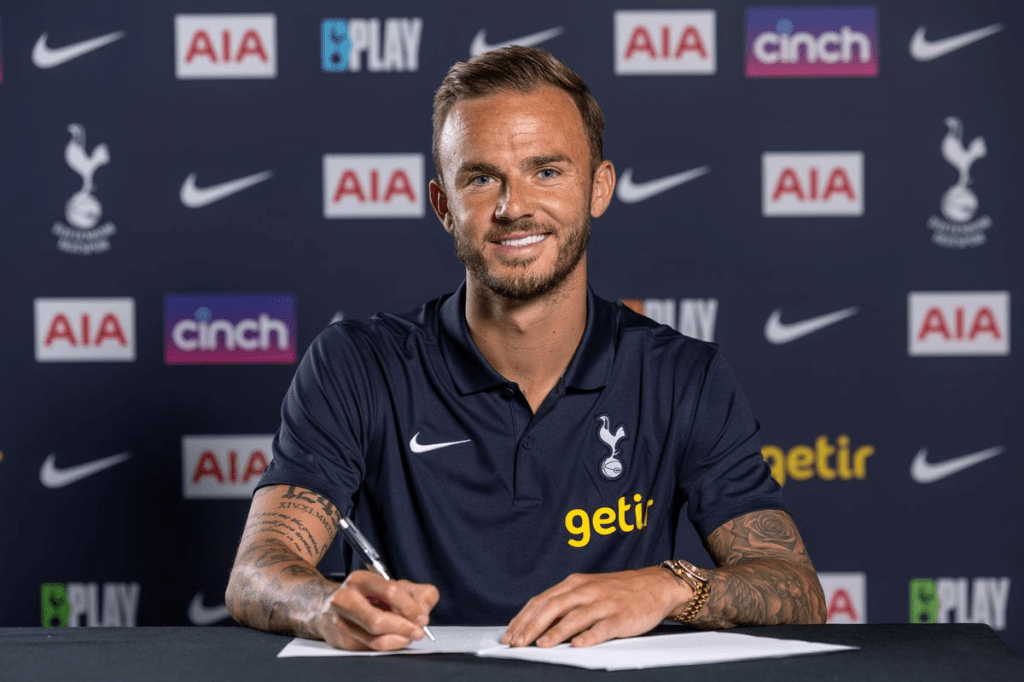
Players Out: Harry Winks, Lucas Moura, Davinson Sanchez*, Harry Kane
Players In: Micky van de Ven, James Maddison, Edmond Tapsoba*, Manor Solomon, Guglielmo Vicario, Ashley Phillips, Alejo Veliz, Pedro Porro (loan-to-buy), Dejan Kulusevski (loan-to-buy), Destiny Udogie (return from loan), Giovani Lo Celso (return from loan), Sergio Reguilon (return from loan), Tanguy Ndombele (return from loan), Bryan Gil (return from loan)
Best Possible XI: Udogie, Van de Ven, Romero, Porro, Bissouma, Maddison, Bentancur, Son, Kane, Kulusevski
Spurs are at the start of what could be a very exciting project. As you can see from the list of Players In, several players who were purchased in previous seasons only to be deemed surplus-to-requirements by the past 2 managers have returned from loans with a fresh slate and a new manager to impress. Let’s be honest too, Spurs needed a clean slate. The past seasons under Mourinho and Conte seemed like an identity crisis for the club, who took the overachievement of Pochettino as a level of results that needed to be matched. This led to the hiring of managers who were proven title-winners, and a change in recruitment strategy from young, high-potential prospects, to the acquisitions of more established veterans for higher transfer fees. Historically, this has always been a club who played high-energy, attacking football, and did not attempt to follow the transfer strategies of clubs like Chelsea and Manchester United, who regularly spend much more than Spurs. Finally, that can change. Appointing Ange Postecoglu as the new manager is a statement that Spurs are returning to the strategy that worked much better in the past: Hire a promising manager who has had success but never managed at the level of a club like Spurs, sign young players who fit the manager’s preferred style, and build up a strong squad over multiple seasons.
Postecoglu’s first signing was James Maddison from Leicester for just over 45M euros. Tottenham had been missing a creative midfielder since Chrisian Eriksen was sold to Inter Milan, and Maddison fits that bill. In addition, Maddison can provide more goals from midfield than any of Spurs’ prior options. Maddison will likely start the majority of league games in midfield, alongside Yves Bissouma, who has established himself as Postecoglu’s preferred #6. Expect Bissouma to regain the form he showed at Brighton this season; last year under Conte his personality and creativeness was stifled, and he was never given much of a change to be a regular starter. During pre-season, Bissouma looks to be a central member of the squad and to have regained his confidence.
Spurs have signed a defender finally, with Micky Van de Ven joining the club from Wolfsburg. A much needed CB signing, this means that Romero won’t be on his own in a backline with Dier, Davies, and Sanchez all starting together, and all Spurs fans know just how much that means. Van de Ven is the perfect partner for the aggressive stopper Romero, able to use his excellent pace to sweep and recover through balls. Now that Spurs will be playing a higher line under Postecoglu’s more possession based approach, a player like Van de Ven is essential to make that system work. Still young and with room to improve, this was money well spent. Another needed replacement was in net, with Hugo Lloris showing clear signs of declining last year. The Spurs club legend will be replaced by Empoli’s Guglielmo Vicario, a very highly-rated keeper who was wanted by Inter Milan to replace Onana as well. Vicario is a result of Spurs more data-driven recruitment approach, exceeding keeper averages in several key sweeping statistics, although he was playing for a bottom-table club who ceded the majority of possession. Under Postecoglu’s system, Vicario will have his opportunity to show that he is capable of becoming one of the world’s best, as Italian legend Gianluigi Buffon predicted he could.
The first time I wrote this, I asked the biggest question for Spurs, will Harry Kane stay? Well, like all other Premier League clubs, Spurs took personal offence to me trying to finish this article without 80 revisions, and sold Kane to Bayern Munich 2 days before their first game of the season! I’ll be honest, as a Spurs fan myself, I’ve tried to be optimistic, but selling your club’s all-time top scorer and best player to Bayern (the team who wins their league every year) because he wants to win trophies seems kinda… meh. I worry for Kane that a few trophies at Bayern will do nothing to change the narrative that has followed him through his career to-date. Unless he can win a Champions League with Bayern, no amount of trophies won in Germany will lessen the hate Kane has been unfairly given for ages. For Spurs, losing Kane 2 days before the season opener is truly less than ideal to put it lightly, having this deal completed weeks ago would have been much better but Bayern had no reason to care about what’s best for Spurs. In the meanwhile, don’t expect an immediate striker signing, that would be a foolish use of the Kane money. Now, every club in Europe knows Spurs have 100M to spend, and due to such will increase asking prices for any player. Signing a striker who is currently at Kane’s level would cost more than what Kane was sold for and be a bad piece of business. Richarlison will lead the line, as he does for Brasil, and finally get his chance to establish himself at Spurs. New signing Alejo Veliz from Rosario Central should also get much more gametime this season than he would have otherwise. The money should be spent on bringing in one or two more centre-backs, with Edmond Tapsoba and Aymeric Laporte being the two most likely targets, and then potentially adding a young winger with potential, as the loss of Kane could mean we see Son Heung-Min line up as the #9 some games.
My original Top 5 prediction has been thrown out the window by the Kane sale, and even if the money is re-invested into the squad intelligently, the Spurs project will need a season to get off the ground in their first season in over a decade without Harry Kane. Top 4 is very unlikely this season, but I think Spurs could still set their sights on a European finish and build on for next season.
Predicted Finish in 2023/2024: 6th
7) Aston Villa (2022/2023 position: 7th)
Players Out: Marvelous Nakamba, Ashley Young
Players In: Moussa Diaby, Pau Torres, Youri Tielemans
Best Possible XI: Martinez, Moreno, Torres, Konsa, Cash, Diaby, Luiz, Kamara, Ramsey, Watkins, Buendia
We might have to start calling him Chef Emery after what he is doing with Aston Villa, because the man is cooking. After what was very clearly an overachievement last season taking Villa all the way up to 6th place from 16th place, where Villa sat after 12 games last year when Emery was appointed, Unai Emery has done some fantastic business to help give his squad the best chances of building on last year’s achievements. A statement of 88M euros was spent on bringing Pau Torres and Moussa Diaby to the club. Torres is a former player of Emery’s at Villareal, and has been one of the best centre-backs in La Liga for the past few seasons. I’m honestly surprised it’s taken this long for a Premier League team to buy him. Diaby is another huge signing for Villa. The winger registered an average of 0.6 G+A per 90 minutes for Leverkusen in the Bundesliga, Europa League, and Champions League matches last seasons, being highly sought after by many top clubs. Aston Villa made it a hat-trick of great signings, bringing in Youri Tielemans from Leicester on a free transfer. As Tielemans is getting older, he will likely be a squad option to help give Villa’s starting midfielders a rest, but brings a wealth of experience to a squad that still has many young players. While Villa will be competing in the Conference League this season (the only reason i haven’t predicted them higher), Emery has built a squad that is prepared for the Premier League and will have a chance to beat anyone. I believe Villa can finish as high as 5th place this year, if everything goes their way. However, I am a more pragmatic person than that, so I have them down for a strong 7th place finish.
Predicted Finish in 2023/2024: 7th
8) Brighton & Hove Albion (2022/2023 position: 6th)
Players Out: Alexis Mac Allister, Robert Sanchez, Deniz Undav (loan), Moises Caicedo*
Players In: João Pedro, Bart Verbruggen, Igor, Adrian Mazilu, Mahmoud Dahoud, James Milner, Mohamed Kudus*, Simon Adingra (return from loan)
Best Possible XI: Verbruggen, Estupinan, Igor, Dunk, Lamptey, Caicedo, Kudus*, Gross, Mitoma, Pedro, March
It is no secret now that Brighton are one of the best-run clubs in the Premier League. Over the last year, Brighton have made more money than it cost to build the AmEx Stadium through selling players (and managers) to Chelsea. Just Chelsea. Every time a Brighton player is bought by one of the big clubs in the league, it seems like the scouting department is able to find a replacement with relative ease. Here’s how Brighton have updated their squad for the coming season, in preparation for their first season of European football. In goal, Robert Sanchez was dropped in favor of Jordan Steele towards the end of last season due to his poor distribution specifically, but poor form overall. Brighton have since sold Sanchez to Chelsea and replaced him with Anderlecht’s Bart Verbruggen for a net profit, who I see as an immediate upgrade in net. While there were no major departures in defense, Fiorentina’s Igor has been brought in to help at CB. A 17M euro fee for a 25 year old central-defender is quite cheap in today’s market, and Igor will have every chance to impress and take a starting spot alongside presumably Lewis Dunk. In midfield, the loss of Alexis Mac Allister to Liverpool was mitigated by two excellent free transfers, and one excellent non-free transfer: Mahmoud Dahoud, James Milner, and Mohamed Kudus are joining the Seagulls. Dahoud and Milner seem like depth and experience acquisitions on free transfers, and will likely serve as backups. Mohamed Kudus’s 40M euro transfer is in the final stages, with personal terms remaining to be negotiated. Assuming the deal doesn’t fall through, Kudus will step into Mac Allister’s attacking midfield role and provide Brighton with the creative spark and attacking threat that they lost when Mac Allister was sold. I predict Brighton to remain a very tough team to beat in the league, but the Europa League will likely cause a drop from last season’s 6th place finish. Similar to Newcastle, the first year back in European football will cause a drop in the league performance this year, but expect to see both teams back to their last season finishing places in 2024/2025.
Predicted Finish in 2023/2024: 8th
9) Chelsea (2022/2023 position: 12th)
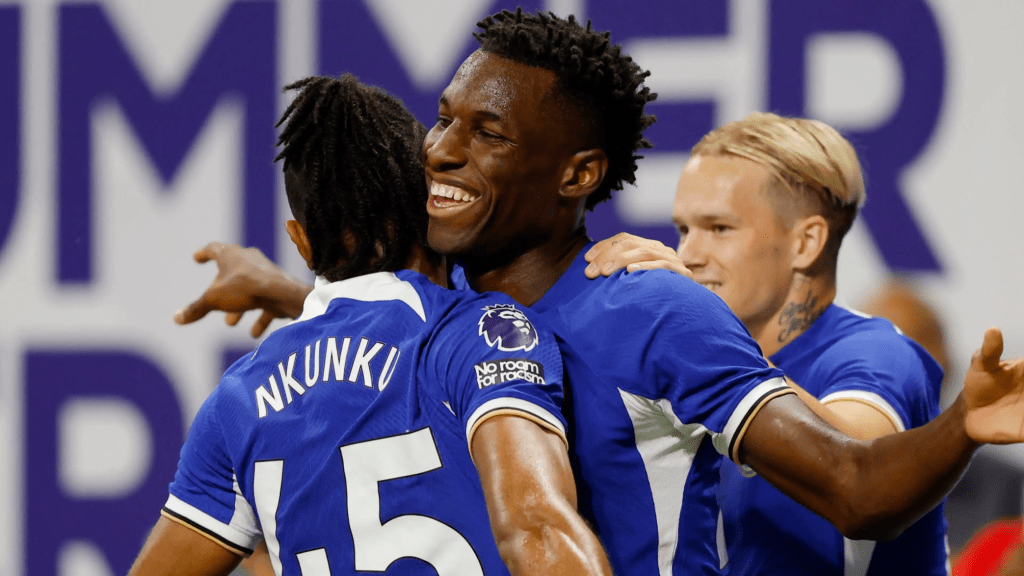
Players Out: Kai Havertz, Mason Mount, Kalidou Koulibaly, Mateo Kovacic, Christian Pulisic, Ruben Loftus-Cheek, N’Golo Kante, Cesar Azpilicueta, Ethan Ampadu, Joao Felix (end of loan), Aubameyang.
Players In: Christopher Nkunku, Nicolas Jackson, Axel Disasi, Lesley Ugochukwu, Robert Sanchez, Ângelo, Levi Colwill, Ian Maatsen, Malo Gusto, Callum Hudson-Odoi, Andrey Santos,
Best Possible XI: Kepa, Chillwell, Colwill, Thiago Silva, Reece James, Enzo, Andrey Santos, Mudryk, Nkunku, Madueke, Jackson
So Chelsea are playing a game of Football Manager apparently. It seems like as soon as another young player is highly regarded, Chelsea submit a bid. Florentino Perez may even find some competition scouting the favelas of Brasil for a change. Regardless, the Chelsea rebuild is in full effect. Was it incredibly fortunate for the Blues that the Saudi Pro League’s first summer with buckets of money to spend happened to coincide with several older players needing to be sold, resulting in over 40 million euros brought in for Edouard Mendy and Kalidou Koulibaly, both in their 30’s? Was it also fortunate that this same summer, Arsenal had pressure to spend and ended up paying 75 million euros for Kai Havertz? Absolutely, Chelsea needed these clubs to buy their players to avoid breaching Financial Fair Play rules, and getting what seemed like better than market value bids was a stroke of good fortune. Now we have to look at the facts: Mauricio Pochettino, one of the best managers for developing young talent at a high level, has been given free-reign to build the team of wonderkids from his dreams, and an unlimited budget. From watching Chelsea’s preseason games, I was very impressed with the style of football, as a Spurs fan myself I know Poch well.
I believe that the most crucial player in this Chelsea side is their new striker, Nicolas Jackson. When I first saw him play, my initial thoughts were that he takes after Didier Drogba, and after further investigation found out that both players actually produced the same G+A per 90 over their final seasons before joining Chelsea (cool, right?) Jackson is the definition of clinical, he will not need 10 chances a game, just one or two good ones. Jackson and Mudryk have already shown great link-up chemistry together, and if he stays healthy, we could be looking at Nicolas Jackson in the top 5 for the Premier League Golden Boot this year (obviously proven scorers like Haaland, Kane, or Salah still deserve to be favorites for the award). I have included Chelsea here in 9th because I think a single long-term injury to a key player has the potential to derail their season much more than the clubs around them. Christopher Nkunku has already gone down with a knee injury and will be out for months. An injury to Jackson would really hurt Chelsea’s chances of qualifying for Europe. However, if everyone stays fit, I see Chelsea capable (note: capable, not guaranteed) of finishing as high as 4th.
Predicted Finish in 2023/2024: 9th
10) Crystal Palace (2022/2023 position: 12th)

Players Out: Wilfried Zaha, Luka Milivojevic, Michael Olise*
Players In: Matheus França, Jefferson Lerma, Lewis Hall* (loan)
Best Possible XI: Johnstone, Mitchell, Guehi, Andersen, Ward, Doucouré, Lerma, Eze, França, Olise, Edouard
After 9 years at Selhurst Park, the player that comes to mind first to many when you say “Crystal Palace”, has left the club. Wilfried Zaha helped Palace be regulars in the Premier League and pull off the regular upset over the biggest clubs in the league. Now he’s departed on a free transfer for Galatasaray, but Palace fans still have reason to be optimistic. One of the most exciting transfers in recent history for the club was confirmed recently, Matheus França from Flamengo. The young attacking midfielder slots in the best as a #10, and will stand to forma formidable attacking quartet next season alongside Eberechi Eze, Michael Olise, and Odsonne Edouard. Eze has elevated his game significantly in recent seasons, and earned his first England callup last season. He will slot into Zaha’s position at LW and provide just as much of a threat to opposing defenders. The biggest question mark at Selhurst Park is the future of Michael Olise, who has attracted interest from both Manchester clubs and Chelsea, who are close to triggering his release clause. As a football fan, I don’t want Olise to move to any of these clubs this summer (City: trophies don’t mean much there in terms of legacy, United: this club ruins young talents like it’s their day job, Chelsea: would have 3 other wonderkids in his position). Also, I think this attacking 4, if kept together, would be as good as most of the top-half teams.
In less flashy, but equally helpful additions, Palace have signed Jefferson Lerma from Bournemouth on a free transfer to partner Doucouré in midfield, offsetting the loss of longtime player Luka Milivojevic. Also rumoured to be nearing completion is the loan signing of Lewis Hall from Chelsea, after the young full-back/midfielder signed a new 6 year deal at Stamford Bridge. Hall brings maturity beyond his age to the pitch, and would be a calm presence subbing in at LB or as a defensive midfielder. If the Eagles of Selhurst Park can keep hold of Michael Olise, I believe Palace could well be in for a top-half finish and could well improve following the loss of Zaha.
Predicted Finish in 2023/2024: 10th
11) Brentford (2022/2023 position: 9th)

Players Out: David Raya, Ivan Toney (suspension), Mads Bidstrup, Halil Dervisoglu
Players In: Kevin Schade, Nathan Collins, Mark Flekken
Best Possible XI: Flekken, Collins, Ajer, Mee, Henry, Jensen, Norgaard, Onyeka, Schade, Mbeumo
Last season, Brentford finished 9th with the lowest wage budget in the division. So if the squad seems underwhelming at first with the losses of Raya and Toney, trust that Thomas Frank knows how to get results without the biggest names in the world on his team. Aside from Roya and Toney, the core of last year’s squad is still here, so the replacements in net and up front will determine Brentford’s ceiling this year. Having David Raya refuse repeated contract extensions, and then demand a move led Brentford with little choice but to loan him to Arsenal with an option to buy, and little time to bring in a replacement. They settled on Mark Flekken, the 30 year old Dutch keeper who played last season in the Bundesliga for Freiburg, and received his first caps for the Netherlands. Also joining from Freiburg permanently is Kevin Schade, who spent the first half of last season at Freiburg before being loaned to Brentford in January. Brentford have made the move official, paying a 25 million euro fee to secure the young German’s services. Both players helped SC Freiburg to a 5th place finish last season, above the likes of Leverkusen, Frankfurt, and Wolfsburg. It will be interesting to see how Flekken adapts to the Premier League, and whether his distribution is comparable to David Raya’s.
Overall, the loss of Toney will hurt. Mbeumo, Wissa, and Schade will be heavily relied on to score while Toney is suspended. I can’t see Brentford maintaining the same level of goals scored without Toney, but that overall the squad is good enough to outperform the wage gap once again. Next season might be more realistic to set their sights on European qualification, but expect the Bees to give any team a tough game and take points off the big clubs.
Predicted Finish in 2023/2024: 11th
12) Bournemouth (2022/2023 position: 15th)

Players Out: Jefferson Lerma, Jordan Zemura, Junior Stanislas, Siriki Dembélé
Players In: Hamed Traore, Alex Scott, Milos Kerkez, Justin Kluivert, Max Aarons
Best Possible XI: Neto, Kerkez, Senesi, Zabarnyi, Aarons, Billing, Scott, Traore, Kluivert, Solanke, Ouattara
While Bournemouth had somewhat of a chaotic season last year, with 2 managers sacked, Andoni Iraiola has been trusted to take the team into next season and has had a pretty impressive first transfer window as a Premier League manager. The former Rayo Vallecano manager has brought in the best young player in the Championship last season, Alex Scott, alongside top Hungarian talent Milos Kerkez from AZ at left-back, Justin Kluivert from Roma on the wing, and Max Aarons from Norwich at right-back. Kerkez and Aarons are some of the most promising young talents at fullback and will provide plenty of energy up and down the pitch. Kerkez is the more defensive of the 2, and should tuck in alongside the centrebacks in possession at times. Alex Scott is a much needed boost in the midfield much like Hamed Traore, back from loan. Those two should combine with Phillip Billing as an anchor to form the core of Bournemouth’s midfield next season. Up front, Dango Ouattara and Dominic Solanke return after strong ends to their campaign last season, and will be partnered by Kluivert on the left. These signings are surprising to see Bournemouth secure, but perhaps is an indication of the players being convinced after speaking with the new manager Iraiola. Overall, I’m excited to see what Bournemouth can do this season, and believe they can optimistically look comfortably to mid-table and not have to worry about relegation this year.
Predicted Finish in 2023/2024: 12th
13) Nottingham Forest (2022/2023 position: 16th)
Players Out: Sam Surridge, Jesse Lingard, André Ayew, Renan Lodi
Players In: Anthony Elanga, Chris Wood, Matt Turner, Ola Aina
Best Possible XI: Turner, Aina, Niakhaté, Worrall, Felipe,Williams, Gibbs-White, Danilo, Elanga, Awoniyi, Johnson
Last season, Nottingham Forest consistently exceeded my expectations in getting results. This year, I’ve decided to give them credit where credit is due, and pick them for a mid-table finish. The signings of Anthony Elanga and Chris Wood will help bolster the sometimes inconsistent attack, with Taiwo Awoniyi and Brennen Johnson hoping to improve upon their solid performances last year. Matt Turner is a good signing in net, with plenty of experience from being in the Arsenal squad, as well as starting for the USA national team. Ola Aina brings good experience at fullback, and will compete for a starting position with Serge Aurier and Neco Williams. Steve Cooper’s side have shown to, aside from the odd blowout, give any team a difficult game and can take points off of technically superior sides. It is refreshing to see how few signings there have been this summer vs the insanity of last year’s transfer window, where almost 2 full squad’s worth of players were brought in. This will surely help with consistency and squad morale. I pick Nottingham Forest to have a solid season that might not be the most exciting football, but they will ruin more than a few weekends for the top-half teams.
Predicted Finish in 2023/2024: 13th
14) Burnley (2022/2023 position: 1st [Championship])

Players Out: Bobby Thomas, Wout Weghorst (loan), Ashley Barnes
Players In: Zeki Amdouni, James Trafford, Jordan Beyer, Sander Berge, Dara O’Shea, Michael Obafemi, Luca Koleosho, Nathan Redmond, Jacob Bruun Larsen (loan)
Best Possible XI: Trafford, Roberts, O’Shea, Beyer, Vitinho, Zaroury, Berge, Cork, Redmond, Amdouni, Foster
Welcome to the Premier League, Vincent Kompany! Here’s a gift: an opening weekend match against the defending champions, Manchester City. It’ll also be the first time you’ll be on the same competitive pitch as your old club, but this time you’re not part of Team Goliath. You’re David now, and you better have a gameplan.
Alright, I’m done addressing Burnley’s manager, don’t worry. Turf Moor is going to host Premier League football again, after Burnley blew away the Championship last year in Vincent Kompany’s first season. Unlike the other two newly promoted teams, Burnley have had a transfer market that indicates they plan on staying promoted. In come England U21 World Cup winning goalkeeper James Trafford, last year’s best CB Jordan Beyer permanently, promising Irish CB Dara O’Shea, and DM Sander Berge from Sheffield United to bolster the defence. Up front, Michael Obafemi and Zeki Amdouni join this season’s squad as well. Amdouni, a 22 year old Swiss international signed from FC Basel, has averaged a goal every 200 minutes in the Swiss league over 120 games. In the Europa Conference League, that drops to a goal every 120 minutes. Burnley clearly see potential in the young centre-forward and hope that he can lead their line consistently this season.
I believe the signings brought in are better than several Premier League clubs who did not get promoted last year. That combined with Kompany’s vast experience playing and winning in the Premier League should be enough for Burnley to stay up this season. Look for Kompany to play similarly, but not identically, to the system he learned under Pep at City. The game plan he comes up with for a team he knows so well will be very interesting to see, who knows, maybe Pep gets surprised on Gameweek 1?
Predicted Finish in 2023/2024: 14th
15) West Ham United (2022/2023 position: 14th)
Players Out: Declan Rice, Gianluca Scamacca, Nikola Vlasic, Arthur Masuaku, Manuel Lanzini, Lucas Paqueta*
Players In: Edson Alvarez, James Ward-Prowse, Harry Maguire*
Best Possible XI: Areola, Emerson, Aguerd, Zouma, Coufal, Alvarez, Ward-Prowse, Soucek, Paqueta, Antonio, Bowen
West Ham may stand to make the most profit from player transfers on a per player basis this summer, with Lucas Paqueta rumored to be subject of a 100M+ bid from Manchester City after Declan Rice already departed the Hammers to Arsenal for the same price. What will David Moyes do with that money? So far, it seems he’s going to try and revive Brexit-ball once again. By that I mean, play for set pieces and get some big angry players signed. James Ward-Prowse, Mr. Set-Piece if you will, was brought in from Southampton for a 30 million euro fee. Joining him in midfield is Ajax’s midfield pitbull Edson Alvarez, a fiery player who can cover ground all game long and isn’t afraid to get stuck into a tackle. Rumored to be joining the defence is long-maligned Manchester United ex-captain, Harry Maguire. I honestly believe that a move to West Ham would truly revive Maguire’s confidence and form, allowing him to prolong his international career which might be in danger if he can’t find game time at United.
Before any signings were made, which was just a week before the season began, I was worried about West Ham being in danger of relegation. The additions of Ward-Prowse and Alvarez can help to replace what Declan Rice brought to the team in aggregate. The loss of Paqueta to Manchester City certainly would damage West Ham’s open-play attack and force them to be somewhat predictably reliant on counter-attacking and set-pieces. I believe there will be enough teams who have worse seasons for West Ham not to be in danger of relegation. If they sell Paqueta and any other players without properly replacing them, we might be having a different conversation by mid-season.
Predicted Finish in 2023/2024: 15th
16) Everton (2022/2023 position: 17th)
Players Out: Moise Kean, Ellis Simms, Niels Nkounkou, Yerry Mina, Tom Davies, Andros Townsend, Conor Coady
Players In: Youssef Chermiti, Arnaut Danjuma (loan), Ashley Young, Andre Gomes (back from loan), Dele (back from loan), Jarrad Branthwaite (end of loan)
Best Possible XI: Pickford, Mykolenko, Tarkowski, Keane, Coleman, Gray, Onana, Doucouré, McNeil, Calvert-Lewin, Danjuma
I would never predict a Sean Dyche team getting relegated, but I find it hard to see Everton doing much better than avoiding relegation this season when looking at the teams I’ve put above them. Youngster Youssef Chermiti joins from Sporting CP for a 12.5 million euro fee, the first transfer fee paid this summer at Goodison Park. This is a likely indication of the club’s precarious financial situation, with the decision to build a new stadium right in the middle of the COVID-19 pandemic coming back to bite the Toffees. Do you recall a few years ago when Spurs had a self-imposed transfer ban (yes, you read that correctly) for 2 windows to save money for their new stadium? Let’s just say Everton did not follow suit, and are in the position where they need to stay in the Premier League to financially sustain the club but can hardly afford to spend enough to keep up with the current player market and stay up.
Enter Youssef Chermiti, the imposing (1.92m) centre-forward who will be Dominic Calvert-Lewin’s partner up front this year. As an 18 year old in the Liga Portugal, Chermiti scored 3 goals and added 2 assists in just over 800 minutes of football, while producing 0.54 non-penalty xG per 90. Those are very strong numbers for an 18 year old pllaying in the Portuguese top-flight, but he will require some resilience to succeed at Everton where it might be a challenging season. Fighting against relegation is not something Sporting CP is very used to, so Chermiti’s adaptability will be tested, but I believe he can succeed and help Everton do juuust well enough to finish in 16th again. Just get that stadium done so we don’t have to say this every year please.
Predicted Finish in 2023/2024: 16th
17) Fulham (2022/2023 position: 10th)

Players Out: Paulo Gazzaniga, Shane Duffy, Ivan Cavaleiro, Steven Sessegnon, Manor Solomon, Aleksandar Mitrovic*
Players In: Calvin Bassey, Raul Jiminez, Kevin Mbabu (return from loan)
Best Possible XI: Leno, Robinson, Diop, Bassey, Tete, Palhinha, Cairney, Pereira, Willian, Mitrovic, Wilson
Fulham in the Premier League has in the past years been synonymous with one player, Aleksandar Mitrovic. The Serbian striker has won Fulham more points than seemingly any other player has won for their team single-handedly in the Premier League. When they stay up, he’s the reason why. We could be coming to a cross-roads for Fulham, with Mitrovic seemingly unhappy at the club, requesting a move and remaining interested in Al-Hilal’s offer to play in Saudi Arabia. Whether he plays another game for Fulham is yet to be determined, but assuming he doesn’t, Fulham are in trouble. Vinicius has struggled to come anywhere near Mitrovic’s level of productivity when played, and that leaves them reliant on Harry Wilson and Willian for goals. Both are fine players, but they won’t score 25 goals between them from long shots. If they can’t score, then Fulham will need to be able to defend. Securing the signing of Calvin Bassey from Ajax will go a long ways towards helping out Bernd Leno in goal, who had a remarkably underrated season last year and was a large reason why Fulham finished 10th. That will be Fulham’s identity this year, defensive but lacking finishing in attack. The only reason I haven’t picked them to be relgated this year is that there are simply 3 teams with more abysmal outlooks to their campaigns.
Predicted Finish in 2023/2024: 17th
18) Wolverhampton (2022/2023 position: 13th)

Players Out: Ruben Neves, Nathan Collins, Conor Coady, Raul Jiminez, Ryan Giles, Joao Moutinho, Adama Traoré
Players In: Matheus Cunha, Boubacar Traoré, Matt Doherty, Goncalo Guedes (return from loan), Fabio Silva (return from loan)
Best Possible XI: Sa, Ait-Nouri, Kilman, Dawson, Doherty, Traoré, Lemina, Matheus Nunes, Guedes, Silva, Neto
What is going on at Wolves? The team that shocked the Premier League, finishing 7th in their first two seasons up, have seemingly lost all ambition to the point where relegation is a very real possibility. Manager Julen Lopetegui’s patience finally reached its limit with the Wolves ownership, and he walked away from his role with under a week before the season starts. In the past seasons, Wolves have spent their way to within a perilous margin of the Premier League’s maximum allowable loss for a club over a three year period. Accordingly, the club informed fans that players would need to be sold before any new arrivals could be brought in. Players were indeed sold, totalling over 105 million euros in revenue for Wolves. However, no new faces appear at Molineux. Due to the loan agreement with Atletico Madrid, Wolves were obligated to purchase Matheus Cunha for a whopping 50 million euros, double the player’s market value, according to Transfermakt.com. This after Cunha scored 2 goals after just under 1000 minutes of play at Wolves, being subbed off in 11/12 of his starts. Boubacar Traoré’s loan deal was made permanent from FC Metz for an 11 million euro fee, but as he already spent the latter half of last season playing for the club, this will not seem like a new signing to Wolves fans either. It is very possible that Wolves will not be able to sign any more players before the season starts, leaving them with Matheus Cunha and young Fabio Silva as striker options. Staying up in the Premier League requires a consistent striker, and that’s not to mention the other holes in the squad that need addressing. There, I’m referring to the losses in midfield of Neves and Moutinho, who played nearly every game for Wolves last season; this summer, no new midfielders have joined. The story of Wolves rise to the Premier League, and now possible fall, should be studied as a case of mis-management. A team qualifying for Europe in their first two seasons after getting promoted should not be in danger of both relegation and breaching Financial Fair Play regulations, just a few seasons on. Wolves will very likely go down, and might take a while to come back. Best of luck to them.
Predicted Finish in 2023/2024: 18th
19) Sheffield United (2022/2023 position: 2nd [Championship])

Players Out: Iliman Ndiaye, Sander Berge
Players In: Vini Souza, Auston Trusty, Bénie Traoré, Anis Slimane, Yasser Larouci (loan)
Best Possible XI: Foderingham, Trusty, Ahmedhodzic, Egan, Bogle, Larouci, Souza, Slimane, Traoré, Norwood, McBurnie
Sheffield United are enduring a difficult offseason for a club about to play in the Premier League again. Star players Iliman Ndiaye and Sander Berge were both sold, generating over 30 million euros for the club. So far 25 million euros have been spent, but on players with potential and promise, rather than proven players to replace the ever-consistent Ndiaye and Berge. Shefield United have lost the heart of their team, and it will be interesting tosee how quickly the new signings can fit in. Auston Trusty was brought in from Arsenal, likely to be deployed as a 3rd centre back playing at LB. To help in defensive midfield, Vini Souza was signed from Belgian side Lommel SK. The 24 year old Flamengo youth product will have high expectations, as his 12 million euro fee was the highest paid by Sheffield United this summer. Anis Slimane was brought in from the Danish league, and will likely partner Souza in midfield. Up front, Bénie Traoré was signed from Swedish champions Hacken after a strong year in the Allsvenskan. I could see him lining up at striker, or on the right wing, depending on the formation used.
I believe the Blades definitely have potential to pick up some wins this season, but the bar for avoiding relegation has been raised in recent years, with established Premier League clubs like Everton nearly avoiding going down last season. When I compare Sheffield United’s squad with those of the teams they will be fighting against relegation with, I think it would require a truly incredible season to stay up. When Sander Berge helps Burnley to an away win over Sheffield United, it will be the moment that sums up the campaign for the Blades. Sheffield United are just too close to being in FFP danger to spend tons this summer and potentially be relegated anyways. I don’t want to see Sheffield United go down, but that seems like the most realistic outcome for the year as the club won’t risk their long-term financial future on a spending spree to try and stay up in a year where that is a more difficult task than past.
Predicted Finish in 2023/2024: 19th
20) Luton Town
Players Out: Sonny Bradley, Harry Isted, Carlos Mendes
Players In: Ryan Giles, Tahith Chong, Mads Andersen, Marvelous Nakamba, Thomas Kaminski, Ross Barkley, Issa Kabore (loan), Chiedozie Ogbene
Best Possible XI: Kaminski, Giles, Andersen, Lockyer, Kaboré, Nakamba, Barkley, Chong, Freeman, Ogbene, Adebayo
I’m sorry to any Luton fans that might be reading this, I truly wish I didn’t have to do this. After an unpredicted and shocking rise to the Premier League through the English football pyramid, Luton Town won the Championship playoff and secured their spot in the 2023/2024 Premier League season. This season was never going to be easy, with significant stadium renovations required simply to qualify to play in the Premier League, which has shown in the level of spending ahead of their first season in the top flight. The squad has some bright young prospects in Giles, Kaboré, and Chong, coming from Wolves, Man City, and Manchester United respectively. The free transfer addition of Ross Barkley is also a smart piece of business, however Marvelous Nakamba is their only other signing with proven Premier League experience. This should lead to a difficult season, with Luton finding themselves up against it in the majority of games. The football fan in me wants to see them pull off some upsets, but the realist in me is worried that may be unlikely. Regardless, going back down this year shouldn’t be seen as a failure for Luton, although the lack of spending is understandably frustrating for their fans. The Premier League’s parachute payments allow any relegated club to have a significant financial advantage over other Championship clubs, which should allow Luton to build on their stadium renovations and come back to the Premier League in a season or two, better prepared to stay up.
Predicted Finish in 2023/2024: 20th
——
Well, that’s all then! Thanks for making it this far, I hope you found some enjoyment in this article and are a bit more excited for the upcoming season. Be sure to leave a comment with any thoughts, and check back in soon for the next article, I’ve got a big project to share soon!
~LM
-
Eliteserien Top Prospects List – July 2023

Hello football fans! The summer transfer window is well upon us, with many exciting moves happening. The Norwegian Eliteserien is yet again being scouted by the bigger European leagues with a few notable departures.
First, fan-favorite Hugo Vetlesen finally departed Aspmyra after 3 seasons and 2 Eliteserien titles won. Club Brugge, under their new Norwegian manager Ronny Delia, formerly of Strømsgodset and Vålerenga, paid a 7M euro fee for Vetlesen’s services, and I believe he will do quite well in the Belgian League. The attacking central midfielder can operate through the middle, or take the ball wide, and will always make good runs into the box to finish off a cut-back.
Second, Christopher Bonsu Baah enjoyed one of the shortest stints in the Eliteserien, departing for KRC Genk this summer for 5.2M after only arriving at Sarpsborg 08 in March. In such a short period of time, Bonsu Baah integrated himself into the team and merited a starting role almost immediately. A creative, agile right-winger who loves to cut inside and can pick a pass or pick out the top corner of the net. Bonsu Baah joins fellow Eliteserien graduate Gift Orban at Genk, and could combine to make quite the attack pair.
Finally, Odin Thiago Holm makes his long awaited departure from the Eliteserien, off to join Brendan Rogers at Celtic after a 3M fee was agreed upon. This is one of the most exciting young Norwegian prospects heading out to the Scottish Premiership to prove himself. Odin Thiago Holm can play anywhere in the midfield, from a defensive #6 to a pure #10. He has the stamina to run all game long, and possesses an elite work-rate to match. I am very excited to see how he progresses while at Celtic. So, now that some more great talents have departed, who are the most interesting prospects to keep an eye on in the Eliteserien?
1. Sivert Mannsverk – The young anchor of Molde’s midfield shows composure and a level of ability beyond his years. He has the potential to go all the way to the very top if he keeps progressing as he has. Also featuring in Norway’s U21 side at the recent U21 Euros, Mannsverk looks to be the future defensive midfielder of the Norwegian national team. Currently valued near 5M euros, I don’t believe it will be long before a club is willing to pay that to secure their future. I could see Mannsverk succeeding in the Belgian, Dutch, or German leagues very easily. (Current market value: 5M)
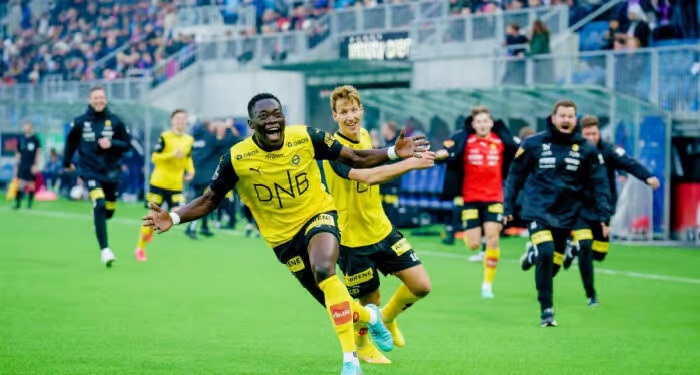
2. Akor Adams – The 23 year old Nigerian is currently in the midst of a breakout season in the Eliteserien, notching 14 goals and 1 assist in 13 matches so far this season. Adams joined Sogndal in the 2nd division of Norway in 2019, when he had a market value of 50k. 2022 was his first full season in the Eliteserien, where in 23 appearances he was able to record 8 goals and add 2 assists. Now, at the halfway point of this season, he’s already surpassed his best ever season, and there are still games to play. If Akor Adams keeps up this form, you can expect him to follow the path of Gift Orban and Christopher Bonsu Baah, likely moving to Belgium. (Current market value: 4M)
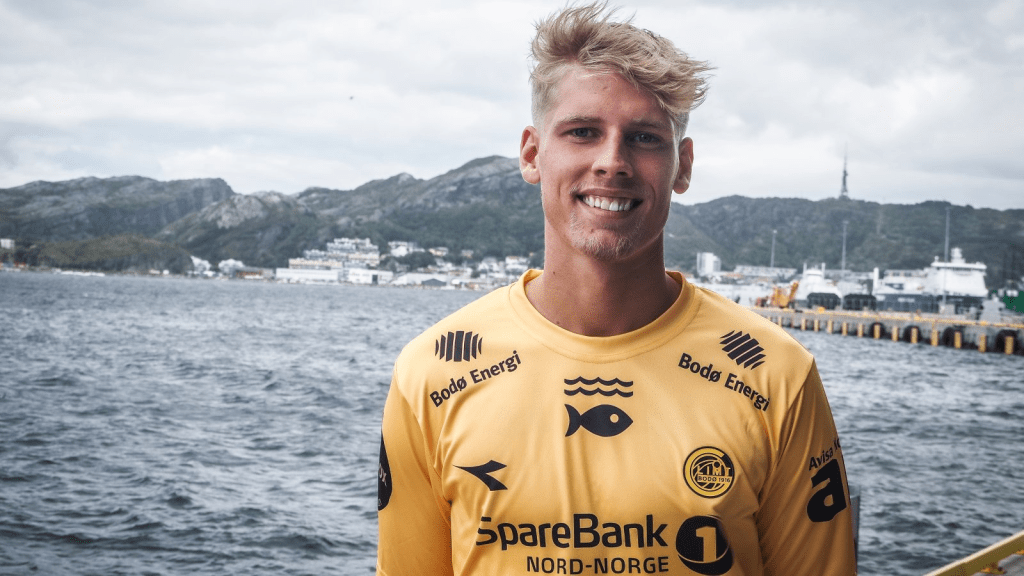
3. Albert Gronbaek – the young Dane has some big shoes to fill in Bodo’s midfield now: Hugo Vetlesen’s. Gronbaek and Vetlesen are similar profile players, both attacking midfielders who enjoy operating in the wide areas as well. Since Vetlesen’s departure, Gronbaek has elevated his game, creating consistent chances for Bodo/Glimt and developing more of an eye for goal. Vetlesen’s departure to Brugge in a way foreshadows Gronbaek’s eventual departure as well, he’s simply too good to stay in Norway forever. (Current market value: 5M)
So there you have it, three great talents departing the Eliteserien, and three great talents who are next up to follow in their footsteps. This league keeps getting more recognition from the rest of Europe, so keep an eye on these players, as the Eliteserien is where you’ll find tomorrow’s superstars, today.
-
2023 Norway Eliteserien : Matchweek 11 Update
Welcome back football fans, I hope you’re ready to take a trip to Norway! All teams in the Eliteserien have played at least 10 games now, so I’d like to take a look at how the season is shaping up, the biggest surprises (both good and bad), and what might happen in the remaining 20 games. If you’d like to check out my Eliteserien season preview and see where I’ve been proven wrong, here is the link: (https://futbird.com/2023/03/18/2023-norway-eliteserien-preview/).
The League Table
Matches
PlayedW D L GF GA GD Points Bodo/Glimt 11 10 1 0 32 9 23 31 Brann 12 6 3 3 24 15 9 21 Viking 11 6 2 3 26 20 6 20 Tromso 10 6 2 2 14 10 4 20 Lillestrom 10 5 2 3 18 16 2 17 Molde 11 5 1 5 24 16 8 16 Sarpsborg 10 4 3 3 12 11 1 15 Stabaek 10 4 3 3 14 17 -3 15 Rosenborg 11 3 4 4 14 15 -1 13 Odd 11 3 4 4 8 11 -3 13 Haugesund 10 3 3 4 10 15 -5 12 Stromsgodset 10 3 2 5 11 14 -3 11 Valerenga 10 3 1 6 14 17 -3 10 Sandefjord 10 2 3 5 12 15 -3 9 HamKam 10 2 1 7 10 26 -16 7 Aalesund 11 1 1 9 7 23 -16 4 Bodø/Glimt, Flying High!
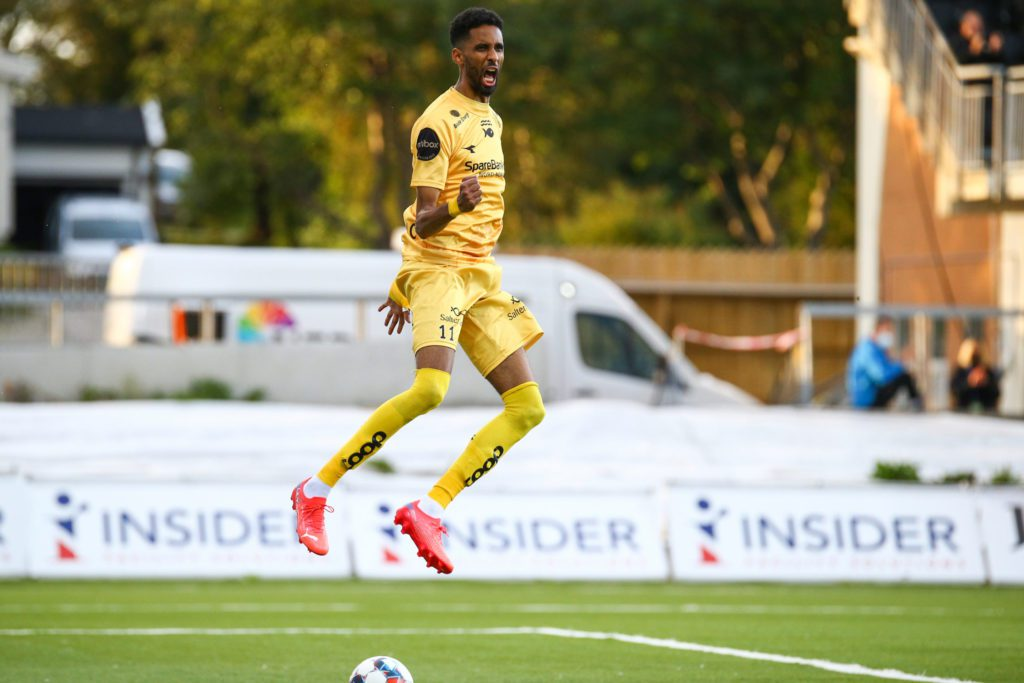
What a start to the season it has been for the yellow flash from the North! 31 points from their opening 11 matches and a +23 goal difference has put Bodø firmly on top of the table with a 10 point lead over Brann in 2nd, who were the one team to take points from Bodø so far. That match required a bit of magic from Amahl Pellegrino to overturn a 0-2 halftime deficit and draw the match 2-2. It is also worth noting that Bodø started several substitutes in that match (and quickly realized their mistake, making changes and getting a point back). Speaking of Pellegrino, the left-winger has been in phenomenal form this season, seemingly scoring goal-of-the-season candidates one after another. “Pelle” as he is affectionately called at the Aspmyra, is leading the Eliteserien in goals… AND assists. With 12G and 5A through 11 games, this inspired form has been the driving catalyst behind Bodø’s early success. Brann’s Bard Finne is the closest competitor, amassing 13 goal contributions in his first 12 matches. New signing Faris Moumbagna has settled in well, notching 8 goals so far this campaign and proving to be the type of physical target forward who can create space for his teammates to score. Finally, the preferred midfield trio of Albert Gronbaek, Patrick Berg, and Hugo Vetlesen is unmatched by any team in the Eliteserien in my opinion, providing an ever-consistent base for the team to build on. The only imperfection this season was going out of the Norwegian Cup to Lillestrøm much earlier than expected, but as a result there will be less fixture congestion for the remainder of the year. Bodø/Glimt have been playing some beautiful football, and are strong favorites for the title this season. Who might be able to stop them?
The Contenders
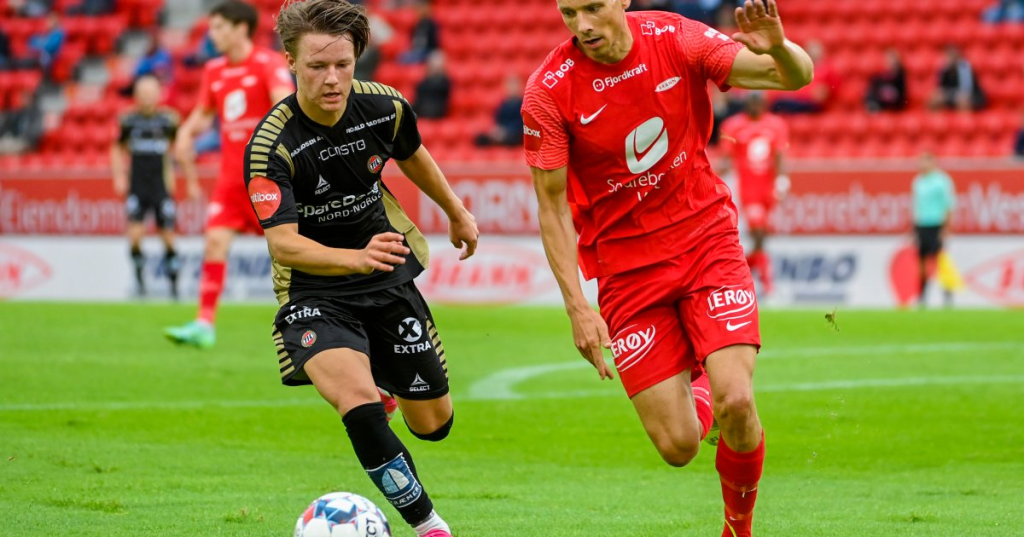
Surprisingly, my pre-season title contenders have not lived up to expectations this season, Molde sit 15 points back in 6th place, Rosenborg are in 9th, and Vålerenga are flirting with relegation, sitting just one point clear of the playoff place. Accordingly, I owe some more respect to a few squads I had thought would be mid-table this season, but could put together a title challenge. Brann and Tromso are the two teams I believe have a chance to compete with Bodø/Glimt. Brann have proven themselves capable, taking points off of Bodø at Aspmyra, but also have losses to Odd and Sarpsborg which they will not be happy about. Also, a 0-0 draw at home to relegation candidates Sandefjord will not give reason for overconfidence. While I think Brann have showed enough to be considered a contender, they will need to clean up their inconsistencies if they are to keep pace with Bodø/Glimt.
Tromso are the more intriguing side in the race this year. Bodø’s northern rivals, Tromso have more motivation than any other side to prevent Bodø/Glimt from claiming their 3rd Eliteserien title in 4 years. They have also gotten off to a great start, able to move to 2nd in the table and 8 points behind Glimt by winning their next match. Suffering the same fate as their northern rivals in the Norwegian Cup (being knocked out by Lillestrøm), Tromso rebounded with a strong run of league form, only losing to Odd and Bodø/Glimt in their first 10 matches. In their upcoming schedule, we will see them tested: Starting on July 2nd, Tromso go through a run of having to face Lillestrøm twice, Rosenborg, Brann, and Bodø/Glimt all in a span of 6 matches. By the time I’ve written the Matchweek 20 Update, we will know whether Tromso has what it takes to be a contender this season.
Biggest Surprises
Good: Newly Promoted Teams – both of last seasons First Division clubs, Brann and Stabaek, have both performed much better than expected in their first season back in the Eliteserien, sitting in 2nd and 8th respectively at the time of writing. I thought the loss of Gift Orban would hurt Stabaek more than it has, and while their 14 league goals this season isn’t mind-blowing by any means, it is very respectable for a newly promoted side.
Bad: Last Season’s Success Stories – last season Odd and Valerenga finished in 5th and 6th place, 1 point apart. This year, Odd has plummeted to 10th place after their inconsistent start. Having beaten Brann, Tromso, and Molde this year, it is confusing to also see big losses to Sandefjord and Sarpsborg. In their wins, Odd are showing why they finished 5th last season, but when they play the worse teams in the league, their performance level has dropped catastrophically. (Sandefjord have scored 12 goals this season. 4 of them came in one game vs Odd).
Meanwhile Vålerenga is in an even worse place: 1 point from the relegation playoff. It has been an abysmal start for Vålerenga, who have only beaten Rosenborg, HamKam, and Aalesund; the latter two clubs being in the bottom 2 places on the table. The main issue for Vålerenga is their lack of scoring. No player has more than 3 goals so far this season, and their best chance creator has a combined xG + xA of 4.9 through 10 matches. When your statistically best player is creating around half of an expected team goal per match, your attack will struggle. For comparison, league leaders Bodø/Glimt have 4 players who have created as much or more xG + xA. If Vålerenga cannot turn around one of their worst starts in years, they may find themselves in trouble by the business end of the season.
Conclusion
If your eyes haven’t opened enough yet to read the whole article, here’s a quick summary: this year’s Eliteserien is Bodø/Glimt’s to lose, led by Amahl Pellegrino in the form of his life. Brann and Stabaek are overachieving so far, while Rosenborg, Odd, and Vålerenga are the biggest disappointments. The next 10 games will be crucial to determine how the league will shape up this season, so tune in! As always, thanks for stopping by.
-LM
-
Ange Postecoglu: Tottenham’s new Man(ager)
“To Dare is to Digeridoo”
Hello again, and welcome back for a very exciting day for Spurs fans, possibly the only exciting day they’ve had this season apart from the day Manchester City ensured their North London rivals would not win the title. It has been a rough few seasons in the white half of North London: the big-name manager appointments of Jose Mourinho and Antonio Conte have failed with fireworks. Each manager grew increasingly frustrated with the club failing to meet their demands in terms of player recruitment, and both were sacked in dramatic fashion – Mourinho days before what could have been Tottenham’s first trophy since 2008 in the League Cup final, and Conte hours after delivering a a press conference filled with criticisms and frustrations of managing Spurs, effectively forcing his own departure.
It makes complete sense though.
To not be mistaken by the reader, both Mourinho and Conte are two of the game’s best ever managers, and their history of accomplishments cannot be denied. However, they were never the right fit for Tottenham, and the signs of discontent were evident long before each manager’s eventual departure. Daniel Levy has been the chairman of the club for almost the entire Premier League era, taking the role in 2001 when ENIC purchased Tottenham. Since his arrival, Spurs have created a club identity around attacking, entertaining football. The transfer profile of the club has been to purchase younger players with potential to develop and then be sold on at a healthy profit to sustain the club’s operations. This has been effective for Spurs, albeit obviously not in the trophies department (Let’s get all the trophy jokes out now so we can discuss the less amusing but more relevant details). Despite never winning the Premier League, or other major silverware recently, this approach by Tottenham has led to increased fan support and financial stability.
In an era where it no longer feels uncommon to hear about some of the biggest clubs in world football having severe financial issues, Spurs have stayed clear of any danger without the unlimited budget that comes with a club owned by an entire country with massive oil reserves. Did Spurs become the first team in history to have a self-imposed transfer ban for 2 consecutive transfer windows? Yes they did, and I shared the frustration of all the fans during that time period. The lack of spending helped Spurs complete the construction of their new stadium, which provides a massive boost to revenue compared to the old White Hart Lane. Once the stadium was completed, the plan was to start spending with more ambition. This was the right idea, but as we have seen through the Mourinho and Conte eras, the right manager for the project was not chosen.
Both managers prefer older, more established players, and play a strict defense-first style. These two preferences directly contrasted with the club identity and culture that Spurs had worked to build over the past 15+ years. High potential young players were not trusted enough to be given game time, and the overall age of the squad increased. Under Pochettino, Spurs regularly lined up with a starting XI who were on average, younger than 25 years old. Meanwhile, Antonio Conte’s most recent edition of Tottenham had the oldest average age of starting XI players (29.6 years) since Glenn Hoddle managed the team in the early 2000’s. The abandonment of “The Tottenham Method”, if you will, resulted in a significant portion of the fanbase losing all trust with upper management, and calling for Daniel Levy’s exit. Gone was the exciting, free-flowing attacking football that entertained fans, win, lose, or draw. Instead, Spurs fans sat through 3 years of boring, pragmatic, defensive football.
“When you’re winning, nobody cares how you play” – A smart man, probably
That’s the thing about defensive football, it’s only tolerable to the fans for so long after the results stop coming. Now, that’s enough about how we’ve gotten to this point, time to talk about the main point of the article: Ange Postecoglu is taking over as the next Spurs manager. This is exactly what Spurs need. Here’s why:
- Postecoglu has made his career playing attacking, high-pressing football. An early mentor in his career was his coach in Australia, Ferenc Puskas, who imparted his philosophy of playing a beautiful attacking game over a more pragmatic one to Postecoglu, who acted as a translator for Puskas upon his arrival in Australia (Puskas spoke little English but was fluent in Greek, which Postecoglu also spoke). He believes in this philosophy, and will not abandon his approach due to a bad run of results. A favorite quote of mine from Ange sums it up perfectly: “The way I see it is this: if you are a vegetarian, you’re not just going to pop into a Macca’s (McDonald’s) because you’re hungry!”
- Naturally suiting his brand of football, Postecoglu has no qualms about playing young players, seeing the energy and potential they bring to the game rather than their lack of experience.
- His teams are families. Any interview of one of Ange’s former players shows nothing but good signs. He knows when to be a disciplinarian and knows when to be a father figure. A change in mentality around the locker room is exactly what Spurs need after 3 years of failure.
- He has never managed a top club at the level of the Premier League. Confused as to why this is a positive? Postecoglu will have a level of motivation that is hard to match once you’ve won everything there is to win in club football. Additionally, he comes across as a very selfless individual. In his interview following Celtic’s completion of their treble, Postecoglu was filled with nothing but praise for his team, accrediting all their success to his players, seemingly uninterested in discussing his own personal contributions. This lack of reputation and ego will likely result in much less frustration and clashes with the management of Spurs. The club will feel less of a need to change their entire identity, and rather have Postecoglu integrated into the Spurs Process.
Before arriving in North London, Ange Postecoglu has managed, and won titles, with the Brisbane Roar of the A-League, the Australian national team, the Yokohama Marinos in the J-League, and finally with Celtic in Scotland. These teams have received some high praise: his Brisbane side are often affectionately referred to as Roarcelona (a compliment to the Catalonians), and the former coach of the alluded-to Barcelona side, Pep Guardiola, heaped praise on Postecoglu’s Yokohama Marinos side (who are interestingly enough also owned by the City Football Group). Most recently, he became one of just a handful of managers to have won the treble with Celtic. The man wins wherever he goes.
How might Spurs line up under Postecoglu?
Ange Postecoglu likes to use a 4-3-3 shape in his teams.
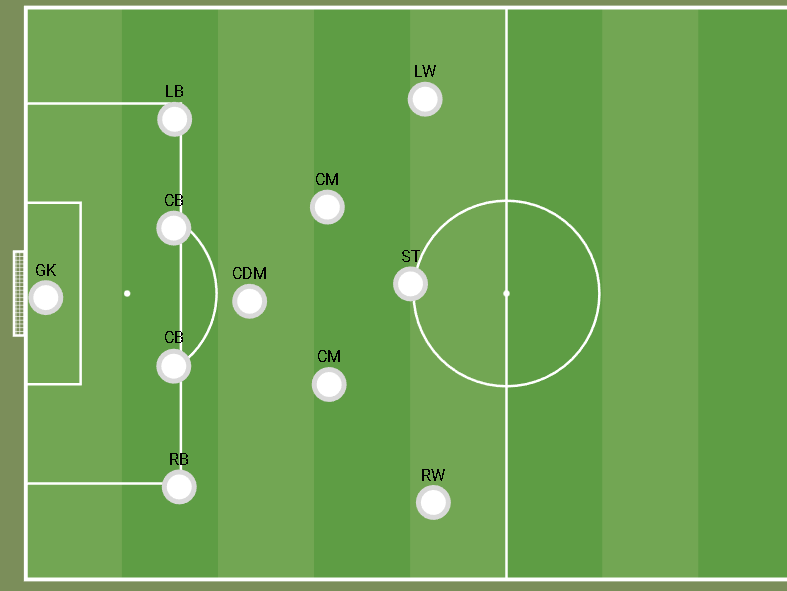
Out of possession, the wingers often stay high up on the pitch, and do much less tracking back than in other systems. They will often stay in line with the striker, acting as an outlet for a quick counter if the ball is won back. Their role is very much single-minded, focused on creating offensive chances. In possession, Postecoglu instructs his wingers to stretch the pitch wide and stay near the touchline, operating in more space with which to beat a defender and get the ball into more central areas. The fullbacks generally tuck into the midfield in buildup, with one playing as a more traditional inverted fullback, and the other operating more in the wide areas of the pitch, but not making many overlapping runs. This forms the 2-3-5 buildup shape that we see many possession-based, high-pressing sides use. With the fullbacks more inverted, this opens up space for the two CM’s to make forward runs into the half-spaces, which is where Postecoglu wants the ball to end up in the final third. Now here is where Ange might need to tweak his approach to fit the current Spurs squad. Assuming there isn’t an entire overhaul of the midfield and fullback positions, the players in the Tottenham squad at CM and FB do not often play the roles they would under Postecoglu. Players like Pedro Porro and Destiny Udogie prefer to be influencing the final third more often, using the width of the pitch. To make matters more complicated, Tottenham’s midfielders all fall more into the holding midfield or box-to-box role than a playmaker. So the question I will attempt to answer is: How can Ange Postecoglu best recreate his offensive build-up shape with the current Spurs team?
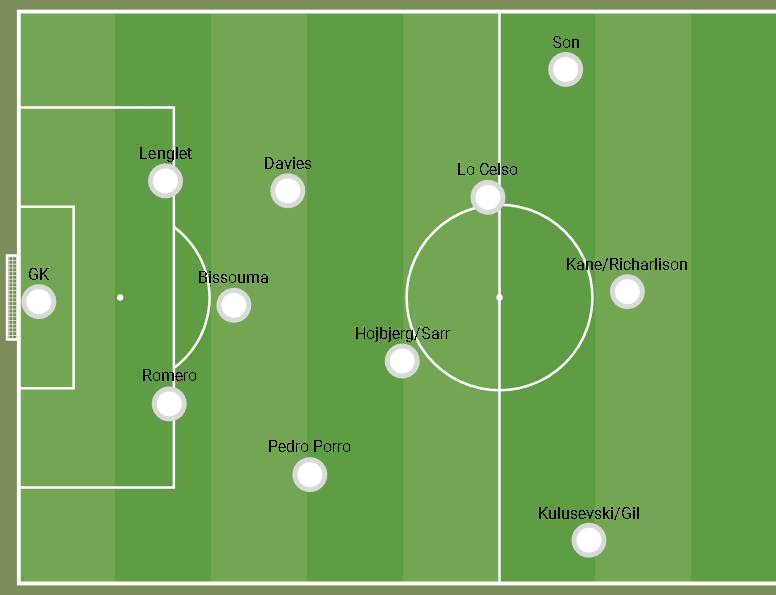
In this lineup, I attempted to emulate Postecoglu’s Celtic lineup. Here, Ben Davies is playing as the inverted LB, and Pedro Porro is operating as the wider, inverted RB. Naturally, the CM on the right side will be dropping slightly deeper in buildup to account for Porro’s offensive contribution, and the RW Kulusevski can move inside to the half-spaces, allowing Porro to overlap down the flank. Runs behind the defense from Porro will certainly be a target for switches from the left flank. Alternatively, the fullback combination of Destiny Udogie and Emerson Royal could be used, with Emerson filling the more inverted fullback role, and Udogie given more freedom to make forward runs. This would flip the formation I’ve lined up, and result in the more attacking CM moving over to the right side of the pitch.
Generally, the striker in a Postecoglu team plays right on the last line of defense, moving into the channels to find space and support build-up, while looking for his opportunity to make a run behind the defense. This is different from the role Harry Kane usually occupies, as he likes to drop deeper to create from midfield, often finding a winger making an inverted run. If Kane stays at Spurs next season, Postecoglu will have to make a decision on whether he asks Kane to play a different role than he is used to, or whether he will change his system to adapt to Kane. If Kane leaves North London, Richarlison fits the mold of a Postecoglu #9 much better.
I’ve mentioned that Tottenham’s central midfielders are hard-working solid players, but they lack creativity. Giovani Lo Celso, who I think is the most needed in the team from the players out on loan, fits the #10 role the best, but I would expect Postecoglu to address that deficiency in the transfer market if he wants to play his style without making any changes. Another way that Spurs could form the 2-3-5 buildup shape in a slightly different manner is from a 4-4-2 defensive shape. We saw Ryan Mason use a 4-4-2 out of possession shape in his time managing the club this season to good effect. The benefits of this are that the 4-4-2 takes advantage of Tottenham’s squad strength, allowing an extra wide player on the pitch instead of a third midfielder. Porro can play RM with Emerson at RB, or Udogie can play LM with Davies at LB. Son and Richarlison can be played both in the wide roles or as a striker. My favorite part about this shape for Spurs is that it allows Kane to effectively function as the team’s creative midfielder in build-up, something he is so good at doing. As Davies inverts, the midfield duo of Bissouma and Hojbjerg/Sarr will slide over, creating the 2-3 base of the buildup shape. This lets both Porro and Udogie drive forward into wide areas, Kulusevski and Son occupy the half-spaces, and Kane can play centrally, dropping deep if he wants to with plenty of passing options. I’ve shown the shift from the 4-4-2 starting shape into the 2-3-5 buildup shape below.
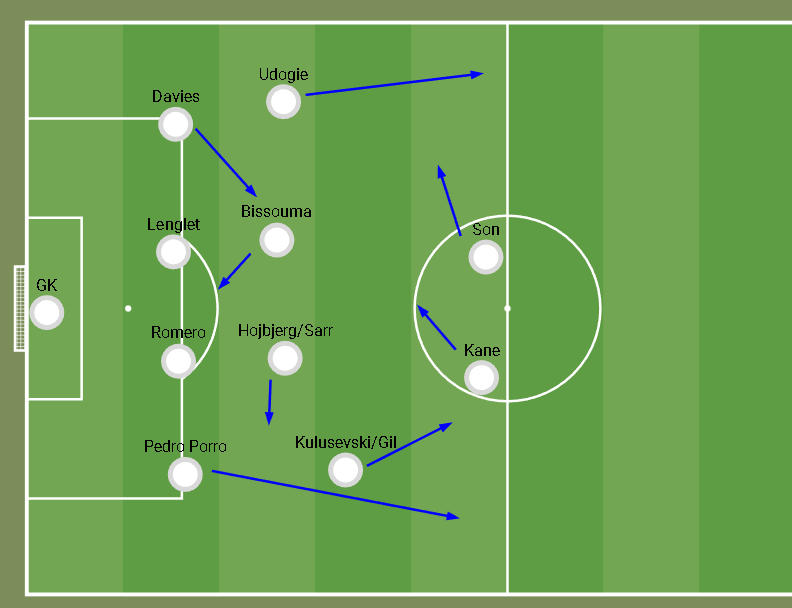
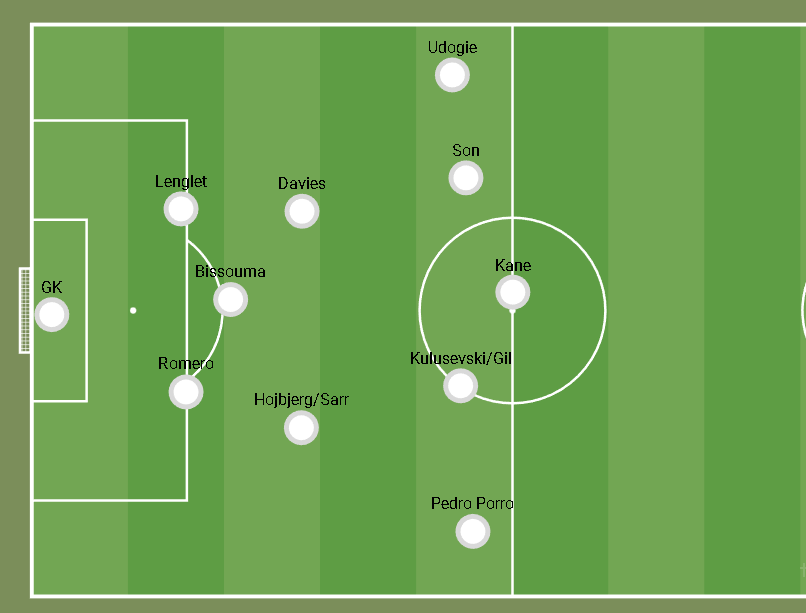
I believe that if Postecoglu wants to play his style of attacking football, he could achieve that without any transfers by lining the team up in such a fashion. To truly make Ange-ball successful, Spurs should look to bring in a left-sided CB, an inverted fullback, and a creative attacking midfielder, along with a new keeper capable of playing the modern sweeper role effectively.
In conclusion, Ange Postecoglu brings a strong mindset, an unyielding self-belief, an electric brand of attacking football, and reason for Spurs fans to be optimistic once again. He has turned every team he has managed into a family of winners, and now he takes on his toughest test yet: bringing silverware to Tottenham. If he is given patience and time (looking at you Mr. Levy), Spurs will soon find themselves back up fighting for Champions League qualification and entertaining their fans with beautiful football.
Keep an eye on the summer transfers and the start of next season! Spurs will bring a much different look than in recent history, and look to be on the right course. Thanks for reading!
-
Oscar Cortes to RC Lens: A Star in the Making
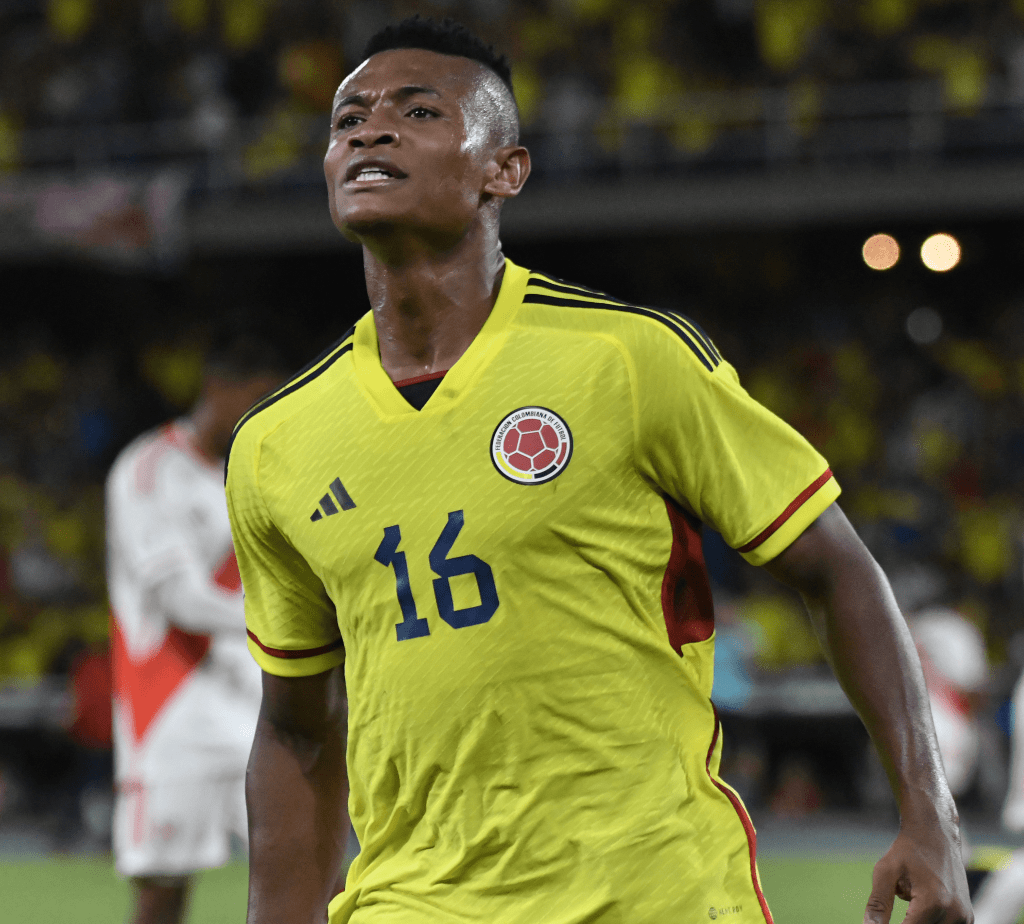
You might not have heard about the young Colombian making impressions for Millionarios FC, but you absolutely want to remember his name: Oscar Cortes. An electric footballer with an ability to find space while surrounded by defenders and with one eye seemingly always turned towards goal, looking for that final ball to be put home by a teammate in the box. At home on the wing, Cortes can play on either flank and is strong with both feet, giving fans a reason to buy a ticket just to watch his ability to make magic out of nothing. Not to heap pressure on the kid (I don’t think he’ll be reading this anyways), but I haven’t seen so much potential in a Colombian winger since Luis Diaz.
Amidst starring for Colombia at the U20 World Cup, Oscar Cortes has recently been linked with RC Lens, and while Fabrizio Romano hasn’t given the “Here We Go!” yet, there is good reason to believe this move is happening. Reported by Colombian sports journalist Pipe Sierra, RC Lens have recently agreed on a 4M euro initial fee for Cortes. Lens are in prime position to finish 2nd in Ligue 1 this year, and with PSG looking less and less intimidating by the year, Lens could be looking to boost their chances at a potential title challenge with the addition of Cortes.
RC Lens and Millionarios share a common owner, Amber Capital, an investment firm owned by Frenchman Joseph Oughourlian. This is a long shot from the wealth of clubs owned by say, the City Football Group or Red Bull, but the movement of players through “feeder clubs” is nothing new to modern football. This also helps explain the modest 4M fee for a player of Oscar’s potential. Should Lens sell him on in a few seasons, they will almost certainly make a handsome profit, as I believe Cortes has the potential to become a top player in the best leagues in the world.
Of modest stature at 5’7″, Cortes possesses the build to produce intricate dribbles through tangles of defenders, using his low centre of gravity to make up for any lack of weight when being challenged by defenders. Capable of playing in the #10 role in the centre of the pitch, Cortes is adept at cutting inside from either wing and looks calm under pressure. What consistently impresses me is his ability to find space, whether it is space to run into, to thread a pass through a defender’s legs to a teammate, or the space that will open up in the box.
His tactical versatility is a manager’s dream. With experience playing across the width of the attacking midfield line and his excellent vision of the field, Cortes can easily roam from his natural right-wing position to the centre or left flank, creating man advantages and the chaos in defense he is so good at exploiting. Due to his skill, Cortes is often tightly marked by one or more defenders, and has shown the ability a top footballer needs to draw those defenders out of position and find a teammate in space. This work rate is prevalent out of possession as well, with Cortes often pressing hard and winning the ball back, though his tackling technique can be improved to avoid conceding as many fouls.
I’ve praised his playmaking ability so much, as it is the area I believe Cortes will become world-class in, but don’t let that make you think he can’t score. Cortes helped Colombia to a 3rd place finish in the 2023 CONMEBOL Sudamericana Sub 20 tournament with 3 goals, one behind the team leader. Cortes is averaging a goal contribution every 83 minutes in the Colombian top league, Categoria Primera A, for Millionarios, which is an impressive feat for a 19 year old winger playing against grown men in South America.
If you didn’t know, the top-flight leagues in South America are officiated much less strictly than European leagues, meaning if you’re a talented young winger, you’re going to get fouled, a lot. For any stats people out there, Cortes is fouled an average of 2.4 times per game. Neymar, the most fouled man in the world since 2016, has been fouled an average of 3.1 times per game. This goes to show the problems Cortes can cause for defenders, who are incapable of stopping him without committing fouls. There seems to still be some bias against South American players moving to Europe (especially the Premier League), where their toughness and physicality are questioned. I’m here to tell you, any teenager that can perform in the top men’s league in Colombia is not going to have ANY issues with toughness, physical play, or the most belligerent of opposition fans.

Oscar Cortes is a bargain for Lens at 4M and should the rest of their recruitment be as efficient as this, we might have an interesting Ligue 1 title race next season. I cannot speak highly enough of this future star, if he receives playing time at Lens next season, there will not be a club in Europe that doesn’t want to sign him. Don’t be like most of the world outside of South America. Remember the name: Oscar Cortes.
-
Subscribe
Subscribed
Have a WordPress.com account? Log in now.

